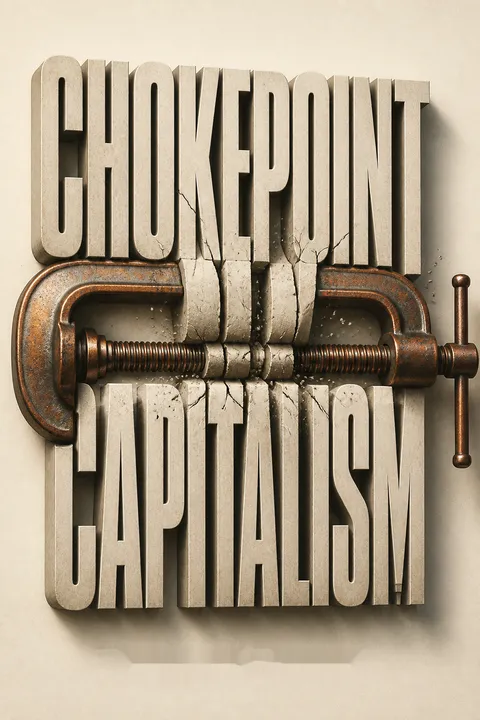


Key Takeaways
Look for the chokepoint between creators and audiences, not just the platform.
Power sits in the middle. The book argues that creative workers are not simply losing income because audiences value culture less. The deeper problem is that powerful intermediaries control access between the people who make culture and the people who want it. A market becomes hourglass-shaped: many creators and audiences depend on a narrow middle controlled by a few firms. Those gatekeepers can take a disproportionate share of the value moving through the system.
Culture is a warning sign. Amazon dominates book sales, Google and Facebook control much online advertising, Spotify and major labels shape music distribution, and Live Nation has integrated concerts and ticketing. The authors see creative workers as an early example of a broader labor problem: concentrated buyers weaken workers' choices and bargaining power.
What's useful about the chokepoint lens is that it shifts attention from a company's label to its position in a market. A platform can be useful to audiences and still exercise excessive control over suppliers. This resembles infrastructure economics: railways, payment networks, and communications systems become socially important when many parties depend on access. The diagnosis is strongest when it identifies a specific bottleneck and the alternatives available to those trapped behind it. Not every large intermediary is automatically abusive, however. Scale can lower distribution costs and connect niche creators to audiences. The key question is whether those gains remain contestable and fairly shared.
Judge markets by workers' choices, not only shoppers' prices.
Buyers can hold power. A monopoly is a seller with power over buyers. A monopsony is a buyer, or a small group of buyers, with power over sellers. When creators have few places to sell their work, the buyer can push payments below what a competitive market would provide. The book argues that decades of antitrust policy focused heavily on consumer prices, often overlooking the harm to workers and suppliers.
A little concentration can bite. Amazon accounted for only 8 percent of Melville House's sales during one dispute, yet the publisher still felt forced to accept its demands because few alternative buyers could replace that revenue. The authors argue producers need several meaningful buyers to negotiate effectively. Low prices for consumers can conceal the costs imposed on workers and suppliers.
The distinction matters because a market can look healthy from the checkout line while becoming harsher at work. Labor economics makes a related point: workers' wages depend not only on their productivity, but also on how many credible employers compete for their labor. The same logic applies to publishers, musicians, and independent sellers. The authors' critique of price-centered antitrust is persuasive when it reveals costs excluded from the consumer price. Yet buyer power is difficult to measure, and a remedy that raises supplier payments could also affect prices, output, or small firms' survival. Better policy needs to track both sides of the exchange.
Digital locks can turn a brief lead into a lasting tollbooth.
A lock can outlast an advantage. Digital rights management, or DRM, is software that restricts how a digital work can be used. Publishers accepted DRM on Kindle books to protect copyright, but the locks also made books difficult to move to competing services. As readers accumulated Kindle libraries, switching became costly, and publishers became more dependent on Amazon.
The law strengthens the lock. The authors criticize anticircumvention rules that can punish people for bypassing digital locks even when they are not infringing copyright. A similar pattern helped Apple dominate music downloads: iTunes purchases were tied to its devices until competition helped push the industry toward DRM-free music. The lesson is that a tool sold as protection for creators can instead give distributors control over both creators and customers.
Digital lock-in is a powerful example of how technical design and law can reinforce each other. In network economics, switching costs can make a service more valuable to its owner than to its users: each new purchase deepens dependence. The book also highlights a governance problem, because copyright owners may be unable to remove locks placed on their own work. That said, DRM can serve legitimate purposes, including restricting unauthorized copying. The policy challenge is not simply to eliminate every technical safeguard, but to distinguish protection against infringement from restrictions that prevent lawful competition, repair, accessibility, or transfer.
When gatekeepers control access, creators pay for everyone else's margin.
The squeeze travels downhill. Amazon pressures publishers for larger discounts, and publishers then have fewer resources for authors, editors, and other staff. In online news advertising, the Guardian found that as much as 70 percent of ad revenue could disappear among intermediaries before reaching the publisher. In recorded music, artists may earn only a small fraction of streaming revenue, especially under old contracts that require them to repay recording costs before receiving royalties.
Different markets, similar pressure. Live Nation combined concert promotion, venues, management, and Ticketmaster. A US government study cited in the book found ticket fees reached 27 percent of the ticket price. These examples show how control over access can let a middleman collect revenue from several points in the same chain, while the people supplying the underlying work have little room to refuse.
The recurring mechanism is cost-shifting. A dominant firm protects its own margin by pushing risk and expense onto parties with fewer alternatives. This resembles supply-chain pressure in agriculture and manufacturing, where a powerful buyer can dictate terms without owning every producer. The examples also caution against treating a single royalty rate as the whole story: recoupment, fees, exclusivity, and access to audiences all shape what a creator actually receives. Still, the book's cross-industry comparison can flatten important differences. Music rights, journalism, and concert ticketing have distinct economics, so remedies need to fit the specific bottleneck rather than assume one universal fix.
Demand auditable numbers before negotiating against a hidden system.
Secrecy hides the scale. Authors and performers often receive royalty statements that do not reveal how payments were calculated, how many sales were returned, or how platform deals affect their share. Susan May, an independent writer, suspected Audible was undercounting sales. A reporting glitch suddenly processed weeks of returns at once, exposing a much larger problem than she expected. May and other writers organized, publicized their findings, and pressed Audible for better reporting and changes to its policies.
Information creates leverage. The authors argue that transparency should include usage data, revenue calculations, and records that can be independently audited. Without such information, creators cannot compare deals, identify errors, or organize around shared problems. The book also points to a large pool of unmatched music royalties, showing how poor data can leave money unclaimed or benefit the largest rights holders.
Transparency is not merely a matter of good accounting. It changes bargaining power by making unequal treatment visible and by lowering the cost of collective oversight. The story also shows how accidental disclosure can spark organization when isolated people discover that their experience is shared. In organizational research, shared information helps groups coordinate around common interests instead of interpreting each loss as an individual failure. Yet disclosure alone does not ensure fair payment. Data must be understandable, comparable, and enforceable, with safeguards for privacy and legitimate commercial confidentiality. Otherwise, transparency risks becoming a pile of spreadsheets only the largest firms can interpret.
Organize together when every individual deal starts from weakness.
Collective action changes the terms. In 2019, about 7,000 Hollywood writers ended their relationships with talent agents after the Writers Guild of America challenged packaging fees and agency conflicts of interest. Agencies had bundled writers and other talent for studios, sometimes earning more from a show than the writer who created it. The writers' coordinated action made it difficult for agencies to continue business as usual, and the major agencies eventually accepted a new code of conduct.
Solidarity is bargaining power. The authors describe collective action as especially important for freelancers and other workers who lack a single employer or a strong individual negotiating position. They note that US antitrust rules can make it legally risky for independent workers or businesses to coordinate, even when a powerful buyer is already dictating terms. Their argument: collective bargaining rights should respond to actual power imbalances, not only traditional employment labels.
The writers' campaign shows that collective action is not just protest; it can alter the expected cost of refusing a group's demands. This connects to labor's classic insight that individual workers often cannot credibly threaten to leave when employers have many replacements, while coordinated withdrawal can. The strategy depends on trust, enforcement, and willingness to bear short-term costs, as the writers did. It is not equally available to every workforce: visibility, union infrastructure, and the ability to stop production matter. Extending coordination rights to freelancers is compelling, but policy must also prevent powerful suppliers from using collective power to exclude smaller rivals or raise costs unfairly.
Make interoperability real so leaving a platform is possible.
Build a usable exit. Interoperability means that different systems can work together. The authors focus on competitive compatibility, also called comcom: users or competitors adapting a product so it works with other services, even when its maker resists. If readers could move Kindle books, or developers could reach phone users without an app store's permission, dominant firms would face a more credible threat of users leaving.
Computers can be restricted by design. A phone may technically be capable of running an outside app, but its software and legal rules can prevent it. The book compares this with right-to-repair battles over cars and farm equipment. It argues that mandates can help, but companies may redesign systems to evade narrow rules. Allowing independent compatibility efforts could make exclusion harder to sustain.
Interoperability addresses a central weakness of consumer choice: an alternative is not meaningful if switching means losing a library, contacts, or access to essential tools. This is closely related to portability in public infrastructure and to repair rights, where users need control over assets they own. The book's emphasis on adversarial compatibility is more ambitious than standard data-export rules because it allows outside innovators to reconnect systems when firms block them. The risks are real: unofficial connections can create security vulnerabilities, privacy leaks, or unstable service. A sound approach protects legitimate competition while requiring interoperators to disclose risks and avoid exposing users to preventable harm.
Give copyright transfers a 25-year sunset.
Rights should return. The authors propose that creative rights automatically revert to creators 25 years after transfer, rather than remaining with a publisher or label for the entire copyright term. They argue that the first 25 years provide ample incentive for investment, while later revenue from older works can strengthen incumbents and keep creators bound to outdated deals. Under their proposal, creators could renegotiate, choose another partner, or exploit the work independently.
Unused works need a plan. Automatic reversion could make ownership unclear when creators cannot be found. The authors suggest registration of transfers and a cultural steward to preserve and license works whose owners do not maintain an active claim. They point to studies in which older books were more available after entering the public domain, and argue that long copyright terms can restrict access without guaranteeing ongoing investment.
A time limit changes the bargaining relationship before a contract expires because the buyer cannot assume permanent control. It also recognizes that creative works often have sharply uneven commercial lives: a small number remain valuable for decades, while many disappear from circulation. The proposed 25-year period is a policy choice, not a proven universal optimum, and returns may vary by medium and investment risk. Automatic reversion also requires reliable ownership records and workable succession rules. The proposal's strongest contribution is to ask whether long-term exclusivity actually funds new creation or mainly protects catalog advantages that established companies already possess.
Set a statutory floor when powerful buyers dictate creative rates.
Fair pay needs enforceable rules. The book proposes residual remuneration rights, which give creators an inalienable claim to appropriate payment when their work is used, even if a contract assigns copyright elsewhere. The authors also explore statutory licenses: legal permissions to use works under set terms, with rules that can establish minimum payments and shares for creators. Such systems could reduce the need for every new service to negotiate separately with powerful rights holders.
Design determines the result. The US noninteractive streaming license requires part of the royalties to go directly to performers, including artists who have not recouped their recording costs. The authors see this as a model for a payment floor, but warn that badly designed rates can become a ceiling, while complex licensing rules can discourage new services. Minimums must support creators without making entry possible only for giant firms.
A statutory floor can address a bargaining imbalance that private contracts cannot fix when one side has nowhere else to go. This is analogous to wage standards: the point is not to set every price centrally, but to establish a boundary below which market pressure cannot push compensation. The book wisely distinguishes a floor from a ceiling and emphasizes entry costs. The hardest questions concern who sets rates, how often they are reviewed, and how to handle differences in work and use. Poorly calibrated rules can entrench incumbents or transfer costs to other vulnerable parties, so rate-setting needs independent expertise and public accountability.
Build creator-owned alternatives instead of begging gatekeepers for crumbs.
Ownership can change incentives. Stocksy, a photographer-owned cooperative, pays creators far higher shares than the industry norms described in the book. Resonate is a music cooperative that lets listeners gradually pay toward owning a track. Local library services such as Chapel Hill's Tracks pay artists an honorarium and connect them with nearby audiences. These examples are not miniature replacements for every global platform. They show how different ownership and funding arrangements can serve needs commercial giants neglect.
Plural systems matter. The authors support a mix of cooperatives, public cultural infrastructure, libraries, and other community-based models. They also discuss public job guarantees as a way to fund socially valuable work that markets may not sustain, including art and journalism. Their wider point is that creators need real alternatives, not merely promises from the firms that currently control distribution.
These models widen the definition of success beyond scale and monthly active users. A local platform can create relationships, preserve work, and support live cultural communities even when it cannot match a global catalog. Cooperative ownership also changes who has a vote over fees and priorities, though it does not erase the challenges of funding, governance, and attracting users. Public support can fill gaps where commercial demand is too weak, but it needs safeguards against political control. A resilient cultural ecosystem is therefore less like one perfect replacement service and more like a portfolio of institutions with different purposes.
Analysis
The book's central move is to reinterpret creative workers' low incomes as a problem of market structure rather than personal failure, weak demand, or insufficient copyright. Its strongest explanatory tool is buyer power. A buyer need not control an entire market to make a supplier dependent; a small number of practical alternatives may be enough to discipline prices, terms, and access. This makes the account more useful than a simple critique of technology companies, because it connects platforms, publishers, labels, agencies, and ticketing firms through recurring mechanisms: lock-in, limited alternatives, opaque accounting, and pressure passed down the supply chain.
The examples give the argument narrative force. Amazon's digital locks, Google's advertising position, Spotify's playlist influence, Live Nation's integrated businesses, and the writers' agency dispute show how power takes different forms while producing similar consequences. The book's most valuable corrective is that low consumer prices do not prove a market is competitive. They may coexist with suppressed supplier income, weaker labor conditions, and diminished choice over time.
The remedies are deliberately plural. Antitrust enforcement matters, but transparency, collective bargaining, interoperability, time-limited contracts, payment floors, cooperatives, and public institutions address problems that breakups alone may not solve. This policy range is a strength, although it makes implementation the hardest part. Each intervention can produce unintended effects: regulation can raise entry costs, statutory rates can become ceilings, and public or cooperative institutions can be poorly governed. The authors acknowledge these tensions, but the proposals require careful design and ongoing evaluation rather than faith in any single reform.
The broader implication is that creative markets should be judged not only by output, convenience, or price, but by whether participants can refuse terms, change partners, and share in the value they create. Competition, in this account, is not simply a way to make firms more efficient. It is a condition for meaningful economic agency.
Review Summary
Chokepoint Capitalism receives mostly positive reviews, with an average rating of 4.27 out of 5. Readers praise its detailed analysis of how large corporations exploit creative industries and artists. The book is divided into two parts: the first explaining the problem, which is highly regarded, and the second proposing solutions, which some find less convincing. Many reviewers consider it essential reading for creators and consumers alike, appreciating its accessible explanation of complex economic concepts and its focus on potential remedies to corporate exploitation.
People Also Read





Glossary
Chokepoint capitalism
Extraction through blocked alternativesAn economic arrangement in which powerful firms control essential points of access between producers and customers. By limiting alternatives, locking in users or suppliers, and raising barriers for competitors, these firms can capture more value than their contribution to the underlying work would otherwise justify.
Monopsony
Buyer power over sellersA market condition in which one buyer, or a small group of buyers, has enough power over suppliers to push payment or other terms below what a more competitive market would support. The book applies the concept to employers, platforms, publishers, labels, and other firms that purchase creative work or access to it.
Anticompetitive flywheel
A self-reinforcing power cycleA cycle in which a firm's existing advantage helps it gain more users or suppliers, which strengthens its control and improves its ability to exclude rivals. The company may use scale, switching costs, data, or legal protections to secure better terms, then use the resulting resources to deepen the original advantage.
Digital rights management
Software restrictions on digital worksTechnology used to control access to or use of digital content, such as an ebook that works only within a particular company's ecosystem. Although DRM is often presented as protection against unauthorized copying, the book argues that it can also prevent lawful transfer, competition, and consumer choice.
Competitive compatibility
Making rival systems work togetherAlso called comcom, this is the practice of adapting a product or service so it works with another system, even when the company that controls that system objects. Examples include independent tools that let users move purchased content or connect to a dominant service through an alternative interface.
Residual remuneration rights
Inalienable payment for later usesA proposed legal right that ensures creators receive appropriate payment when their work is used, even after they have transferred copyright or signed a contract. The book suggests that creators could enforce this right against licensees and platforms, providing an income safeguard where individual contracts offer little bargaining power.
Statutory license
Use rights under set legal termsA legal arrangement that allows qualifying users to use copyrighted works without negotiating permission separately with each rights holder, provided they meet prescribed conditions and pay established fees. The book proposes using statutory licenses to lower entry barriers and establish minimum payments and protections for creators.
Chickenization
Centralized control of suppliersA model of vertical control in which a powerful company supplies or controls key inputs, sets production conditions through contracts, and gains detailed insight into suppliers' operations while leaving them with little bargaining power. The book uses the term for agricultural production and applies its logic to other industries, including live music.
FAQ
What's Chokepoint Capitalism about?
- Focus on Creative Industries: Chokepoint Capitalism by Rebecca Giblin and Cory Doctorow examines how major corporations in tech and media monopolize creative labor markets, squeezing profits from artists and creators.
- Chokepoints Defined: The book introduces "chokepoints" as strategic control points where a few companies dominate, dictating terms and extracting value from creators.
- Call to Action: It critiques the current state of these industries and proposes solutions for reclaiming power and value for creators through collective action and systemic changes.
Why should I read Chokepoint Capitalism?
- Insightful Analysis: The book provides a thorough analysis of how corporate monopolies affect creative workers, essential for understanding the future of art and culture.
- Practical Solutions: Giblin and Doctorow offer actionable strategies for artists to regain control over their work and earnings, making it a guide for change.
- Cultural Relevance: As creative industries evolve, understanding power dynamics and profit is crucial, making this book timely and relevant for those involved or affected by these industries.
What are the key takeaways of Chokepoint Capitalism?
- Monopoly and Monopsony: The book highlights the difference between monopolies and monopsonies, both creating imbalances that disadvantage creators and workers.
- Impact of Digital Platforms: Platforms like Amazon, Spotify, and YouTube create chokepoints that limit competition and exploit creators, manipulating market dynamics to their advantage.
- Need for Collective Action: The authors stress the importance of solidarity among creators to challenge powerful entities, proposing methods like transparency rights and minimum wages for creative work.
What are the best quotes from Chokepoint Capitalism and what do they mean?
- “If you don’t own your masters, your master owns you.”: This quote by Prince underscores the importance of ownership in the music industry, highlighting potential exploitation if artists don't retain rights to their work.
- “Capitalism doesn’t work without competition.”: Emphasizes the necessity of a competitive market for fair economic practices, warning against monopolies that exploit and reduce choices.
- “The revolution will not be spotified!”: Critiques how streaming services like Spotify can undermine music's value for artists, suggesting true industry change requires more than adapting to existing platforms.
How does Chokepoint Capitalism define monopolies and monopsonies?
- Monopoly Explained: A monopoly occurs when a single seller controls a market, dictating prices and terms, leading to consumer exploitation and stifled competition.
- Monopsony Defined: A monopsony is when a single buyer has power over many sellers, dictating terms and prices, relevant in creative industries where platforms control artists.
- Consequences of Both: Both structures harm workers and creators, leading to lower wages and reduced opportunities, necessitating dismantling for a healthier economy.
What are the anticompetitive flywheels mentioned in Chokepoint Capitalism?
- Definition of Flywheels: Anticompetitive flywheels are mechanisms reinforcing monopolistic power, making it hard for competitors to enter the market, increasing the dominant player's power.
- Examples in Industries: Examples include Spotify's playlist culture locking in listeners and artists, and Amazon's pricing strategies squeezing publishers and authors.
- Impact on Creators: These flywheels lead to lower earnings for creators and less market diversity, with the authors arguing for breaking these cycles to restore fairness.
How has Amazon taken over the book market according to Chokepoint Capitalism?
- Market Dominance: Amazon controls over 50% of US physical book sales and a larger share of ebooks and audiobooks, dictating terms to publishers and authors.
- Shakedown Tactics: Describes Amazon's "Gazelle Project," pressuring smaller publishers for better terms, leading to significant discounts squeezing margins.
- Impact on Authors: Amazon's practices have led to plummeting advances for authors, with many struggling to make a living, a direct consequence of its monopolistic strategies.
What solutions does Chokepoint Capitalism propose for creators?
- Collective Action: Advocates for solidarity among creators to challenge monopolistic platforms, possibly through unions or collective bargaining groups.
- Transparency Rights: Proposes creators should access detailed information about their work's use and compensation, empowering them to advocate for fairer pay.
- Minimum Wages for Creative Work: Suggests implementing minimum wage standards for creative labor to ensure all artists earn a living wage, leveling the playing field against corporations.
How does Chokepoint Capitalism address the role of streaming services in the music industry?
- Streaming Economics: Highlights how services like Spotify pay artists a fraction of a cent per stream, making it hard for musicians to earn a living.
- Playlist Culture: Discusses how Spotify's playlist reliance forces artists to conform to trends for visibility, often sacrificing artistic integrity.
- Call for Change: Argues for reforming the streaming model to ensure fair compensation, proposing alternatives like user-centric payment models.
What is the significance of transparency rights in Chokepoint Capitalism?
- Empowerment of Creators: Transparency rights allow creators to see how their work is used and compensated, enabling advocacy for fairer pay.
- Combatting Exploitation: Demanding transparency challenges powerful platforms' secretive practices, leveling the playing field and reducing power imbalances.
- Broader Implications: Suggests transparency rights could apply across industries, leading to a more equitable economy overall.
How does Chokepoint Capitalism relate to current economic and social issues?
- Reflection of Inequality: Connects creative worker exploitation to broader economic inequality and corporate power issues, affecting many sectors.
- Call for Systemic Change: Emphasizes systemic solutions over individual actions, advocating for collective movements to challenge corporate dominance.
- Cultural Impact: Highlights how declining fair compensation affects cultural diversity and expression, with a healthy creative ecosystem essential for a vibrant society.
How can collective ownership help creative workers according to Chokepoint Capitalism?
- Empowerment through Ownership: Collective ownership models, like cooperatives, empower creative workers by sharing profits generated by their work.
- Sustainable Business Models: Suggests cooperatively owned platforms prioritize creators' interests over shareholders, leading to a healthier creative ecosystem.
- Examples of Success: Provides examples like Stocksy, demonstrating how collective ownership can lead to better pay and conditions for artists, serving as a blueprint for future initiatives.
Download PDF
Download EPUB
.epub digital book format is ideal for reading ebooks on phones, tablets, and e-readers.








