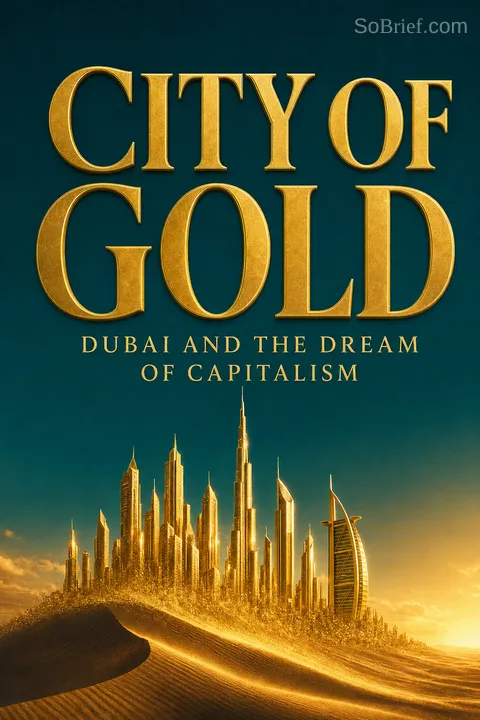


Key Takeaways
Turn a forgotten port into a global city by making trade welcome.
A harsh beginning. For centuries, the southeastern Arabian coast was isolated by desert, salt flats, and scarce water. Dubai was a small settlement around a shallow creek, not an obvious candidate for a world city. In 1833, the Maktoum family took control, beginning a long period of stable rule. Its later leaders made the town more welcoming to merchants and visitors than many of its neighbors.
The dream takes shape. Sheikh Rashid, who ruled from 1958, wanted the world to know Dubai. His successors pursued that ambition through commerce, infrastructure, and conspicuous projects. The book’s central point is not that Dubai possessed a hidden natural fortune. It is that its rulers repeatedly tried to turn location, openness, and risk-taking into advantages.
The story usefully shifts attention from resources to institutions. A port’s value depends not only on geography, but on the rules, connections, and confidence that let people use it. In economic terms, Dubai built an advantage by reducing friction for trade. Yet the account also warns against treating leadership vision as a complete explanation: geography near major shipping routes and access to regional oil wealth mattered too. Dubai’s rise is best understood as an unusual combination of location, policy, and political power.
Make your port valuable by welcoming the merchants competitors push away.
A rival’s mistake. Around 1900, Iran tightened taxes and control over Bandar Lengeh, a port used by Qawasim merchants. Dubai’s ruler, Sheikh Maktoum bin Hasher, recognized an opportunity. He removed the town’s 5 percent customs duty, cut fees, offered land, and promised merchants access to his council and a light government touch.
Trade follows trust. Iranian and Arab businesses moved across the Gulf, bringing customers, suppliers, language, and expertise with them. Dubai’s population reached about 10,000 by 1908, and steamships began stopping regularly. The policy helped turn the creekside settlement into a reexport hub, moving imported goods onward to Iran and inland markets. In Krane’s account, Dubai grew partly by making itself a more convenient home for other people’s commerce.
This is a vivid example of how business ecosystems travel. A merchant brings more than capital: partners, know-how, and customers often follow. Modern regional development strategies use similar tools, such as tax incentives and simplified regulations, to attract clusters of firms. The harder question is whether the gains are durable or simply transferred from a weaker competitor. Bandar Lengeh’s decline shows that a welcoming policy can enrich one place while draining another, rather than creating prosperity evenly.
Never let one luxury export become the whole economy.
Pearls made the boom. By the early twentieth century, pearls accounted for about 95 percent of the lower Gulf economy. Dubai sent out hundreds of pearling boats, while financiers and merchants grew wealthy from the trade. But the industry depended on a luxury purchase and a single natural resource, leaving the region exposed when demand faltered.
Then the floor fell away. The Great Depression cut demand, while Japanese cultured pearls offered buyers a cheaper alternative. The fleet returned to find few buyers. Dubai’s schools and businesses collapsed, food became scarce, and people survived on leaves, lizards, and locusts. British restrictions on modern diving methods had also helped preserve old practices instead of encouraging adaptation. The lesson was brutal: a dominant export can look like security until technology or taste changes.
The pearl bust illustrates concentration risk, a principle that applies to companies and national economies alike. A revenue stream can be highly profitable and still make a system fragile if it crowds out alternatives. The useful test is not whether a sector is thriving now, but whether the surrounding economy can absorb a shock to it. Diversification is not automatically wise, however. The book’s account suggests that timing, skills, and institutions matter as much as the number of sectors on a government’s list.
Stability can protect commerce while silencing the people who create it.
A changing bargain. Earlier tribal sheikhs had to earn support through generosity, judgment, and courage. People could leave a ruler they disliked or back a rival. British treaties helped replace that fluid arrangement with hereditary monarchies, creating more predictable rule but fewer avenues for public challenge.
Reform met force. During the hardship of the 1930s, Dubai’s merchants formed a council that proposed schools, health care, sanitation, and limits on the ruler’s income. In 1939, Sheikh Rashid’s forces crushed the reform movement during his wedding celebrations. Rashid later adopted many of its practical proposals, while granting prominent merchants contracts and trading privileges. The episode shows how Dubai’s rulers combined coercion, business opportunity, and personal patronage to hold power and build support.
The book resists a simple equation between political freedom and effective government. Stable rule did help leaders make long-term commercial commitments, but the destruction of the reform council shows that stability could also mean suppressed accountability. Political science distinguishes state capacity, the ability to carry out decisions, from political voice, the ability to contest them. Dubai developed the first much faster than the second. The arrangement can deliver projects, but it makes public feedback depend heavily on a ruler’s willingness to listen.
Build infrastructure before demand arrives, but size the gamble to resilience.
Rashid built ahead. Dubai’s creek was too shallow for reliable shipping, so Sheikh Rashid borrowed from Kuwait and raised money from merchants to dredge it. The work, completed in 1961, made the town a more dependable port. Later came Port Rashid, Jebel Ali, an airport, and a dry dock. The projects attracted trade and industry, even when advisers and merchants questioned their scale.
A calculated risk. Rashid argued that building early was cheaper than waiting until demand made construction unaffordable. The dry dock, for example, opened just before the Iran-Iraq tanker war sent damaged ships toward Dubai for repairs. Yet infrastructure is not magic: its value depends on maintenance, power, transport links, and enough demand to pay for it. Rashid’s bets worked, but the same appetite for megaprojects could become dangerous when borrowed money replaced scarce oil revenue.
Infrastructure can create demand rather than merely respond to it. Ports, airports, and utilities lower the cost of doing business, encouraging private investment to follow public investment. This is a powerful development mechanism, but it is also vulnerable to overconfidence: leaders can mistake a successful early bet for proof that every large bet will pay off. The key distinction is between building capacity that many businesses can use and building prestige assets whose returns depend on continued growth.
Sell a destination, not just services, and give investors a reason to stay.
A city becomes the product. Sheikh Mohammed pushed Dubai beyond shipping and oil by developing tourism, aviation, finance, and real estate. Emirates began flying in 1985. The sail-shaped Burj Al Arab became a recognizable symbol, while hotels and attractions made the city itself a reason to travel. In 2002, foreigners gained permission to buy property, adding a powerful incentive to bring money and family to Dubai.
Build a platform. Dubai’s free zones offered foreign firms tax advantages and exceptions to rules requiring a local partner. Internet City and Media City attracted international companies, while the financial center sought to draw banks. These ventures did not all deliver what they promised: the tech district attracted offices more readily than research and development. Still, the strategy made Dubai a regional base for firms that might otherwise have operated elsewhere.
A destination brand can connect activities that otherwise seem unrelated. Flights bring tourists and executives; hotels support conferences; business districts attract workers; and those workers create demand for housing and services. This kind of mutually reinforcing growth is often called a cluster effect. The caution is that a strong brand can outpace underlying capability. The book’s example of limited local research activity shows why attracting company names is not the same as building the knowledge, skills, and innovation those companies generate elsewhere.
Keep trade open to adversaries, but never mistake neutrality for protection.
Two essential relationships. Dubai’s proximity to Iran made it a natural trading partner. Iranian merchants, businesses, and capital helped sustain the city, while Dubai provided Iran with a route to global goods and finance. At the same time, the UAE depended on the United States for military protection and hosted American forces and ships.
Openness has a political price. Dubai tried to maintain both relationships, but U.S. pressure over Iran increased, especially after international sanctions. The 2006 controversy over Dubai-owned DP World’s purchase of port operations in the United States showed how quickly commercial ties could become a political fight. Although foreign firms already ran those ports, opposition surged once the buyer was Arab. Dubai withdrew. Its access to markets depended not only on good deals, but on how other countries viewed the dealmaker.
The case captures a central problem for small trading states: neutrality can preserve access, but it cannot erase the interests of larger powers. Dubai’s strategy resembles the logic of a hub, where many parties benefit from keeping connections open. Yet hubs are politically exposed because they sit at the intersection of rival systems. The ports dispute also shows that formal security review is not the only barrier to investment. Public trust, national identity, and political symbolism can matter just as much.
Count the people and ecosystems hidden beneath the skyline.
Workers carried the boom. Migrants built and maintained Dubai, yet many lived in crowded camps, earned low wages, and sent most of their income home. One Indian worker profiled by Krane began on about $160 a month while supporting his family and paying for his brothers’ education. Workers also faced dangerous construction sites, heat, debt, and limited freedom to change jobs.
The landscape paid too. A 2008 report ranked the UAE’s ecological footprint first globally, at 9.5 global hectares per person. Water use was about 145 gallons per person each day, much of it produced through energy-intensive desalination. Dredging and artificial islands damaged marine habitats and altered coastal currents. Roads, air conditioning, and sprawling construction added further costs. The skyline’s glamour rested on labor and resources that were easy to overlook.
A city’s success looks different depending on who gets counted. National income and iconic buildings record investment, but say little about workers’ bargaining power, ecological damage, or whether infrastructure is safe. This is a measurement problem as much as an ethical one: what governments track shapes what they repair. The book’s details make externalities tangible, though some labor-death estimates it cites differ sharply from official figures. That discrepancy itself points to the need for transparent reporting.
Secure belonging before demographic arithmetic becomes a political crisis.
A city of temporary residents. By 2008, foreigners made up about 95 percent of Dubai’s population. Across the UAE, citizens were only about 15 percent of the population. Most migrants could live and work in the country for decades without gaining citizenship. Nationality generally passed through Emirati fathers, leaving the foreign husbands and children of Emirati women outside the citizen community.
Privilege does not guarantee confidence. Emiratis received substantial subsidies, public jobs, housing, and services, while the economy relied on expatriate labor and expertise. Many locals worried that they were losing cultural influence and control over their own country. Political participation remained extremely limited. This created a tension: Dubai needed foreign residents to grow, but treated most of them as temporary, while citizens had material security without much say in the direction of that growth.
Belonging is an institutional question, not just a feeling. Long-term residents who build a city have durable interests in its schools, laws, and public spaces, even if they lack citizenship. At the same time, the Emirati concern described here is not merely resistance to change: a small population feared losing its culture and political agency. Any solution must take both claims seriously. A labor market can remain globally open while still debating fair routes to residency, representation, and civic responsibility.
Use each boom to build capabilities that survive capital flight.
The boom reversed. In late 2008, global credit tightened and investors pulled money out of the UAE. Dubai’s property market stalled, share prices plunged, and construction projects were halted or delayed. The city reported $10 billion in direct government debt and about $70 billion owed by state-owned companies. Abu Dhabi stepped in with financial support, exposing how closely Dubai’s fortunes remained tied to the wider region and global markets.
Build beyond the skyline. Krane’s account argues that Dubai had proved it could construct ports, hotels, and office districts, but had not yet built equally deep foundations in education, research, arts, public planning, or political debate. Those capabilities are slower to create than buildings, but they can help a city adapt when property values fall or investors leave. The crash did not erase Dubai’s achievements; it revealed what rapid construction alone could not secure.
The distinction between assets and capabilities is crucial. A port or airport can create lasting value, while a speculative building can lose value quickly; education, trusted institutions, and technical expertise help determine whether either asset remains useful. Dubai’s crisis also challenges the idea that diversification makes a place immune to downturns. Different industries can still depend on the same global credit and confidence. Resilience comes less from having many sectors than from understanding their shared vulnerabilities.
Analysis
City of Gold is both a developmental history and a portrait of a political bargain. Its narrative moves from isolation and pearling, through Rashid’s infrastructure bets, to Mohammed’s global city project and the 2008 downturn. The book’s strongest contribution is to make that transformation concrete: a shallow creek becomes a port; an airline dispute helps produce Emirates; and an artificial island is sold before it exists. These stories show how policy, timing, and executive authority can turn a place into a commercial platform.
The same evidence complicates the triumphal story. Dubai’s growth relied on more than visionary rulers: Iranian entrepreneurs, foreign expertise, migrant labor, neighboring oil wealth, and access to global capital were indispensable. Yet the people who supplied much of that labor and knowledge had little claim to permanent membership. The city was internationally open in commerce while politically narrow at home. That tension is not incidental to the model. It is one of its defining conditions.
The book also reveals a speed tradeoff. Concentrated authority can commit resources quickly and coordinate major projects, but it weakens independent checks on cost, safety, environmental damage, and public consent. The same institutional arrangement that made ambitious construction possible could make correction slower when growth assumptions failed. Dubai’s roads, energy demand, labor camps, and damaged coastal habitats are not side stories. They show what happens when measuring success primarily through investment and construction leaves other forms of value out of view.
Because the account was written as the boom was ending, it is strongest as an analysis of the choices and vulnerabilities visible in 2009, not as a final verdict on Dubai’s future. Its enduring question is whether a city can convert commercial success into durable human and civic capacity. Ports and towers can make a place famous. The harder achievement is creating a society able to learn, adapt, and belong when the money moves on.
Review Summary
City of Gold offers a comprehensive look at Dubai's history and transformation. Readers praise its balanced approach, detailing both achievements and challenges. The book provides valuable insights into Dubai's rapid development, governance, and social issues. Many found it informative and engaging, particularly the historical sections. Some critiqued its dated information and dry economic focus. Overall, reviewers recommend it for those interested in understanding Dubai's rise, though casual readers may find parts less accessible.
People Also Read







Glossary
rentier state
State funded by external rentsA state whose rulers receive substantial income from resources, location, or concessions rather than relying mainly on taxes paid by citizens. In the Trucial States, early rents included payments for aircraft landing rights and later oil royalties. Rulers could use this income for public projects and subsidies, strengthening their political position without needing broad taxation.
majlis
Ruler’s council and receptionA gathering place and forum where a ruler or sheikh meets citizens, merchants, and other visitors to hear complaints, discuss business, and settle disputes. Historically, a sheikh might travel to a troubled village and hold a majlis in a tent. In modern Dubai, the practice continued, though the growing population made personal access less practical.
free zone
Special business areaA designated area where firms receive exemptions or advantages that do not apply under the country’s ordinary commercial rules. Dubai used free zones to attract international businesses with benefits such as tax relief, easier capital transfers, and exceptions to the requirement that foreign companies take a local partner. Jebel Ali, Internet City, and Media City used versions of this model.
bidoun
People without nationalityA term used in the UAE for people without recognized citizenship or nationality. The word means, in effect, without. Krane describes residents and descendants who had not acquired UAE citizenship after independence and who could lack citizenship elsewhere as well. Their situation made clear that being born, raised, or employed in the country did not necessarily lead to belonging as a citizen.
Dubai Inc.
Government run as enterpriseA shorthand for Dubai’s governance approach, in which the ruler and senior officials treat the city as an enterprise to be managed, benchmarked, and expanded. The government used corporate performance measures and created state-owned firms in sectors such as aviation, ports, and property. The approach could move projects quickly, while concentrating decision-making in a small circle around the ruler.
FAQ
1. What is City of Gold: Dubai and the Dream of Capitalism by Jim Krane about?
- Comprehensive Dubai history: The book traces Dubai’s journey from a small fishing village to a global metropolis, focusing on its economic, social, and political transformation.
- Themes of capitalism and risk: It explores how visionary leadership, bold risk-taking, and the embrace of capitalism fueled Dubai’s rapid rise.
- Contradictions and challenges: Krane balances Dubai’s dazzling achievements with its social, environmental, and political challenges, offering a nuanced portrait.
- Research-driven narrative: The author uses interviews, historical research, and firsthand observation to provide an in-depth, critical look at Dubai’s unique development model.
2. Why should I read City of Gold: Dubai and the Dream of Capitalism by Jim Krane?
- Insight into Dubai’s model: The book offers a rare, detailed look at how Dubai’s rulers engineered its economic miracle by blending tribal governance with modern capitalism.
- Balanced perspective: Krane addresses both the city’s successes and its darker sides, such as labor exploitation and environmental issues, providing a realistic view.
- Global relevance: Dubai’s story serves as a case study in globalization, rapid urban development, and the complexities of managing diversity and sustainability.
- Lessons for other cities: Readers gain valuable insights into the possibilities and pitfalls of building a global city in a traditional society.
3. What are the key takeaways and lessons from City of Gold: Dubai and the Dream of Capitalism by Jim Krane?
- Unique development model: Dubai exemplifies a rare blend of tribal leadership and global capitalism, achieving rapid growth through visionary planning and openness to foreign investment.
- Complex contradictions: The city’s success is tempered by social inequalities, labor exploitation, environmental costs, and political restrictions.
- Urban development insights: The book offers lessons on governance, multicultural coexistence, and the challenges of modernization in a traditional context.
- Global implications: Dubai’s experience provides both inspiration and caution for other emerging cities and economies worldwide.
4. Who were the key leaders in Dubai’s transformation according to Jim Krane’s City of Gold?
- Sheikh Rashid bin Saeed al-Maktoum: Initiated major infrastructure projects and economic diversification, laying the foundation for modern Dubai.
- Sheikh Mohammed bin Rashid al-Maktoum: Accelerated Dubai’s growth with bold projects and a hands-on, entrepreneurial leadership style.
- Sheikh Zayed bin Sultan al-Nahyan: As Abu Dhabi’s ruler, he was instrumental in forming the UAE federation and supporting Dubai financially.
- Influential businessmen and officials: Figures like Mohammed Ali Alabbar and Sultan bin Sulayem played key roles in economic planning and development.
5. How did Dubai’s geography and history influence its development, as explained in City of Gold by Jim Krane?
- Harsh desert environment: Dubai’s location on the Arabian Peninsula limited early development but fostered resilience and adaptability.
- Strategic trading post: The natural harbor of Dubai Creek made it a hub for merchants, especially after becoming a free port.
- Colonial and tribal legacy: British treaties and tribal politics shaped Dubai’s governance, stability, and openness to global trade.
- Isolation and safety: The region’s remoteness preserved traditional structures and allowed for gradual, controlled modernization.
6. How did free trade and immigration shape Dubai’s growth in City of Gold: Dubai and the Dream of Capitalism?
- Free port status: Abolishing customs duties attracted merchants and capital, especially from Iran, fueling economic dynamism.
- Cosmopolitan population: Waves of immigrants from Iran, India, and elsewhere contributed to Dubai’s diverse, vibrant society.
- Economic diversification: Foreign expertise and labor enabled Dubai to expand beyond pearling and oil into trade, finance, tourism, and real estate.
- Cultural tolerance: Rulers embraced religious and cultural diversity, making Dubai attractive to global business and talent.
7. What does Jim Krane’s City of Gold reveal about labor conditions and migrant workers in Dubai?
- Migrant majority: Migrant workers, mainly from South Asia, form the backbone of Dubai’s construction and service sectors, vastly outnumbering Emiratis.
- Harsh realities: Many laborers endure overcrowded, unsanitary living conditions, low wages, and dangerous work environments.
- Limited protections: Labor rights are weak, with little enforcement of safety standards or wage guarantees, and many workers fall into debt traps.
- Social impact: The book uses the “melting candles” metaphor to describe how workers sacrifice their well-being to support families back home.
8. How does City of Gold: Dubai and the Dream of Capitalism address Dubai’s environmental impact and sustainability challenges?
- High ecological footprint: Dubai consumes vast amounts of water and energy, leading to significant environmental degradation.
- Development at all costs: Rapid growth has damaged wildlife habitats, altered coastal currents, and increased pollution, with sustainability often an afterthought.
- Slow progress: While some green initiatives have been introduced, such as LEED standards for new buildings, overall environmental policies remain inadequate.
- Regional context: The book contrasts Dubai’s efforts with Abu Dhabi’s Masdar City, highlighting the broader Gulf region’s struggle with sustainability.
9. How does Jim Krane describe Dubai’s governance and economic model in City of Gold?
- Tribal autocracy: Dubai is ruled by the Maktoum family in a hereditary monarchy, blending traditional authority with modern state institutions.
- Government as entrepreneur: The ruler acts as CEO of “Dubai Inc.,” with state-owned enterprises driving economic development and diversification.
- Free zones and incentives: Dubai uses free trade zones, tax exemptions, and relaxed ownership laws to attract foreign investment.
- Balancing control and openness: The leadership maintains political control while fostering a business-friendly, socially open environment.
10. What are the main challenges and criticisms of Dubai’s development highlighted in City of Gold: Dubai and the Dream of Capitalism?
- Labor and human rights: The exploitation of migrant workers and poor working conditions are major concerns.
- Loss of heritage: Rapid modernization has led to the demolition of historic neighborhoods and cultural sites.
- Economic vulnerability: Dependence on global markets and speculative real estate makes Dubai susceptible to boom-bust cycles.
- Political repression: Political dissent is limited, with no real democracy or political parties allowed.
11. How does City of Gold explain Dubai’s role in global trade and geopolitics?
- Strategic entrepôt: Dubai serves as a major re-export hub connecting Asia, Africa, and the Middle East, leveraging its ports and free trade policies.
- Complex international ties: The city maintains economic relationships with Iran and Israel, often balancing regional and global interests.
- U.S. alliance: Dubai is a key U.S. ally, hosting military bases and cooperating on security, but also faces political controversies.
- Soft power strategy: Dubai uses tourism, luxury projects, and media to craft a global image as a modern, tolerant, and dynamic city.
12. What are the most significant infrastructure projects discussed in City of Gold: Dubai and the Dream of Capitalism by Jim Krane?
- Dredging Dubai Creek: This project in the 1950s allowed larger ships to dock, boosting trade and transforming the port.
- Port Rashid and Jebel Ali: The construction of deepwater ports positioned Dubai as a global shipping hub, with Jebel Ali becoming the world’s largest man-made harbor.
- Airport and Emirates airline: The development of Dubai’s airport and the founding of Emirates airline were critical in connecting Dubai to the world.
- Iconic buildings: Projects like the Burj Al Arab hotel and the Burj Dubai (now Burj Khalifa) symbolized Dubai’s ambition and attracted international attention and investment.
Download PDF
Download EPUB
.epub digital book format is ideal for reading ebooks on phones, tablets, and e-readers.








