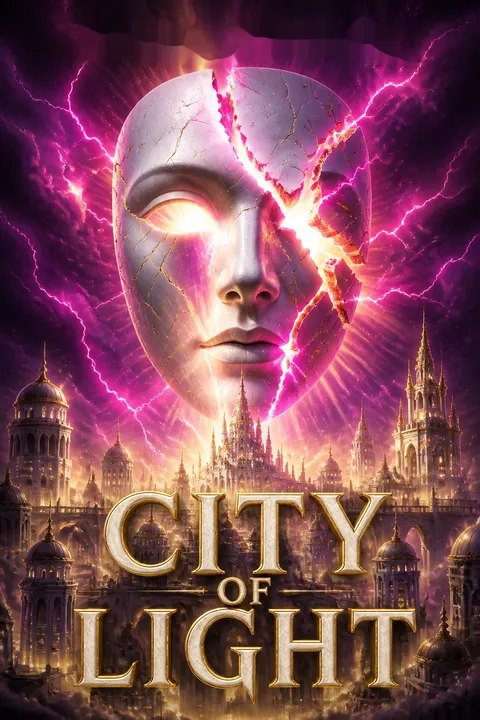


Plot Summary
The Crimson Dome Breaks
After the battle that ended the previous crisis, the Eldest Nye retrieves a blood-red Ragnarus sword from the dead Valin and carries it back to Valinhall. In Cana, King Zakareth emerges from the Crimson Vault changed: his son Talos is dead, the city is ruined, and a crimson barrier seals every route in or out.
He raises a pillar that will draw power from Cana's people, accepting their suffering as the price of rebuilding his kingdom. Meanwhile, Alin, now joined to Elysia, returns to Enosh and accuses its Grandmasters of releasing the Incarnations. He kills Grandmaster Helgard before the watching citizens. Simon, still recovering, lets Alin's sister Ilana leave to find him, fearing he may have to stop his friend.
The novel begins with two transformations of authority. Zakareth treats the citizens' lives as fuel for national power; Alin replaces the Grandmasters by claiming moral authority over the city. Both men see themselves as protectors, but their methods already blur protection with ownership. Simon's decision to let Ilana go exposes his own uncertainty: he knows Alin may become dangerous, yet he still hopes personal loyalty can reach the person beneath the power.
A Scholar in the Snow
Six months later, Simon waits in a frozen mountain valley for Queen Leah's signal to confront an Incarnation. Helgard arrives with a pack of summoned beasts, and one poisons Simon while another locks his feet in ice. Gloria, one of his wooden advisor dolls, helps him burn out the venom, but Helgard traps him in a rising pillar of ice.
Simon reaches for a dangerous mask and stops only when Gloria warns that using it could cost him more than capture. Indirial bursts in under a Nye cloak, then Leah and Helgard Travelers join the fight. Helgard escapes through a red-edged Gate. Leah recognizes the portal as an entrance to Ragnarus, a discovery that suggests the enemy can breach the Vault.
Simon survives by combining preparation with restraint. His doll notices the poison, his accumulated powers keep him moving, and his fear of the mask stops him from reaching for the fastest solution. Helgard's curiosity makes her more unsettling than a simple predator: she wants to possess knowledge of Simon, not merely defeat him. Her escape changes the campaign's geography. Ragnarus, once Leah's most private refuge, may no longer be sealed to outsiders.
The Graveyard's Living Dead
Back in Valinhall, the Eldest guides Simon into a storm-lit graveyard where eight headstones mark dead members of the old Dragon Army. Simon finds Kai there, sparring with a man he recognizes as Valin, the founder he believed he had killed. The Eldest has returned Valin as a room guardian, bound to the graveyard and no longer a full Incarnation.
Valin trains Simon, then forces him to face a lethal trial without the mask. Simon survives by calling on Valinhall's ghost armor, which shields him from attacks made with a Traveler's powers. Kai reveals that a Ragnarus wound has left him unable to leave the House, even with the healing pool. Valin's questions force Simon to confront how little he wants beyond fighting.
The graveyard turns Valinhall's history into a physical obstacle course. Simon must face the dead, but he also has to recognize that his own future could become another empty tomb if he treats combat as a complete life. Valin's apparent return complicates the boundary between death and duty, while Kai's incurable wound shows the cost of surviving through borrowed power. The ghost armor arrives only when Simon believes he is about to die, tying defense to the moment he stops assuming he can control every outcome.
Gold Rules Enosh
As Alin reconstructs Enosh in Elysia's image, his presence turns walls gold and reshapes streets. He claims the city is orderly and well supplied, yet he avoids the Silver Light when an ill worker collapses. Alin tries to heal the man with Rose Light without first examining him; the treatment worsens a hidden tumor, and the worker dies.
Rhalia, Elysia's remnant guide, warns Alin that compassion without judgment can still harm the people it intends to save. He suppresses her criticism and continues enforcing rules through summoned creatures and obedient overseers. His city has food and safety, but citizens fear punishment for small infractions and cannot leave. Alin believes his intentions make his rule righteous.
Alin's danger lies less in cruelty than in the certainty that good intentions excuse unchecked power. His refusal to use the Silver Light is psychologically revealing: insight might expose not only the worker's illness but Alin's own mistakes. The death makes moral failure concrete, yet he lets other virtues soothe his guilt rather than revising his conduct. Rhalia recognizes the pattern because she once imposed order on Elysia herself. Their relationship becomes a contest over whether wisdom can still interrupt a benevolent ruler's self-justification.
The Brother Simon Strikes
Leah organizes a cautious scouting mission into Enosh, and Simon slips through the city in his concealing Nye cloak. He witnesses guards and summoned creatures terrorizing residents, then finds Ilana watching the Naraka waystation.
She explains that she has spent months helping people evade Alin's rule. Though Leah argues that Damasca must deal with the missing Incarnations first, Simon refuses to leave Enosh's people behind. Alin enters the waystation and tries to take Ilana and the captured Grandmaster Naraka.
When he restrains his sister, Simon intervenes. He dons his mask and punches Alin through the doors. The mask floods him with Valinhall's strength and speed, but it also sends chains racing over his body, bringing him dangerously close to Incarnation.
Simon makes a consequential choice before he has a complete plan: he will not let strategic priorities erase the people suffering in front of him. His intervention is both moral and personal, because Alin is a childhood friend and Ilana is part of Simon's found family. The mask converts that choice into force, but its growing chains show that power is not a free expression of conviction. Simon can act decisively only by risking the very transformation he has spent the book trying to resist.
A King's Captive
After the clash in Enosh, Zakareth's forces attack the Damascan camp and capture Indirial, Overlord of Cana. The King holds Indirial's wife Nerissa and daughter Elaina in cages, then subjects him to repeated torture designed to make him call on Valinhall until he Incarnates.
Indirial resists because he understands that this is what Zakareth wants, but he spends his powers to keep his family alive. When an Asphodel illusion makes him believe Simon has arrived to rescue them, Indirial uses diamond clarity to recognize the deception.
He finally embraces Valinhall, breaks the King's binding command, and frees Nerissa and Elaina. Zakareth then offers him a place at his side. Indirial accepts, believing the King's challenge has earned his loyalty.
Zakareth turns Indirial's strongest attachment into leverage, but the test also exposes what Indirial values more than his own independence. His resistance is not passivity; it is a deliberate effort to deny the King the transformation he seeks. The Asphodel illusion makes loyalty itself a weapon, using Indirial's hope against him. Once Indirial chooses power to save his family, he mistakes survival for a fair contest and lets Zakareth define what the victory means.
Avernus Keeps the Past
Separated from her allies after the battle, Leah crosses Avernus and meets its Incarnation, who has regained enough self-control to speak with her. The Incarnation reveals that her father, not Talos, is the Ragnarus Incarnation.
She also argues that the old Incarnations were manipulated into transforming outside their Territories, where they became dangerous; Damasca then benefited from keeping them sealed beneath the Hanging Trees. Leah recognizes that the system her family built protected the kingdom while restricting the Territories.
The Avernus Incarnation proposes that each Territory should govern its own outposts instead. Leah does not accept the proposal outright, but she understands that the old arrangement has a moral cost beyond the annual sacrifices. Eugan's guidance helps her find a way back toward her people.
Leah's discovery does not simply reveal a villainous ancestor or a corrupt institution. It makes her own political legitimacy dependent on a system that has also kept the country safe. The Avernus Incarnation offers a competing account of history, and Leah tests it rather than accepting it as absolution. Her recognition that Damasca benefited from the containment of Incarnations marks a change from crisis management to political responsibility. She must now decide what protection should mean when the protected system itself is implicated.
The King Comes Home
Back at the camp, Leah and Simon watch Zakareth stage a public victory over the Endross Incarnation. The supposed surrender is so controlled that it exposes the King's power to command the other Incarnations. Zakareth announces that he has returned, that Cana is open, and that Damasca will follow him against Enosh. He denies the need for an heir, making Leah's position immediately precarious.
She retreats into the Crimson Vault to find answers. Simon, meanwhile, feels Azura's grief and learns through the sword that Kai's beloved doll Otoku has been badly damaged in an attack on Valinhall. He abandons the camp and rushes toward Cana, putting on the mask before he reaches the House. The war has become personal as well as political.
The staged surrender transforms Zakareth from a missing king into a claimant who can command the very catastrophe his family once contained. His public speech is political theater, designed to make obedience feel like relief after six months of uncertainty. Leah responds by seeking knowledge from the source of Ragnarus, while Simon responds to grief through immediate action. Their different instincts matter: Leah searches for leverage, but Simon's attachment to Otoku draws him into a fight he cannot yet see clearly.
The House Is Invaded
Indirial leads Tartarus and Ornheim into Valinhall to seize the Dragon's Fangs, the weapons that let its Travelers call on the House. Young Andra and her brother Lycus try to stop the armored Tartarus Incarnation, but their attacks cannot pierce its plating. Kai arrives and uses Mithra, Valin's gold-striped sword, with a new wind-sharpening power to dismantle Tartarus.
The victory reveals that the invader was heading for the gallery, where Valinhall's new masks are being made. Indirial escapes with several Fangs and leaves the House weakened. Kai pursues the wider threat, but his old Ragnarus wound and the mask's power have already made his body unstable. The Eldest cannot simply restore the order the invasion has broken.
The House's invasion makes its abstract rules tangible: the Dragon's Fangs are not merely weapons, they are access to belonging and power. Lycus's failed attempt to help shows how age and ability determine who is allowed to act, while Kai's fight proves his skill has not vanished. Yet his victory comes at a cost. By focusing on what he can still do, Kai approaches a danger he cannot master, and Valinhall's self-defense begins to consume its own people.
Mithra's Last Duel
On Cana's wall, Kai fights Indirial, now transformed into Valinhall's Incarnation under Zakareth's influence. Their masks make them near equals, but Kai's Ragnarus wound keeps worsening. Simon arrives and uses the stronger mask to strike Indirial hard enough to throw him back through a Gate into Valinhall. The blow saves the House from immediate attack, but Kai has pushed his own powers too far.
His body begins turning into a chaotic fusion of metal and flesh. Simon reaches him after the damage is irreversible. The dolls gather around Kai, and he dies holding Otoku, the doll crushed during Tartarus's assault. Simon's grief becomes more than sorrow for a friend: it is proof that his victories cannot undo every cost.
This duel makes Simon's victory morally incomplete. He saves the House by defeating Indirial, but the force required does not save Kai, whose body has been carrying damage long before the battle began. The dolls' grief gives the loss a communal shape, while Simon's inability to reverse it exposes the limit of his familiar strategy: if he fights hard enough, he can usually find a way out. Kai's death forces him to accept that love cannot always be converted into rescue.
A Founder Must Choose
Simon mourns Kai in Valinhall's graveyard, where Valin and the Eldest confront him with the choice Kai avoided: whether to take responsibility for the House. Simon accepts the role of Founder's heir, not because he longs to rule, but because the House is failing and someone must protect its Travelers.
At the same time, Leah enters Ragnarus and bargains with Queen Cynara the First. Cynara replaces Leah's damaged eye with the Eye of Ages, which lets her see traces of power and hidden connections.
She also explains that the Hanging Trees were never a merciful solution, especially for Incarnations. Leah emerges with clearer sight and a harder understanding of the price her family has imposed. Simon and Leah now carry new duties as well as grief.
Leadership arrives here as obligation rather than reward. Simon does not accept the Founder's mantle because he has solved his doubts; he accepts because other people and a whole Territory will suffer if he refuses to act. Leah's bargain follows a parallel logic. The Eye gives her greater perception, but she must surrender bodily certainty and accept Cynara's terms. Both characters gain authority through a cost they cannot simply reverse.
The Seed Finds Soil
Leah returns to Simon with two Dragon's Fangs recovered from the Vault and the Eye of Ages in place. When Simon produces a strange red seed, Leah recognizes it as a Seed of the Hanging Tree, possibly the last of its kind. It cannot be planted inside a Territory, so using it against an Incarnation will require a battle in the outside world.
Leah and Alin set aside their distrust long enough to plan against Zakareth, whose army includes several Incarnations and hundreds of Travelers. The Eldest exploits the King's belief that Valinhall has been broken, summoning the missing Travelers Denner and Kathrin at the crucial moment. Simon agrees to lead the defense, though the mask still threatens to bind him permanently to Valinhall.
The seed converts a buried instrument of control into a possible last resort, but it does not make the conflict easy. It requires the characters to fight where the Incarnations can use their full power. Leah and Alin cooperate without pretending their histories are settled; necessity temporarily outranks resentment. The Eldest's secret recruitment of Denner and Kathrin shows that strategic deception can serve survival, but Simon's limited time in the mask keeps every plan tied to a human cost.
Enosh Becomes a Battlefield
Zakareth's forces attack Enosh, and Alin draws the main army toward the city's broken walls. Simon's team waits in the districts, expecting the enemy Incarnations to arrive one by one. Only Endross appears at first, and Denner helps bring him down. Then Zakareth's group opens a Gate inside the city, sending Helgard, Lirial, and Ornheim directly at the defenders.
Helgard targets Andra, Lirial attacks Erastes, and Ornheim begins cutting a Gate into Elysia. Simon puts on his mask to protect his allies. Alin fights beside him, but the contest scatters them across the streets. The enemy's real aim is not just Enosh: by opening a path to Elysia, Zakareth threatens the City of Light itself.
The battle invalidates the defenders' carefully prepared geography. Zakareth bypasses the walls and puts the Incarnations among the people they are supposed to protect, making every tactical choice a moral one. Simon reaches for the mask because Andra and Erastes are in immediate danger, not because he expects glory. Alin's participation matters, but the city remains vulnerable to the consequences of his earlier choices. Their coalition is real, yet its members have not erased the mistrust that formed it.
The White Door Opens
As the fighting reaches Elysia, Leah and Queen Cynara drive back Lirial while Rhalia finally reunites with her sister. Alin discovers that the last link of Simon's Valinhall chain is closing; once complete, it will kill or transform him. Rhalia shows Alin that the White Light, which can be used only for someone else's sake, is the missing virtue he has refused to learn.
Alin opens the White Door and gives its power to Simon rather than keeping it for himself. Simon's chains turn white and vanish, allowing him to defeat Ornheim, Helgard, and Lirial. Erastes uses a Ragnarus blade against Helgard, while Leah plants the Hanging Tree's seed outside Elysia. The surviving defenders now have a way to contain Zakareth.
Alin's pivotal act reverses the logic that has governed him since his Incarnation: he does not use virtue to justify his own command, but gives power away for Simon's survival. The White Light is not another technique to master; it requires a decentering of the self. Meanwhile, Rhalia and Cynara's reunion joins personal repair to the larger conflict. Leah's tree grows from the same legacy that once enabled dynastic control, but this time its target is the ruler who has turned control into conquest.
The Hanging Tree's Price
With the other Incarnations defeated, Zakareth fights Simon and the assembled allies while trying to reach the Gate into Elysia. Leah's new tree catches the King and begins drawing him into the earth. She recognizes that a Ragnarus Incarnation's suffering beneath a Hanging Tree may last longer than any human can imagine, and asks Simon for mercy.
Simon cuts through the branches instead of leaving his father to the tree. When Zakareth continues to threaten a return, Simon kills him with Mithra. The King dies rather than becoming a prisoner for centuries. His end breaks the immediate campaign, but it does not erase the system that made the Hanging Trees seem necessary or settle what should replace it.
The climax distinguishes justice from prolonged punishment. Leah has inherited the power to bind her father, yet she recognizes that repeating the old method would reproduce its cruelty. Simon's decision to kill Zakareth is not presented as an easy victory; it is a choice made under pressure, shaped by the King's refusal to stop. Their response rejects both the King's domination and the dynastic habit of turning enemies into hidden, suffering resources.
A New Order Takes Shape
After the battle, Leah rewards Feiora and restores her brother Lysander to her guardianship, with a warning against further treason. At the formal ceremony, Simon accepts leadership of Valinhall and pledges its Travelers to Damasca's safety, including responsibility for watching the Incarnations. Leah also appoints him as her personal protector.
Alin and Rhalia open Elysia to students from across the country, giving the once-isolated City of Light a public role beyond Alin's rule. Simon returns to Valinhall exhausted and uncertain about his new offices, but Caela chooses to stay with him for now. The Eldest immediately gives him another task: persuade the absent Kathrin to return to her duties or surrender her Dragon's Fang.
The ending replaces a single ruler's sweeping control with negotiated roles, public education, and continuing obligations. It is a beginning rather than a clean settlement: Simon inherits a House in disrepair, Leah must govern after exposing her family's history, and Alin's new school could either broaden access or create another powerful institution. Caela's continued companionship softens Simon's loss without undoing it. His first work as Founder is not conquest but persuading another Traveler to accept responsibility.
Analysis
City of Light asks whether power can protect people without converting them into instruments. Zakareth treats lives as payment for order. Alin tries to replace coercion with virtue, yet his certainty that he embodies the good allows him to regulate citizens, ignore counsel, and mistake obedience for well-being. Leah inherits a state whose stability rests on an old bargain with suffering, so her crisis is not simply whether to defeat her father. She must decide what kind of protection remains legitimate after its hidden costs are exposed.
Simon faces a smaller but related problem. Valinhall rewards him for surviving danger, then tempts him to make danger the only measure of purpose. The mask dramatizes that temptation: it lets him save others immediately while drawing him toward a transformation that could erase his ability to choose. His acceptance of leadership matters because it follows reflection and grief, not because he has become certain or invulnerable. He chooses responsibility while retaining the right to question the Eldest's demands.
The Incarnations complicate the boundary between individual and institution. Each carries the nature of a Territory, but the novel shows that this nature does not absolve choices. Alin can be compassionate and still do harm; Avernus can be dangerous and still remember injustice. Their actions emerge from both power and history. The book therefore resists a simple solution in which every threat is destroyed or every old system restored.
Its ending offers beginnings rather than a perfected settlement. The Hanging Tree stops Zakareth, but Simon's final act prevents containment from becoming another inherited cruelty. Elysia opens to students, Valinhall accepts a leader, and Leah must govern with knowledge of what Damasca has done. The deepest lesson is practical: good intentions become ethical only when power can be questioned, shared, and refused.
People Also Read

Characters
Simon, son of Kalman
Reluctant House of Blades heroSimon is a village-born Valinhall Traveler whose life has been shaped by combat, loss, and the need to act when other people are in danger. He is practical rather than eloquent, often moving before he has fully named what he wants. The House rewards that instinct with immense power, but its chains make every victory potentially dangerous. Simon relies on weapons, training, and the advice of his dolls, while remaining wary of authority that asks him to become a tool. His central psychological tension is between self-sacrifice and self-direction: he wants to help, yet must learn that service without a chosen purpose can become another form of captivity.
Leah
Queen with a strategist's eyeLeah is the young Queen of Damasca and a Traveler of both Ragnarus and Lirial. She thinks in contingencies, studies political motives, and rarely lets uncertainty show when others need direction. Her family history gives her access to power and places a heavy burden on her judgment: she must protect a kingdom whose security has depended on coercive practices. Leah's composure can harden into secrecy, especially when she believes information would distract or endanger her allies. She is most effective when she combines tactical foresight with a willingness to question the traditions that made her powerful. Her relationships with Simon and the Overlords test whether leadership can include trust.
Alin, son of Torin
Elysia's earnest reformerAlin is Simon's childhood friend and Ilana's younger brother, a naturally gifted Traveler drawn to ideals of justice and public service. Before his transformation, he is warm, talkative, and confident in his ability to persuade others. As the embodiment of Elysia, he gains access to virtues that pull his thoughts in different directions, but he mistakes those powers for proof of his own moral completeness. His desire to prevent another tragedy is genuine; so is his tendency to make decisions for people who have not consented. Alin's deepest struggle is not choosing between good and evil, but recognizing that virtue becomes dangerous when it removes the need to listen.
King Zakareth
Ruler of the Crimson VaultZakareth is the King of Damasca, a disciplined ruler who values efficiency, hierarchy, and decisions that can be measured by results. He sees the Ragnarus principle of price and reward as a natural law: power should belong to whoever is willing to pay for it. This makes him decisive in a crisis and dangerously comfortable treating other people as resources. His relationship with Leah carries both political authority and a father's claim, which complicates her ability to oppose him. Zakareth's calm manner is not evidence of neutrality; it lets him pursue extreme plans without being distracted by the suffering those plans cause.
Indirial
Valinhall's smiling swordsmanIndirial is an experienced Valinhall Traveler, Overlord of Cana, and trusted protector of Damasca's ruling family. He is sociable and humorous, but beneath the ease is a warrior who measures himself through challenge. His loyalty to his family and King Zakareth sits beside a restless appetite for opponents worthy of his skill. Indirial has spent years keeping danger at a distance from Leah and Simon, often taking responsibility before asking permission. His confidence can make him underestimate the emotional consequences of his choices. He is both a mentor figure and a warning about how a life organized around combat can narrow the meaning of freedom.
Kai
Unsettled master of dollsKai is Simon's former mentor, a brilliant Valinhall swordsman whose eccentricity can conceal deep loneliness and pain. He speaks to his wooden dolls as companions and treats them with a tenderness he rarely extends to people. A lingering injury limits his freedom and leaves him dependent on the House's healing pool, while his history with Valin and Indirial gives him reason to distrust the Eldest. Kai's habits can seem childish or evasive, but they are also his way of preserving attachments in a life defined by violence. He understands the cost of power intimately, even when he struggles to accept the responsibilities that come with it.
Valin
Valinhall's vanished founderValin created the House of Blades and trained the original Dragon Army. He is a gifted fighter whose enthusiasm for testing strength can turn frighteningly ruthless. His students remember both his skill and the damage done by his choices, so his authority is never simply reassuring. Valin sees combat as a means of revealing character, but he also understands that a person cannot live forever as a weapon answering other people's emergencies. His sharp questions challenge Simon to define a future beyond survival. He represents Valinhall's strongest virtues and its most dangerous temptations in the same restless figure.
The Eldest Nye
Keeper of Valinhall's balanceThe Eldest Nye is the ancient, shadow-cloaked leader of Valinhall's Nye, beings who defend the House and test its Travelers. He speaks sparingly and measures relationships through debts, bargains, and the survival of his Territory. His long memory gives him knowledge others lack, but it does not make his motives impartial. He wants Valinhall to grow stronger because he fears its return to weakness and dissolution. The Eldest can protect, manipulate, and threaten in the same breath. His relationship with Simon turns leadership into a negotiation over whether the House's future belongs to its people or to the being who has guarded it longest.
Queen Cynara
Founder of Damascan ruleCynara is the first Queen of Damasca and a former Incarnation of Ragnarus. She is shrewd, proud, and accustomed to bargaining from a position of strength. Her bluntness can sound like mockery, but it often exposes the self-deception beneath another person's argument. Cynara understands the dangers of power because she has paid for it herself, though she does not pretend that experience makes her harmless. Her complicated bond with her sister Rhalia links private grief to the earliest conflict between Elysia and Ragnarus. She treats Leah as a political heir who must learn to see clearly, not as a child who deserves comforting illusions.
Rhalia
Elysia's grieving guideRhalia is the former guide and mentor of Elysia, a bright, agile presence whose cheerfulness can give way to sorrow when she recalls her past. She wants Alin to understand that the virtues of Elysia require judgment and humility, not merely power. Her failure to teach him carefully weighs on her, and she recognizes the dangers of repeating her own mistakes. Rhalia's relationship with Cynara carries centuries of distance and unresolved affection. She is both a source of historical knowledge and a person seeking forgiveness, which prevents her wisdom from feeling detached from the consequences of the choices she describes.
Ilana
Alin's stubborn older sisterIlana is Alin's older sister, practical, independent, and willing to travel into danger when her family needs her. She does not understand the technical rules of the Territories, but she reads people well and is difficult to intimidate. Ilana's affection for Alin survives her fear of what he is becoming, though she refuses to mistake kinship for obedience. Her choice to remain near Enosh reflects a strong sense of responsibility to the people harmed by her family's history. She often acts as a reminder that ordinary human judgment can challenge Travelers who have begun to treat power as a substitute for connection.
Feiora Torannus
Avernus's hard-eyed OverlordFeiora is an Avernus Traveler and Overlord who prefers political alliances to the unpredictability of other Travelers. Blunt, armored, and watchful, she approaches danger with practical caution rather than ceremony. Her raven Eugan is both advisor and companion, reflecting the Avernus bond between Traveler and bird. Feiora's ambition is real, especially where her imprisoned brother is concerned, but she can set personal grievances aside when the country's survival is at stake. Leah finds her abrasive, yet relies on her competence. Their relationship is a tense negotiation between mutual distrust and the recognition that effective government depends on people whose motives are not perfectly pure.
Grandmaster Naraka
Enosh's dangerous defectorThe elderly Grandmaster Naraka is a shrewd and unsettling Traveler, marked by her red spectacles, missing hand, and long experience with Enosh's political machinery. She can be sarcastic and difficult to control, but her knowledge of the city's leaders and changing streets is invaluable. Naraka's loyalties are shaped by survival and by her own sense of justice, not by uncomplicated allegiance to Leah or Alin. She has little patience for the moral language of rulers, though she knows how to use it when useful. Her presence forces the others to distinguish between someone who is dangerous and someone whose information they need.
Andra Agnos
Young blade of ValinhallAndra is a young Valinhall Traveler and daughter of Olissa and Caius Agnos. She is quick, energetic, and more willing to joke than to dwell on fear. Her closeness to her younger brother Lycus makes her protective, although she also expects him to learn by facing difficult tests. Andra is still early in her training, and her short chain marks show that her access to Valinhall's power is limited. She brings a grounded, familial perspective into the House's severe training culture. Her determination comes not from confidence that she will win, but from the belief that she must keep improving.
Erastes
Old soldier with new powerErastes is a veteran Damascan soldier whose hard discipline and measured courage make him a steady presence among the younger Travelers. He takes Lycus seriously when others might dismiss him, and he treats duty as a practice rather than a grand claim. His developing bond with Valinhall gives him new strength, but his identity remains rooted in the habits of a soldier: observe, endure, and act when the opening appears. Erastes is less interested in power for its own sake than in whether it allows him to protect the people beside him.
Caela
Simon's sharp-tongued advisorCaela is one of Valinhall's wooden dolls and Simon's most frequent advisor. Her voice is teasing, impatient, and often more perceptive than Simon expects. She helps him interpret danger and think through the people around him, but she also has opinions of her own and dislikes being treated as equipment. Her bond with Kai and Simon gives her a place in the House's emotional life, even though she is made of wood. Caela's humor makes frightening choices easier to face without making their consequences disappear.
Otoku
Kai's fiercely proud dollOtoku is a black-haired wooden doll in a red flowered dress, one of Kai's cherished companions. She is proud, outspoken, and acutely sensitive to whether people listen to her. Her stillness is often deliberate, not a sign that she lacks feeling or awareness. Otoku's connection with Kai reveals how much companionship he needs, while her exchanges with Simon show the dolls' distinct personalities. She refuses to be treated as a possession without a voice, even when the people around her forget that she can hear and judge them.
Denner
Wandering Dragon Army veteranDenner is an experienced member of Valinhall's old Dragon Army, recognizable by his weathered traveling clothes and his large book advisor, Hariman. He tends to arrive and depart without warning, making him difficult to rely on for routine plans. In a fight, he brings patience and specialized skill rather than showmanship. Denner's independence reflects a broader Valinhall tension: the House needs capable Travelers, but those Travelers resist being kept under another person's control.
Kathrin
Absent Dragon Army fighterKathrin is a seasoned Valinhall Traveler with a short-bladed Dragon's Fang and little tolerance for being summoned without explanation. She is blunt, capable, and confident enough to treat danger as a practical inconvenience. Her absence from Valinhall has left others uncertain about her loyalties and duties. Kathrin's independence is not mere carelessness; she expects the right to choose where her skill is used. Her return forces Simon to consider whether a bond to a Territory creates obligations as well as powers.
Lycus Agnos
Youngest hopeful of the HouseLycus is Andra's younger brother and the son of Olissa and Caius. He is impatient to prove himself, particularly because adults and Travelers often see him as too young to matter. His attempts to help during danger reveal courage mixed with a realistic awareness of his own limits. Lycus wants training not for status, but so that he can protect his family and contribute when the House is threatened.
Olissa and Caius Agnos
Craftspeople of ValinhallOlissa and Caius Agnos are Valinhall Travelers and the parents of Andra and Lycus. Olissa is an inventive maker who studies how the House's power can be shaped into usable tools, including the masks. Caius is a warm, practical smith who supports her work and keeps the family workshop running. Their craft gives the House new possibilities, but also raises questions about how safely power can be reproduced. Together they provide Simon with a family life that exists beyond battle and training.
Shai
Alin's youngest sisterShai is Alin's youngest sister, a quiet, observant girl whose bored expression can hide intense interest. Her connection to Elysia gives her a perspective on the Territory that differs from Alin's. She is one of the family relationships that continue to shape his choices, and her presence reminds him that his understanding of what is best for others may be incomplete.
Eugan
Feiora's watchful ravenEugan is Feiora's bonded raven and an Avernus advisor. He can sense thoughts and other minds, offering warnings that Feiora translates for those around her. His blunt caws and self-assured manner often communicate more than the humans would prefer. Eugan's bond with Feiora shows that Avernus power depends on relationship and interpretation, not simply command.
Plot Devices
The Territories and Incarnations
Power with a living natureEach Territory is a distinct world with its own powers, inhabitants, and rules. Travelers draw abilities from a Territory, but excessive use can bind them to it or trigger Incarnation, a transformation that makes the Traveler an embodiment of that place. Incarnations reshape the outside world around themselves and act under the pressure of their Territory's nature. The story complicates the idea that they are simply monsters: they can retain human motives, but their power intensifies those motives and can overwhelm judgment. The Territories make travel, communication, warfare, and political control inseparable.
The Valinhall Mask
Power at a lethal priceThe mask lets Simon draw far more strength and speed from Valinhall than his ordinary powers allow. Its benefit makes it decisive against Incarnations, but every use accelerates the chains of Valinhall across his body. If those chains close, Simon risks death or a transformation beyond his control. The mask therefore imposes a visible time limit on the climactic battles. Other masks are being made in the House, creating a broader question about whether a weapon can be made safer without erasing the debt that gives it power.
The Hanging Tree Seed
A living prison for IncarnationsThe Hanging Trees can contain Incarnations, but their roots drain power and impose a prolonged, conscious imprisonment. Damasca has used the trees for generations, tying public safety to blood sacrifice and the suffering of beings it considers dangerous. The last known seed offers Leah a way to grow a tree outside any Territory, where it might trap an Incarnation. Its existence makes the old method available again, but the characters must decide whether containment through agony is preferable to killing or releasing their enemies.
The Dragon's Fangs
Keys to Valinhall's powersThe Dragon's Fangs are Valinhall's distinctive swords, each connected to a Traveler and to the House's powers. They can be summoned or banished by their bearers, and a blade's particular qualities shape how its Traveler fights. Losing the Fangs weakens Valinhall's defenders and gives an enemy a way to isolate its people from their Territory. The swords also have a measure of agency, choosing their bearers rather than functioning as ordinary weapons. Their recovery becomes part of Simon's responsibility as Valinhall's new leader.
The Nine Elysian Lights
Virtues made into powersElysia's nine Lights embody virtues such as courage, compassion, patience, honesty, wisdom, and mercy. Alin can call on them to heal, bind, defend, attack, or perceive hidden facts, and their differing impulses shape his thoughts. Their influence is not automatically moral: a virtue used without the others can become distorted. Alin's inability to access the White Light, which can only serve someone else, marks the limit of his self-understanding. Its eventual use makes selflessness a concrete power rather than a principle he can merely claim.
Traveler's Gate Series


Download PDF
Download EPUB
.epub digital book format is ideal for reading ebooks on phones, tablets, and e-readers.








