

Key Takeaways
Study whole civilizations, not nations trapped inside unfinished stories.
Start with the larger unit. Toynbee argues that national histories are too narrow to explain the forces that shape them. To understand England or the United States, one must look at the broader Western civilization, its older roots, and its relations with other societies. A civilization, in his usage, is a large, connected society whose history makes more sense as a whole than as a collection of separate nations.
Past and present overlap. Toynbee’s understanding of history changed when the First World War made Thucydides feel strikingly relevant: the Greek historian’s world was not merely ancient, but in a meaningful sense contemporary with his own. He calls this philosophical contemporaneity. Civilizations that lived in different calendar eras can face comparable human problems, so historical distance should not be mistaken for irrelevance.
What's valuable here is the shift in scale: a country is often a political container, not a complete explanation. This resembles systems thinking, where patterns emerge from relationships among parts rather than from any single part alone. The approach also checks national self-congratulation by placing a society beside others. Its difficulty is practical: larger frames can blur local differences, so comparison works best when it clarifies particular histories rather than replacing them.
Treat civilization as a risky response, not a machine with a timetable.
Challenges create movement. Toynbee rejects the idea that civilizations follow a fixed life-cycle. He proposes instead that a society grows when it answers a challenge successfully, and falters when it cannot. Race and physical environment, he argues, do not explain why some societies developed civilization while others in comparable circumstances did not.
Failure is possible. Toynbee found a suggestive image in Goethe’s Faust: God accepts Mephistopheles’ challenge to test a created world, making new creation possible but also putting it at risk. In Toynbee’s historical account, encounters between challenge and response can produce growth, but they can also end in breakdown. A society that loses control may divide between a dominant minority that cannot lead effectively and a disaffected population that no longer accepts its authority.
The model’s strength is that it gives human choices a role without pretending people act outside conditions. A challenge matters only through the response it draws out, which keeps the explanation dynamic rather than mechanical. The model also has a limit: after the fact, almost any success or failure can be described as a response to some challenge. A careful reader should ask what evidence distinguishes a genuine causal explanation from a persuasive story told in retrospect.
Use historical repetition as a navigation chart, never a prophecy.
Patterns are not commands. Toynbee distinguishes recurring events from laws that make the future inevitable. Seasonal farming repeats because it depends on physical cycles; political decisions, by contrast, retain room for human choice. Similar events can recur without being identical or destined to end the same way.
Analogy can guide action. He compares history to a navigator’s chart: it marks hazards, but does not dictate the route. The industrial transformation that began in Britain appeared again in the United States and Germany. Political union also recurred in different forms, including Canada’s federation. Such parallels show that societies can face related problems and borrow workable solutions. They do not prove that a present society must follow another’s entire path, including its failures.
This is a useful middle ground between fatalism and the claim that every era is wholly unique. Historical comparison can reveal recurring pressures, while attention to context prevents a past case from becoming a rigid template. The navigator metaphor also implies responsibility: knowing where earlier ships struck reefs does not steer the vessel by itself. The chart helps only when decision-makers remain willing to change course.
Modern technology makes war and class injustice threats to humanity's survival.
Old problems gained new force. Toynbee sees war and class conflict as longstanding weaknesses of civilization, but argues that modern technology has made their consequences radically more dangerous. In 1947, he feared that another war could destroy not just the combatants but humanity itself. The same technological power that increases destructive capacity also makes the persistent division between privileged and underprivileged people harder to defend.
Material gains do not settle justice. A higher minimum standard of living cannot by itself answer demands for fairness. In earlier societies, elites could argue that limited production required unequal access to its benefits. Toynbee says modern productive power weakens that excuse: when society can produce more, preserving extreme inequality becomes a moral choice, not simply an unavoidable necessity. His challenge is stark: civilization must overcome both war and class domination or risk a final collapse.
The central insight is about amplification: technology changes the scale of consequences without automatically improving the motives behind its use. That distinction remains powerful because technical capacity and moral capacity do not advance at the same pace. Toynbee’s case against inequality is strongest when it connects abundance to responsibility, rather than implying that technology can distribute goods fairly on its own. Institutions and political choices still determine who benefits.
Let Greece warn you: interdependent economies need shared political rules.
Trade outgrew the city-state. In sixth-century BCE Greece, population pressure helped drive a shift from farming mainly for local use toward producing specialized crops for export. This economic change made Greek communities more interdependent. Yet the city-states continued to insist on political independence and fought one another, creating a mismatch between their shared economic life and fragmented political order.
A partial fix came too late. After the Greek city-states defeated Persia, Athens led the Delian League, an attempt at cooperation among the liberated communities. Toynbee argues that the league failed to replace political rivalry with a durable common order. Centuries of conflict followed. The Roman Empire eventually imposed a broad peace, but Toynbee sees it as a late settlement achieved after Greek society had already inflicted grave damage on itself.
This case links economic integration to political coordination: shared markets generate needs that isolated authorities may struggle to meet. The comparison is especially useful because it does not treat cooperation as automatic; the league existed, but its structure failed to resolve the underlying contest over power. The Greek story supports institutional design as a serious question, though it cannot establish that one political model fits every society facing interdependence.
Treat Western expansion as humanity's forced merger, not Europe's final victory.
The map changed under sail. Before the modern era, many civilizations had limited contact, connected chiefly by routes across the Eurasian steppes and by slower sea travel. Western mariners eventually made the ocean a major highway between societies. Toynbee captures the shock through Babur, a Central Asian ruler and keen observer whose world remained centered on overland Asia even as Europeans began linking distant continents by sea.
Contact rewrites history. Western expansion brought much of humanity into one connected society, but Toynbee warns against mistaking this for a permanent Western triumph. Non-Western peoples, forced into contact with Western power, began reinterpreting their own histories and learning Western methods. Westerners, he argues, must reciprocate by recognizing that other civilizations’ pasts now belong to the shared human story.
The reversal is the memorable point: an expansion that appears to demonstrate one society’s dominance also creates conditions for influence to travel back toward it. This makes globalization less a story of simple diffusion than of mutual exposure and adaptation, even when the initial encounter is coercive. Toynbee’s framing usefully restores the agency of those described as recipients, though the word 'merger' should not hide the enormous differences in power that shaped the contact.
Meet foreign pressure with discernment, not reflexive imitation or retreat.
Two responses recur. Toynbee calls defensive revival of familiar customs Zealotism, and calls deliberate adoption of a stronger rival’s methods Herodianism. He uses these terms to describe responses to pressure, not fixed kinds of people. A Zealot may resist change by returning to tradition; a Herodian tries to master foreign techniques and institutions.
Neither route guarantees renewal. Russia, in Toynbee’s account, repeatedly adopted Western technology to protect a distinct Byzantine inheritance, first under Peter the Great and again under the Bolsheviks. In the Muslim world, he contrasts revivalist movements with reformers such as Mehmed Ali and the Turkish nationalists. He sees imitation as potentially useful but culturally risky: imported institutions can transform a society without necessarily creating a new source of purpose or creativity.
The distinction is helpful because it separates a society’s response to pressure from the pressure itself. It also warns against two easy stories: that tradition is always a refuge, or that copying a powerful society amounts to progress. Toynbee’s categories can sound too binary, since real societies combine resistance, borrowing, and adaptation. Their best use is as questions to ask of a particular response, not as labels that settle its meaning.
Read civilization's rise and fall through the soul's spiritual education.
Social success is not the final measure. Toynbee considers whether civilizations exist mainly to perpetuate themselves, or whether their repeated failures can serve a higher purpose. He suggests that suffering may deepen spiritual understanding, tracing religious insight through successive social breakdowns and encounters. In this view, history is not simply a cycle of societies repeating themselves; it can also be a setting in which people learn, imperfectly, about their relation to God.
The soul is social, too. Toynbee rejects both the worship of society as the highest good and the idea that earthly life is meaningless. He argues that seeking spiritual growth should deepen, not cancel, concern for other people. The Christian ideal, as he presents it, joins the soul’s relation to God with its duty toward fellow human beings. Social improvement matters, but it is not the ultimate purpose of life.
Toynbee’s theological reading gives historical suffering a possible meaning without reducing it to a simple story of progress. Its moral force lies in refusing to make social order the highest object of loyalty, while also refusing indifference to earthly suffering. The interpretive risk is substantial: a claim that catastrophe educates humanity can sound as if victims suffer for the benefit of later generations. Any spiritual interpretation must preserve the particular reality of that loss.
Build world unity through cooperation, economic compromise, and spiritual purpose.
Choose cooperation over conquest. Writing after two world wars, Toynbee argued that political unification was becoming unavoidable because societies were interdependent and modern weapons were so destructive. The urgent question, in his view, was whether unity would be imposed by a victorious power or built through cooperation. He favored an effective system of world government, while recognizing that the United Nations faced difficult obstacles.
Make room for practical variation. Toynbee also urged compromise between unrestricted private enterprise and comprehensive socialism, with arrangements adapted to local conditions. He saw political cooperation and economic reform as urgent, and spiritual renewal as ultimately more important. These recommendations belong to his 1947-48 postwar setting, but their structure is clear: avoid rigid ideological formulas, reduce the dangers of rivalry, and build institutions capable of managing shared problems.
The proposal’s strength is its refusal to confuse ideological consistency with practical success. Toynbee treats political institutions and economic arrangements as tools that must fit real conditions, rather than universal blueprints. His emphasis on cooperation also follows from his account of interdependence: shared dangers require some shared capacity to act. The harder question is how to secure accountability and consent in world institutions, a problem his broad prescription identifies more clearly than it solves.
Analysis
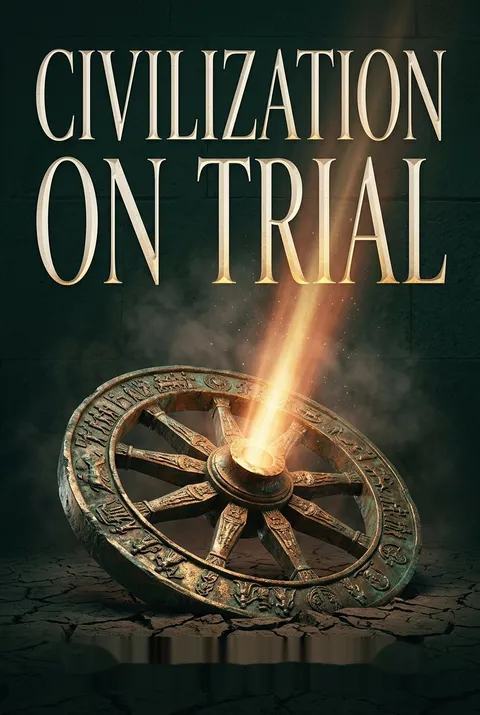
Civilization on Trial is a collection of essays, but its argument holds together around a single shift in scale. Toynbee asks readers to stop treating nations as self-contained historical actors and to view civilizations as interacting societies, all caught in a shared human story. From that vantage, he links the Greek failure to create stable political cooperation with the dangers of a technologically unified modern world. The historical comparison is not merely decorative. It turns the past into evidence that political arrangements can lag behind economic interdependence, with devastating consequences.
The book’s strongest move is to pair structural risk with human agency. Civilizations may repeat patterns, but they are not machines on a fixed schedule. People can learn from earlier breakdowns and choose a different response. This makes Toynbee’s warning about war and class more than a prediction of doom: it is a demand to act before the consequences become irreversible. His emphasis on religion likewise challenges accounts of history that measure success only in political power, material production, or institutional survival.
The method has real limits. Toynbee’s large civilizational categories can flatten internal differences, and his comparisons sometimes move quickly from resemblance to explanation. His account also carries a theological interpretation of history that readers need not accept in order to value his political arguments. The 1948 prescriptions should be read in their postwar context, not treated as ready-made instructions for another era. Even so, the book remains compelling where its diagnosis is most concrete: human technical power can connect societies faster than their political judgment matures. Its lasting question is whether people can build forms of cooperation strong enough to match the world they have already made.
Review Summary
Civilization on Trial is a collection of essays written in the late 1940s by Arnold J. Toynbee exploring civilizations' rise and decline. Reviewers appreciate Toynbee's ambitious scope and interdisciplinary approach, particularly his analysis of Christianity, Islam, and predictions about post-WWII geopolitics. Some find his work dated or overly focused on mid-century British concerns, while others praise his timeless insights. Critics note his Christian bias and dense scholarly style. Many value his theory that civilizations respond to challenges cyclically while religion develops linearly, offering valuable historical perspective despite some flawed predictions.
People Also Read



Glossary
challenge-and-response
Societal growth through responseToynbee’s account of how civilizations develop: a society encounters a challenge and grows when it finds an effective response. A challenge may be environmental, social, or political. Success is not guaranteed; failure to respond can contribute to breakdown. The idea makes human and collective choices central, rather than treating civilizational change as a predetermined life-cycle.
philosophical contemporaneity
Comparable historical experienceThe idea that societies separated by centuries can be meaningfully contemporary because they face comparable human experiences. Toynbee describes how reading Thucydides during the First World War made ancient Greek history feel immediately relevant. The concept challenges the assumption that calendar distance alone makes one society’s history remote or unhelpful to another.
dominant minority
A society's weakening rulersIn Toynbee’s account of social disintegration, the dominant minority is the ruling group that once provided effective leadership but increasingly loses the ability to secure willing cooperation. As its authority weakens, it relies more heavily on force and faces growing resistance from the society’s less privileged members.
proletariat
The disaffected majorityToynbee uses proletariat for a society’s large, less privileged population, not only for industrial workers. During breakdown, this group may become alienated from the ruling order and form a new community of belief. In his account, that community can outlast the failing political society and influence a later civilization.
universal state
An empire-wide political orderA large political structure established within a disintegrating civilization, often by a ruling minority seeking to restore order. Toynbee describes it as a temporary rally after periods of conflict. The Roman Empire is his main example. A universal state can provide peace, but its creation does not necessarily repair the deeper problems that caused breakdown.
universal church
A faith beyond one societyA religious community that reaches beyond the boundaries of a particular civilization or state. Toynbee argues that such a community may take root during a society’s decline and survive its political collapse. Christianity within the Roman Empire is his central example, while Mahayana Buddhism plays a comparable role in his account of East Asian history.
Zealotism
Defensive return to traditionToynbee’s term for responding to foreign pressure by clinging more tightly to familiar customs and beliefs. The response aims to preserve a society’s identity in the face of a stronger rival. Toynbee contrasts it with Herodianism, but treats both as responses to an encounter, not as permanent traits of particular peoples.
Herodianism
Adoption of a rival's methodsToynbee’s term for responding to foreign pressure by learning and adopting the methods of a more powerful society. This can include military techniques, institutions, and social practices. It may help a society protect itself, but Toynbee warns that borrowing can transform the borrower without ensuring that the resulting society develops its own creative purpose.
pammixia
Intensive cultural interminglingToynbee uses this term for the mixing of societies and cultures through sustained contact. He discusses it in relation to Greek influence among peoples of the Middle East and beyond. Such contact can produce significant cultural and religious change, but he does not treat mixing as automatically harmonious or as proof that one culture simply replaces another.
About the Author
Other books by Arnold Joseph Toynbee
Download PDF
Download EPUB
.epub digital book format is ideal for reading ebooks on phones, tablets, and e-readers.








