

Key Takeaways
When you do everything for capable kids, they learn to expect service.
The first warning sign. On a Dallas drive surrounded by luxury cars, Wyma’s fourteen-year-old announced the Porsche he expected to own at sixteen. The bigger shock came at home: none of her five children could do their own laundry, clean a bathroom, or prepare and clean up after dinner. Their dependence was not simply a character flaw. It reflected the routines she had built by stepping in to make life smoother.
The hidden lesson. A parent who repeatedly takes over can unintentionally teach that someone else will handle ordinary responsibilities. Wyma’s twelve-month Experiment began by assigning children practical work, from beds and meals to errands and service. Its central message was not that children should be left alone, but that love includes trusting them with responsibilities they can learn to manage.
What's striking is the gap between what a parent says and what a child experiences. Praise says, You are capable. Taking over says, This is safer in my hands. The book makes that contradiction visible through small domestic scenes rather than abstract blame. It also avoids treating entitlement as a fixed trait: habits of dependence can be taught, so family routines can teach participation instead. The argument needs a boundary, however. Help is not inherently harmful, and children differ in age, ability, and circumstance. The useful test is whether assistance builds capacity or quietly replaces it.
Teach a task, then transfer ownership before efficiency takes over.
The parent as instructor. Wyma compares parenting to driver education. A driving teacher does not prove expertise by steering for the student. The teacher explains, demonstrates, stays close, and lets the learner practice, including making manageable mistakes. Parents can use the same sequence with laundry, cooking, shopping, and other everyday work.
Shared expectations. The family’s monthly assignments began with a meeting where the children could help decide how to handle the work. Wyma still set the standard, but participation made the tasks less like arbitrary orders. Her challenge was often not getting the children to act, but resisting the urge to finish the work herself because she could do it faster or better. Teaching requires tolerating the slower, messier learning stage.
This approach treats competence as something built through supported practice, not a trait children either possess or lack. The instructor metaphor is useful because it gives parents a role without making them the permanent operator. It also makes room for mistakes that are small enough to be instructive. A limit matters: stepping back should not mean withdrawing attention. Children need clear demonstrations, realistic expectations, and a route to ask for help. The goal is not parental absence. It is a gradual shift from doing the task for a child to making sure the child can do it.
Build responsibility through one practical family skill at a time.
Small steps, visible results. Wyma divided her plan into twelve monthly tasks, beginning with beds and clutter, then adding cooking, yard work, jobs, bathroom cleaning, laundry, repairs, hosting, teamwork, errands, service, and manners. Starting with rooms kept the change manageable. The children made their beds and cleared their floors, and soon some used their newly tidy desks and rooms for homework, reading, and play.
A simple incentive. Each child received a jar containing thirty dollars. Wyma removed a dollar when a daily task was missed, rather than relying on a vague promise to pay an allowance. She later connected the approach to loss aversion, the idea that losing an amount can feel more motivating than gaining the same amount. The jars helped, but the children’s satisfaction with their work became a more durable reward.
The monthly structure turns an enormous parenting ambition into a sequence of teachable problems. Visible results matter: a clear floor or a meal on the table makes effort legible to both child and parent. The incentive jar also gives the rule a concrete consequence, reducing repeated negotiation. Still, a reward system can become the point of the exercise if it is not paired with explanation and growing ownership. The book’s strongest version of the method treats money as scaffolding, not the purpose. The deeper measure is whether a child begins to notice and handle responsibilities without waiting for a payout.
Treat household work as a contribution, not merely a chore.
Work has a recipient. During the family’s Month of Meals, each child planned, shopped for, cooked, served, and cleaned up after a dinner. Ten-year-old Barton adjusted the seasoning so siblings who disliked pepper could enjoy the food. Her work had taught her more than how to prepare a meal: she was thinking about what other people needed.
Daily life is the curriculum. The same pattern appeared in laundry, bathrooms, and yard work. Children discovered where food came from, what household supplies cost, and how much effort it took to keep a home functioning. The author’s point is not that every task feels meaningful in the moment. It is that real contributions let children see themselves as needed members of a family, rather than customers waiting to be served.
The example of Barton changing the meal for her siblings clarifies how practical competence can create an opening for consideration. A task becomes relational when someone benefits from the work. That is more compelling than assigning chores simply to keep children busy. The idea also reframes domestic labor, which is often treated as invisible because it repeats and leaves no permanent product. Its limitation is that contribution should not become a parent’s euphemism for transferring an unfair burden to children. Work is empowering when it is proportionate, shared, and recognized as part of family life.
Give young people commitments beyond home, with real people depending on them.
Practice outside the family. Wyma’s son Boxster worked at a youth center, helping with younger children and handling tasks such as cleaning up after a child had an accident. He disliked some days, but completing an uncomfortable job gave him a story of his own competence. His mother valued the experience because he answered to adults outside the family and had to show up when expected.
Start where possible. The book notes that age limits and employers’ reluctance can make formal jobs difficult for younger teens. Families can look for suitable apprenticeships, babysitting, neighborhood services, or volunteer roles instead. Wyma’s daughter made a babysitting flyer and learned both how to seek clients and when a situation exceeded her abilities. Real responsibility includes knowing when to ask for help, not pretending every assignment is appropriate.
Work outside the family changes the feedback loop. A parent may be heard as a nag; a supervisor or client makes the task’s consequences more concrete. That can help a young person see reliability as a service to others, not merely compliance at home. The book is strongest when it distinguishes age-appropriate apprenticeship from adult employment. It also offers a useful corrective to the idea that every difficult situation must be endured: the babysitting example ends with recognizing a mismatch and learning to seek help. Responsibility includes judgment, boundaries, and follow-through.
Praise honest effort, but don't mistake a task started for finished.
Ownership matters. When Wyma helped her daughter with an English assignment, she gradually took over the writing and editing. The teacher praised the polished paper, but the child felt embarrassed because the achievement no longer felt like hers. Wyma saw that rescuing a child can undermine the very confidence that praise is meant to build.
Be clear about quality. The bathroom-cleaning task showed the other side of the lesson. Some children stopped before the job was actually clean. Wyma had to point out what remained and ask them to complete it, while also adjusting the tools when the work was unnecessarily difficult. Her standard was neither perfection nor empty approval: explain the task, inspect the result, correct unfinished work, and notice genuine improvement.
The contrast between the essay and the bathroom is important. Children need both ownership and standards. Taking over deprives them of authorship, while praising incomplete work can teach that appearances matter more than results. Honest feedback can preserve dignity when it identifies the gap between the task and the outcome rather than labeling the child. The book also wisely shows the parent revising the conditions of the job, such as supplying easier cleaning tools. A fair standard asks children to stretch, but it does not make success depend on adult-level skill from the first attempt.
Let children face safe difficulty before your rescue becomes their identity.
A costly intervention. When Boxster’s shower drain clogged, his father took over the repair, worried about time, mess, and the plumbing tool. The boy concluded that he was too young to handle such work and could not do it himself. Wyma realized that the parents’ disagreement about control had become a lesson in the child’s ability. Later, father and son installed blinds together, creating a smaller, more constructive chance to work side by side.
Safety still matters. The book is not an argument for handing children dangerous tools without instruction. Its challenge is to distinguish genuine risk from adult impatience or a preference for doing the job correctly on the first try. Parents can demonstrate, supervise, and choose a safer task, then let children take meaningful responsibility for the portion they can handle.
This is the book’s clearest account of how a parent’s decision can become a child’s self-description. One blocked opportunity does not determine a child’s future, but repeated signals of incapacity can make dependence feel sensible. The answer is not to romanticize risk. It is to separate danger from inconvenience and to design a supervised version of the challenge. The repair scene also shows that a parent’s authority is not the only issue: adults must coordinate their approach, especially in front of children. A willingness to repair a missed opportunity is itself a form of modeling responsibility.
Let siblings solve a shared problem with their different strengths.
One project, many roles. The children wanted room to play Ping-Pong and volleyball. They cleared a crowded garage, arranged for unwanted items to be collected, and pulled up a stone path in the yard. They divided the work according to what each could do: one child directed where things should go, another carried heavy objects, and the youngest handled lighter items and brought water.
The group made more possible. The children completed substantial work in a weekend, dealt with disagreements, and saw the result in spaces they could use. Even a sibling who contributed less did not derail the project. The experience let them notice one another’s strengths and feel ownership of an outcome no one child could have achieved alone.
Shared work makes interdependence tangible. A younger child can be useful without doing an older sibling’s job, and a child with organizational skill can contribute as much as the one carrying the heaviest load. That broader definition of contribution is valuable in families, schools, and workplaces. The author’s emphasis on self-organizing also matters: children who help plan the work can find reasons to care about its completion. Yet teamwork does not mean ignoring unequal effort. Parents may still need to make roles clear and address persistent unfairness, so that cooperation does not quietly become one child compensating for another.
Teach children to host simply, with attention on guests instead of impressing them.
Hospitality is learned. Wyma grew up watching her family welcome people without relying on a grand house or elaborate meals. Her children each planned a party with a fifty-dollar budget, choosing invitations, food, and activities. Some ran late or skipped decorations, but their guests mainly wanted to be together. Planning and hosting helped the children practice welcoming people, managing time, and noticing who might feel left out.
A human model. Wyma’s elderly neighbor Dottie welcomed visitors into a modest home, kept toys for children, and made guests feel wanted. Her example showed that hospitality was less about presentation than sustained attention. The children’s parties were not perfect productions. They were practice in making space for other people.
The party task usefully separates hospitality from performance. A host can be warm without being polished, and the guest’s experience often depends more on welcome than on décor. This makes hosting a practical social skill rather than a test of status or taste. The neighbor’s example gives the idea a longer horizon: hospitality is not confined to planned events. There is also a sensible limit. Welcoming others should not require a family to spend beyond its means or ignore its own needs. Simplicity makes the practice more accessible, not less sincere.
Practice service and manners as daily ways of noticing other people.
Small acts count. During a service-focused month, the children wrote sympathy cards, collected food for a food bank, and helped choose coloring books and markers for children who might otherwise receive little for Christmas. A daughter also noticed a classmate sitting alone after she had begun paying closer attention to others. These acts were modest, but they made people’s needs visible.
Courtesy is attention in action. The final task focused on manners: listening without interrupting, thanking people, holding doors, and considering who should be served first. Wyma connects these habits to the same principle as service: move attention beyond personal convenience. Her Christian framework treats loving one’s neighbor as a central purpose, while the family’s daily examples make that principle concrete.
Service and manners are not identical, but both ask a person to register someone else’s presence. A thank-you or a food donation can communicate recognition, while a small act may reveal a need that would otherwise go unseen. The book’s emphasis on quiet service also guards against turning generosity into self-display. At the same time, personal kindness cannot meet the full scale of poverty or illness. The account of a family facing unemployment makes that limitation plain. Individual action matters as a human response, but it should not be confused with a complete remedy for structural hardship.
Analysis
Cleaning House is a parenting memoir organized around a practical experiment: one year, twelve household and social responsibilities, five children, and a mother trying to stop doing every task herself. Its narrative strength comes from the gap between intention and behavior. Wyma believes in her children’s abilities, yet repeatedly finds herself polishing homework, ordering food for them, or letting her husband take over repairs. The ordinary scenes make the central argument concrete: children learn what adults expect partly through what adults consistently do for them.
The book’s most useful distinction is between protection and preparation. Wyma does not recommend abandoning children to difficulty. She advocates instruction, proportionate responsibility, and space for imperfect attempts. The experiment moves from visible household tasks toward more complex practices: earning money, coordinating a group project, hosting guests, serving strangers, and showing courtesy. Across these settings, work becomes more than a way to maintain a home. It gives children a reason to contribute and a chance to experience themselves as capable.
The memoir also complicates its own prescription. Parents can overcontrol in the name of safety, but they can also under-teach by expecting competence without demonstration. The bathroom and drain stories show why responsibility needs both standards and judgment. A child should not be praised for work left unfinished, nor pushed into a task beyond their training or safety. The better aim is graduated ownership, with adults available to guide without automatically taking over.
Its evidence is mainly anecdotal, not a controlled demonstration that chores prevent entitlement or improve mental health. The book’s broad claims about a generation should therefore be read as a parent’s diagnosis, not a settled social-science conclusion. Its Christian account of work and service will also speak most directly to readers who share that frame. Still, the practical insight travels beyond it: family routines communicate values. Assigning a real task, showing how to do it, and letting the child own the result can make belonging and capability visible in everyday life.
Review Summary
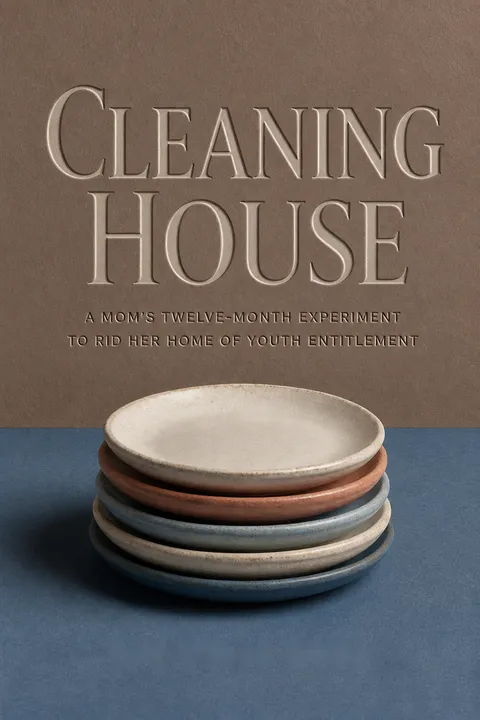
Cleaning House: A Mom's Twelve-Month Experiment to Rid Her Home of Youth Entitlement receives mixed reviews. Many readers appreciate the author's efforts to teach children responsibility and life skills, finding the book inspiring and practical. However, some criticize the author's tone, political views, and religious content. The book's ideas on chores, allowances, and fostering independence are praised, but some find the author's affluent lifestyle hard to relate to. Despite disagreements, most readers acknowledge the importance of addressing youth entitlement and value the book's core message of empowering children through meaningful work.
People Also Read







Glossary
The Experiment
Yearlong responsibility programWyma’s twelve-month family project to replace children’s expectation of being served with practical responsibility and participation. Each month introduced a new area to learn, including tidiness, cooking, yard work, employment, cleaning, laundry, repairs, hosting, teamwork, errands, service, and manners. The aim was both skill-building and a change in the family’s habits.
Ironing Board
Parent advice networkWyma’s name for experienced parents and other advisers who offered practical ideas and encouragement during her family’s experiment. The label refers to their help smoothing the difficulties she encountered. Their role was advisory, not supervisory: they shared lessons from their own parenting, while Wyma and her children adapted suggestions to their household.
Job Postings/Bored Chores
Paid and consequence-based jobsWyma’s household list of optional odd jobs for children seeking work and unpaid chores assigned when a child complained of being bored. A willing child could earn compensation for a job; the same task could become a consequence when prompted by the complaint. The approach was intended to make free time productive and expose children to ordinary work.
Gen XL
A capable, work-ready generationWyma’s aspirational alternative to the label Gen Me. The letters suggest a generation energized by ingenuity, technical skills, and a strong work ethic. Rather than treating young people as naturally self-centered or helpless, the phrase imagines what they might contribute if adults teach practical responsibility, provide meaningful challenges, and give them room to act.
FAQ
What's Cleaning House about?
- Focus on Youth Entitlement: Cleaning House by Kay Wills Wyma addresses the issue of youth entitlement in modern parenting. Wyma shares her journey of realizing her children lacked essential life skills due to her overprotective parenting.
- Twelve-Month Experiment: The book details a year-long experiment where Wyma assigns her children various household tasks to teach them responsibility and independence. Each month focuses on a different task, such as cleaning or cooking.
- Empowerment Through Work: The overarching theme is that meaningful work fosters self-esteem and prepares children for adulthood. Wyma emphasizes the importance of children contributing to their families and communities.
Why should I read Cleaning House?
- Practical Parenting Guide: The book offers practical advice for parents struggling with raising responsible children in a culture of entitlement. Wyma provides actionable steps that can be implemented in any household.
- Relatable Anecdotes: Wyma shares humorous and relatable stories from her own family life, making the book engaging and easy to read. Parents will find comfort in knowing they are not alone in their struggles.
- Encouragement for Change: Wyma inspires parents to rethink their approach to parenting and encourages them to set higher expectations for their children. The book serves as a motivational tool for fostering independence in kids.
What are the key takeaways of Cleaning House?
- Importance of Responsibility: Children need to learn responsibility through hands-on experience. Wyma argues that doing things for children hinders their growth and independence.
- Value of Hard Work: Hard work is essential for building character and self-esteem. Completing tasks can lead to a sense of accomplishment and pride.
- Parenting with Intent: Wyma encourages parents to be intentional, setting clear expectations and allowing children to face challenges. This helps develop resilience and problem-solving skills.
What specific methods does Wyma use in Cleaning House?
- Monthly Tasks: Wyma introduces a specific task each month for her children to master, such as cooking or yard work. This structured approach helps them build life skills gradually.
- Accountability and Consequences: A system of accountability is implemented where children face consequences for not completing tasks. This teaches the importance of following through on commitments.
- Incentives for Success: Wyma uses incentives, like allowing children to keep money earned from chores, to motivate them. This reinforces the idea that hard work leads to tangible rewards.
What challenges does Wyma face in Cleaning House?
- Resistance from Children: Wyma encounters significant resistance from her children, who are initially reluctant to take on new responsibilities. Their complaints highlight the difficulties of changing family dynamics.
- Balancing Expectations: She struggles to balance her expectations with her children's willingness to participate. Setting realistic goals is crucial for maintaining motivation and engagement.
- Overcoming Personal Habits: Wyma confronts her own enabling habits and the tendency to do things for her children. This self-reflection is key to becoming a more effective parent.
How does Wyma’s approach to chores differ from traditional parenting methods?
- Hands-On Learning: Unlike traditional methods where parents do chores for children, Wyma emphasizes hands-on learning. Children actively participate in tasks to develop essential life skills.
- Empowerment Through Responsibility: Wyma focuses on empowering children by giving them responsibilities rather than shielding them from work. This contrasts with overprotective parenting that can lead to entitlement.
- Encouraging Independence: She encourages children to take ownership of their tasks, fostering independence and self-sufficiency. This helps them learn to navigate challenges on their own.
How does Cleaning House address the issue of entitlement in children?
- Identifying the Problem: Wyma discusses her realization that her children have developed an entitlement mentality. She uses personal experiences to illustrate how this issue manifests in everyday life.
- Implementing Change: Proactive steps are taken to combat entitlement by assigning meaningful tasks and responsibilities. This encourages children to contribute to the family and understand the value of hard work.
- Fostering Gratitude: Wyma emphasizes the importance of gratitude and appreciation. By engaging in work, children learn to value their possessions and the effort that goes into maintaining them.
What lessons does Wyma learn about herself throughout the process in Cleaning House?
- Confronting Enabling Behaviors: Wyma learns to recognize her enabling behaviors that contribute to her children’s entitlement. This self-awareness is crucial for her growth as a parent.
- Embracing Imperfection: She discovers that it’s okay for her children to make mistakes and learn from them. This helps her let go of the need for perfection in parenting.
- The Importance of Patience: Wyma learns that change takes time and she must be patient with her children as they adapt to new responsibilities. Growth is a gradual process.
How can parents apply the principles from Cleaning House in their own homes?
- Set Clear Expectations: Parents can start by setting clear expectations for their children regarding household responsibilities. This helps children understand their roles within the family.
- Encourage Independence: Allow children to take ownership of their tasks and encourage them to work independently. This fosters self-sufficiency and builds confidence.
- Be Patient and Supportive: Parents should be patient as their children learn new skills and responsibilities. Offering support and encouragement helps children navigate challenges and develop a strong work ethic.
What are the best quotes from Cleaning House and what do they mean?
- “I think I’m raising little socialists.” This reflects Wyma's realization of her children's entitlement mentality, underscoring the need to instill a work ethic.
- “If a job’s worth doing, it’s worth doing well.” Emphasizes taking pride in work and striving for excellence, encouraging children to put forth their best effort.
- “Work isn’t always fun. It’s something we all have to do.” Captures the message that responsibility and hard work are essential parts of life, teaching fulfillment through contribution.
How does Cleaning House change the family dynamic?
- Increased Responsibility: As children take on more responsibilities, they develop a greater sense of ownership and accountability within the family, reducing entitlement.
- Strengthened Relationships: Tasks encourage teamwork and cooperation, strengthening family relationships. Working together creates a sense of belonging and unity.
- Empowered Children: The experiment empowers children to take initiative and develop skills, leading to increased self-esteem and confidence in their abilities.
What role does service play in Cleaning House?
- Fostering Empathy: Service helps children develop empathy and compassion for others. By serving those in need, they learn to appreciate their own blessings.
- Building Community: Wyma emphasizes community involvement, encouraging children to engage in service projects. This helps them understand the value of contributing to the greater good.
- Personal Growth: Through service, children experience personal growth and fulfillment. Serving others can lead to a sense of purpose and connection, enriching their lives.
Download PDF
Download EPUB
.epub digital book format is ideal for reading ebooks on phones, tablets, and e-readers.








