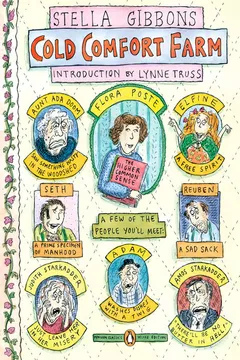


Plot Summary
Orphan's Hundred Pounds
When influenza takes Flora Poste’s1 parents, she inherits only a small annual income and no practical way to support herself. Her friend Mrs Smiling10 offers a safe London home and urges her to learn a profession, but Flora1 prefers a more entertaining solution: she will live with relatives, improve their disorderly lives, then marry by choice.
Letters from an aunt, an uncle, and a cousin offer rooms with conditions Flora1 rejects. The strangest reply comes from Judith Starkadder,3 who invites her to Cold Comfort Farm and hints that Flora1 has family rights there, while refusing to explain an old wrong done to Flora’s father.1 Curiosity outweighs the warning. Flora1 books her journey to Sussex.
Flora’s inheritance creates dependence, but she refuses to treat dependence as shameful when relatives are available. Her plan is both self-serving and oddly reformist: she wants comfort, yet cannot leave a disorderly household alone. The premise turns the expected helpless orphan into an observer who regards family crises as solvable arrangements. Judith’s unexplained reference to rights supplies the mystery, while Flora’s practical confidence promises that she will not accept the Starkadders’ account of themselves without inspection.
A Farm Built on Silence
At Cold Comfort, Flora1 finds a neglected farm and relatives who barely speak without turning a meal into a quarrel. Judith,3 her cousin, lives in grief and watches over her handsome son Seth;6 Reuben,5 the elder son, guards the land as if Flora1 might take it from him. Amos,7 the family patriarch, preaches damnation, while the ancient farmhand Adam8 tends the animals and treats them as confidants.
Judith3 keeps Flora1 from meeting the unseen matriarch, Ada Doom,2 who rules the household from her bedroom. Flora1 also learns that the hired girl Meriam12 has just given birth to her fourth child, fathered by Seth.6 The farm’s supposed curse seems less supernatural than a pattern of neglect, fear, and people allowed to avoid ordinary choices.
Cold Comfort is organized like a closed system: Ada’s authority keeps the family physically and psychologically in place, while each relative converts frustration into a private ritual. Seth pursues women, Amos pursues sin, Adam retreats among animals, and Reuben clings to the farm. Flora’s first task is therefore not simply improving rooms or manners. She must learn which habits protect someone from change and which merely preserve the family’s power structure.
A Mop Meets Resistance
Flora1 starts small. She suggests that Adam8 replace the thorn twig he uses to scrape dishes with a mop, and later buys him one, but Adam8 cherishes it as a possession instead of using it. She visits Meriam12 in her hut and explains how to prevent another pregnancy; Meriam12 resists the idea as unnatural, though her mother11 recognizes its usefulness.
Flora1 also learns that Seth’s6 real devotion is to the cinema, not to seduction, despite his reputation and his string of lovers. When she makes tea in the kitchen, Reuben5 accuses her of wanting the farm. Flora1 assures him she has no interest in managing it, giving him the first reason to consider her an ally rather than a rival.
Flora’s reforms expose the limits of good advice. Adam’s treasured mop shows that a tool cannot change a life unless its owner is ready to use it; Meriam’s hesitation shows how custom can disguise a lack of choice. Yet Flora also notices the gap between Seth’s public image and his private enthusiasm for films. Her method is less moral judgment than accurate diagnosis, and even Reuben’s suspicion begins to loosen when she refuses the prize he assumes she wants.
Amos Finds a Wider Pulpit
Flora1 accompanies Amos7 to preach at the Church of the Quivering Brethren, where he terrifies his congregation with vivid accounts of hell. She leaves before the sermon ends and spends the wait in a tea shop with Mr Mybug,15 a visiting writer who argues that Branwell Brontë secretly wrote his sisters’ novels. Flora1 listens politely but avoids his attempts to turn the meeting into a romance.
On the drive home, she has already begun steering Amos7 toward a more ambitious mission: traveling in a van to preach to larger crowds. The idea appeals to him, though he is troubled by the possibility that it might make him vain. Flora1 has found a way to move him away from the farm without openly challenging his authority.
Amos’s preaching converts fear into performance, and his audience enjoys the spectacle more than it appears to fear the message. Flora’s proposal works because she understands that his vanity and his humility are entangled: a larger audience tempts him, while the temptation itself gives him another sin to brood over. Mr Mybug offers a parallel comic target. He mistakes confident speculation for evidence and treats Flora’s politeness as invitation, showing how easily self-absorption can masquerade as insight.
Elfine Wants a Dance
Flora1 finally speaks at length with Elfine,4 the shy seventeen-year-old who wanders the Downs and writes poetry. Elfine4 is drawn to Richard Hawk-Monitor,14 but their courtship has no firm promise, and she fears that her grandmother2 intends her to marry Urk,13 a cousin who spies on her and treats a childhood ritual as ownership.
Elfine4 has also been barred from the Hawk-Monitors’ ball because Ada2 forbids the Starkadders to accept ordinary invitations. Flora1 decides to get her there. With help from her London friend Claud Hart-Harris,17 she secures places for herself, Elfine,4 and two escorts. She also begins reshaping Elfine’s4 dress and appearance, convinced that the girl’s unpolished style is hiding rather than expressing her character.
Elfine’s romantic language offers refuge from a household where desire is usually coercive or theatrically crude. Her poetry is genuine, but it also leaves her exposed to Urk’s assumption that family tradition can substitute for consent. Flora’s intervention is protective and controlling at once: she sees Elfine’s danger clearly, yet initially treats social grooming as a route to safety. The ball becomes more than a romantic occasion. It is Elfine’s first chance to appear in a world Ada has kept beyond the farm’s boundaries.
White Satin, Open Gate
After Urk13 discovers Flora’s1 preparations, he insists that Elfine4 belongs to him and threatens anyone who tries to take her away. Flora1 abandons her plan to travel the next day. She takes Elfine4 to London immediately, where a hairdresser cuts Elfine’s4 hair and a famous dressmaker creates a white satin gown for the ball.
Back at the farm, Flora1 also opens the bull’s shed and drives Big Business into a field, an act she openly owns rather than letting the family blame one another. Seth6 drives the cousins to the station. His willingness to help comes partly from wanting to attend the dance himself, but he also understands that it will be an escape from the farm’s usual claims on him.
This is the point where Flora’s meddling becomes a direct answer to coercion. She does not wait for the Starkadders to grant Elfine permission, because their rules are the machinery of the threat. The bull’s release echoes that break in a literal way: a confined animal gets air, while Flora takes responsibility for the disruption instead of hiding behind family blame. Her makeover is less a conversion of Elfine than an attempt to let others see what the farm’s isolation has obscured.
The Ball Chooses Elfine
At Richard’s14 twenty-first birthday ball, Elfine4 descends into the assembly room in her new dress and draws the attention of the county. Richard14 dances with her throughout the evening, then tells the guests they are engaged. His mother is startled and wary because she knows little about Elfine4 or the Starkadders. Flora1 advises her to arrange the wedding quickly, before the family can obstruct the match.
Mr Mybug,15 who has followed Flora1 to the event without an invitation, is removed by the staff. Flora1 feels a flicker of pity for him, but she stays focused on the couple. On the drive back, Seth6 warns that Ada2 will react badly. The farmhouse windows are lit when they arrive, and Elfine4 realizes that Ada2 has called the family together.
Elfine’s transformation succeeds not because clothes create her worth, but because Richard and the guests finally encounter her outside the farm’s restrictive frame. The engagement turns private attraction into a public commitment, which matters in a family where Ada’s wishes have functioned as law. Flora’s advice to Richard’s mother is tactical rather than sentimental: she knows the Starkadders may resist and that delay would give their control time to reassert itself. The return to the lit farmhouse makes the celebration feel provisional.
The Counting Breaks Open
The family’s annual Counting brings Flora1 and Elfine4 into the kitchen before Ada,2 who has come downstairs to check who remains under her authority. Flora1 announces Elfine’s4 engagement, and Urk13 collapses in despair when he realizes that his claim has failed. Amos7 then declares that he will leave on a preaching mission, despite Ada’s2 protests.
He departs in a milk van before dawn, while Reuben5 quietly helps Flora1 and Elfine4 escape the family gathering through a hidden door. Urk13 turns to Meriam,12 who accepts his offer of marriage, and the household’s old arrangements begin to crack. By morning, Reuben5 is acting as master of the farm. Ada2 remains in her room, furious and frightened by the people who have begun to leave.
The Counting makes Ada’s authority visible as a ritual of surveillance: she gathers the family to confirm that no one has escaped her grasp. Instead, the gathering becomes a sequence of departures. Flora’s announcement makes Elfine’s choice public, Amos claims a mission of his own, and Reuben helps the younger women leave the room. Urk’s shift toward Meriam is not a tidy moral transformation, but it redirects his possessive energy into a possible relationship. The family’s old order weakens through concrete acts of exit.
Seth Gets His Screen
The day after the Counting, Flora1 receives the Hollywood producer Mr Neck16 and Mr Mybug15 at the farm. Neck16 sees Seth6 enter the room and recognizes the screen presence he has been searching for. Seth,6 who has wanted a life in the movies, accepts the chance and leaves for America with Neck.16 Ada2 watches from an upstairs window and tries to stop him, but the car carries him away.
Mr Mybug,15 meanwhile, becomes fascinated by Rennett, a Starkadder cousin whose unusual appearance catches his eye. He invites her for a walk, and they later decide to marry. Elfine4 stays with the Hawk-Monitors, while Amos7 sends word that he is preaching farther afield. Urk13 lives with Meriam12 and her children as they prepare for marriage.
Seth’s departure reveals that his apparent sexual appetite was never his deepest allegiance. The cinema gives him a future unrelated to the farm, though Mr Neck’s plans will turn his individuality into a marketable image. Ada’s inability to stop the car marks another failure of her control, but the departure is not simply liberation: Seth trades family confinement for Hollywood’s machinery. The scattered pairings around the farm are similarly comic and imperfect. They suggest that ordinary life can begin without making every new arrangement ideal.
Reuben Takes the Farm
With Amos7 away, Reuben5 takes charge and begins improving Cold Comfort. He has secretly diverted money by falsifying the egg accounts, saving for machinery the farm needs.
When he asks Flora1 to marry him, she declines kindly and suggests Nancy Dolour, who is younger and already connected to the farm through the chickens’ feathers used for her dolls’ hats. Reuben5 accepts the idea. The other Starkadder women move into the farmhouse, and ordinary work becomes less chaotic.
Flora1 then takes Judith3 to London to meet Dr Müdel, a psychoanalyst who redirects Judith’s3 fixation on Seth6 toward travel and old churches. Judith3 agrees to stay in his care. The farm is cleaner and more open, but Ada2 still rules from her room, leaving Flora’s1 largest problem untouched.
Reuben’s competence emerges once he can imagine a future beyond waiting for his father to die. His secret savings are dishonest, but they have financed tools that can make the farm viable, so the novel refuses a simple equation between respectable methods and useful outcomes. Flora’s refusal of his proposal preserves their affection without turning her into the reward for his improvement. Judith’s treatment likewise shows the ambiguity of redirection: her intensity is not erased, but given a safer object and a possible life beyond the farm.
Ada Receives Paris
As Elfine’s4 wedding approaches, Flora1 worries that Ada2 may disrupt the reception and that the farm’s progress is still vulnerable to her moods. She devises a plan after reading Jane Austen: she sends for a fashion magazine, a Paris hotel prospectus, and photographs of the actress Fanny Ward.
Carrying Ada’s2 lunch and these gifts upstairs, Flora1 stays with her for hours. She does not argue about the old woodshed trauma or demand an apology. Instead, she helps Ada2 imagine a life of travel, comfort, and personal style beyond Cold Comfort.
When Flora1 returns downstairs, Ada2 is asleep, and Flora1 assures the waiting family that the wedding can proceed without a scene. The Starkadders do not know exactly what changed, but they trust Flora’s1 judgment.
Flora succeeds by refusing the emotional terms Ada has imposed. The family treats Ada’s trauma as a permanent veto, but Flora offers her a future that does not require denying the childhood event or surrendering dignity. The tactic is both compassionate and manipulative: she does not cure Ada so much as make departure more appealing than control. This distinction matters. The novel’s practical optimism does not claim that painful histories vanish; it asks whether they must continue governing everyone else.
A Wedding and a Departure
On the wedding day, Flora1 arranges a feast at Cold Comfort and gives Ada2 a special drink. At the reception, Ada2 appears dressed for flying, greets the guests, and announces that she is leaving for Paris.
She tells Flora1 privately about the old wrong involving Flora’s father1 and the rights Judith3 had mentioned, but the conversation is interrupted before Flora1 can learn whether a goat died. Ada2 leaves by airplane. Elfine4 marries Richard14 and departs with him, while Adam8 moves to the Hawk-Monitor estate with the four cows he loves.
Reuben5 remains to run the farm, and the gathering ends with the Starkadders sharing an ordinary celebration rather than another family crisis. Flora1 has changed the household, but her own place there is now finished.
The wedding gathers the novel’s reforms into one public scene: Elfine chooses her partner, Ada chooses to leave, Adam chooses the animals he will care for, and Reuben can keep building a working farm. Yet the old mystery remains unresolved. Ada begins to disclose Flora’s rights, but the interrupted question about the goat denies the neat explanation a conventional plot might promise. Change arrives through altered choices, not through a complete accounting of the past.
Flora Comes Home
After the guests leave, Flora1 decides she has done enough at Cold Comfort and telephones Charles Fairford,9 her serious, quiet cousin who once promised to rescue her by airplane. Charles9 flies to the farm that evening. Before he arrives, Flora1 watches Adam8 lead the decorated cows across the field toward their new home, then leaves Reuben5 a note explaining that she is returning to London.
When Charles9 lands, the two acknowledge the love that has grown beneath their friendship and fly back together. The final journey reverses Flora’s1 original trip: she first entered Sussex as a self-appointed fixer with nowhere else to go, and now leaves by choice, with the farm’s future no longer dependent on her presence.
Flora’s departure completes a structure built around chosen movement. At the beginning she uses relatives as a substitute for work and safety; now she can leave because she has helped others claim futures of their own. Her relationship with Charles is presented as an arrangement that surprises even her, not as the reward for rescuing the family. Adam’s procession gives the ending a quiet counterpoint to the airplanes: some characters move toward the wider world, while others simply carry their attachments somewhere kinder.
Analysis
Cold Comfort Farm makes a joke of the idea that people are doomed to repeat the roles assigned to them by family history, rural tradition, or literary convention. Flora1 enters a household whose members behave as if they have been written into a single bleak story: the lustful son,6 the grief-stricken mother,3 the tormented preacher,7 the earthbound laborer,5 the wild young poet.4 Her most radical act is to ask what each person wants when no one is performing misery for an audience. Seth6 wants films, Elfine4 wants love and room to imagine, Reuben5 wants to run a functioning farm, and Adam8 wants to stay close to animals he trusts.
The novel’s satire is directed less at pain than at the way pain becomes an exemption from choice. Ada’s2 childhood terror is not dismissed as unreal, but her family has built a system around it in which everyone else must live small. Flora’s1 response is not therapy in a modern clinical sense. She changes the practical conditions: she gives Meriam12 information, brings Elfine4 into a wider social world, finds a new religious mission for Amos,7 and offers Ada2 a future more attractive than continued isolation. Some of these interventions are controlling, and the book does not pretend otherwise. Flora’s1 confidence can make people into projects. Yet her attention to what they actually desire often gives them more freedom than sympathy alone would.
Nature is another target of the comedy. The family invokes seasons, soil, and inherited blood as if they explain every failure, while Flora1 exposes the human decisions hidden beneath those explanations. The farm improves not because the landscape changes, but because Reuben5 can use money, machinery, and judgment. In the end, escape does not mean one uniform fate. Some leave by airplane, some take up new work, and some stay to repair the farm. Flora’s1 lasting achievement is not that she makes everyone like herself. It is that Cold Comfort ceases to be the only story any of them can live.
Review Summary
Cold Comfort Farm is widely praised as a brilliantly funny satirical parody of gloomy rural fiction by Hardy, the Brontës, and D.H. Lawrence. Readers love its witty protagonist Flora Poste, whose pragmatic common sense transforms the eccentric, doom-laden Starkadder family. Many consider it a comic masterpiece with memorable characters and sharp prose. Some critics find it dated, overly contrived, or too knowing in its winking at readers. The 1995 film adaptation receives frequent praise, occasionally surpassing the book in readers' estimations. Overall, it earns appreciation as an enduringly entertaining, uniquely British classic.
People Also Read



Characters
Flora Poste
The practical interloperFlora is a well-educated young Londoner left with little money after her parents die. She values order, comfort, and clear thinking, and has a dry amusement about the habits people mistake for destiny. Her plan to live with relatives lets her avoid conventional employment while gathering material for a future novel, but her intolerance of preventable disorder makes her more involved than she first admits. She does not offer deep sympathy so much as close attention: she notices what people actually want, then finds a practical route toward it. Her confidence can shade into manipulation, especially when she remakes other people’s lives according to her own standards. Yet she learns to distinguish helpful intervention from taking over.
Ada Doom
The absent household rulerAda is the elderly Starkadder matriarch, isolated in her bedroom but powerful over every relative who remains at Cold Comfort. A frightening childhood experience has become the story through which she understands the outside world, marriage, and change. She uses her family’s fear of her distress to keep them close, while the farm’s money and traditions reinforce her authority. Her devotion to Seth6 is especially revealing: she can indulge the grandson who pleases her while treating the rest of the family as dependents. Ada is not merely a tyrant or a victim. Her need for safety is real, but she has built a life in which other people pay for it.
Judith Starkadder
A mother in mourningJudith is Flora’s1 cousin and the mother of Seth6, Reuben5, and Elfine4. She carries herself with grandeur, but her emotional life is narrowed by grief, shame, and fixation on Seth6. She keeps his photographs and treats his behavior as a personal wound, even as she struggles to acknowledge her daughter’s4 needs. Judith has learned to endure rather than act, and she often turns sorrow into a reason to remain still. Her relationship with Ada2 is shaped by obedience and fear, while her connection to her children is uneven and intense. Judith’s theatrical manner conceals a person who has few ways to imagine herself outside family roles.
Elfine Starkadder
The farm's wild poetElfine is Judith’s3 seventeen-year-old daughter, a long-legged, shy young woman who finds expression in poetry and in solitary walks across the Downs. She dislikes the farm but has little experience of life beyond it, and her romantic idealism leaves her uncertain about how to protect her own wishes. She is gentle rather than weak, and readily responds to kindness once Flora1 gives her room to speak. Flora’s1 advice challenges Elfine’s belief that beauty and poetry should be enough to secure love, though it also pressures her toward conventional presentation. Her central tension is between a private imaginative life and the practical terms by which she can choose a future.
Reuben Starkadder
The watchful farm heirReuben is Judith’s3 elder son, a tireless farmer who assumes Flora’s1 arrival threatens his future at Cold Comfort. He understands the land and its work, but suspicion has made him defensive and ungenerous. Once Flora1 proves she has no desire to take the farm, he becomes capable of listening and planning. His practical intelligence has been suppressed by the family’s hierarchy, not erased. He wants ownership because he believes he can make the place function, and his careful attention to money and labor sets him apart from relatives who prefer grievance to change.
Seth Starkadder
The farm's movie devoteeSeth is Judith’s3 handsome younger son, notorious for casual affairs and admired by women who take his confidence for depth. Beneath that reputation, his strongest enthusiasm is for films. He is impatient with emotional claims and wary of being absorbed into someone else’s needs, including his mother’s3. His blunt manner makes him seem like an embodiment of the farm’s rough sexuality, but his love of the cinema points toward a more specific ambition. Seth’s desires are less mysterious than the family’s stories about him suggest.
Amos Starkadder
The travelling preacherAmos is Judith’s3 husband and the family’s formidable religious patriarch. He preaches damnation to the Church of the Quivering Brethren and finds purpose in describing punishment in vivid detail. He treats guilt as proof of spiritual seriousness, which allows him to turn nearly any choice into another religious struggle. His authority over the farm is weakened by Ada’s2 deeper control, and he rarely speaks warmly to his family. Flora1 recognizes that his zeal contains ambition as well as conviction, and that a larger mission could draw him beyond the household.
Adam Lambsbreath
The animals' old friendAdam is the ancient farmhand who has spent most of his life tending the Starkadders’ animals. He speaks of the cows and other beasts as intimate companions and finds more understanding in them than in the family. His habits are stubborn, his speech full of rural sayings, and his attachment to small possessions unexpectedly tender. Adam’s care can be genuine even when it becomes an excuse to avoid change. Flora’s1 attempt to improve his work shows both his independence and her difficulty in accepting that people may value familiar rituals over efficiency.
Charles Fairford
The quiet flying cousinCharles is Flora’s1 serious, reserved cousin, a prospective clergyman with an airplane and a quietly amused view of her schemes. He offers help without demanding that Flora1 explain or justify herself, which makes him different from the more intrusive men she encounters. His calm presence suits Flora’s1 preference for companionship without social performance. He is not as verbally clever as she is, but his steadiness and practical competence give their friendship room to deepen naturally.
Mrs Smiling
Flora's London refugeMrs Smiling is Flora’s1 longtime friend and the first person to offer her a secure home after her parents’ deaths. She prizes comfort, moderation, and civilized habits, and has an elaborate interest in brassieres. Her instinct is to protect Flora1 from the Starkadders by persuading her to find respectable work. Though she disagrees with Flora’s1 plan, she remains a warm source of stability and a reminder of the London life Flora1 can return to.
Mrs Beetle
The farm's sharp housekeeperMrs Beetle works at Cold Comfort and is Meriam’s12 mother. Unlike the Starkadders, she has a brisk, organized view of domestic problems and speaks plainly about money, food, and the children in her care. Her scheme to train Meriam’s12 children as a jazz band may be self-interested, but it also gives them a plan beyond the farm. She is one of the few people who can puncture the household’s melodrama without becoming trapped in it.
Meriam
The hired girlMeriam is the hired girl at Cold Comfort and the mother of several children. The family treats her repeated pregnancies as a natural consequence of the seasons, while Flora1 insists she can make choices about preventing them. Meriam is resilient and less fragile than the Starkadders imagine, but her circumstances leave her dependent on her mother11 and the farm. Her responses reveal how custom can limit a person without extinguishing her humor or practical sense.
Urk Starkadder
Elfine's possessive cousinUrk is a foxy-looking Starkadder who believes Elfine4 has been promised to him since childhood. He turns a private ritual involving water voles into evidence that she belongs to him, revealing how family custom can be used to dress possession as fate. His jealousy makes him threatening, but his behavior also grows out of a household where Ada2 has long treated people as property. Urk is capable of attachment, though he must learn that attachment does not grant ownership.
Richard Hawk-Monitor
Elfine's country suitorRichard is the young country gentleman Elfine4 loves. He is sociable and conventional, and initially seems uncertain about the seriousness of their connection. Meeting Elfine4 in a new setting lets him recognize his own feelings more clearly. He represents access to a life beyond Cold Comfort, but he is not a rescuer in the sense that Flora1 is: the choice must become his and Elfine’s4 together.
Mr Mybug
The overconfident writerMr Mybug, whose actual surname is Meyerburg, is a visiting writer preoccupied with sexual theories and a contrarian biography of Branwell Brontë. He repeatedly mistakes his opinions for psychological insight and reads Flora’s1 courtesy as personal interest. His comic self-importance does not make him wholly cruel; he can be tender beneath his bluster. He is drawn to people as material for his theories, which makes his sudden interest in Rennett another test of whether he can meet someone as a person.
Earl P. Neck
The Hollywood talent scoutMr Neck is an American film producer visiting England in search of a new male star. He judges performers by their appeal to audiences and speaks in the brisk language of the movie business. His eye for Seth’s screen presence changes the young man’s prospects, though Neck’s publicity plans promise to reshape Seth into a product as well as a performer.
Claud Hart-Harris
Flora's social allyClaud is Flora’s1 London friend, a well-connected man who helps secure invitations to the Hawk-Monitor ball. He is witty and socially fluent, but his humor can conceal a more melancholy view of life. He supports Flora’s1 campaign for Elfine4 while maintaining enough distance to comment on its absurdities.
Harkaway Starkadder
The farm's observant cousinHarkaway is one of the Starkadder relatives who handles the farm’s weekly banking. He explains to Flora1 that Ada’s2 control extends even to the family’s marriages and household arrangements. His guarded manner hints at the private bargains people make to survive under her rule.
Plot Devices
The Higher Common Sense
A manual for interventionFlora1 carries the writings of the fictional Abbé Fausse-Maigre as guides to clear thinking. She turns to them when the Starkadders’ emotional habits make ordinary reasoning difficult, and the books help her maintain distance from crises she might otherwise be drawn into. Their greatest use is not a formula for solving every problem. Flora1 eventually recognizes that Ada2 requires intuition and a carefully chosen alternative, not an argument. The books therefore frame her method while also setting a limit on it: practical wisdom must respond to the person in front of it.
The Woodshed Memory
Trauma turned into authorityAda’s2 childhood sight of something disturbing in a woodshed becomes the central explanation she gives for fearing the outside world. She repeats the memory whenever a relative tries to leave or challenge her, and the family has learned to treat her distress as a command. The memory is not explained in full, even when Ada2 later begins to confide in Flora1. Its narrative function is to show how an old injury can be real while also being used to control the lives of people who did not cause it.
The Sukebind Season
Nature as family excuseThe Starkadders treat the flowering of the sukebind as a force that brings desire, pregnancy, and disorder. Its seasonal return accompanies Meriam’s12 repeated pregnancies and the family’s claim that human behavior is simply an extension of nature. Flora1 challenges this fatalism by giving Meriam12 practical information about contraception. The plant also serves the novel’s satire of writing that reduces people to elemental impulses: the more the family blames the season, the more clearly its choices and failures remain visible.
The Annual Counting
A ritual of confinementAda2 gathers the family once a year to count who remains alive and present at Cold Comfort. The ceremony reflects the farm’s dangerous history and gives Ada2 a ritual confirmation of her authority. This year, the assembly instead exposes how many people are ready to leave or make choices she cannot control. The Counting concentrates several tensions in one room and turns the family’s private rules into a visible test: each departure weakens the assumption that Starkadders must remain at the farm forever.
Download PDF
Download EPUB
.epub digital book format is ideal for reading ebooks on phones, tablets, and e-readers.








