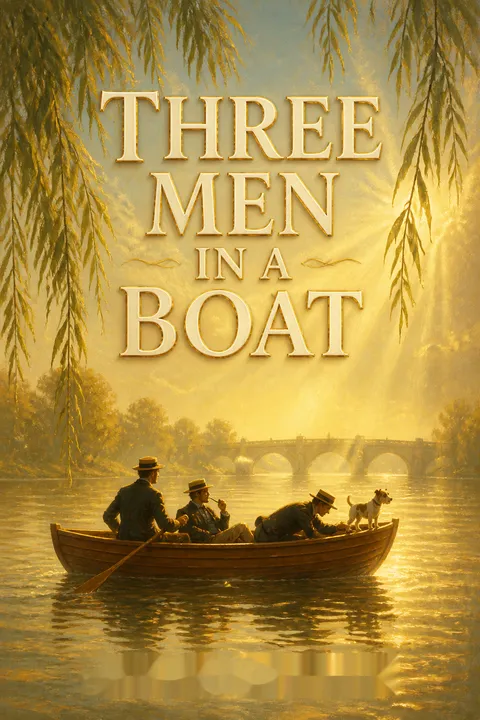


Plot Summary
Four Invalids Choose the Thames
In the narrator’s room, he, George, Harris, and Montmorency compare symptoms and decide that overwork has made them unwell. The narrator has diagnosed himself with nearly every disease after reading a medical guide, so his doctor prescribes ordinary food, exercise, and an early bedtime rather than pills.
The friends agree they need rest, but disagree about how to find it. Harris rejects a quiet countryside retreat and favors the sea, while the narrator argues that a short voyage would leave them seasick for most of the week.
George proposes rowing up the Thames instead. The three men approve, despite Montmorency’s objection that a river trip offers him nothing to do. Their vote fixes the journey’s purpose: to recover by doing the work of a holiday.
The trip begins in comic self-deception: the narrator’s symptoms grow more convincing the more he reads, while the doctor’s practical prescription cuts through the elaborate diagnosis. The men are not escaping a particular crisis so much as their own habits of exaggeration and idleness. Their remedy is deliberately paradoxical. They seek rest through rowing, packing, cooking, and managing a dog, all activities that will expose how little control they have over ordinary tasks. Montmorency’s dissent introduces a useful counterpoint: the humans romanticize the river, while the dog judges the plan by its immediate pleasures.
The Hamper Wins
The friends debate whether to camp or stay at inns, settling on a flexible mixture after imagining rain flattening their tent and soaking their supper. George recommends taking only necessities, but the proposed equipment and food still multiply.
They reject an oil stove after remembering how its fuel seemed to permeate an earlier outing, and the narrator recalls the havoc caused by a pair of overpoweringly pungent cheeses. On packing night, he closes the clothes bag before remembering the boots, then empties it repeatedly in search of his toothbrush.
George and Harris mishandle the food hamper: a cup breaks, jam crushes a tomato, butter migrates from slipper to teapot, and Montmorency attacks the lemons. By the time they finish, the men are exhausted and have failed to make the early start they planned.
The preparations turn an ideal of simple living into an inventory of anxieties. Every precaution against discomfort creates more objects to manage, and each man’s confidence in his own competence makes cooperation harder. The narrator’s toothbrush ritual is especially revealing: he knows the routine is irrational, yet cannot escape repeating it. The packing scene establishes the book’s governing comic mechanism, in which modest intentions meet material resistance. Montmorency intensifies the disorder, but the men are already quite capable of creating it themselves.
Kingston Starts Crooked
After oversleeping, the narrator and Harris rush their belongings to Waterloo, where railway staff cannot agree which platform holds their train. They persuade an engine driver to take them toward Kingston, only to learn later that they rode the wrong service.
Their boat is waiting, so they set off without further delay. At Kingston, the narrator’s historical reverie distracts him from steering; the boat grinds into the towpath, and Harris takes over. As they pass Hampton Court, Harris recounts how he once led a growing crowd around the palace maze by following what he thought was a simple rule.
He and his followers repeatedly returned to the centre, and even the young keeper became lost trying to rescue them. The story suits the journey: confidence proves a poor substitute for knowing where one is going.
The railway confusion and the maze anecdote are not merely separate jokes. Both show people surrendering judgment to systems they assume must be navigable, whether a station’s platforms or a printed map. The narrator’s historical imagination similarly pulls him away from the immediate task of steering. The river holiday therefore begins with a small but telling mismatch between aspiration and attention. They want a slow, restorative passage, yet already move through it by improvisation, mistaken assumptions, and recovery from avoidable errors.
Harris Dives for a Tomb
At Moulsey Lock, Harris wants to leave the boat to inspect a tomb, but the narrator keeps them moving because they must meet George farther upriver. Harris grows angry about George’s late start, the bank, and the lack of a pub; reaching into the hamper for lemonade while trying to steer, he sends the boat into the bank and falls headfirst among the provisions.
Later, at Kempton Park, a riverside man threatens to remove the friends for trespassing, but they refuse to be intimidated and continue their lunch. At Weybridge, they finally spot George inside the lock, wearing a striking new blazer and carrying a banjo he has bought despite not knowing how to play. The group is reunited, and George’s instrument becomes an unexpected addition to their already crowded holiday.
Harris’s plunge converts his frustration into physical comedy, but it also marks the group’s first clear division of labor and patience: the narrator manages the schedule while Harris resents being made to follow it. George’s arrival brings the party together, yet his banjo hints that each man has packed private ambitions alongside the practical gear. The trespass encounter briefly raises a real question of access to the riverbank, then shrinks it back to the scale of the outing. Their freedom depends on persistence as much as scenery.
The Tent Takes Command
George takes the tow-line after joining the party, and the men struggle through the final miles to a riverside camping spot. They choose a covered boat instead of a tent, but fitting its iron hoops and canvas takes far longer than expected.
Harris and George become tangled in the covering, while the narrator waits until their muffled distress forces him to help. Supper restores their good humor, though sleeping cramped inside the boat leaves the narrator awake and uncomfortable. In the morning, none of the men wants the cold swim they had promised themselves.
The narrator falls into the river while edging along a branch, then accidentally drops George’s shirt into the water. Harris attempts scrambled eggs, but burns himself repeatedly and turns six eggs into a tiny, charred portion.
The first night tests the men’s romantic picture of outdoor life against its physical terms: damp equipment, awkward sleep, cold water, and labor that cannot be delegated to an idea. Their appetites and discomfort repeatedly determine their mood more reliably than their resolutions do. The narrator’s accidental swim also exposes the gap between performed courage and actual desire. The episode does not discourage the trip; instead, failure becomes shared material for amusement, allowing the friends to keep moving without pretending they have mastered the river.
The Pineapple Tin Fights Back
After breakfast, the men visit Magna Carta Island, where the narrator imagines the medieval signing before returning to the work of washing up. They continue upriver, recalling a previous night in Datchet when their fussiness about inns left them without a bed until a local boy found them shelter.
At lunch, the absence of mustard darkens their mood; then they discover they have no tin-opener for their pineapple. Harris cuts himself with a pocketknife, George nearly injures an eye with scissors, and the narrator falls into shallow water while trying to pierce the tin.
They finally abandon it in the river. Later, a favorable wind lets them sail toward Marlow, but the narrator’s dreamy steering carries their boat into a fishing punt, knocking three elderly anglers off their chairs and earning the party a furious scolding.
This day compresses the book’s central contrast between imagined grandeur and ordinary logistics. Magna Carta invites the narrator to turn a riverbank into a stage for history, but the immediate drama is a sealed food tin and a clumsy collision. The abandoned pineapple is a miniature monument to desire made disproportionate by scarcity. Sailing briefly gives the men the sensation of effortless movement, then the punt restores the human consequences of inattentive reverie. The river permits wonder, but it does not excuse the people who drift through it.
Montmorency Meets the Cat
At Marlow, Montmorency charges after a large black cat, then loses his nerve when it calmly turns to face him. The friends replenish their supplies and make a grand procession through town, with boys carrying baskets and the dog surrounded by stray companions.
Back on the river, they irritate passing steam launches by drifting in their path, then ask a lock-keeper for water and discover he means the Thames itself. They later boil backwater for tea, but abandon their cups when a dead dog floats past.
During lunch near Wargrave, Harris leans backward while carving a beefsteak pie and disappears into a hidden gully. George and the narrator first suspect something supernatural; Harris’s indignant head soon emerges from the grass, followed by the battered pie.
The changing mishaps make the river feel less like a pastoral refuge than a place where every comfort requires judgment. Montmorency’s retreat before the cat punctures his reputation as a fearless nuisance; the men’s behavior around steam launches, water, and the pie shows that they too misread their surroundings. The dead dog makes their food and water anxieties suddenly concrete, while Harris’s fall turns danger back into comedy. The group survives by converting embarrassment into a story, but that habit can also obscure how close carelessness comes to harm.
Harris Fights the Swans
On a Shiplake island, George proposes Irish stew, and the friends add potatoes, peas, cabbage, leftovers, and nearly every neglected scrap from the hampers. Montmorency brings a dead water-rat as his contribution, but George refuses to include it; the stew nevertheless proves satisfying.
George tries his new banjo, only to be drowned out by Harris’s complaints and Montmorency’s howling. Later, George and the narrator walk to Henley, expecting Harris to collect them from the island.
They lose their way in the darkness and rain, calling from several islands before Montmorency finally answers. Harris brings the boat across in a confused state and reports a battle with swans that grows more elaborate with each retelling. By morning, he seems to have no memory of the encounter.
The stew gathers the trip’s practical and comic logic into one pot: ingredients are chosen less by recipe than by the need to use what is available. The result is unexpectedly successful, suggesting that improvisation can work when the men stop insisting on an ideal version of the meal. The banjo, by contrast, cannot overcome the group’s competing reactions. Harris’s swan story blurs fatigue, fear, and invention, leaving the others unable to distinguish a real ordeal from an overnight fantasy. Companionship here means accepting uncertainty without demanding a final verdict.
The River Gives Up a Secret
The next morning, the friends argue over who has done the most rowing, then take turns pulling upriver. Their talk and memories of earlier boating failures carry them toward Reading, where a steam launch tows them for part of the way. When they resume rowing, George spots a woman’s body floating on the water.
Men on the bank take charge of it, and the narrator learns that she had been abandoned by her family after a pregnancy, struggled to support herself and her child, and returned to the river after visiting the child. The discovery breaks the holiday’s comic rhythm. Rather than continue to Wallingford as planned, the friends stop at Streatley, where the river and surrounding hills offer a quieter place to remain.
The woman’s death changes the moral register of the journey without changing its outward form. Until now, discomfort has largely been reversible: a wet shirt can be retrieved, a lost boat recovered, and a ruined meal replaced. Her story exposes a hardship that cannot be converted so easily into a joke, and the narrator’s sympathy is sharpened by the social rejection and poverty that preceded her death. The river is no longer only scenery or a stage for the friends’ mishaps. It has carried another person’s grief, one their holiday cannot repair.
The Trout Was Plaster
The friends stay two days at Streatley and pay a washerwoman to clean clothes that their own river washing has made dirtier. While exploring the area, the narrator mocks the confidence of anglers who claim enormous catches.
In a local inn, several men separately insist they caught the same mounted trout, each offering a different weight and method. The landlord explains that he caught it as a schoolboy, by luck; when George climbs to inspect it, the case falls and reveals that the fish is plaster.
The friends leave Streatley and continue through Wallingford, Dorchester, Abingdon, and the locks toward Oxford. A photographer nearly captures George and the narrator capsized in a lock, and the river’s awkward currents keep them arguing until they reach Oxford.
The fake trout crystallizes the book’s interest in how stories acquire authority through repetition. Each fisherman embellishes the same object, while the landlord’s plain account is less grand and more credible. The crash exposes the material truth beneath the legend, much as the laundry reveals what the men’s confident plans actually produce. Their passage toward Oxford continues through historical sites and difficult water, but the episode’s humor depends on a recurring reversal: the apparent masterpiece or expertise turns out to be fragile, fabricated, or simply mishandled.
Rain Sends Them Home
After two pleasant days in Oxford, the friends begin the return journey under steady rain. They insist for a while that the wet weather is enjoyable, but damp clothes, cold meals, and cramped nights wear down their resolve.
George plays his banjo, and its mournful sound makes the evening feel even bleaker. By the second rainy day, they decide that continuing would mean choosing misery merely to honor their original plan. They leave the boat in Pangbourne with instructions for its care and take a train to London.
Clean food and a warm restaurant restore their spirits; later, they attend a variety show, then return for supper. Looking out at the rain, Harris recognizes that abandoning the trip was sensible, and Montmorency’s bark joins the men’s toast to their escape.
The ending resolves the opening by revising, rather than fulfilling, the men’s idea of rest. They began by treating a change of scene as medicine; they finish by admitting that persistence can become another form of self-imposed labor. Leaving the boat is a small retreat, but not a moral failure. The restaurant meal and city entertainment restore pleasure because the friends stop pretending that discomfort is inherently ennobling. Montmorency’s final approval completes the book’s playful contest between human ideals and bodily needs: on this occasion, the dog’s practical judgment proves sound.
Analysis
Three Men in a Boat turns a simple Thames holiday into a study of how people manufacture difficulty while insisting they are seeking ease. The friends plan a restorative escape, but packing, cooking, steering, and sleeping expose their dependence on routines they thought they were leaving behind. The humor is built from friction between intention and consequence: the man who claims to pack best forgets essential items, the practical planner buys an instrument he cannot play, and the confident traveler repeatedly misunderstands his surroundings.
J.’s digressive narration is central to that design. He makes every mishap larger through recollection and commentary, so the book’s real forward motion lies less in reaching Oxford than in accumulating examples of human self-importance. Yet his jokes do not flatten every experience into farce. The dead woman found near Reading interrupts the narrator’s playful control and forces attention onto poverty, exclusion, and suffering that cannot be repaired by storytelling. That tonal shift gives the comedy ethical limits.
The river itself is both setting and corrective. Its beauty invites reverie, but current, weather, locks, and muddy banks demand attention. The men learn no grand lesson about self-improvement; instead, they gradually accept that comfort is ordinary, bodily, and sometimes best found by abandoning a stubborn plan. Their retreat from the rain is not defeat but a more honest form of judgment. The book’s lasting pleasure comes from holding these truths together: people are ridiculous, their needs are real, and friendship makes their shared incompetence bearable.
Review Summary
Three Men in a Boat is a humorous travelogue about three friends and a dog on a Thames boating trip. Readers praise its timeless comedy, witty observations, and relatable characters. Many find it laugh-out-loud funny, with memorable scenes like packing mishaps and cooking disasters. Some note the occasional tonal shifts and historical digressions. While a few readers found it less engaging, most appreciate its clever satire of Victorian life and human nature. The book's enduring popularity is evident in its influence on later works and continued readership.
People Also Read



Characters
J. (the narrator)
Self-appointed river guideJ. narrates the journey and repeatedly presents himself as the most capable member of the party, especially when packing, steering, or managing the others. His confidence is unstable: he forgets to steer while thinking about history, loses track of his toothbrush, and turns small inconveniences into elaborate cases. He is observant and imaginative, able to find beauty in the Thames and historical meaning in its towns, but his reveries often detach him from practical responsibility. His humor depends on recognizing human folly while remaining implicated in it. J. is at his most affecting when the comic surface gives way to sympathy, particularly when he learns the circumstances behind the woman found in the river.
George
Sleepy practical dreamerGeorge proposes the river holiday and often offers the most sensible advice, especially when he urges the group to pack only what they need. Yet his practicality rarely survives contact with equipment, cooking, or the weather. He sleeps through the agreed wake-up time, struggles with the tent, and buys a banjo before learning to play it. George is less inclined than J. to claim authority through elaborate observation, but he enjoys stories and can contribute an unexpectedly sharp judgment. His relationship with Harris and J. is affectionate and competitive: he complains about their laziness while avoiding work himself. He represents the gap between knowing what would be sensible and being able to carry it out.
Harris
Hungry, confident companionHarris is sociable, appetite-led, and certain that he knows where to find a good drink or how an outing should be organized. He dislikes remote, uncomfortable schemes and is quick to complain when the river offers no convenient pub. His confidence often exceeds his judgment: he gets tangled in practical tasks, mishandles the boat while reaching for provisions, and tells stories whose details shift with his memory. Yet Harris is not merely a foil for the narrator’s fussy imagination. His directness punctures romantic plans, and his readiness to enjoy food, company, and a familiar inn gives the journey much of its warmth. His appetite is both a source of comedy and a reliable measure of immediate reality.
Montmorency
Fox-terrier agent of chaosMontmorency is J.’s small fox-terrier, an energetic dog who seeks noise, conflict, and attention. He interferes with packing, makes trouble around other dogs, and approaches river life according to his own interests rather than the men’s plans. His innocent-looking appearance contrasts with his unruly behavior, making him a comic companion rather than a decorative pet. Montmorency’s reactions also puncture the men’s self-importance: he has little patience for scenery, dislikes the river’s quiet stretches, and responds plainly to the people and animals around him.
Mrs. Poppets
Their patient landladyMrs. Poppets is the landlady who feeds the men before their trip and wakes them when they oversleep. Her brief interventions expose the gap between their elaborate plans and their ordinary dependence on other people. She remains a practical presence outside the trio’s self-dramatizing adventures.
Uncle Podger
Model of busy incompetenceUncle Podger appears in the narrator’s story about hanging a picture. He turns a small household task into a sprawling operation that recruits the entire family, loses its tools, and leaves damage behind. The anecdote gives J. a comic model for Harris’s way of making work more complicated.
The Datchet boy
Unexpected local rescuerA local boy once finds the three friends a place to sleep after they reject the available inns in Datchet. His simple offer ends their fruitless search and reveals how quickly the men’s standards collapse when they are tired and hungry.
Plot Devices
The Thames itinerary
Episodic travel frameThe river journey gives the book a continuous route from Kingston to Oxford and back, while allowing each town, lock, island, and stretch of weather to become a new comic situation. Because the destination is less important than the passage, the men can pause for local history, meals, mistakes, and memories without losing the larger shape of the trip. The river also supplies real constraints: current, locks, towpaths, rain, and limited space aboard the boat. Those conditions repeatedly test the friends’ plans and turn their leisurely holiday into a sequence of practical negotiations.
The narrator’s digressions
Comic detour engineJ. often leaves the immediate journey to tell an anecdote about packing, food, boating, fishing, illness, or social behavior. These detours enlarge minor frustrations into miniature stories, while their placement keeps interrupting the men’s progress. They also define J.’s way of seeing: he converts experience into performance, using a mishap as material for analysis and exaggeration. The digressions are not separate from the journey’s meaning, because they repeatedly return to the same practical question: how people behave when their plans meet inconvenient reality.
Food and equipment
Material comedy machineThe men’s hamper, stove, tent cover, clothes, and cooking tools give physical form to their belief that they can organize a carefree holiday. In practice, their supplies break, spill, tangle, or prove unusable at the crucial moment. Food repeatedly restores their spirits, while missing mustard, an unopened pineapple tin, and a disastrous attempt at scrambled eggs puncture them. The device keeps the comedy grounded in recognizable chores and appetites: the men’s grand reflections may roam across history, but their mood often depends on whether they can prepare a meal and keep it dry.
Montmorency
Canine counterpointMontmorency makes the holiday a four-member expedition rather than a purely human retreat. His fox-terrier impulses disrupt packing, provoke encounters, and resist the men’s attempts to treat the river as a peaceful landscape. The dog’s behavior mirrors the disorder already present among his owners, but it also offers a blunt alternative to their self-conscious plans. He wants action, food, and company, not poetic explanations. His recurring presence keeps the comedy physical and helps puncture the narrator’s claims of authority.
FAQ
Synopsis & Basic Details
What is Three Men in a Boat about?
- A comedic river journey: The novel follows three hypochondriac friends, J. (the narrator), George, and Harris, along with their dog Montmorency, who decide a two-week boating holiday up the River Thames from Kingston to Oxford will cure their perceived ailments and the stresses of city life.
- An episodic travelogue: The narrative blends descriptions of the river's scenery and historical sites with humorous anecdotes, digressions, and observations about human nature, often triggered by the trio's misadventures and packing struggles.
- A satire on Victorian life: Through witty commentary and farcical situations, the book gently mocks various aspects of late Victorian society, including health fads, social customs, leisure pursuits, and the contrast between romantic ideals and mundane reality.
Why should I read Three Men in a Boat?
- Timeless humor and wit: The book offers laugh-out-loud comedy through slapstick mishaps, sharp satire, and the narrator's dry, self-deprecating wit, making it a classic of English humor that remains funny today.
- Charming portrayal of friendship: The dynamic between the three distinct personalities and their long-suffering dog provides a warm and relatable depiction of male camaraderie, complete with petty squabbles, shared struggles, and mutual affection.
- Evocative historical travelogue: Beyond the comedy, the novel serves as a delightful guide to the Thames, weaving in historical anecdotes and descriptions of the landscape that offer a glimpse into England's past and the enduring beauty of the river.
What is the background of Three Men in a Boat?
- Originally a serious travel guide: Jerome K. Jerome initially intended to write a serious guide to the Thames, incorporating historical and topographical information, but the humorous anecdotes about his friends and their trip took over, transforming it into a comic novel.
- Based on a real boating trip: The story is inspired by an actual boating holiday Jerome took with two friends, George Wingrave and Carl Hentschel, and Hentschel's dog, although the events are heavily fictionalized and exaggerated for comedic effect.
- Published in 1889: The book was an immediate and immense success upon publication, becoming a bestseller and establishing Jerome's reputation as a humorist, capturing the public's imagination with its relatable characters and lighthearted escape from everyday life.
What are the most memorable quotes in Three Men in a Boat?
- "I never read a patent medicine advertisement without being impelled to the conclusion that I am suffering from the particular disease therein dealt with in its most virulent form.": This quote, from Chapter 1, perfectly encapsulates the narrator's hypochondria and sets the tone for the book's satirical look at health anxieties and self-diagnosis.
- "Let your boat of life be light, packed with only what you need – a homely home and simple pleasures, one or two friends, worth the name, someone to love and someone to love you, a cat, a dog, and a pipe or two, enough to eat and enough to wear, and a little more than enough to drink; for thirst is a dangerous thing.": Found in Chapter 3 during a digression on packing, this philosophical interlude offers a surprisingly poignant reflection on the essentials for a happy life, contrasting material excess with simple contentment.
- "I like work: it fascinates me. I can sit and look at it for hours. I love to keep it by me: the idea of getting rid of it nearly breaks my heart.": This witty line from Chapter 15 exemplifies the book's pervasive humor about laziness and the human tendency to avoid effort, framing idleness as a form of appreciation for work itself.
What writing style, narrative choices, and literary techniques does Jerome K. Jerome use?
- First-person, conversational narration: The story is told from the perspective of "J.", who addresses the reader directly in a chatty, informal, and often confiding tone, creating a sense of intimacy and shared amusement.
- Extensive use of digressions: Jerome frequently interrupts the narrative flow with lengthy anecdotes, personal reflections, and historical interludes, which, while seemingly off-topic, often serve to illustrate character traits, explore themes, or provide historical context, contributing significantly to the book's unique structure and humor.
- Satire, irony, and understatement: The humor relies heavily on gentle satire of human foibles, ironic observations about the gap between expectation and reality, and frequent use of understatement to heighten the comedic effect of absurd situations.
Hidden Details & Subtle Connections
What are some minor details that add significant meaning?
- The doctor's prescription: The doctor's advice to J. ("1 lb. beefsteak... 1 ten-mile walk... 1 bed at 11 sharp... And don't stuff up your head with things you don't understand") in Chapter 1 is a subtle critique of J.'s hypochondria and overthinking, suggesting his ailments are psychosomatic and require simple, practical remedies rather than medical intervention.
- The description of Montmorency's "Oh-what-a-wicked-world-this-is" expression: In Chapter 2, the narrator notes Montmorency's pious look that fools old ladies, immediately followed by tales of his actual depravity (killing chickens, fighting dogs). This highlights the theme of deceptive appearances and the contrast between outward presentation and inner nature, applying not just to the dog but implicitly to the human characters and society.
- The recurring mention of George sleeping: George is frequently depicted as asleep or wanting to sleep (at the bank, in the boat). While played for laughs, this subtle detail reinforces his laid-back, almost passive nature compared to the more anxious J. and the impulsive Harris, making his occasional moments of practicality (like the packing advice) more impactful.
What are some subtle foreshadowing and callbacks?
- Early mentions of getting upset: George repeatedly brings up the possibility of the boat getting upset when discussing packing (Chapter 4), suggesting taking extra clothes and whisky "in case we got upset." This seemingly practical concern subtly foreshadows later minor mishaps and the general unpredictability of their journey, though not a literal capsizing.
- The difficulty of washing clothes: George's casual assertion in Chapter 3 that washing flannels in the river is "easy enough" is later proven disastrously wrong in Chapter 17. This callback highlights the gap between theoretical knowledge and practical experience, a recurring source of humor and frustration for the trio.
- Harris's sea-sickness anecdotes: In Chapter 1, Harris boasts about never getting seasick, even in rough conditions. This sets up an expectation of his resilience, making his later struggles with the Irish stew (Chapter 14) and the mysterious swan incident (Chapter 14) subtly funnier, implying that while the sea couldn't defeat him, the river and bad food might.
What are some unexpected character connections?
- Harris and George's fathers' shared anecdote: In Chapter 10, both Harris and George recount the exact same story about their respective fathers accidentally getting into the same bed at a country inn. This improbable coincidence, presented matter-of-factly, serves as a meta-commentary on the nature of storytelling, tall tales, and the way anecdotes circulate and get attributed, blurring the lines between truth and fiction within the narrative itself.
- The narrator's connection to Uncle Podger: The lengthy digression about Uncle Podger's chaotic picture-hanging in Chapter 3 is presented as a comparison to Harris's approach to work. This connection reveals the narrator's own family background and suggests that the tendency towards well-intentioned but ultimately disastrous endeavors might be a trait he recognizes in others, perhaps even subtly in himself.
- Montmorency's "friends": In Chapter 5, Montmorency invites two other dogs to see him off, who then try to follow him into the cab. This brief interaction highlights Montmorency's social life outside the main trio and reinforces his character as a leader among local dogs, adding a layer to his personality beyond just being the main characters' pet.
Who are the most significant supporting characters?
- Uncle Podger: Though only appearing in a lengthy anecdote in Chapter 3, Uncle Podger is a significant character whose chaotic attempts at simple tasks serve as a prime example of human inefficiency and the tendency to make simple things complicated, a theme echoed throughout the book's depiction of the trio's struggles.
- The various lock-keepers: These minor characters, encountered at nearly every lock, provide brief but insightful interactions that reveal local color, offer practical advice (or lack thereof, as with the water), and serve as representatives of the steady, grounded life along the river, contrasting with the tourists' transient chaos.
- The old fishermen: Appearing in several anecdotes (Chapters 15, 19), the fishermen embody the art of the tall tale and the leisurely pace of river life. Their exaggerated stories about fish and their calm reactions to mishaps (like being crashed into) highlight the book's themes of storytelling, perception, and the different ways people experience the world.
Psychological, Emotional, & Relational Analysis
What are some unspoken motivations of the characters?
- Escape from routine and responsibility: While framed as a health cure for "overwork," the trip's deeper motivation is a desire to escape the mundane, predictable routines of their Victorian city lives and the perceived pressures of work, even if their actual work seems minimal (George sleeping at the bank).
- Validation of their perceived suffering: The initial meeting in Chapter 1, where they list their ailments, suggests a subtle competition for who is most ill. Their shared hypochondria and the trip itself might be an unspoken way to validate their feelings of being overworked and deserving of rest.
- A desire for simple, authentic experience: Despite their often-inept attempts, there's an underlying yearning for a more natural, less artificial existence, hinted at in the narrator's romantic descriptions of camping (Chapter 2) and the critique of "painted civilization" and "artificiality."
What psychological complexities do the characters exhibit?
- The narrator's unreliable self-perception: J. sees himself as competent and knowledgeable (especially regarding packing and steering), yet his actions often lead to disaster. This gap between self-image and reality is a key source of humor and reveals a common human tendency towards self-deception.
- Harris's blend of bluntness and hidden anxiety: Harris is often the most practical and direct, cutting through romantic notions (like camping in the rain). However, his later, exaggerated tale of fighting swans (Chapter 14) suggests a hidden anxiety or need to appear heroic, perhaps stemming from the stresses of the trip or his own insecurities.
- George's passive resistance: George often goes along with plans but subtly resists effort (sleeping, suggesting others do the work). This passive approach can be seen as a coping mechanism for avoiding responsibility or conflict, contrasting with the narrator's anxious energy and Harris's impulsive actions.
What are the major emotional turning points?
- The decision to abandon camping in the rain: In Chapter 2, the romantic ideal of camping is shattered by Harris's practical question about rain, leading to a compromise. This marks an early turning point where the harsh reality of nature begins to temper their idealized vision of the trip.
- The struggle with the pineapple tin: The collective frustration and eventual violent destruction of the pineapple tin in Chapter 13 represents a peak of shared exasperation and loss of composure, highlighting how minor inconveniences can escalate into disproportionate emotional reactions when under stress.
- The decision to cut the trip short due to rain: The final decision in Chapter 19 to abandon the boat and take the train home is a significant emotional shift. It represents a surrender to the weather and a rejection of their initial resolve to endure, prioritizing comfort over the romantic ideal of the full river journey.
How do relationship dynamics evolve?
- Shared adversity strengthens bonds: Despite frequent bickering and blaming (e.g., over packing, steering, the tow-line), the trio's shared struggles and mishaps on the river ultimately reinforce their friendship, creating common memories and inside jokes that deepen their camaraderie.
- Roles shift based on situation: While J. is the narrator and often the planner, and George is supposedly the practical one, their roles become fluid. Harris takes charge of cooking (disastrously), George has moments of unexpected wisdom, and J. proves inept at simple tasks like packing or steering, showing how different challenges bring out different aspects of their personalities and interactions.
- Montmorency as a catalyst and confidante: Montmorency, though a dog, acts as a catalyst for interaction and conflict (fights, packing chaos) and also serves as a silent confidante for the narrator's observations, his reactions (or lack thereof) often mirroring or contrasting with the human emotions and absurdities.
Interpretation & Debate
Which parts of the story remain ambiguous or open-ended?
- The true nature of their "illnesses": The book begins with the friends listing numerous ailments, but it's never definitively stated whether these are real physical conditions, psychosomatic manifestations of stress, or simply hypochondria. The doctor's prescription suggests the latter, but the ambiguity allows for interpretation of their initial state.
- The extent of Harris's swan battle: Harris's account of fighting off dozens of swans in Chapter 14 is wildly inconsistent and delivered while he is half-asleep. It's left ambiguous whether a minor incident occurred and was exaggerated, or if it was entirely a dream or fabrication, highlighting the unreliability of storytelling, especially under duress.
- The long-term impact of the trip: While the friends return home, the narrative doesn't explicitly state whether the trip cured their hypochondria or significantly changed their lives. The ending implies a return to comfort, leaving the reader to ponder whether the adventure had a lasting effect or was merely a temporary diversion.
What are some debatable, controversial scenes or moments in Three Men in a Boat?
- The treatment of the dead woman's body: The scene in Chapter 16 where they find a drowned woman's body is a stark, somber moment that contrasts sharply with the book's prevailing humor. Its inclusion and the brief, almost detached description of handling the body can be debated in terms of narrative tone and sensitivity, interrupting the comedic flow with sudden tragedy.
- The satire on riparian owners: The narrator's strong condemnation and violent fantasies regarding landowners who restrict river access (Chapter 8) are unusually intense compared to the book's generally gentle satire. This passionate outburst can be seen as a controversial political statement within a lighthearted narrative, sparking debate about property rights and public access.
- The exaggerated fishing stories: While played for laughs, the escalating, unbelievable fishing tales told by various characters (Chapter 17) and the narrator's commentary on the "art" of angling exaggeration can be debated as a critique of male bravado and competitive storytelling, pushing the boundaries of believable humor.
Three Men in a Boat Ending Explained: How It Ends & What It Means
- Abrupt end to the river journey: The trip doesn't reach Oxford as planned. Faced with persistent rain and the prospect of another miserable night camping, the trio spontaneously decides in Chapter 19 to abandon the boat at Pangbourne, take a train back to London, and seek comfort in a restaurant and theatre.
- Prioritizing comfort over endurance: The ending signifies a surrender to practicality and comfort over the romantic ideal of the arduous river adventure. Despite their earlier resolve to see the trip through "if it killed us," the reality of sustained discomfort proves too much, highlighting the human preference for ease over idealized hardship.
- A return to the familiar: The final scene depicts them enjoying a meal and planning a night out in London, a return to the urban comforts they initially sought to escape. The ending suggests that while adventure is appealing in theory, the familiar pleasures of home and city life hold a strong, perhaps stronger, appeal, and that sometimes the best part of a difficult journey is the return.
Three Men Series
Download PDF
Download EPUB
.epub digital book format is ideal for reading ebooks on phones, tablets, and e-readers.








