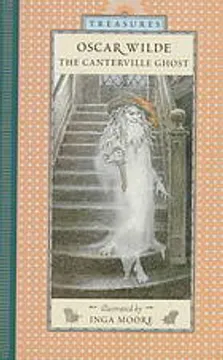


Plot Summary
A Ghost Comes with the Estate
Before the Otises move into Canterville Chase, Lord Canterville warns Mr. Otis that the family ghost has haunted the estate for centuries. The American minister treats the warning as salesmanship and buys the house, bringing his wife, their children, and their practical habits into an old English world.
Housekeeper Mrs. Umney greets them, then points out the bloodstain where Sir Simon de Canterville murdered his wife, Lady Eleanore. Washington Otis scrubs the mark away with a commercial cleaner.
Thunder breaks over the house, and Mrs. Umney faints, but the family dismisses her alarm. The next morning the stain has returned, even though Washington cleaned it thoroughly. The ghost has announced itself, and the family has turned its first warning into a household puzzle.
The opening collision is not simply between belief and disbelief. Mr. Otis assumes that anything troubling can be managed as a purchase, a service, or a household inconvenience. The stain's return interrupts that confidence without immediately making the Americans afraid; instead, it turns haunting into an experiment. Wilde makes the old house carry a history that cannot be scrubbed away, while the family's first response reduces that history to a maintenance problem. Mrs. Umney understands the blood as testimony. Washington sees a stain to remove. Their competing interpretations establish the comic conflict and quietly prepare for Virginia, who will eventually treat the ghost not as a nuisance but as a suffering person.
The Chains Meet Commerce
After the stain returns through several locked nights, the family accepts that something unexplained is at work. At one in the morning, Mr. Otis opens his door to find an ancient-looking figure dragging heavy chains through the corridor.
Rather than flee, he offers the ghost a bottle of lubricant and leaves it beside his room. Sir Simon, insulted by this practical response, smashes the bottle and retreats in a flare of supernatural light. The twins appear with pillows and drive him farther down the passage.
In a hidden room, Sir Simon revisits the frightening performances that once terrified aristocrats, servants, and clergymen. His record of success makes the Otises' refusal to fear him feel less like disbelief than a public humiliation, and he begins plotting revenge.
Sir Simon's first failure exposes the dependence of his power on an audience willing to interpret his acts as terrifying. The Otises do not disprove him; they translate him into familiar categories, treating chains as a noise problem and an apparition as a person who might need a product. That translation strips his carefully cultivated performance of its authority. His private review of past victims reveals the vanity beneath the horror: he measures himself by the effect he produces. The scene also gives the comedy its sharper edge. The family is not merely brave; its confidence can become crude, because it mistakes the ghost's dignity for another inconvenience to be managed.
The Armor Falls First
Sir Simon's next attempt begins when an old suit of armor crashes to the floor and he is left sitting nearby, bruised from its weight. The twins fire their pea-shooters at him, while Mr. Otis points a revolver in his direction.
Sir Simon sweeps through the family, extinguishing their candle, then tries to recover his authority with a terrifying laugh. Mrs. Otis steps into the corridor and offers him a remedy for indigestion. He prepares to transform into a monstrous black dog, but approaching footsteps make him vanish instead.
The episode leaves him shaken and physically sore. For several days he stays in his room, tending the bloodstain and reconsidering how to frighten a household that answers supernatural spectacle with weapons, medicine, and practical concern.
The failed armor performance turns inherited grandeur into literal dead weight. Sir Simon expects the antique suit to command reverence, but it topples him, and the family responds as if he were an unruly visitor rather than a legend. Mrs. Otis's medicinal offer sharpens the reversal: she meets his theatrical terror with the social reflex of caretaking, which is both absurdly dismissive and oddly humane. Sir Simon is wounded not only in his knees but in the professional identity he has built across centuries. His retreat shows how an audience can unsettle a performer by refusing the role assigned to it, even when that refusal is neither wise nor kind.
The Ghost Meets His Double
On a stormy night, Sir Simon prepares an elaborate attack on Washington and the rest of the family. Near Washington's room, he encounters what looks like a rival ghost: a grinning, glowing figure carrying a weapon and a record of crimes. Sir Simon flees in terror, only to discover at dawn that the apparition is a dummy made from household objects and labeled as a counterfeit ghost.
The twins have turned his own methods into a prank. Furious, he vows revenge, but the second crow he expects never comes, leaving him to abandon his oath. Exhausted and confused, he hides in his coffin. His carefully staged supernatural world has become a stage on which the Otis children can improvise, and he cannot tell spectacle from threat.
The fake apparition is more than a trick: it makes Sir Simon experience the vulnerability he has manufactured in others. He is frightened before he can verify what he sees, then discovers that the image has no hidden supernatural force. The twins understand his craft well enough to parody it, though they do so without grasping the old grief beneath it. His frustrated oath and dependence on the expected second crow show how much his sense of control rests on inherited rituals. The scene gives the story's humor a psychological mechanism: Sir Simon's terror is genuine, but the family treats fear as a game because they have never been made to feel its cost.
Every Passage Becomes Dangerous
Trying to preserve his dignity, Sir Simon oils his chains and moves quietly through the corridors, but the twins stretch strings across his path and set a butter-slide on the stairs. He chooses a fearsome headless-rider costume for another assault, only to be drenched by a water jug hidden above their bedroom door.
After that, he gives up on frightening them and prowls in slippers, muffler, and self-defense weapon. His final nocturnal expedition ends when the twins spring from a dark corner and Washington blocks the stairs with a garden syringe. Sir Simon escapes through an iron stove and chimney, filthy and shaken. The family assumes he has left. He remains in the house, but humiliation has made him too afraid to appear.
The repeated traps steadily change the balance of the haunting. At first, the family reacts to each appearance with comic confidence; now the ghost anticipates their attacks and adapts his costume, route, and equipment. That adaptation is survival, but it also marks the collapse of his identity as master of the house. The twins' pranks are not harmless from his perspective, even if the comedy encourages us to laugh at them. Their cruelty makes the ghost retreat into silence, suggesting that ridicule can reproduce the very isolation it claims to puncture. When the Otises mistake his withdrawal for departure, their practical worldview again fails to recognize another being's distress.
Virginia Sees the Person
While returning from a ride with Cecil, the young Duke of Cheshire, Virginia finds Sir Simon alone in the Tapestry Chamber. He looks exhausted, and her first impulse to escape gives way to pity.
Sir Simon admits that he murdered his wife, blaming her cooking and appearance, then recounts how her brothers starved him after his death. Virginia condemns the murder and also challenges his theft of paint from her art supplies, which he used to keep the famous stain fresh.
Beneath his vanity and excuses, she hears a deeper confession: he has not slept for three hundred years and wants release. Unlike the rest of the family, Virginia can see both the harm he caused and the suffering he carries, so she listens without pretending that either cancels the other.
Virginia's encounter shifts the story from comic contest to moral relationship. She does not excuse Sir Simon's murder, and she does not accept his self-serving account of his wife as justification. Yet she also notices his fatigue, which lets her distinguish accountability from permanent condemnation. Her indignation over the stolen paints matters because it makes compassion concrete rather than saintly: she has been wronged too, and she names it. Sir Simon's wish for sleep reframes the haunting as a condition he cannot end through more performance. Virginia's response begins the story's central ethical move, which is to recognize a person without erasing the damage that person has done.
The Prophecy Takes Virginia
Sir Simon tells Virginia that an old prophecy in the library window offers him peace if a compassionate child weeps for his sins and prays for his soul. He cannot provide tears or faith himself, so he asks her to help him reach the place where he believes he can finally rest. Virginia understands that the passage may expose her to frightening sights, yet agrees to go.
As Sir Simon leads her through the Tapestry Chamber, embroidered hunters and carved creatures seem to warn her back. She shuts her eyes and keeps hold of his hand. At the far wall, it fades open into a dark cavern, and a cold wind pulls at her clothes. The hidden panel closes behind them. When Virginia fails to appear for tea, her family begins searching the house.
The prophecy gives Virginia's compassion a demanding form: sympathy must become action, and the action requires her to enter an unknown space rather than merely feel sorry for Sir Simon. Its terms are morally revealing because his release depends on another person's grief and prayer, not on a final display of his own frightening power. Virginia's courage is not the absence of fear; the warnings in the room register that she understands the danger and proceeds anyway. The passage through the wall also literalizes a movement into the history the Otises have treated as decoration. By crossing it, Virginia accepts a responsibility to the past that her family has not yet recognized.
Midnight Gives Her Back
As darkness falls and Virginia remains missing, Mr. Otis searches the grounds with Washington and Cecil, while Mrs. Otis and the boys scour the house. The gypsies who camped nearby prove to be a false lead; they have already left, and Virginia is not with them. The family returns exhausted, and at midnight a crash and strange music announce her arrival through a hidden panel.
Virginia carries a small casket and says Sir Simon is dead. She leads them to a sealed room, where they find his skeleton chained to a wall, with an empty food dish and a water vessel placed just beyond reach. Virginia kneels to pray. A twin then spots blossoms on the old almond tree, and Virginia takes them as a sign that Sir Simon has been forgiven.
The search makes the emotional consequences of Virginia's disappearance visible in the living family: Mr. Otis abandons his habitual composure, Cecil refuses to stay behind, and even the twins lose their appetite for mischief. Her return does not restore the old household unchanged. The hidden chamber supplies the evidence that Sir Simon's tale lacked: his body was chained and starved, while the unreachable food and water make his suffering brutally physical. Virginia's prayer responds to this history without converting it into an excuse for murder. The almond blossoms provide a fragile sign of release, joining the house's inherited prophecy to a visible change in the landscape.
A Grave, Then a Marriage
Four days later, the Cantervilles and Otises bury Sir Simon beneath the old yew tree. Virginia places a cross made from almond blossoms on his grave, completing the farewell that began in the hidden chamber. Mr. Otis offers the jewels Sir Simon gave her back to Lord Canterville, but the peer insists they belong to Virginia in gratitude for her help.
In spring 1890, Virginia marries Cecil and becomes Duchess of Cheshire; the jewels draw admiration at her presentation. Later, at Sir Simon's grave, Cecil asks what happened during the hours she was gone. Virginia refuses to disclose the experience, explaining only that Sir Simon changed how she understands life, death, and love. Cecil accepts the boundary, and her secret remains hers.
The ending settles the story's competing forms of inheritance. Mr. Otis approaches the jewels through legal and republican principles, while Lord Canterville treats them as a personal debt that cannot be neatly returned to the old family. Virginia carries the objects forward, but she also carries a private knowledge that neither family custom nor marriage can claim. Her silence is not a rejection of Cecil; it is a boundary around an experience whose meaning cannot be made public on demand. The final grave visit gives the past a place without making it disappear. Canterville's history remains present, but it no longer has to repeat itself as a haunting.
Analysis
The Canterville Ghost builds its comedy from a clash between two systems of value. The Otises trust products, procedures, and plain speech; the Cantervilles inherit symbols, rituals, and a house whose past insists on being seen. Neither system is complete. The Americans can scrub the stain but cannot remove the history it represents, while Sir Simon's ornate performances cannot make the living grant him authority. His repeated humiliations expose the dependence of power on an audience, but the family’s laughter also risks repeating the cruelty that has left him isolated.
Virginia changes the terms of the story because she neither accepts the ghost's excuses nor reduces him to a joke. She recognizes that his murder remains wrong while listening to the suffering he describes. Her compassion is therefore not simple forgiveness. It is an act of moral attention that makes responsibility and mercy coexist. The hidden chamber gives that attention material proof: behind the ghost's theatrical account lies a body chained beyond reach of food and water. The truth does not erase his crime, but it complicates the family legend that has made him only a monster.
The ending treats remembrance as something more useful than either denial or endless haunting. The grave gives Sir Simon a place, the blossoms give Virginia a sign that the house can be quiet, and the jewels pass from one household to another without resolving the past into property law. Virginia's refusal to explain everything to Cecil preserves the privacy of an experience that cannot be reduced to a family anecdote. The story's lasting insight is not that love makes wrongdoing disappear, but that attentive compassion can interrupt the repetition of old harm and allow the living to carry memory without being ruled by it.
Review Summary
Readers largely adore this witty, satirical tale, praising Wilde's sharp humor and elegant prose. The Canterville Ghost earns appreciation for cleverly inverting ghost story conventions — the pragmatic American Otis family torments rather than fears the ghost, Sir Simon. Many highlight the story's surprising emotional depth, touching on themes of redemption, forgiveness, and love. Reviewers frequently note its brevity as both a strength and limitation, with several wishing it were longer. The blend of comedy, cultural satire, and genuine pathos makes it widely recommended across ages.
People Also Read




Characters
Virginia Otis
The compassionate witnessVirginia is the fifteen-year-old daughter of Mr. and Mrs. Otis, a capable rider with a lively independence and a strong moral instinct. She can be playful and sharp, especially when defending her family, but she is more attentive than the others to the sadness behind the ghost's theatrics. Her sympathy does not make her morally vague: she condemns wrongdoing while remaining curious about the person who committed it. Virginia's imagination, expressed through painting and her response to the old house, gives her a way to notice what her family dismisses. She is also learning how to trust her own judgment, even when it asks her to face frightening things without the protection of adult certainty.
Sir Simon de Canterville
The thwarted house ghostSir Simon is the former lord of Canterville Chase, a ghost whose long career has been built around elaborate costumes, unsettling appearances, and the fear he inspires. He is vain about his craft and keenly sensitive to disrespect, so the Otises' practical responses wound his pride as much as they frustrate his plans. His account of his past reveals a man who reaches for excuses when confronted with his crimes, even as fatigue and loneliness begin to show through the performance. He embodies both the danger of refusing responsibility and the possibility that a wrongdoer may still be capable of remorse. His relationship with Virginia draws out a more vulnerable self.
Mr. Hiram B. Otis
The practical American ministerMr. Otis is the American minister who purchases Canterville Chase and brings his family into its haunted history. He trusts reason, commerce, and practical fixes; when faced with supernatural trouble, he thinks first of oil, cleaning products, and orderly searches. His calmness helps keep his family from panic, but it also makes him slow to recognize that the ghost's behavior has an emotional dimension. He is a loving father who takes responsibility when Virginia disappears, and a principled man who worries about property, money, and republican values. His fondness for Cecil coexists with discomfort over aristocratic titles, revealing the gap between his personal affections and his political ideals.
Mrs. Otis
The unflappable motherMrs. Otis is a warm, energetic mother who meets the strange events at Canterville Chase with practical concern. When Sir Simon attempts to frighten the family, she responds as if he might be ill and offers him medicine. Her composure mirrors her husband's confidence, though Virginia's disappearance reveals how deeply she fears for her children. Mrs. Otis brings vitality and domestic order into a house governed by old stories and inherited anxiety.
Washington Otis
The stain-cleaning sonWashington is the Otises' eldest son, a confident young man whose first instinct is to solve the bloodstain with a commercial cleaner. His practical streak makes him part of the family's comic resistance to the ghost, and he joins the search when Virginia goes missing. He is socially polished and fond of the privileges he associates with English life, but he remains loyal to his family.
The Otis twins
The ghost's young tormentorsThe twins are Virginia's younger brothers, energetic pranksters whose pea-shooters, traps, and improvised decoys turn the haunting into a contest. Their confidence comes from treating the ghost as an opponent in a game rather than a source of fear. They are affectionate toward Virginia, and her disappearance quiets their mischief. Their practical jokes expose the ghost's vulnerability, while also showing how easily amusement can harden into cruelty.
Cecil, Duke of Cheshire
Virginia's devoted young suitorCecil is the young Duke of Cheshire, Virginia's childhood suitor and companion on a ride through the meadows. His affection is earnest and impulsive: when Virginia disappears, he insists on joining the search despite Mr. Otis's concern. Cecil belongs to the English aristocratic world that Mr. Otis views with suspicion, but his loyalty gives their families a personal bond that crosses those differences.
Mrs. Umney
The keeper of old warningsMrs. Umney is the longtime housekeeper at Canterville Chase, retained when the Otises buy the estate. She knows the story of Sir Simon and the bloodstain and treats the ghost's presence as a serious reality, not a household curiosity. Her fear reflects years of living under the house's reputation. She connects the new family to the history they have inherited, even when they refuse to heed her cautions.
Lord Canterville
The candid former ownerLord Canterville sells Canterville Chase to Mr. Otis and warns him openly that the estate is haunted. He is careful about his obligations and later approaches Virginia's role in the ghost's history with gratitude. His courteous manner represents an older social order, but he is practical enough to accept that the Otises will judge the house by different standards.
The Reverend Augustus Dampier
The parish's learned rectorThe Reverend Augustus Dampier is the local rector and a scholar associated with King's College, Cambridge. Lord Canterville cites him as one of the people who has encountered the ghost, and he later conducts the burial service. His presence lends the supernatural history both local testimony and religious context.
Plot Devices
The returning bloodstain
History that resists erasureThe bloodstain marks the place where Sir Simon murdered Lady Eleanore. Washington repeatedly cleans it with a modern product, but it reappears, sometimes in different colors. The stain establishes the ghost's presence before he appears and gives the Otises a recurring puzzle to discuss. Its changing colors also allow the family to turn a grim remnant into a game, exposing the gap between their amusement and the violence the stain records. Virginia's discomfort with it distinguishes her response from the rest of the household.
Ghostly performances
Terror turned into comedySir Simon relies on costumes, chains, noises, and transformations to frighten the living. The Otises answer these performances with lubricant, medicine, weapons, and pranks, while the twins eventually build a fake ghost of their own. This repeated pattern drives the comic conflict and makes the ghost's fading authority visible through concrete failures. His theatrical skill is real, but its effect depends on an audience that accepts fear as the proper response.
The prophecy and hidden passage
A test of compassionAn old verse in the library window links Sir Simon's release to a child's tears and prayer. Virginia learns its meaning from him and follows him through a concealed opening in the Tapestry Chamber. The prophecy gives her decision a clear cost: she must trust him and enter a frightening place, while the passage leads the family toward evidence of the house's concealed history. Its fulfillment is tied to compassion and faith rather than another display of supernatural force.
The almond blossoms
A visible sign of releaseThe old almond tree near Canterville Chase is named in the prophecy as a sign that peace can come to the house. After Virginia returns, the twins see it in bloom, and she understands the flowering as evidence that Sir Simon has been forgiven. She later uses almond blossoms to make a cross for his grave. The image links the hidden chamber, the prophecy, and the funeral, turning a seasonal change into a marker of release and remembrance.
About the Author

Download PDF
Download EPUB
.epub digital book format is ideal for reading ebooks on phones, tablets, and e-readers.








