

Plot Summary
The Child Who Misread Rules
As a child, Keiko Furukura sees a dead bird and suggests cooking it for dinner while the other children mourn. At school, she grabs a shovel to stop two boys fighting, then pulls down a teacher’s clothes when the teacher cannot calm the class. Adults scold her, but their rules make little sense to her; what she understands is that her actions distress her loving parents.
Keiko learns to stay quiet and copy other people. Her younger sister, Mami, remains fond of her, yet their parents seek help because they fear Keiko will not manage adult life. By university, Keiko has no close friends and still relies on silence to avoid making mistakes.
Keiko’s early actions are not framed as cruelty so much as literal problem-solving without the social assumptions that make other people’s responses intelligible. Her parents’ affection does not translate into an explanation she can use; instead, she learns that safety comes from suppressing initiative. This makes imitation a survival skill before it becomes a chosen way of belonging. The book begins with a mismatch between Keiko’s reasoning and the community’s expectations, rather than with a desire for romance, ambition, or independence.
Smile Mart Gives Her Shape
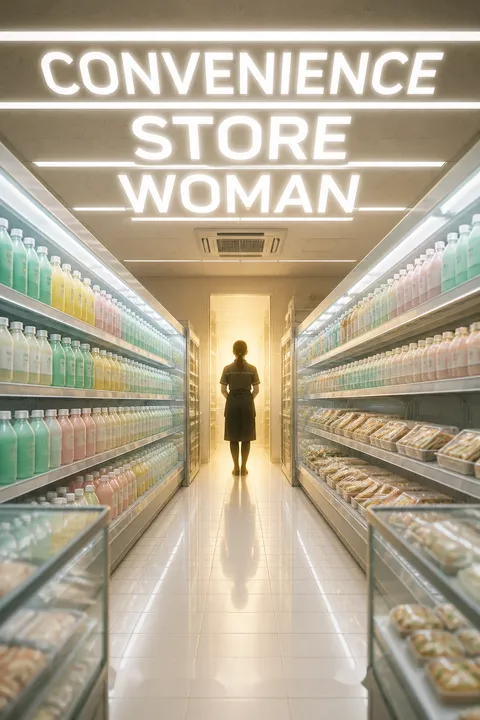
After a Noh performance leaves her lost in an unfamiliar office district, Keiko finds a convenience store recruiting staff and applies. Training gives her explicit instructions for greetings, posture, handling food, and serving customers.
When the store opens, she follows them so precisely that her manager praises her; for the first time, Keiko feels useful in a world she can understand. She stays at Smile Mart for eighteen years, learning its rhythms so thoroughly that she anticipates customer needs and organizes stock by instinct.
As staff and managers change, she absorbs their speech and mannerisms, while the store’s routines remain dependable. Outside work, attempts to enter regular employment fail, and Keiko increasingly treats the shop as the only place where she knows how to be.
The store’s manual supplies what Keiko’s childhood lacked: behavioral rules that are concrete, repeatable, and judged by results. Her sense of self is not simply imposed by work; she finds genuine satisfaction in the precision and mutual dependence of the shift. Yet the store’s acceptance is conditional on function. Its stable routines shelter her from social ambiguity, while also making her increasingly unable to imagine a life organized by different standards.
The Village Finds Its Outsider
At a barbecue with old friends, thirty-six-year-old Keiko struggles to explain why she has neither a conventional career nor a romantic history. When she answers honestly that she has never dated, the group quickly recasts her as someone whose private life must be painful. Friends suggest a marriage site and offer to help find her a partner.
Keiko watches them turn her actual contentment into a problem they can solve, then realizes they see her as an outsider. Their reaction echoes her family’s long effort to make her more ordinary. The pressure does not make her want marriage or a career for their own sake; it makes her want some change that will quiet the scrutiny and give others an acceptable story about her.
The barbecue exposes how social concern can become a form of correction. Keiko’s friends do not ask what kind of life she wants; they translate her answers into familiar troubles and prescribe familiar remedies. Their matchmaking is meant as kindness, but it makes her legible only by replacing her experience with a shared script. The scene sharpens the novel’s central distinction: belonging may depend less on happiness than on whether other people can recognize the shape of one’s life.
Shiraha Enters the Store
The store hires Shiraha, a thin, hostile newcomer who complains about basic tasks and explains workplace roles through a crude theory of prehistoric gender. He neglects his duties and uses customer information to pursue a woman who shops there, so the manager fires him. Later, Keiko finds Shiraha hiding near the store and warns him that the manager may involve the police if he bothers customers again.
At a nearby restaurant, he reveals that he is behind on rent and has nowhere to go. Keiko recognizes that having a man in her apartment might quiet questions about her own life, and offers him shelter in exchange for food money. Shiraha accepts, asking her to keep him hidden from people who might demand that he work or marry.
Shiraha and Keiko both resent being judged by social rules, but their responses differ sharply. Keiko adapts to a system that gives her meaningful tasks; Shiraha uses his theory of society to excuse exploitation and avoid responsibility. His dismissal therefore matters twice: it removes a disruptive worker from the store, then brings him into Keiko’s private life. Their arrangement begins not in mutual intimacy but in a bargain over appearances, with each hoping the other can reduce unwanted attention.
A Couple on Paper
Keiko tells friends that Shiraha lives with her, and they greet the news as proof that her life is finally progressing, imagining a romance and future she does not describe. At work, her manager and supervisor Mrs. Izumi become more interested in the arrangement than in store business.
When Keiko’s sister Mami visits, she finds Shiraha hiding in the bathroom and breaks down over Keiko’s refusal to become conventional. Shiraha invents a story about an unfaithful relationship, giving Mami a familiar reason to scold him and accept the household.
Then Shiraha’s sister-in-law tracks him down over unpaid rent. He presents Keiko as his partner and says she will support them, prompting his relative to urge Keiko to leave the store and get a proper job. The scrutiny finally drives Keiko to resign.
The household succeeds as social camouflage precisely because outsiders supply its missing romance and purpose for themselves. Keiko’s sister can tolerate a troubled couple more easily than a sister whose life resists explanation; friends likewise welcome a conventional plot even when its details are false. But the cover story is not neutral. It gives Shiraha room to shift burdens onto Keiko and turns workplace relationships into surveillance. The performance that briefly protects her ultimately helps push her away from the one role she chose for herself.
The Store Calls Her Back
After leaving Smile Mart, Keiko loses the routines that once governed when she slept, ate, and cared for her body. Shiraha searches job listings for her, but she drifts through the apartment and cannot make herself follow a new schedule.
Nearly a month later, he accompanies her to an employment interview. While waiting, Keiko enters a different convenience store and immediately spots poorly arranged sale items, understaffed tills, and shelves that need attention. She reorganizes displays and guides a young worker through the next tasks.
Shiraha pulls her outside and tries to continue toward the interview, but Keiko understands that she cannot exchange her work for the role he wants her to perform. She abandons the interview and decides to find another convenience store where her abilities have a place.
Keiko’s return to a store is not a sudden cure or a simple escape from social pressure. It is an act of recognition: faced with actual shelves, customers, and a struggling coworker, she can identify what is needed and respond with confidence. The scene also distinguishes chosen competence from social approval. Shiraha can offer her a respectable-looking narrative, but it cannot replace the reciprocal demands of work that make her feel present and capable. Her decision remains materially uncertain, yet it is finally her own.
Analysis
Convenience Store Woman asks what makes a life intelligible to other people, and whether intelligibility should be mistaken for well-being. Keiko’s relatives and friends are not presented as villains: they worry, offer advice, and try to protect her. Their care nevertheless carries a narrow assumption that a proper adult life must be legible through employment, marriage, and children. When Keiko cannot supply those signs, they replace her account with explanations they already understand.
The convenience store offers a revealing counter-system. Its rules are explicit, its needs change with weather and customers, and its workers can contribute without first proving that they have achieved the right personal milestones. Keiko’s dedication is not treated as a joke by the narrative. It is a genuine form of attention and competence, even as the store’s replaceable staff show that institutional belonging has limits.
Shiraha complicates any simple contrast between conformity and freedom. He diagnoses the pressure to fit in, but uses that insight to justify dependence and intrusion. Keiko, by contrast, can adapt without believing that society’s judgments are true. The novel’s final choice is therefore not a victory over every social constraint. It is Keiko’s refusal to let a fabricated respectable identity erase the work through which she experiences agency, usefulness, and connection.
Review Summary
Convenience Store Woman is a quirky, darkly humorous novel about Keiko, a 36-year-old woman content working at a convenience store for 18 years. The story explores societal pressure to conform, with Keiko struggling to fit in and be "normal." Reviewers praised its unique perspective on Japanese society, work culture, and expectations for women. Some found it depressing rather than funny, while others appreciated its commentary on conformity and finding happiness in unconventional ways. The character of Keiko resonated with many readers, though opinions varied on the overall execution of the story's themes.
People Also Read










Characters
Keiko Furukura
Manual-born workerKeiko is a precise observer whose instincts often differ from the assumptions of people around her. As a child, she learns to copy others after her literal attempts to solve problems alarm adults. At Smile Mart, explicit procedures let her turn that habit into skill: she reads customers, tracks stock, and takes pride in reliable work. She is not motivated by the career and romantic milestones her family and friends expect, and she has little interest in pretending those goals are hers. Her difficulty is less a lack of feeling than a mismatch between her own priorities and the social language available to explain them.
Shiraha
Resentful village exileShiraha is a new convenience store employee who resents being measured by work, money, and marriage. He explains modern life through a theory that society still rewards men as hunters and women as partners and mothers. Yet his contempt for social expectations does not prevent him from exploiting other people or evading responsibility. His self-pity makes him perceptive about the pressure to conform but unreliable about the harm he causes. Keiko’s practical, unsentimental approach unsettles him because she does not share his need to turn every setback into proof that the world is conspiring against him.
Mami
Protective younger sisterMami is Keiko’s younger sister, a gentle and affectionate person who has long tried to help her navigate social situations. As an adult, she is a wife and mother, and she assumes that Keiko also wants the conventional milestones she has reached. Her concern is sincere, but she struggles to distinguish helping Keiko from trying to make her more recognizable to others.
Mrs. Izumi
Store's exacting anchorMrs. Izumi is an efficient day-shift supervisor, a wife and mother who takes pride in keeping the store running. She corrects younger staff and sets a strong example for Keiko, who also borrows her clothes and speech as models of adult femininity. Mrs. Izumi’s practical authority makes her a valued colleague, though she shares the community’s assumptions about what a woman’s life should look like.
Sugawara
Cheerful shift modelSugawara is a lively part-time worker and aspiring singer whose early lateness and work habits improve under Mrs. Izumi’s guidance. Her expressive manner gives Keiko another set of social cues to absorb. She values camaraderie and dependable teamwork, but, like her colleagues, can be drawn into treating Keiko’s private life as more important than the work they share.
Manager #8
Hard-driving store managerThe store’s eighth manager is businesslike, energetic, and respected by the staff for handling difficult physical work. He relies on Keiko’s consistency, especially while the store is short-staffed. His view of employees is rooted in operational usefulness, but he also adopts the surrounding culture’s assumptions about gender, partnership, and adulthood.
Miho
Practical longtime friendMiho is an old school friend who reconnects with Keiko at a reunion and invites her into gatherings with married friends. She is warm and eager to include Keiko, often covering for her in awkward conversations. But her help tends to rely on familiar explanations, revealing the gap between affectionate friendship and the ability to accept a life that does not fit expected milestones.
Tuan
New Vietnamese coworkerTuan is a new Vietnamese employee who is still learning the register and store routines. Keiko assists him during a rush and takes heart when he joins her in promoting the day’s food special. His willingness to work alongside her briefly restores the team spirit she values.
Plot Devices
The store manual
Rules made tangibleThe training manual and daily procedures give Keiko explicit instructions for conduct that other people seem to learn intuitively. They teach greetings, hygiene, stocking, and service, turning imitation into competence. The manual also provides a clear standard of success: customers are served and the store functions. Its limits become visible when Keiko tries to apply its certainty to a life outside the shop.
The convenience store
A working model of belongingSmile Mart is both Keiko’s workplace and a social system with shared tasks, rhythms, and rules. The staff change, products rotate, and managers come and go, while the store’s basic operations continue. This structure gives Keiko a stable way to contribute and lets the novel test how belonging changes when a person is valued for a specific role rather than judged by age, gender, or marital status.
The sound of the store
Work made bodilyDoor chimes, scanners, customers, and staff calls form a soundscape Keiko learns to read as practical information. The noises cue her actions and become bound to her sense of routine and purpose. When she leaves the store, that familiar structure falls away; encountering another shop brings her attention and instincts back into focus.
FAQ
Synopsis & Basic Details
What is Convenience Store Woman about?
- Unique perspective on normalcy: The novel follows Keiko Furukura, a 36-year-old woman who has worked at a convenience store for 18 years, finding comfort and purpose in its structured environment.
- Clash with societal expectations: Keiko's unconventional lifestyle and lack of ambition are constantly questioned by her family and friends, who pressure her to conform to traditional roles.
- Exploration of identity: The story delves into Keiko's struggle to reconcile her personal contentment with the expectations of society, exploring themes of identity, conformity, and what it means to be "normal."
Why should I read Convenience Store Woman?
- Unique narrative voice: Sayaka Murata's writing offers a distinct and compelling perspective through Keiko's detached yet insightful narration, providing a fresh take on everyday life.
- Thought-provoking themes: The novel challenges conventional notions of normalcy, success, and happiness, prompting readers to question societal expectations and their own values.
- Subtle social commentary: Through Keiko's experiences, the book offers a sharp critique of societal pressures and the often-absurd expectations placed on individuals to conform.
What is the background of Convenience Store Woman?
- Contemporary Japanese society: The novel is set in modern-day Japan, reflecting the country's unique cultural norms, work culture, and societal pressures, particularly on women.
- "Freeter" culture: The story touches upon the concept of "freeters," young people who choose to work part-time jobs rather than pursue traditional careers, a phenomenon in Japan.
- Critique of conformity: The book subtly critiques the rigid expectations of Japanese society, where individuals are often pressured to follow prescribed paths in life, such as marriage and career advancement.
What are the most memorable quotes in Convenience Store Woman?
- "I have become a functioning part of the world, rotating in the time of day called morning.": This quote encapsulates Keiko's sense of belonging and purpose within the structured environment of the convenience store, highlighting her unique perspective on normalcy.
- "When I think that my body is entirely made up of food from this store, I feel like I'm as much a part of the store as the magazine racks or the coffee machine.": This quote reveals Keiko's deep connection to the store, blurring the lines between her identity and the physical space, emphasizing her integration into its system.
- "A convenience store is a forcibly normalized environment where foreign matter is immediately eliminated.": This quote underscores the novel's theme of conformity and the pressure to fit in, highlighting the store as a microcosm of society's intolerance for those who deviate from the norm.
What writing style, narrative choices, and literary techniques does Sayaka Murata use?
- Deadpan, detached narration: Murata employs a unique narrative voice through Keiko, characterized by a flat, emotionless tone that contrasts with the often-absurd situations she describes, creating a sense of dark humor.
- Repetitive, rhythmic prose: The author uses repetitive language and descriptions of routine to mirror Keiko's structured life, emphasizing the comfort and stability she finds in the convenience store's predictable environment.
- Subtle social satire: Murata uses Keiko's observations and interactions to subtly critique societal norms and expectations, often highlighting the absurdity of conventional behavior through Keiko's detached perspective.
Hidden Details & Subtle Connections
What are some minor details that add significant meaning?
- Dented cans: Keiko's preference for dented cans, which are considered unsellable, symbolizes her own sense of being "damaged" or not fitting into societal norms, yet finding value in what others discard.
- The store manual: The detailed manual that dictates every aspect of a convenience store worker's behavior represents the rigid rules and expectations of society, which Keiko both adheres to and subverts.
- The security camera: The security camera, which the manager uses to monitor the staff, symbolizes the constant surveillance and judgment that Keiko feels from society, highlighting the lack of privacy and freedom.
What are some subtle foreshadowing and callbacks?
- Early childhood incidents: Keiko's childhood incidents, such as trying to eat a dead bird, foreshadow her later inability to conform to societal norms and her pragmatic, detached approach to life.
- The "cured" concept: The recurring idea of Keiko needing to be "cured" foreshadows her eventual rejection of societal expectations and her embrace of her unique identity as a convenience store worker.
- Shiraha's "Stone Age" rants: Shiraha's constant references to the Stone Age foreshadow his eventual desire to be hidden from society, mirroring Keiko's own desire to escape societal pressures.
What are some unexpected character connections?
- Keiko and Shiraha: Despite their seemingly opposite personalities, Keiko and Shiraha share a common desire to escape societal expectations, forming an unexpected bond based on their shared alienation.
- Keiko and the store managers: The series of store managers, each with their own quirks, collectively represent the ever-changing yet ultimately consistent nature of the convenience store, highlighting Keiko's enduring connection to the store itself.
- Keiko and the customers: The recurring customer with a walking stick, who always says "This place never changes," highlights the cyclical nature of the store and Keiko's role within it, emphasizing her sense of belonging.
Who are the most significant supporting characters?
- Mrs. Izumi: As a supervisor, Mrs. Izumi embodies the conventional expectations of a working woman, highlighting the societal pressures that Keiko resists, and serving as a foil to Keiko's unconventional lifestyle.
- Sugawara: Sugawara's cheerful and supportive nature provides a contrast to the more critical voices in Keiko's life, representing the possibility of acceptance and camaraderie within the store's environment.
- Keiko's sister: Keiko's sister represents the well-meaning but ultimately misguided attempts of family to "cure" Keiko, highlighting the tension between personal fulfillment and societal expectations.
Psychological, Emotional, & Relational Analysis
What are some unspoken motivations of the characters?
- Keiko's desire for order: Keiko's unspoken motivation is her deep need for order and predictability, which she finds in the structured environment of the convenience store, providing her with a sense of control and purpose.
- Shiraha's fear of judgment: Shiraha's unspoken motivation is his fear of societal judgment and his desire to be hidden from the world, which drives his parasitic lifestyle and his need for Keiko to provide him with refuge.
- Family's need for normalcy: Keiko's family's unspoken motivation is their desire for her to be "normal" and to fit into societal expectations, driven by their love and concern for her well-being, but also by their own need for social acceptance.
What psychological complexities do the characters exhibit?
- Keiko's detachment: Keiko exhibits a psychological detachment from her own emotions and societal expectations, allowing her to observe the world with a unique, almost clinical perspective, highlighting her struggle to connect with others on an emotional level.
- Shiraha's self-pity: Shiraha displays a complex mix of self-pity and arrogance, constantly blaming society for his problems while simultaneously believing himself to be superior, revealing his deep-seated insecurities and inability to take responsibility.
- Family's cognitive dissonance: Keiko's family exhibits cognitive dissonance, struggling to reconcile their love for her with their desire for her to conform, highlighting the internal conflict they experience when faced with her unconventional lifestyle.
What are the major emotional turning points?
- Keiko's "rebirth": Keiko's "rebirth" as a convenience store worker is a major emotional turning point, as she finds a sense of belonging and purpose in the store's structured environment, marking a shift from her childhood struggles.
- The pressure to conform: The increasing pressure from family and friends to conform to societal expectations is a major emotional turning point, forcing Keiko to confront the limitations of her chosen path and question her own motivations.
- Keiko's return to the store: Keiko's decision to return to the convenience store is a major emotional turning point, as she embraces her identity as a "convenience store animal" and rejects the pressure to conform, marking a moment of self-acceptance.
How do relationship dynamics evolve?
- Keiko and her family: The relationship between Keiko and her family evolves from one of concern and attempts to "cure" her to one of grudging acceptance, highlighting the limitations of their understanding of her unique identity.
- Keiko and Shiraha: The relationship between Keiko and Shiraha evolves from a convenient arrangement to a source of conflict, as their differing views on society and their roles in it clash, ultimately leading to their separation.
- Keiko and her coworkers: Keiko's relationships with her coworkers evolve from a sense of camaraderie to a realization that they are also bound by societal expectations, highlighting her growing awareness of her own unique perspective.
Interpretation & Debate
Which parts of the story remain ambiguous or open-ended?
- Keiko's future: The novel leaves Keiko's future open-ended, with her returning to the convenience store but without a clear path beyond that, prompting readers to question whether she will ever truly escape societal pressures.
- The nature of "normal": The novel does not provide a definitive answer to what constitutes "normal," leaving it up to the reader to interpret the concept and question the validity of societal expectations.
- Shiraha's fate: Shiraha's fate is left ambiguous, with his departure from Keiko's life but without a clear resolution to his own struggles, prompting readers to consider the complexities of his character and his place in society.
What are some debatable, controversial scenes or moments in Convenience Store Woman?
- Keiko's childhood actions: Keiko's childhood actions, such as hitting a classmate with a shovel, are controversial, prompting readers to question her understanding of social norms and the extent to which she is responsible for her behavior.
- Keiko's relationship with Shiraha: Keiko's decision to live with Shiraha is controversial, prompting readers to question her motivations and the extent to which she is using him to conform to societal expectations.
- Keiko's final decision: Keiko's final decision to return to the convenience store is debatable, prompting readers to question whether she has truly embraced her identity or simply retreated into a familiar environment.
Convenience Store Woman Ending Explained: How It Ends & What It Means
- Rejection of societal norms: The ending sees Keiko fully embrace her identity as a "convenience store animal," rejecting societal expectations and choosing to live authentically, highlighting the novel's central theme of nonconformity.
- Embrace of the store's voice: Keiko's decision to return to the store is driven by her recognition that she is intrinsically connected to its operations, finding purpose and meaning in its structured environment, emphasizing her unique perspective on normalcy.
- Ambiguous future: While Keiko finds solace in the store, the ending leaves her future open-ended, prompting readers to question whether she will ever truly escape societal pressures or if her identity is forever tied to the convenience store, highlighting the complexities of self-discovery and acceptance.
About the Author



Download PDF
Download EPUB
.epub digital book format is ideal for reading ebooks on phones, tablets, and e-readers.








