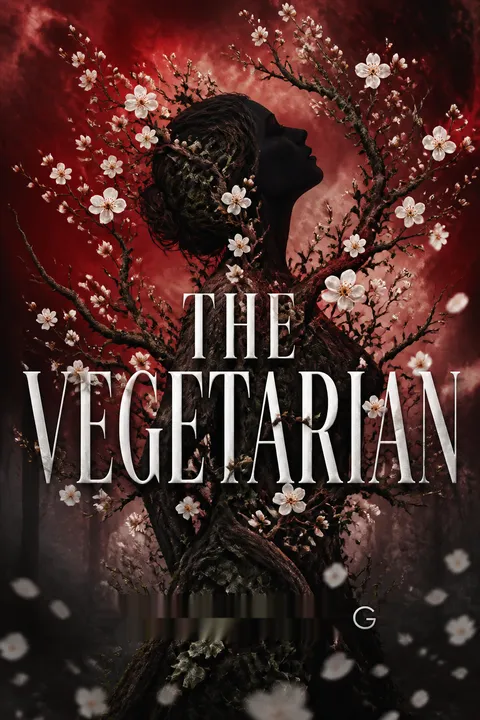


Plot Summary
The Fridge at Four
Cheong has chosen a life that asks little of him, including a quiet marriage to Yeong-hye, whom he considers unremarkable and dependable. Then he finds her awake before dawn, staring into the refrigerator. The next morning she throws away the household’s meat, eggs, and milk, explaining only that a dream made keeping them feel wrong.
She promises to stop eating animal products forever. Her first dream traps her in a barn crowded with dripping meat, then leaves her hiding from a picnic, terrified by blood on her hands and in her mouth. Cheong treats the dream as an excuse, but Yeong-hye’s calm refusal unsettles the domestic routine he mistook for a complete understanding of his wife.
Cheong’s account opens by making his limitations part of the plot: he chose Yeong-hye because she seemed unlikely to challenge him, and therefore mistook her quietness for simplicity. The dream does not arrive with an explanation that can be tested; instead, it changes an everyday act, what the household eats. Yeong-hye’s decision is at once bodily, ethical, and opaque to her husband. That opacity matters because Cheong responds by trying to restore his own convenience rather than discover what she is experiencing. The refrigerator becomes the first site where private refusal collides with marital authority.
The Dinner She Refuses
As spring passes, Yeong-hye grows thinner, sleeps little, avoids sex, and says Cheong’s body smells of meat. He refuses to seek help, telling himself the problem has nothing to do with him. At a formal dinner with his superiors, she arrives without a bra and declines every meat dish, offering her dream as the reason.
Cheong invents a medical explanation to protect his standing, while the guests debate her choice and leave her isolated at the table. Afterward he recruits her mother and sister to change her mind. His concern centers on the disruption to his work and household, not on the sleepless, increasingly frail woman sitting beside him.
The dinner turns private refusal into a public test of conformity. Cheong is less alarmed by Yeong-hye’s physical decline than by the possibility that her conduct will damage his professional image, so he lies on her behalf while denying her account. The guests’ polite discussion reinforces the coercion: they treat her body as a topic for collective judgment and her decision as evidence of poor character. Her silence does not make her compliant; it prevents others from translating her into a convenient explanation. Cheong’s attempt to enlist her family extends the same logic of control beyond the marriage.
A Marriage Turns Violent
With Yeong-hye withdrawing from him, Cheong rapes her, then repeats the assault because her lack of resistance lets him pretend the marriage remains intact. He is disturbed by her blankness afterward, but not enough to stop. Three days before her family gathers, he finds her bare to the waist, calmly peeling potatoes in the cool apartment.
Her explanation that she is hungry does not reassure him. The scene exposes how thoroughly he has confused access with affection: he wants her to look at him, laugh, and confirm his version of their life. Instead, her body and choices continue to move beyond his authority, sharpening the dread that precedes the family confrontation.
Cheong’s violence is not an interruption of his self-image so much as its consequence. He has long understood marriage as a system that should accommodate his needs, and he converts Yeong-hye’s silence into permission because that interpretation protects him from recognizing her refusal. His unease afterward registers a conscience, but it remains subordinate to entitlement. The bare, potato-peeling scene unsettles him precisely because it offers no performance of shame or reassurance. Yeong-hye’s ordinary task becomes unreadable to him, revealing that the domestic familiarity he prized was never the same as mutual knowledge.
Pork at the Family Table
At In-hye’s new apartment, Yeong-hye’s family lays out meat and seafood and urges her to eat. Her father, a domineering veteran who beat her during childhood, strikes her when she refuses. Her brother and Cheong hold her while their father pushes pork against her mouth. Yeong-hye spits it out, grabs a fruit knife, and slashes her wrist.
In-hye’s husband, until then a detached spectator, binds the wound and carries her to the hospital. The children cry as the adults scramble after them. What the family calls care has become physical force, and Yeong-hye’s self-injury makes the violence impossible to disguise as a disagreement about food.
The meal condenses the family’s hierarchy into a single act: the father decides what his daughter must consume, and other relatives help restrain her. His concern about her health may be sincere, but it does not soften the coercion. Yeong-hye’s knife wound is a desperate seizure of control over the body everyone else is trying to govern. In-hye’s husband, previously passive, acts decisively only once blood appears. The children’s presence exposes the lesson being transmitted across generations: affection can be claimed by those who use force, while the person resisting them is treated as the problem.
The Bird in Her Hand
In the hospital, Yeong-hye wakes after treatment for her wound while her mother brings black goat broth disguised as medicine, hoping to restore her strength. Yeong-hye recognizes the meat, drinks a little under pressure, then vomits it up. Carrying the spilled packet away, she leaves the ward without Cheong following.
He later finds her in the hospital garden, exposed to the sun, with the bandage undone and a crushed white-eye bird in her fist. She asks whether she has done something wrong. Cheong covers her with her gown, but cannot answer the deeper question raised by her bloodied wrist, her refusal, and the bird.
The hospital does not resolve the conflict; it relocates it into a place where care and coercion remain difficult to separate. The mother disguises food to protect her daughter, yet the deception repeats the family’s assumption that Yeong-hye must be made to accept what others decide she needs. Yeong-hye’s vomiting is an active rejection, while the blood on her bandage and the dead bird suggest that her distress is no longer confined to diet. Cheong’s recognition that he does not know his wife arrives too late to become understanding. He can cover her body, but cannot interpret or answer her.
Flowers on Bare Skin
Years later, In-hye’s husband, a video artist stalled in his work, becomes fixated on the idea of painting flowers across naked bodies. His wife mentions that Yeong-hye still has a blue Mongolian birthmark, and he links it to an image of flowers painted over a woman making love. He visits Yeong-hye, now living alone after psychiatric treatment and separation from Cheong.
She agrees to model. In a borrowed studio, he paints blossoms over her back and chest, filming her stillness and the birthmark he leaves visible. Yeong-hye says she wants the paint to remain because it keeps the dreams away. The artist’s project has begun as an image, but his attention to her increasingly blurs art and desire.
The birthmark becomes a hinge between the artist’s private fantasy and Yeong-hye’s experience of her body. He treats her as the source of an image, while she accepts the paint for a reason he cannot fully grasp: it seems to quiet her dreams. Their purposes overlap without becoming the same. The camera offers him a way to frame what he cannot understand, turning her stillness into composition. Yet his growing fixation makes that artistic control unstable. The scene asks whether representing a person can be separated from using them, especially when the person’s quiet consent is mistaken for an invitation to unlimited access.
The Model Refuses
The artist paints flowers on J, a younger fellow video artist, then films J and Yeong-hye embracing and imitating sex. When he asks them to have actual sex for the camera, J recoils, calls the project pornography, and leaves. Yeong-hye tells the artist that the flowers, not J, stirred her desire.
The artist realizes that his own body must enter the image if he is to pursue it further. He persuades P, a former lover and fellow artist, to paint flowers on him, then visits Yeong-hye wearing the paint. They have sex while he films. For him, the act completes the image; for Yeong-hye, the painted bodies have opened a desire she says she had never felt before.
J’s refusal establishes a limit the artist has tried to treat as an artistic obstacle. His request crosses from staged representation into actual sex, and J recognizes the exploitation before the artist does. Yeong-hye’s response complicates the scene: her desire is real, but it is attached to the flowers and the altered bodies, not straightforwardly to the artist. He nevertheless interprets her willingness as permission to pursue his vision. The shift from painting others to painting himself makes him part of the spectacle he controls, but it does not erase the unequal power of the camera or his manipulation of the situation.
The Camera Exposes Them
The next day, In-hye comes to Yeong-hye’s apartment with food and finds her husband asleep beside her sister, both marked with paint. She rewinds the camcorder tape and watches their filmed encounter. As she confronts him, Yeong-hye walks naked onto the veranda and leans over the railing, reaching toward the sunlight. In-hye calls emergency services.
When paramedics arrive, Yeong-hye fights their restraint while her husband tries to throw himself from the veranda; a paramedic stops him. The scandal ends their marriage and brings both artists and sister into psychiatric care. In-hye’s later account makes clear that her husband was eventually released after legal inquiries, then disappeared from her life.
The camera changes the affair from an act the artist can privately aestheticize into evidence that In-hye must confront. Her discovery joins two forms of betrayal: her husband has violated their marriage, and he has used her sister’s vulnerability as material for his work. Yeong-hye’s movement toward the sunlight is not framed as a clear, rational intention, but it makes the immediate danger undeniable. The artist’s attempt to jump follows the collapse of the world he constructed around the image. In-hye responds by summoning help, a practical act that cannot undo the harm but prevents the crisis from remaining hidden.
The Forest Calls Her
In-hye becomes Yeong-hye’s sole regular visitor at a psychiatric hospital, where her sister initially seems calmer. Three months before the present visit, Yeong-hye disappears during a permitted walk and is found deep in the rainy woods, standing still as if she belonged among the trees. Afterward she refuses all food, believing she needs only water and sunlight.
She balances on her hands in the corridor, convinced that trees stand upside down with their roots in the earth. Doctors struggle to keep her hydrated and medicated. Now they warn In-hye that Yeong-hye may need transfer to a general hospital. Her sister’s earlier refusal of meat has become a refusal of nourishment itself.
The forest episode marks a shift from a dietary boundary to an attempt to leave human life altogether, though Yeong-hye experiences it as transformation rather than self-destruction. Her plant belief gives a coherent shape to her refusal: she imagines a body that can live on sunlight and water, beyond appetite and violence. The hospital reads the same behavior as a medical emergency, and its interventions intensify the conflict over who has authority over her body. In-hye remains between these interpretations, responsible for her sister’s care while unable to know whether care means preserving life or overriding Yeong-hye’s will.
In-hye's Unraveling
While keeping the cosmetics shop open and raising Ji-woo alone, In-hye revisits the childhood she shared with Yeong-hye. Their father beat Yeong-hye more often, while In-hye survived by becoming useful and obedient. She wonders whether she could have stopped the force-feeding, the artist’s betrayal, or her sister’s decline.
After discovering her husband’s affair, she briefly approached a mountain path with a cord in her pocket, but returned instead of leaving her son. A minor medical procedure later confirms that her bleeding is not a serious illness, yet the relief does not lift her despair. Her routine continues, but she recognizes that endurance has not kept her from being wounded.
In-hye’s memories reveal that competence has been both her strength and her means of survival. As a child, she learned to anticipate her father’s needs; as an adult, she manages work, motherhood, and her sister’s care. Her repeated questions about what she could have prevented turn responsibility into self-accusation, even when the violence belonged to others. Her walk toward the mountain exposes the cost of a life organized around duty, while her return for Ji-woo shows how responsibility can also keep her connected to living. She does not arrive at certainty, only a clearer view of the burden she carries.
The Tube and the Trees
At the hospital, Yeong-hye is dangerously weak, and doctors attempt to feed her through a tube after ordinary nourishment and other interventions have failed. In-hye watches her sister fight the staff and reject the tube; when blood pours from Yeong-hye’s mouth, In-hye breaks past the carers and demands they stop.
The doctors arrange an urgent transfer to a general hospital. In the ambulance, In-hye holds her sister’s hand and struggles with the thought that she, too, once wanted to escape her life. She tells Yeong-hye that dreams cannot be the only reality. As the vehicle leaves the mountain, In-hye stares at the trees, neither comforted nor convinced, still insisting on an answer.
The final struggle gives In-hye no clean choice. Allowing the feeding procedure may preserve Yeong-hye’s life while violating the refusal she has maintained; stopping it may honor that refusal while exposing her to death. In-hye intervenes when blood appears, but the emergency transfer postpones rather than settles the dilemma. Her appeal to wake from dreams is an attempt to keep her sister attached to the world, and perhaps to keep herself there too. The trees offer neither a diagnosis nor consolation. The ending leaves care as an action performed under uncertainty, with love unable to guarantee agreement or rescue.
Analysis
The novel makes the body the place where private refusal becomes impossible for others to ignore. Yeong-hye’s initial rejection of meat begins as a response to dreams, but family members, husbands, doctors, and artists all try to assign it meanings that serve their own needs. Her father calls force discipline; Cheong treats her behavior as an inconvenience; the video artist turns her into an image; the hospital treats her body as a life to be preserved. These interpretations are not equivalent, but each risks displacing Yeong-hye’s own experience.
The three-part structure refuses the comfort of a single authoritative explanation. Cheong’s narration exposes the limits of self-serving perception. The artist’s section shows how aesthetic attention can become appropriation when the subject is treated as a means to complete a vision. In-hye’s perspective, finally, offers neither diagnosis nor rescue. She sees her sister more clearly than the men do, yet she cannot know whether preserving Yeong-hye’s life means honoring or overriding her wishes.
In-hye’s own story prevents the novel from dividing people neatly into the free and the trapped. She has survived through competence, work, and duty, but that survival has required her to suppress her own needs. Yeong-hye’s refusal makes visible the boundaries In-hye has learned not to cross, while also frightening her with the possibility of a freedom that may be indistinguishable from self-destruction. Their bond is therefore not a simple contrast between rebellion and responsibility. It is a relationship in which one sister’s crisis forces the other to ask whether endurance is a choice, a form of care, or merely the habit that has kept her functioning.
The ending preserves that uncertainty. In-hye resists the feeding procedure when it produces blood, then continues toward medical help. Her actions express love without resolving its contradiction. The novel’s hardest insight is that care cannot always make another person safe, and that the impulse to protect can repeat the very control it opposes. The trees offer no verdict. In-hye keeps looking, caught between the demand to let go and the demand to keep someone alive.
Review Summary
The Vegetarian is a deeply unsettling and thought-provoking novel that explores themes of mental illness, societal pressure, and autonomy. Many readers found it disturbing yet compelling, praising Han Kang's poetic prose and ability to tackle complex issues. The book's structure, told from three different perspectives, received mixed reactions. Some appreciated its unique approach, while others felt disconnected from the main character. Critics noted the novel's powerful commentary on gender roles and cultural expectations in South Korea, though some found the portrayal of vegetarianism problematic.
People Also Read







Characters
Yeong-hye
The refusing sisterYeong-hye is a quiet woman whose reserve makes it easy for others to assume they understand her. She reads, keeps house, and rarely demands attention, but her inward life is intense and shaped by dreams that she struggles to explain. Her relationship with food and her body becomes the clearest way she can resist demands imposed by family and society. She is not simply passive: her stillness can conceal a firm refusal, while her decisions unsettle the people who once relied on her compliance. Her story asks what happens when a person’s private distress is visible only through actions others interpret as irrational.
Mr. Cheong
The self-protective husbandYeong-hye’s first-person narrator husband prizes predictability, status, and a marriage that does not ask much of him. He interprets his wife’s quietness as proof that she is ordinary and easy to live with, and he is slow to distinguish that assumption from genuine intimacy. When her behavior challenges his routines, he focuses on embarrassment and inconvenience rather than curiosity. His account is revealing less for what he understands than for what he repeatedly refuses to see. He is not a neutral witness: his self-interest shapes the story he tells and the treatment he considers acceptable.
In-hye
The burdened older sisterIn-hye is Yeong-hye’s older sister, a capable shop owner and mother who has built her life through discipline. As a child, she learned to manage the household and avoid provoking their volatile father. That competence makes her dependable, but also leaves her inclined to carry responsibility even when events are beyond her control. She worries about Yeong-hye while maintaining work and caring for her son, Ji-woo. Her perspective reveals the costs of being the person who keeps going: she can care deeply for others and still feel trapped by the obligations that have organized her life.
In-hye's husband
The image-obsessed artistIn-hye’s husband is a video artist whose work has stalled and whose attention is often fixed on images that other people cannot decipher. He is a father to Ji-woo, but he struggles to inhabit ordinary family life with the same intensity he brings to his artistic visions. His imagination can be patient and formally inventive, yet it also tempts him to treat people as material for a composition. He is especially drawn to what seems to escape ordinary categories, including flight, color, and the human body. His artistic sensitivity does not automatically give him ethical insight.
Ji-woo
In-hye's young sonJi-woo is In-hye’s young son, a sensitive child who becomes the center of her daily responsibilities. He is prone to minor illnesses and depends on his mother’s steadiness, but he also has an imaginative, playful nature. His need for care gives In-hye a reason to keep moving through periods when she feels close to collapse. He does not understand the adults’ conflicts, yet their choices shape the fragile family world in which he is growing up.
Yeong-hye's father
The patriarchal disciplinarianYeong-hye’s father is a forceful, authoritarian man who expects obedience from his family. Proud of his military service and quick to anger, he believes discipline is a form of care. His treatment of Yeong-hye during childhood leaves a lasting mark on both daughters: she absorbs the violence, while In-hye learns to survive by being useful and compliant. He represents a household order in which a father’s intentions can be treated as more important than a daughter’s bodily autonomy.
Yeong-hye's mother
The anxious caretakerYeong-hye’s mother is practical and worried, accustomed to expressing affection through food and physical care. She fears the visible effects of her daughter’s refusal to eat and tries to restore her strength by familiar means. Her concern is real, but she shares the family’s belief that Yeong-hye can be persuaded or managed into accepting what others think she needs. She embodies the painful overlap between love and control within the family.
Yeong-ho
The younger brotherYeong-ho is Yeong-hye and In-hye’s younger brother. He is hot-tempered like their father, though he is less commanding within the family. During the crisis at In-hye’s home, he participates in restraining Yeong-hye, believing that compliance might prevent a larger conflict. His response shows how family roles can reproduce the habits of the household even when relatives think they are trying to calm a situation.
Yeong-hye's ex-husband
The conventional spouseYeong-hye’s former husband is an ordinary, practical man who expects marriage to remain within familiar routines. He has little patience for behavior he regards as abnormal and interprets her condition through the limits of his own comfort. His response to her distress reflects a broader preference for removing disruption rather than understanding its source. He is distinct from In-hye’s husband, the video artist.
J
The reluctant modelJ is a younger video artist who shares studio space with In-hye’s husband. He admires the flower-painted footage but becomes uncomfortable when the project asks him to cross from simulated intimacy into actual sex. His refusal establishes a personal limit even while he wants to be open to unfamiliar artistic work. J’s unease makes visible the ethical boundary the older artist is trying to ignore.
P
The artist's former loverP is an artist and In-hye’s husband’s former partner. She is candid, professionally assured, and willing to help paint his body, though she notices how the transformation alters her view of him. Their history gives their encounter an intimacy that is separate from his fixation on Yeong-hye.
Hee-joo
Yeong-hye's hospital aideHee-joo is a patient receiving treatment for alcoholism and hypomania who helps care for Yeong-hye. She takes that work seriously and grows emotionally attached to the woman she looks after. Her concern makes her more than a background attendant: she offers In-hye a glimpse of the informal bonds that can form among people living under institutional care.
Plot Devices
Yeong-hye's dreams
Violence from withinYeong-hye’s dreams of blood, meat, and unfamiliar faces give her refusal a private origin that she cannot fully translate for others. At first they explain why she empties the refrigerator, but they do not function as a puzzle with a single solution. As the story advances, the dreams deepen into an image of violence lodged within the self. They connect eating, memory, bodily fear, and the wish to escape human appetite, while leaving open how much is revelation and how much is illness.
The Mongolian mark
A body becomes an imageThe blue birthmark on Yeong-hye’s body first enters the story as a detail from her childhood, then becomes the focus of her brother-in-law’s flower imagery. For him it anchors a visual fantasy and inspires the video project; for Yeong-hye it belongs to a body she experiences differently from those around her. The mark links the artist’s desire to the novel’s questions about ownership, representation, and the gap between seeing a body and understanding its inhabitant.
Meat refusal
A bodily boundaryYeong-hye’s refusal begins with meat but quickly exposes the coercive assumptions surrounding food, marriage, and family duty. Relatives interpret her choice as a challenge that must be corrected, while she experiences eating as bound to the violence in her dreams. The refusal is not presented as a simple lifestyle preference or as a clear political program. It becomes the visible boundary through which she contests other people’s control, even as that boundary develops into a dangerous rejection of nourishment itself.
Shifting narrators
Each witness sees lessThe novel moves from Cheong’s self-protective account to the video artist’s desire-driven perspective, then to In-hye’s exhausted, reflective viewpoint. Yeong-hye remains central but is never given a single explanatory narration that could make her fully legible to the others. Each shift changes the meaning of earlier events: a domestic refusal becomes a family crisis, then artistic material, then a question of care and survival. The structure makes readers feel the difference between witnessing a person and possessing an explanation of them.
FAQ
Synopsis & Basic Details
What is The Vegetarian about?
- A woman's radical choice: The Vegetarian centers on Yeong-hye, a seemingly ordinary woman who abruptly decides to become a vegetarian, a decision that spirals into a profound and disturbing transformation.
- Disruption of normalcy: Her choice disrupts her marriage, family, and social life, forcing those around her to confront their own desires, fears, and limitations.
- Exploration of inner turmoil: The novel delves into themes of identity, rebellion, and the struggle for self-expression, exploring the psychological depths of Yeong-hye's transformation and its impact on others.
Why should I read The Vegetarian?
- Unique narrative perspective: Han Kang's novel offers a compelling and unsettling narrative, told through multiple perspectives, providing a fragmented yet comprehensive view of Yeong-hye's transformation.
- Exploration of complex themes: The Vegetarian tackles profound themes such as the body, desire, violence, and the search for meaning, prompting readers to question societal norms and personal boundaries.
- Emotionally resonant experience: The novel evokes a range of intense emotions, from discomfort and confusion to empathy and horror, creating a deeply immersive and thought-provoking reading experience.
What is the background of The Vegetarian?
- South Korean societal norms: The novel is set against the backdrop of South Korean society, where traditional values and expectations regarding family, marriage, and diet are deeply ingrained.
- Cultural expectations of women: The story explores the limited roles and expectations placed on women in Korean society, highlighting the pressures to conform and the consequences of rebellion.
- Exploration of mental health: The novel touches upon the stigma surrounding mental illness and the challenges faced by individuals who deviate from societal norms, reflecting broader cultural attitudes towards psychological well-being.
What are the most memorable quotes in The Vegetarian?
- "I had a dream.": This recurring phrase, uttered by Yeong-hye, signifies the powerful influence of her subconscious and the catalyst for her transformation, highlighting the disconnect between her inner world and external reality.
- "The meat smell. Your body smells of meat.": This quote reveals Yeong-hye's growing aversion to the physical world and her husband's embodiment of it, symbolizing her rejection of societal norms and her desire for purity.
- "I do not eat meat.": This simple yet defiant statement encapsulates Yeong-hye's unwavering commitment to her vegetarianism, showcasing her rebellion against familial and societal expectations, and her assertion of self-determination.
What writing style, narrative choices, and literary techniques does Han Kang use?
- Fragmented perspectives: Han Kang employs multiple narrators, including Yeong-hye's husband, her brother-in-law, and her sister, providing a multifaceted and often contradictory view of her transformation.
- Symbolic imagery: The novel is rich in symbolic imagery, such as blood, flowers, and trees, which represent themes of violence, desire, and the connection to nature, enhancing the story's emotional depth.
- Subtle foreshadowing: Han Kang uses subtle foreshadowing and callbacks to create a sense of unease and inevitability, hinting at the tragic trajectory of Yeong-hye's journey and the consequences of her choices.
Hidden Details & Subtle Connections
What are some minor details that add significant meaning?
- Yeong-hye's dislike of bras: Her aversion to wearing a bra, initially dismissed as a quirk, foreshadows her later rejection of societal constraints and her desire for physical and emotional freedom.
- The Mongolian mark: The blue birthmark on Yeong-hye's buttocks becomes a symbol of her unique identity and the artist's obsession, linking her physical body to his artistic vision and highlighting the theme of the body as a site of both beauty and vulnerability.
- The recurring mention of blood: The repeated imagery of blood, from Yeong-hye's dreams to her self-harm, underscores the novel's themes of violence, trauma, and the fragility of the human body, connecting her inner turmoil to her physical experiences.
What are some subtle foreshadowing and callbacks?
- The knife incident: The early scene where Yeong-hye cuts her finger while preparing meat foreshadows her later act of self-harm, highlighting the connection between her aversion to meat and her violent tendencies.
- The description of the family's meat-heavy meals: The detailed descriptions of the family's traditional meat-based meals foreshadow Yeong-hye's rejection of these customs and her subsequent alienation from her family.
- The artist's previous work: The artist's past video work, which features images of social decay and violence, foreshadows his later obsession with Yeong-hye and his descent into a world of forbidden desires and artistic extremes.
What are some unexpected character connections?
- The artist and Yeong-hye: The unexpected connection between the artist and Yeong-hye, driven by his artistic obsession, reveals a shared desire to transcend societal norms and explore the boundaries of the human experience.
- In-hye and her husband: The strained relationship between In-hye and her husband, marked by his emotional distance and her quiet resentment, mirrors the lack of connection in Yeong-hye's marriage, highlighting the theme of marital dissatisfaction.
- Hee-joo and Yeong-hye: The bond between Hee-joo, a fellow patient, and Yeong-hye, reveals a shared understanding of the struggles with mental health and the desire for connection, despite their different circumstances.
Who are the most significant supporting characters?
- In-hye: As Yeong-hye's sister, In-hye serves as a crucial narrator, providing insight into Yeong-hye's transformation and the impact it has on her family, while also grappling with her own desires and limitations.
- The artist: Yeong-hye's brother-in-law, the artist, plays a significant role in exploring themes of desire, obsession, and the power of art, driving the narrative forward with his controversial project.
- Mr. Cheong: Yeong-hye's husband, Mr. Cheong, represents the societal norms and expectations that Yeong-hye rebels against, highlighting the conflict between individual desires and societal pressures.
Psychological, Emotional, & Relational Analysis
What are some unspoken motivations of the characters?
- Mr. Cheong's desire for control: Beneath his appreciation for Yeong-hye's ordinariness lies a deep-seated desire for control and predictability, which is threatened by her transformation, revealing his fear of the unknown.
- The artist's search for meaning: The artist's obsession with Yeong-hye is driven by a deeper search for meaning and artistic inspiration, reflecting his own dissatisfaction with his life and his desire to transcend the mundane.
- In-hye's need for stability: In-hye's unwavering sense of responsibility and her attempts to maintain order stem from a deep-seated need for stability and control, which is challenged by her sister's unpredictable behavior.
What psychological complexities do the characters exhibit?
- Yeong-hye's detachment from reality: Yeong-hye's psychological state is marked by a growing detachment from reality, as she becomes increasingly consumed by her dreams and her desire to transcend her physical body, blurring the lines between sanity and madness.
- The artist's obsessive tendencies: The artist's obsessive tendencies reveal a complex psychological state, as he becomes consumed by his desire to capture Yeong-hye's transformation through his art, highlighting the destructive nature of unchecked desire.
- In-hye's internal conflict: In-hye's internal conflict between her sense of duty and her own desires reveals a complex psychological state, as she struggles to reconcile her love for her sister with her own need for self-preservation.
What are the major emotional turning points?
- Yeong-hye's first dream: The vivid and disturbing dream that triggers Yeong-hye's vegetarianism marks a major emotional turning point, setting her on a path of transformation and rebellion.
- The family gathering: The violent confrontation at the family gathering, where Yeong-hye is force-fed meat, marks a major emotional turning point, solidifying her resolve and further alienating her from her family.
- The artist's final encounter with Yeong-hye: The artist's final encounter with Yeong-hye, where he films her having sex with another man, marks a major emotional turning point, revealing the destructive nature of his obsession and the tragic consequences of his actions.
How do relationship dynamics evolve?
- Yeong-hye and Mr. Cheong: The relationship between Yeong-hye and Mr. Cheong deteriorates from a state of detached indifference to one of open conflict and eventual separation, highlighting the destructive impact of their inability to understand each other.
- Yeong-hye and In-hye: The relationship between Yeong-hye and In-hye evolves from a bond of sisterly affection to one of strained responsibility and unspoken resentment, reflecting the challenges of caring for a loved one struggling with mental illness.
- The artist and his wife: The artist's relationship with his wife is strained by his obsession with Yeong-hye, highlighting the destructive impact of his desires on his marriage and his inability to connect with his wife on an emotional level.
Interpretation & Debate
Which parts of the story remain ambiguous or open-ended?
- The true nature of Yeong-hye's transformation: The novel leaves the true nature of Yeong-hye's transformation ambiguous, leaving readers to question whether she is experiencing a genuine spiritual awakening, a mental breakdown, or a form of radical self-expression.
- The meaning of the dreams: The meaning of Yeong-hye's dreams remains open to interpretation, with readers left to ponder whether they are a manifestation of her subconscious, a form of spiritual insight, or a symptom of her mental illness.
- The artist's motivations: The artist's motivations for his obsession with Yeong-hye remain ambiguous, leaving readers to question whether he is driven by genuine artistic inspiration, sexual desire, or a combination of both.
What are some debatable, controversial scenes or moments in The Vegetarian?
- The forced feeding scene: The scene where Yeong-hye's father force-feeds her meat is highly controversial, raising questions about the limits of parental authority, cultural expectations, and the use of violence to control individual behavior.
- The artist's filming of Yeong-hye: The artist's filming of Yeong-hye's naked body, particularly the scene where she has sex with another man, is highly controversial, raising questions about the ethics of art, the exploitation of vulnerable individuals, and the boundaries of consent.
- Yeong-hye's self-harm: Yeong-hye's acts of self-harm, including her attempt to slit her wrist, are highly disturbing, raising questions about the nature of mental illness, the limits of self-expression, and the responsibility of others to intervene.
The Vegetarian Ending Explained: How It Ends & What It Means
- Yeong-hye's physical decline: The novel ends with Yeong-hye's physical decline and her transfer to a general hospital, highlighting the tragic consequences of her refusal to eat and her inability to reconcile her inner world with external reality.
- In-hye's reflections: In-hye's reflections on her sister's journey and her own role in it underscore the novel's themes of responsibility, guilt, and the limitations of human understanding, leaving readers to ponder the meaning of Yeong-hye's transformation.
- Ambiguous conclusion: The ending is deliberately ambiguous, leaving readers to question whether Yeong-hye's transformation is a form of self-destruction or a radical act of self-discovery, and whether her journey ultimately leads to liberation or despair.
About the Author

Download PDF
Download EPUB
.epub digital book format is ideal for reading ebooks on phones, tablets, and e-readers.








