

Key Takeaways
Treat cooking as a practice of return, not a project to finish.
Repetition builds a repertoire. Lawson uses repertoire to mean the changing set of dishes a cook returns to until their preparation feels familiar. Repeating a recipe does not mean reproducing it identically: ingredients, weather, equipment, and mood all alter the result. Familiarity supplies a stable base, while curiosity brings new dishes into the rotation. Even a meal made from leftovers can repeat an ingredient in a fresh form, turning yesterday's food into today's cooking.
Routine can feel freeing. The title's cycle of cooking, eating, and cooking again names an ordinary rhythm that can provide structure and pleasure, rather than a task to conquer once and for all. This is not a demand to cook elaborate meals every day. The daily repetition itself is the point, and each meal offers another chance to practice.
The book treats repetition as a form of learning, much like practicing an instrument: the basic movements become familiar enough to leave room for interpretation. That is a useful alternative to the idea that every meal must be novel to count as creative. The qualification matters, though. Repetition can soothe, but it can also become exhausting when cooking is compulsory and time is scarce. The strongest version of Lawson's claim is not that routine is always pleasurable, but that ordinary meals deserve more than the status of chores.
Let recipes guide your hands, then let your senses finish the job.
A recipe is guidance, not law. Lawson sees recipe writing as a balance between reliability and room for interpretation. A recipe must be tested and clear, but a listed onion weight or cooking time cannot account for every kitchen. One inherited pot-roast instruction told cooks to trim both ends of the meat; the family eventually learned the step began because an earlier cook's casserole was too small. Tradition can preserve a useful method, but it can also preserve an accident.
Adapt by function. For savory dishes, a substitute should offer the quality the original ingredient supplied, such as sourness, richness, crunch, or salt. Baking is less forgiving because small changes can alter structure, so alternatives need testing rather than optimistic guesswork. A recipe writer can offer a dependable starting point without claiming authority over every cook's stove, palate, or circumstances.
A recipe resembles a technical instruction translated across different equipment and conditions. Its success depends on more than exact wording: the cook must notice whether a sauce thickens or a vegetable softens. Lawson's approach makes space for tacit knowledge, the practical understanding built through doing. Still, flexibility has limits. Ingredient swaps can change more than flavor, especially in baking, and a written recipe cannot guarantee success in every setting. Treating instructions as guidance works best when paired with honest attention to what has and has not been tested.
Repeat small kitchen tasks until your senses can take over.
Attention grows through practice. Peeling, chopping, and stirring are repetitive, but Lawson finds that their modest demands can quiet a busy mind. They require enough attention to draw a cook into the present without requiring constant high alert. With experience, the senses become useful guides: onions change their sound as they cook, and a cake's smell can signal that it is ready. Learning to notice such cues takes practice, not a mysterious inborn gift.
Cooking is craft, not performance. The kitchen can be a place to focus on touch, smell, sight, and sound instead of trying to produce a flawless result. Lawson is careful not to promise that cooking is always calming. It can be stressful, especially when time is tight, but familiar actions can offer a small, absorbing task amid a noisy day.
This account connects cooking to embodied attention: skilled action often depends on noticing changes that are difficult to capture in a timer or checklist. Repetition gives the cook a richer sensory vocabulary, while the task itself can narrow attention in a restorative way. The distinction between practice and performance is valuable because it lowers the stakes of ordinary cooking. Yet calming routines are not universal, and kitchen work is labor, often unevenly distributed. The practice becomes restorative most readily when the cook has some choice in how and when to do it.
Eat for pleasure without turning appetite into a moral trial.
Pleasure need not be earned. Lawson objects to calling enjoyable food a guilty pleasure because the phrase can turn eating into a test of character. She recalls her mother, a devoted cook who also lived with patterns of food denial and self-reproach. Only after receiving a terminal cancer diagnosis did her mother describe eating without those worries. The story makes the cost of postponed pleasure painfully concrete.
Enjoyment is not mindless excess. Lawson distinguishes attentive pleasure from eating automatically after the enjoyment has faded. She describes savoring chocolate, but also finds pleasure in foods often cast as virtuous, such as spinach or salad. Her point is not that every food choice is identical, but that shame narrows enjoyment and makes appetite something to police instead of understand.
The argument challenges a moral vocabulary that can make food choices stand in for personal virtue. It also distinguishes pleasure from compulsion: attention to what tastes good can be more meaningful than either strict denial or automatic indulgence. That distinction is helpful, though food guilt can have different sources, including medical needs, ethical commitments, and material insecurity. A humane approach need not dismiss those concerns. It can separate practical care from shame, allowing people to make choices without treating the pleasure of eating as evidence against them.
Use anchovies as dissolved depth, not just an assertive topping.
Salt becomes background richness. Lawson's anchovy chapter is a case study in using a powerful ingredient quietly. Cured anchovies bring salt and savory depth, which she connects to umami, the taste associated with ingredients such as Parmesan, mushrooms, and tomatoes. When warmed in oil at the start of a stew, anchovies can dissolve into the base; the finished dish need not taste overtly fishy.
One ingredient travels widely. Anchovies can enrich pasta with chard, greens, eggs, vegetables, meat sauces, or a creamy dressing. They can also be served plainly on bread with butter, where their intensity remains the point. Lawson recognizes that some people genuinely dislike them and does not treat every objection as a mistake. The lesson is to understand what an ingredient contributes, then decide whether that contribution fits the dish and the eater.
Anchovies illustrate a powerful cooking principle: an ingredient can alter a dish without announcing itself as a distinct flavor. Their salt and savoriness function as structural support, much as acidity or fat can balance a sauce. This makes them a practical tool for cooks who want depth without adding another dominant component. The broader lesson is not to conceal ingredients indiscriminately. A flavor that disappears into a shared dish may still matter to someone with an allergy, dietary restriction, or strong aversion, so culinary subtlety does not replace clear disclosure.
Give brown food the respect its long cooking has earned.
Looks can mislead. Lawson defends stews and other brown dishes against a food culture that rewards vivid, camera-ready plates. Slow cooking often produces warm, varied shades that photographs flatten into an unappealing block. But appearance is not the only obstacle: some eaters associate stews with childhood meals that were overcooked, bland, or unpleasantly textured. A good stew must still taste good; brownness is not a guarantee of quality.
Comfort is a real culinary aim. Lawson argues that cooking to comfort can matter more than cooking to impress. A stew may not make a dramatic entrance, but its long cooking can yield depth and tenderness. She also welcomes foods that lose their bright color as they soften, such as slowly cooked greens. Their changed appearance does not erase the pleasure they offer at the table.
The defense of brown food questions the assumption that visual novelty is the best measure of culinary value. A photograph is a thin record of a meal: it cannot convey aroma, warmth, tenderness, or the social feeling of eating. Lawson's emphasis on comfort expands what counts as a successful dish. Her argument is strongest when it avoids reversing the hierarchy and declaring brown food superior. Some dishes are beautiful in bright colors, others in depth and softness; taste, technique, and context matter more than a single visual standard.
See leftovers as the next meal's raw material, not failure.
Use what cooking leaves behind. Lawson treats leftovers and scraps as ingredients with future uses. She saves bones and vegetable trimmings for stock, keeps cooking water for bread or soup, and reuses fats such as chicken fat. She even develops a curry using banana skins left after baking banana bread. These are not merely frugal gestures; they turn attention to what an ingredient can still do.
Thrift can be pleasurable. Her habit is shaped by her mother's childhood during wartime rationing and by the satisfaction of making a meal from what is already available. Lawson admits that rescuing one ingredient can sometimes require other ingredients, as when she makes banana bread to avoid discarding bananas. The aim is not a perfect calculation of savings. It is a more resourceful, less dismissive relationship with food.
This approach resembles circular design: a process is considered not only for its main product, but also for the materials it leaves behind. In a kitchen, that mindset can reduce waste while widening a cook's repertoire. Lawson's candor about banana bread is important because thrift is not always a simple equation, and the cheapest use is not necessarily the most meaningful one. There is also a risk of turning waste avoidance into another source of guilt. Resourcefulness is most sustaining when it creates options rather than a new standard of domestic perfection.
Use recipes to remember people, not merely reproduce their instructions.
Recipes carry personal history. Lawson remembers her grandmother's detailed method for poaching salmon, delivered alongside a carefully staged whole fish at family meals. She also recounts a pot-roast instruction passed down through generations for no reason beyond the size of an ancestor's casserole. The stories show how recipes preserve affection and habit, but also how inherited directions can outlive their original purpose.
Food can preserve identity. Lawson reflects on recipes written and shared by women imprisoned in the Theresienstadt concentration camp. They exchanged dishes from home, argued about versions, and recorded food they hoped to eat again. These practical notes expressed memory and belonging under conditions designed to destroy both. A recipe can therefore be a working instruction and a record of who cooked, what they valued, and what they hoped to return to.
Recipes operate as a form of memory that can be repeated with the body, not only recalled in words. Their practical details preserve gestures, tastes, and relationships across time. The story of the prisoners' recipes shows how food can speak to identity even when the ingredients themselves are absent. At the same time, a recipe is not a complete account of a life or culture. Its silences matter too. Reading inherited instructions with curiosity allows tradition to remain meaningful without treating every old method as sacred.
Make dinner hospitable by lowering performance pressure, not raising spectacle.
Company is not an audience. Lawson admits that inviting people to supper can turn generosity into anxious performance. A cook may start seeking approval through elaborate food, then resent the work. Her alternative is to make manageable meals that bring people together. A dinner where the food is admired but conversation never catches fire can feel like a missed opportunity; a lively table can matter more than a flawless menu.
Ritual supports connection. The book's account of lockdown gives ordinary hospitality a sharper value: sharing a meal with friends becomes something to appreciate rather than take for granted. At Christmas, familiar menus and repeated family customs provide continuity, while leftovers keep the meal going into the following days. The point is not that food is incidental, but that cooking serves a larger experience of eating and being together.
This reframes hospitality as a social practice rather than a culinary audition. A familiar dish can free the host to pay attention to guests instead of monitoring every detail for signs of approval. That is a useful counterweight to the pressure to make gatherings photogenic or memorable through spectacle. The caveat is that conviviality also depends on practical conditions: time, space, money, and a fair share of the labor. Lowering performance expectations helps, but it does not make the work disappear or distribute it evenly.
Borrow dishes honestly, then let your kitchen change them.
Recipes evolve through exchange. Lawson describes developing fish finger bhorta after encountering a short account of the dish by journalist Ash Sarkar. She adapted the idea in her own kitchen, worried at first about changing a dish with personal meaning, and received reassurance from Sarkar. The episode illustrates cooking as a conversation across cooks, rather than a museum devoted to fixed versions.
Credit and testing matter. Lawson argues that borrowing is a natural part of cooking, while acknowledging the source of an idea and being honest about what has actually been tested. Her recipes also accommodate some practical substitutions, but she resists claiming that every dish can be transformed for every diet without changing its character. Adaptation works best when the cook understands the original idea and accepts responsibility for the version being served.
The episode makes culinary creativity look relational: a dish can carry one cook's memory and still be reinterpreted by another. Acknowledging sources is an important start, since it makes influence visible rather than disguising it as invention. Credit alone, however, cannot settle every question about borrowing across cultures. Context, power, and the way a dish is represented also matter. Lawson's emphasis on conversation offers a productive principle: adaptation should involve respect for the people and histories attached to the food, not just permission to make it taste good.
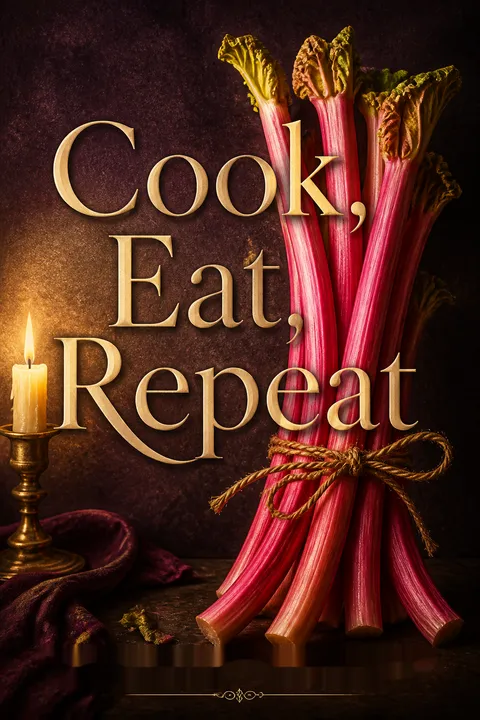
Let winter rhubarb move from custard to meat, not just dessert.
Seasonality invites reinvention. Lawson celebrates Yorkshire forced rhubarb, grown in darkness and harvested in winter, for its tender texture and vivid pink color. She favors roasting it gently with sugar when she wants the stalks to hold their shape. The resulting fruit can become a compote, trifle, crumble, cake, or syrup, but its use need not stop with sweets.
Tartness has savory uses. Rhubarb can sharpen a sauce for pork or oily fish, and it can bring a bright sour note to a slow-cooked beef stew. These combinations take advantage of the ingredient's acidity rather than forcing it into a familiar dessert role. Seasonal cooking here is not a rulebook about eating only what is local; it is a prompt to notice what is available and explore more than one expression of it.
Rhubarb provides a vivid example of how seasonality can shape imagination as well as shopping. Its winter arrival challenges the assumption that a spring ingredient must belong to spring, while its tartness makes it useful beyond the dessert course. The approach encourages cooks to think in terms of flavor and texture rather than rigid categories. Still, Yorkshire forced rhubarb is tied to a particular place and supply, and access varies. The broader lesson travels better than the ingredient: use the character of what is in season to find unexpected roles for it.
Analysis
Cook, Eat, Repeat is neither simply a recipe collection nor a memoir with recipes attached. Its essays make a case for home cooking as an everyday practice where skill, memory, appetite, and care meet. The recipes function as evidence: anchovies show how a strong ingredient can become subtle; brown stews challenge image-first ideas of good food; rhubarb moves between sweet and savory dishes; and leftovers make repetition tangible rather than monotonous.
The book's most useful tension is between precision and freedom. A cook needs clear, tested instructions, especially when baking, yet an instruction cannot account for every stove, ingredient, appetite, or household. Lawson resolves this not with a universal rule but with a developing capacity to notice. Experience helps cooks recognize when a dish needs time, liquid, salt, or a different route. The approach respects expertise without pretending that intuition is innate.
Its defense of pleasure is also more nuanced than a simple invitation to indulge. Lawson rejects shame as a way to govern eating, while distinguishing attentive enjoyment from automatic consumption. That distinction is compelling, though her emphasis is on psychological permission rather than the full range of constraints that shape food choices. Health, money, labor, ethics, and access can complicate pleasure. Her argument is best understood as opposition to self-punishment, not as a claim that every appetite exists outside those conditions.
The book's deepest social claim is that meals matter because they connect daily life to other people and to the past. Recipes preserve family habits, but they also invite scrutiny and change. Cooking for guests need not be a performance, and cooking alone need not be lesser. Across both settings, the kitchen is presented as a place where routine can become craft and sustenance can acquire emotional meaning. The result is a portrait of cooking that values the repeatable meal as much as the celebratory feast.
Review Summary
Cook, Eat, Repeat receives mostly positive reviews, praised for its eloquent food writing, personal essays, and diverse recipes. Readers appreciate Lawson's passion for cooking, her adaptable recipes, and her focus on pleasure in eating. Some criticize the wordiness and small font size. The book is seen as more than a typical cookbook, offering reflections on food culture and cooking philosophy. While some recipes are complex, many are accessible. The book's pandemic-era context adds depth to Lawson's musings on food and community.
People Also Read

Glossary
repertoire
Dishes a cook returns toLawson uses repertoire for the evolving collection of dishes a cook makes repeatedly and comes to know through practice. Familiarity makes preparation easier, but the collection is not fixed: new recipes can join it, old favorites can change, and the same dish can turn out differently from one cooking to the next.
Stanislavski ordering method
Imagining each dish before choosingLawson's name for deciding what to order by mentally imagining eating each dish on a menu and noticing which one promises the greatest pleasure. The method relies on attending to one's actual appetite rather than choosing what seems virtuous, fashionable, or expected by others.
cartouche
Paper cover for a cooking potA piece of baking parchment placed directly on the surface of a stew or braise, with its edges tucked inside the pot. Lawson scrunches the paper and opens it again so it can fit the dish. It helps limit evaporation while food cooks slowly beneath the pot's lid.
tandsmør
Butter spread thickly on breadA Danish word Lawson uses for a generous layer of butter on bread, thick enough to leave the marks of one's teeth after a bite. She invokes it to convey a particular pleasure in bread, butter, and anchovies, rather than as a measured recipe instruction.
umami
Savory, flavor-deepening tasteLawson describes umami as the fifth taste, alongside sweet, sour, bitter, and salty. It is associated in her discussion with savory ingredients such as anchovies, meat, Parmesan, mushrooms, tomatoes, and yeast extract. She also uses it informally to describe the depth or extra force these ingredients can give a dish.
schmaltz
Rendered chicken fatSchmaltz is chicken fat collected from cooking or roasting. Lawson saves it for later use, treating it as a flavorful cooking fat rather than something to discard. She distinguishes it from other saved fats, such as beef dripping, while describing her household practice of keeping several kinds on hand.
bottarga
Cured mullet roeBottarga is cured grey mullet roe, sometimes described as Sardinian caviar. Lawson grates it over pasta and other foods for a concentrated, salty, briny flavor. She advises adding it off the heat rather than cooking it, so its intense taste remains distinct.
ansjovis
Swedish cured spratsIn Lawson's account of Jansson's Temptation, ansjovis refers to Swedish cured sprats, not the saltier anchovies commonly meant by the English word. Their milder, sweeter cure gives the potato gratin a different balance. She notes that the liquid in the tins is often included, though she chooses not to use it.
About the Author
Other books by Nigella Lawson

Download PDF
Download EPUB
.epub digital book format is ideal for reading ebooks on phones, tablets, and e-readers.








