

Key Takeaways
Turn the dining table into a stage for diplomacy, not just appetite
Dinner carried influence. In 1829, writer Lady Morgan attended a Rothschild dinner cooked by Antonin Carême. Twelve guests faced a seven-service menu offering 18 dishes, including a new champagne fish soup named for Morgan and a spun-sugar temple bearing her name. The meal displayed technique, wealth, and a host’s attentiveness in one carefully managed performance.
A chef became famous. Carême had already cooked for Napoleon’s circle, the Russian Tsar, and Britain’s Prince Regent. But the Rothschild dinner shows how his work moved beyond feeding powerful people: guests talked about the food, writers described it, and his name attracted public interest. His celebrity grew from culinary skill joined to political access and publicity.
What's striking is that the meal works as communication before anyone speaks. A menu can signal generosity, cultural fluency, and respect for a guest, making hospitality a kind of soft power. Carême’s dinner also shows why celebrity requires intermediaries: the host provides the room, the chef creates the event, and the writer carries its reputation outward. Yet spectacle should not be confused with political success. A magnificent table can build relationships, but it cannot guarantee agreement or erase the unequal power behind the invitation.
Study architecture until pastry becomes a language of shape and order
A pastry boy studied monuments. Abandoned during the upheaval of the French Revolution, Carême entered kitchen work as a child and later apprenticed with Paris pastry chef Sylvain Bailly. In his spare hours, he studied architectural drawings and classical buildings at the Bibliothèque Nationale. He brought that visual education into pastry, designing symmetrical towers, temples, fountains, and ruined landscapes from sugar, marzipan, and dough.
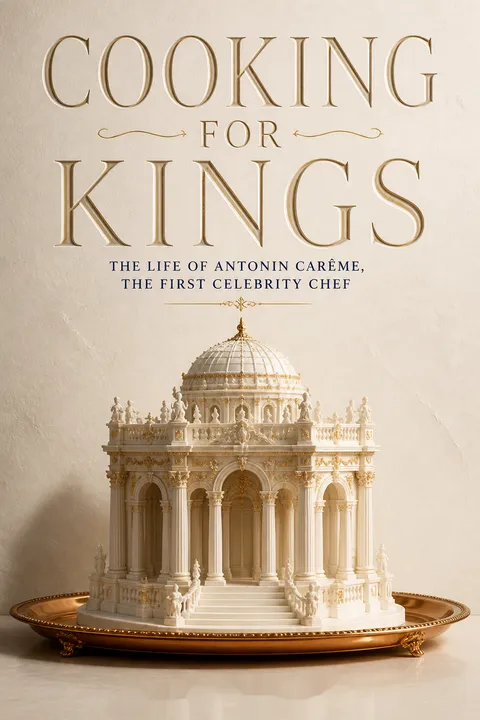
Edible art had a name. A pièce montée is a constructed centerpiece, often designed more for display than eating. Carême’s versions could take days to build, and some parts were made from durable materials intended to be reused. His creations joined the exactness of pastry work to architecture’s concerns with proportion, balance, and theatrical effect.
Carême’s career makes a case for learning across disciplines: architecture gave him a design vocabulary, while pastry gave that vocabulary material limits, heat, time, and fragility. This resembles modern design practice, where an elegant concept must survive the conditions of use. The analogy also clarifies why his centerpieces mattered. They were not simply extravagant desserts; they made a chef’s skill legible to people who might never enter a kitchen. The risk is that visual achievement can eclipse taste and labor, a tension Carême’s elaborate displays made hard to ignore.
Design the meal for eating, not merely for looking
Service shaped the food. In service à la française, many dishes appeared together on the table. The arrangement created a grand display, but food could cool, and guests might struggle to reach or share it. Service à la russe instead served dishes in sequence, closer to the plated meals familiar today. Carême worked with both approaches and saw that presentation had to serve the diner as well as the eye.
Scale exposed the problem. At an 1816 banquet for 3,000 people, Carême helped create a tiered buffet whose dramatic arrangement made some dishes difficult for guests to reach. At the Brighton Pavilion, a steam-heated table could keep about 40 platters warm at once. Better equipment helped, but the larger lesson remained: a beautiful meal is poorly designed if it arrives cold or cannot be served easily.
This is a lesson in systems design disguised as dining history. The guest experiences not just a recipe, but a chain of decisions about timing, temperature, access, and service. Carême’s attention to those constraints anticipates the modern distinction between a product’s appearance and its usability. His example also resists a simplistic story of progress: sequential service is not automatically superior in every setting, and a banquet may value ceremony as much as convenience. The useful question is what the occasion asks the meal to accomplish, then how to make its form support that purpose.
Stay mobile when political patrons and regimes change
Patronage offered room to move. Carême worked for private households, took freelance commissions, and ran a pastry shop on Paris’s rue de la Paix. He avoided making a restaurant his sole base, partly because political turmoil could make a public business vulnerable and partly because private commissions gave him access to influential kitchens and skilled colleagues.
His network crossed regimes. His mentor, diplomat Talleyrand, served successive French governments, and Carême’s own work connected him to Napoleon’s court, the restored Bourbons, the Russian occupation, British royalty, and the Rothschilds. He was not politically independent: his livelihood depended on powerful employers. But a mix of clients, skills, and public reputation helped him keep working as the rulers around him changed.
Carême’s career illustrates a durable form of resilience: build skills and relationships that transfer between institutions rather than relying on one employer or market. His pastry training opened doors beyond pastry, and his reputation could travel from Paris to London, Vienna, and St. Petersburg. Still, mobility is not the same as security. Patronage can provide resources and room for experimentation, while also making a worker dependent on a few powerful people. The model is most useful when paired with an asset that belongs to the worker, in Carême’s case, portable expertise and an increasingly recognizable name.
Write recipes so personal mastery can travel beyond your kitchen
Books expanded his reach. Carême published his first major pastry book in 1815, then a work on menus and household catering in 1822. The latter offered a different seasonal menu for every day of the year and recorded meals prepared for European courts. In 1822, he also organized sauces into four principal families: béchamel, velouté, espagnol, and allemande, presenting them as foundations from which other sauces could be developed.
Documentation paid off. His books made professional methods available to cooks and curious readers who could not dine at his employers’ tables. By 1832, royalties from his collected works brought him about 20,000 francs a year. His final encyclopedic project remained unfinished at his death, but its scale reveals his ambition: preserve a craft in writing, not only in memory.
Carême’s publishing turns individual skill into transferable knowledge, much as technical manuals allow work to be repeated beyond the original workshop. The four sauce families offer a compact organizing principle: instead of memorizing an endless list, cooks can understand relationships among preparations. That makes the book more than a collection of recipes. Yet written instructions cannot capture every judgment made by an experienced cook, and Carême’s own recipes sometimes leave quantities or procedures imprecise. A useful craft record therefore does two things: standardizes what can be standardized and makes the remaining need for practice visible.
Use cultural expertise to turn money into social authority
A banker needed acceptance. When James and Betty de Rothschild engaged Carême in 1823, James was wealthy but not yet fully accepted by Parisian high society. The family faced snobbery and antisemitism. Betty, a knowledgeable host and arts patron, used elaborate dinners and parties to draw influential guests into their home.
The table helped change their standing. Carême prepared meals for the Rothschilds’ guests, while writers and artists, including Lady Morgan, Balzac, Chopin, and Ingres, became part of their social circle. The dinners gave the family a public setting in which to display taste, hospitality, and cultural connections. Carême’s cooking did not single-handedly overcome prejudice, but it helped make the Rothschild home a center of Parisian society.
The episode shows that wealth alone does not automatically confer belonging. In sociology, cultural capital describes valued knowledge and practices that help people gain recognition within a social group. The Rothschilds’ hosting translated financial resources into shared experiences and relationships, while Carême supplied expertise that guests could recognize and discuss. But the account should not be mistaken for a neat story in which good taste defeats discrimination. Hospitality could improve access to elite circles without dissolving the prejudices that limited that access in the first place.
Remember that culinary spectacle rests on punishing hidden labor
The feast began long before guests arrived. For a major dinner, Carême coordinated a large staff, vast quantities of ingredients, hot stoves, sauces, pastries, and elaborate centerpieces. At the Rothschild dinner in 1829, he had worked for about 18 hours by the time he briefly met Lady Morgan. His kitchens were hot, crowded, and often poorly ventilated.
The chef paid physically. Carême believed the charcoal fumes that filled kitchens contributed to his illness; the biographer considers chronic carbon-monoxide exposure a likely cause of his decline. He died at 49. His career also unfolded amid sharp inequalities: he could command a high salary and still depended on the labor of assistants, kitchen hands, and servants whose work largely disappeared from the finished spectacle.
The biography’s glamour is strongest when set against the conditions that produced it. A polished dinner is the visible tip of a labor system, and focusing on the celebrated chef can make teams, exhaustion, and occupational risk seem incidental. Contemporary conversations about workplace safety and invisible service work sharpen this point: artistry does not cancel the need for humane conditions. At the same time, Carême’s own suffering should not stand in for every worker’s experience. His status and income were exceptional, while many below him had fewer choices and less recognition.
Make a chef's signature tangible enough for others to repeat
A uniform became an emblem. While working for Lord Stewart in Vienna, Carême began wearing a raised white hat, stiffened to distinguish it from the soft caps common in kitchens. Other chefs copied the look, and it became a recognizable mark of the profession. His reputation was also attached to dishes and methods that entered broader culinary practice, including soufflés, vol-au-vents, piped meringues, and a systematic approach to sauces.
Influence spread through imitation. Carême’s books, recipes, and public image helped make the professional chef a figure whose name could carry authority beyond a single household. The book credits him with shaping French haute cuisine, a refined tradition of elaborate technique and presentation. His legacy is not one invention alone, but a visible identity combined with methods other cooks could adapt.
The toque is a striking example of how professional identity can become visible through a small, repeatable object. A uniform marks expertise to outsiders and builds solidarity among practitioners; recipes and techniques perform a similar role inside the craft. Together, they made the chef more publicly legible. Yet culinary history rarely belongs to one person alone. Carême’s influence is substantial, but the dishes and standards associated with him emerged through kitchens, assistants, predecessors, and later cooks. The strongest legacy is therefore not a solitary genius myth, but a body of practice that others could carry forward.
Don't mistake the inheritance of a cookbook for the inheritance of affection
His final plans bound family to work. In a 1832 letter to his assistant Jay, Carême hoped Jay would marry his daughter Marie and help complete the remaining volumes of his culinary encyclopedia. He linked their future to Marie’s wellbeing, the continuation of his work, and its potential income. Carême died in January 1833 before these hopes were resolved.
The private legacy fractured. Jay and Marie did not marry. After her father’s death, Marie disposed of much of his personal material and did not support completion of the final volumes. The reasons are uncertain. The biography suggests that her childhood separation from her father and the failed marriage plan may have shaped her response, but the surviving record cannot settle her motives. His professional work endured; his family story did not end neatly.
The letter reveals how easily mentorship, inheritance, and family obligation can become tangled. Carême appears to have viewed Jay as both a trusted collaborator and a potential son-in-law, while Marie’s wishes remain less visible in the record. That imbalance matters: a father’s plan for a child’s future is not the same as the child’s consent. The biographical evidence supports a poignant tension, not a confident diagnosis of Marie’s motives. The broader lesson is modest but important: professional succession can preserve a body of work, yet it cannot substitute for a relationship built through attention and mutual choice.
Analysis
Cooking for Kings follows Carême from a childhood shaped by revolutionary violence to kitchens serving Europe’s most powerful households. Its central subject is not simply culinary invention. It is the conversion of craft into cultural and political influence. Carême’s meals helped Talleyrand entertain diplomats, helped the Rothschilds claim a place in Parisian society, and gave rulers a language of hospitality that could be staged, recorded, and discussed. His career also tracks changes in how people ate, from table displays that prioritized visual abundance toward sequential service that better preserved temperature and access.
The book’s strongest method is to make culinary labor visible through scenes: the hours required to build a sugar centerpiece, the logistics of a banquet, the timing of dishes, and the atmosphere of crowded charcoal kitchens. These details make the history concrete, while menus and recipes show how tastes and social conventions changed. The dinner for Lady Morgan provides a particularly effective frame because it joins food, celebrity, patronage, and writing in one event.
The account also has the uncertainties of a life reconstructed from uneven records. Carême shaped his own public image through books and memoir-like recollections, while key details of his birth, marriages, and family life remain unclear. The biographer sometimes proposes explanations, especially around illness and his daughter’s later choices, that should be read as plausible interpretations rather than settled facts. That uncertainty does not weaken the story; it reveals how fame can preserve professional output while leaving intimate relationships obscure.
Carême’s achievement was collective in practice even when celebrity attached itself to one name. He systematized knowledge, trained assistants, worked within large staffs, and made the chef recognizable as an author and public figure. The biography’s richest tension is that this elevated status coexisted with exhausting conditions and personal disconnection. It presents culinary history as both an art of brilliant construction and a labor system with costs borne by people beneath the glittering table.
Review Summary
Cooking for Kings received mixed reviews, with an average rating of 3.74 out of 5. Readers praised the book's historical insights, fascinating subject matter, and beautiful design. Many appreciated learning about Antonin Careme's life and influence on modern cuisine. However, some critics found the writing dry and the biographical details lacking. The included recipes were noted as interesting historical artifacts, though not necessarily practical for modern cooks. Overall, the book was seen as an engaging, if sometimes flawed, exploration of the world's first celebrity chef.
People Also Read






Glossary
service à la française
many dishes served togetherA formal style of dining in which many dishes are placed on the table at once, often arranged symmetrically. Guests choose from the display, while hot dishes may be brought out in successive sets. The style creates visual abundance and ceremony, but can make food harder to keep hot and distribute evenly.
service à la russe
dishes served in sequenceA style of dining in which dishes are served one after another, often already portioned for individual guests. Carême encountered it in Russia and helped support its adoption in France. It offered better control over temperature and pacing than displaying most of a meal at once, though it changed the visual drama of the table.
pièce montée
constructed centerpieceA built centerpiece made from pastry, sugar, marzipan, or other confectionery materials. In Carême’s work, these structures often represented buildings, landscapes, or monuments. Some parts were edible, while others were made to be durable and could be reused. The purpose was as much visual display and ceremony as dessert.
extraordinaire
elaborate confectionery displayCarême’s term for an elaborate confectionery creation, often designed as an architectural centerpiece for a banquet. These displays helped distinguish his early work as a pastry chef and brought him commissions from wealthy patrons. They could be elaborate enough to require several days of construction and were valued for their visual impact as well as their culinary craft.
haute cuisine
refined professional cookingA tradition of ambitious, technically demanding cooking associated with elite dining and professional kitchens. In the book, Carême helps codify its methods through elaborate menus, carefully prepared sauces, precise presentation, and published recipes. The term describes both a style of food and the standards of expertise that made professional chefs influential.
nouvelle cuisine
Carême's soup-based menusCarême used this phrase for menus organized around soup as the opening of a meal. He treated soup as more than a dish: it could renew the palate, begin a shared dining ritual, and, in some cases, serve a restorative purpose. This historical usage should not be confused with the later movement also called nouvelle cuisine.
four classic sauces
four foundational sauce familiesCarême grouped sauces into four principal families: béchamel, velouté, espagnol, and allemande. He treated these as foundations from which other sauces could be developed. The classification gave professional cooks a way to organize a large repertoire by underlying method and ingredients rather than treating every sauce as an unrelated recipe.
Download PDF
Download EPUB
.epub digital book format is ideal for reading ebooks on phones, tablets, and e-readers.








