

Key Takeaways
Redesign the system, not just its emissions
A flawed inheritance. The Titanic stands for an industrial system built with confidence in its power, but little thought for what its design would leave behind. The Industrial Revolution was not planned as a whole. It emerged from decisions to make goods faster, cheaper, and in greater quantities. Those choices brought wider access to products, jobs, and comforts, while also creating a linear pattern: extract materials, make products, then discard them.
Look upstream. The authors cite an estimate that more than 90 percent of materials extracted for durable goods in the United States become waste almost immediately. They also estimate that a finished product contains only about 5 percent of the raw materials used to make and deliver it. The problem, they argue, is not simply careless behavior. It is a design brief that treats the natural world as an unlimited supply and a dump.
The useful shift is from judging individual choices to examining the systems that make those choices normal. A product's ingredients, factory, supply chain, and end-of-use route are usually settled long before a customer encounters it. That makes designers and executives powerful points of intervention, not merely convenient villains. The industrial system also delivered real gains in health, mobility, and access, so rejecting it wholesale would obscure the challenge. The sharper question is how to preserve its productive capacity while changing the material flows that turn production into pollution.
Efficiency can make a harmful system quietly more destructive
Less damage is not repair. Eco-efficiency means producing more value with fewer resources and less pollution. The authors acknowledge its benefits, including the pollution-prevention program at 3M, which reported savings of more than $750 million by 1997. Their objection is to treating efficiency as the final goal: it can slow harmful activity without changing its direction.
Check the whole result. Recycling often means downcycling, or turning a material into a lower-quality form that cannot return to its original use. Mixing different steel alloys and contaminants, for example, can prevent recovered steel from becoming high-grade car steel again. The book also describes tightly sealed, energy-saving homes that can concentrate pollutants from poorly chosen materials. Efficiency is valuable when the larger system is beneficial, but optimizing a destructive system can simply make its damage harder to see.
Efficiency is a measure of means, not ends. In systems engineering, a process can meet its local target while worsening the performance of the larger system, a familiar problem when a factory optimizes unit cost but ignores disposal or health costs. This is a strong reason to pair efficiency metrics with measures of material quality and ecological consequence. The caution has limits: reducing energy use or toxic releases can prevent immediate harm even before a full redesign is possible. The book's best distinction is not efficiency versus effectiveness, but efficiency as a tool versus efficiency as a complete environmental strategy.
Make every material useful again, in nature or industry
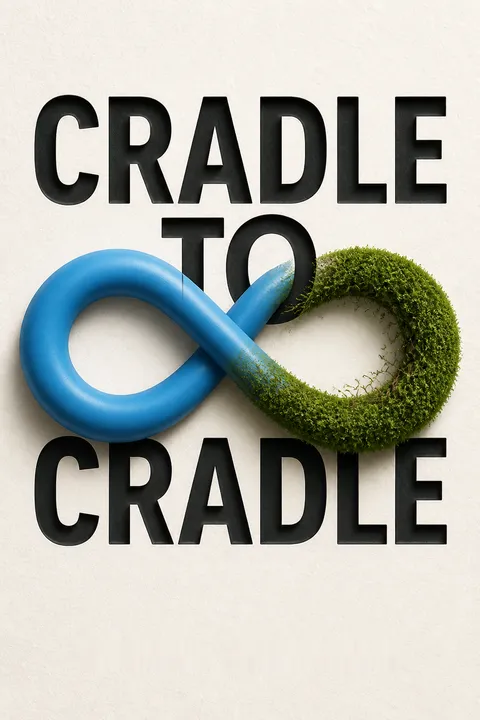
Waste is a design choice. Cradle to Cradle is the book's central idea: design products so their materials become nutrients for natural systems or inputs for new industrial products, rather than waste headed for a landfill or incinerator. The authors describe two material cycles. The biological metabolism is nature's cycle of growth and decomposition. The technical metabolism is industry's cycle of materials that can be recovered and reused.
Follow the tree. A cherry tree produces more blossoms and fruit than it needs to reproduce. Fallen blossoms and fruit feed soil organisms and other life. The tree's surplus becomes nourishment, not rubbish. Human industry could follow the same logic by designing the next use of materials before making the product. Materials must be suitable for their intended cycle, and the two cycles must not contaminate one another.
This is a more ambitious model than simply reducing the volume of waste. It asks whether a material can circulate at useful quality, and whether its return supports the system receiving it. That distinction resembles the difference between a metabolic cycle and a one-way supply chain: the first preserves relationships among inputs, outputs, and future production. The tree is an inspiring model, though not a literal blueprint. Industrial materials, collection networks, and safety requirements differ from biological systems, so the analogy works best as a design question: what should this product feed when its first job is done?
Keep biological nutrients separate from industrial materials
Design for one destination. A product should either return safely to living systems or keep its useful materials circulating in industry. A material that is harmless in a factory loop may still be damaging in soil or water. A mixed product can fail both routes, becoming what the authors call a monstrous hybrid: materials combined so that they cannot be safely composted or effectively recovered.
The fabric test. For an office upholstery project, the designers rejected a proposed blend of cotton and recycled plastic because the combined fabric could not safely return to nature or industry. They instead selected plant and animal fibers, then scrutinized dyes and processing chemicals. After nearly 8,000 commonly used textile chemicals were ruled out, the team chose 38 ingredients for the fabric. The mill's wastewater reportedly tested as clean as, or cleaner than, its incoming water.
The example makes material compatibility a design requirement, not a recycling problem to solve after manufacture. It also shows why ingredient lists alone are insufficient: the same substance can have different risks depending on exposure, processing, and destination. The project's intensive screening required unusual cooperation from a chemical supplier, which is a reminder that transparency is a prerequisite for informed design. A single successful fabric does not establish a universal recipe, but it demonstrates a method: choose the intended material cycle first, then select ingredients and processes that fit it.
Sell useful service, then reclaim the materials
Keep materials in circulation. A product of service is a product the customer uses without necessarily owning its valuable materials. The manufacturer retains responsibility for taking it back, disassembling it, and recovering suitable ingredients for future products. Customers pay for the service they need, such as carpeting or television use, instead of paying to own materials they will eventually have to discard.
Change the incentive. The authors describe a rent-a-solvent proposal in which a provider supplies a degreasing service, then recovers the solvent and separates it from the grease for reuse. The provider has a reason to use a durable, recoverable solvent because it remains responsible for the material. Carpet makers could similarly retrieve old flooring, replace its surface, and reuse the recovered material. The aim is to make useful materials an asset to the manufacturer, not a disposal cost passed to the customer.
This model aligns responsibility with control: the organization that chooses a product's materials also has reason to plan its recovery. It can make durability, repair, and disassembly commercially relevant rather than charitable extras. The model is not automatic, however. Take-back requires transport, sorting, and reliable markets for recovered inputs, and those systems can be costly or uneven across regions. The strongest applications are likely products with valuable, identifiable materials and customers who can return them conveniently. Service-based ownership is therefore a powerful incentive design, but it still needs practical recovery infrastructure.
Fit design to local ecosystems, cultures, and energy
Design for a place. The authors argue that a universal product or building often ignores local climate, materials, customs, and ecological needs. Their proposed homes for Bedouin communities in Jordan used local clay, straw, and craft knowledge rather than importing generic housing blocks. The design took advantage of the desert's daily temperature changes, storing nighttime coolness in the building's mass.
Make local cycles visible. A wastewater system in Brazil used ponds, plants, microbes, and other organisms to clean village wastewater. The resulting water and nutrient-rich sludge became useful to local farmers. Such projects make a community's material flows tangible instead of sending pollution somewhere called away. The authors extend the principle to local energy, native species, and cultural expression: the right solution depends on the place and the people who live there.
Local fit is more than an aesthetic preference. It can reduce dependence on imported materials, draw on existing skills, and make environmental consequences legible to the people affected. The Jordan and Brazil examples also reveal design as a social process: local knowledge and participation help determine whether a technically sound idea is usable. Localism should not become a blanket rule, though. Some regions lack particular materials or expertise, and supply chains can support livelihoods elsewhere. The more defensible principle is to account for distant effects while adapting solutions to the ecological and cultural realities of each place.
Choose ingredients for health, not merely the absence of toxins
Move beyond bans. The authors warn that removing one suspect ingredient can introduce a worse substitute. Their design process moves from avoiding known hazards toward choosing materials for positive qualities:
1. Remove substances widely recognized as harmful.
2. Use informed preferences when information is incomplete.
3. Inventory ingredients and screen their effects.
4. Redesign around a preferred set of safe ingredients.
5. Reimagine the product or the need it serves.
Sort the evidence. The book's X list identifies the most urgent substances to phase out. Its gray list holds problematic materials that may still be necessary when safer substitutes are unavailable. Its P list contains materials judged preferable for health and environmental performance. These lists help teams prioritize action while acknowledging uncertainty. The goal is not a product that is merely free of a famous toxin, but one whose ingredients and uses have been deliberately assessed.
This approach treats chemical knowledge as a design filter, while admitting that incomplete data makes decisions difficult. The three lists offer a useful triage: urgent hazards, conditional concerns, and preferred options. That is more practical than pretending every ingredient can be declared safe or unsafe with certainty. Still, classifications depend on the quality of available evidence and the conditions of use. A preferred ingredient can have impacts in extraction or manufacture that a product-level screen misses. The framework is strongest when the lists are updated, transparent, and connected to the full material life cycle.
Put ecology, fairness, and profit into the first design brief
Design value at the start. The authors contrast a triple bottom line, often calculated after a business plan is set, with a triple top line that builds ecological, social, and economic goals into the original design. Their fractal tool prompts teams to examine a proposal from multiple perspectives, including profitability, fair treatment, human health, and ecosystem effects.
The River Rouge test. Ford chose to redesign its aging manufacturing site rather than abandon it and build elsewhere. The plan included a green roof, porous parking areas, and a constructed wetland to manage stormwater. The company estimated that this approach could avoid up to $48 million in conventional infrastructure costs and save as much as $35 million. It could also improve habitat and the workplace. The project shows how ecological and financial goals can reinforce one another when considered together.
The design-stage framing matters because trade-offs become harder to escape once the basic product or site has already been chosen. A team that starts with several kinds of value can discover options that a narrow cost calculation would miss. The Ford example also gives the argument an institutional dimension: senior leadership created space for engineers, workers, scientists, and designers to challenge established assumptions. The financial estimates are project-specific, not proof that every ecological feature pays for itself. Their broader significance is that ecological performance can be treated as a source of value to test, rather than a penalty to add afterward.
Start with today's product, then redesign the need itself
Change in stages. The book's practical sequence begins with existing products and expands the design assignment as understanding improves. Teams first remove obvious hazards and make the best choices possible with available information. They then map ingredients and effects, create a preferred materials list, and redesign the product for biological or technical cycles. Finally, they question whether the original product is the best way to meet the customer's need.
Keep learning. An automobile redesigned for disassembly and cleaner materials is progress, but it does not settle whether more cars or a different transportation system would better serve people. The authors therefore urge companies to signal a clear direction, restore damaged places, leave room for experimentation, and account for future generations. The process is not a demand for instant perfection. It is a commitment to improve the design brief instead of endlessly polishing a flawed one.
The staged approach avoids two common traps: waiting for complete information before acting, and treating a safer version of an existing product as the final answer. It also distinguishes product innovation from problem reframing. A better car may reduce some harms, while a broader mobility design might address needs the car itself cannot solve. That wider question is strategically useful, but it can unsettle organizations built around current products. The framework asks leaders to protect space for experiments whose commercial purpose is not yet obvious, while still measuring whether those experiments improve material, social, and economic outcomes.
Analysis
Cradle to Cradle is best understood as a design argument rather than a consumer rulebook. Its central move is to shift environmental responsibility upstream, from guilt about consumption to decisions about materials, product architecture, ownership, and infrastructure. The book's memorable biological analogy gives this shift emotional force: in living systems, outputs can nourish other processes. Its industrial translation is more demanding than recycling because it requires materials to retain value and remain suitable for a defined cycle.
The argument also corrects a blind spot in efficiency thinking. A percentage improvement can look successful while the total system continues to extract resources, mix incompatible materials, or export pollution. The authors therefore ask what is being optimized and for whom. Their examples of upholstery, wastewater, buildings, and Ford's River Rouge make the principle concrete, showing that environmental design can also improve working conditions, local ecosystems, and business prospects.
The framework should not be mistaken for evidence that every closed loop is technically or economically achievable. Recovery systems require collection, sorting, transport, and markets; those processes consume resources and depend on institutions. Nor does a material's ability to circulate prove that the product is needed at its current scale. The book itself gestures toward this larger question when it moves from redesigning a car to reconsidering transportation.
A rigorous application would combine the book's design ambition with transparent life-cycle assessment, careful accounting of rebound effects, and attention to who bears costs or risks. It would also distinguish biological degradation from harmless degradation: a material is not nourishing merely because it is called biodegradable. These qualifications do not weaken the central proposition. They make it testable. The lasting contribution is a better opening question for design: not how to make today's damage slightly smaller, but what a product should give back, to whom, and through which material pathway.
Review Summary
Cradle to Cradle presents a revolutionary approach to design and manufacturing, advocating for products that can be endlessly recycled or reused. Readers appreciate the book's innovative ideas but criticize its repetitiveness and lack of practical solutions. Many find the concept of "cradle to cradle" design inspiring, though some feel the authors are overly idealistic. The book's unique physical properties, being made of recyclable plastic, exemplify its philosophy. Overall, readers value the book for challenging conventional thinking about sustainability and consumption.
People Also Read




Glossary
Cradle to Cradle
Materials circulate as nutrientsA design approach in which products are planned from the beginning to return their materials to useful cycles after use. Biological materials should safely nourish living systems, while industrial materials should remain recoverable for new products. The approach rejects the assumption that a product's useful life must end in landfill or incineration.
eco-effectiveness
Design for positive effectsA design strategy that aims to create products, buildings, and systems with beneficial effects on ecological, social, and economic life. Rather than only reducing the harm of existing production, it asks whether materials can nourish biological or industrial cycles, whether the design fits its setting, and whether its growth contributes to wider prosperity.
eco-efficiency
More value, fewer inputsThe strategy of producing more value while using fewer resources and releasing less pollution. The authors regard it as useful for reducing immediate impacts and improving operations, but insufficient as an overall environmental goal. If the underlying product or system is poorly designed, greater efficiency can prolong or conceal its harmful effects.
biological metabolism
Nature's nutrient cycleThe cycle of materials that living systems can safely consume and use. Biological nutrients decompose through natural processes and contribute to soil, organisms, or other ecological functions. Products intended for this cycle must avoid substances that persist, accumulate, or harm the organisms and environments that receive them.
technical metabolism
Industry's material cycleThe industrial cycle in which durable materials are recovered and reused as inputs for further manufacturing. Technical nutrients should retain their usefulness and quality rather than being mixed with biological materials or degraded into products that cannot return to high-value industrial uses.
products of consumption
Products safe for natureProducts designed from materials that can safely return to biological systems after use. The book suggests that many short-lived items, particularly packaging, could be made this way. Their ingredients should be suitable for decomposition and should not contaminate soil, water, or living organisms.
products of service
Use without material ownershipProducts whose function is provided to customers while the manufacturer retains responsibility for valuable materials. The maker can take products back, disassemble them, and recover components for further use. Carpets, televisions, and solvents are examples discussed as potential service offerings rather than objects customers must eventually discard.
monstrous hybrids
Materials that defeat recoveryProducts made by combining biological and technical materials, or incompatible industrial materials, in ways that make safe return or high-quality recovery difficult. A mixed-material shoe or fabric can become waste because its ingredients cannot be separated into useful biological or technical cycles.
X list
Urgent phaseout substancesA screening category for substances considered highly problematic because they are known or strongly suspected to cause serious harm, including carcinogenic, mutagenic, teratogenic, or other damaging effects. The authors treat these materials as the highest priority for phaseout and, where possible, replacement.
gray list
Conditional concern substancesA category for problematic substances that may be less urgent to eliminate or may currently lack viable substitutes. Their acceptability depends on how they are used and controlled. The book suggests that a substance may be more manageable when retained in a closed technical cycle than when it can enter waste or biological systems.
P list
Preferred material ingredientsThe positive or preferred list of substances judged suitable for use after assessment of factors such as toxicity, persistence, bioaccumulation, effects on organisms, and biodegradability. The list guides designers toward deliberately selected ingredients rather than materials chosen merely because they are not on a well-known hazard list.
triple top line
Design for three kinds of valueAn approach that incorporates ecological, social, and economic goals at the beginning of design, rather than assessing them only after a business plan or product has been established. It aims to create value across all three areas through the design itself, instead of treating social and ecological performance as afterthoughts.
FAQ
What's "Cradle to Cradle" about?
- Overview of the book: "Cradle to Cradle" by William McDonough and Michael Braungart explores sustainable design and manufacturing practices. It advocates for a shift from the traditional "cradle-to-grave" model to a "cradle-to-cradle" approach.
- Core concept: The book emphasizes designing products with their entire lifecycle in mind, ensuring that materials can be reused or safely returned to the environment.
- Environmental focus: It challenges the notion of being "less bad" and instead promotes creating systems that are inherently good for the environment.
- Innovative solutions: The authors provide examples of how industries can redesign processes to eliminate waste and create positive environmental impacts.
Why should I read "Cradle to Cradle"?
- Sustainability insights: The book offers a fresh perspective on sustainability, encouraging readers to rethink how products are designed and consumed.
- Practical applications: It provides actionable strategies for businesses and individuals to implement eco-effective practices.
- Inspiration for change: The authors present a hopeful vision for the future, showing how industries can thrive while benefiting the planet.
- Thought-provoking ideas: It challenges conventional environmental approaches and inspires readers to consider innovative solutions.
What are the key takeaways of "Cradle to Cradle"?
- Cradle-to-cradle design: Products should be designed for continuous cycles of use, either as biological or technical nutrients.
- Eco-effectiveness over eco-efficiency: The goal is to create systems that are inherently beneficial, rather than just reducing harm.
- Respect for diversity: Emphasizes the importance of cultural, ecological, and material diversity in sustainable design.
- Positive impact: Encourages industries to create products and processes that contribute positively to the environment and society.
What is the "cradle-to-cradle" concept?
- Definition: "Cradle-to-cradle" is a sustainable design philosophy that considers a product's entire lifecycle, ensuring materials can be reused or safely returned to nature.
- Biological and technical cycles: Products are designed to fit into either biological cycles (biodegradable) or technical cycles (recyclable without loss of quality).
- Elimination of waste: The concept aims to eliminate the very idea of waste by designing products that can be perpetually cycled.
- Contrast with traditional models: Unlike the "cradle-to-grave" model, which ends in disposal, "cradle-to-cradle" focuses on regeneration and renewal.
How do McDonough and Braungart define "eco-effectiveness"?
- Beyond eco-efficiency: Eco-effectiveness focuses on creating systems that are inherently good, rather than just minimizing harm.
- Positive design: It involves designing products and processes that have a positive impact on the environment and society.
- Holistic approach: Considers the entire lifecycle of a product, from raw material extraction to end-of-life disposal or reuse.
- Long-term benefits: Aims to create sustainable systems that support ecological and human health over the long term.
What are some examples of "cradle-to-cradle" design in practice?
- Textile industry: The authors discuss a project with DesignTex to create a compostable upholstery fabric using safe, biodegradable materials.
- Automotive industry: Ford's River Rouge plant is highlighted as an example of transforming an industrial site into a sustainable manufacturing facility.
- Packaging solutions: The book suggests designing packaging that can safely decompose or be reused, reducing environmental impact.
- Product of service: Encourages companies to design products as services, where materials are reclaimed and reused by the manufacturer.
What is the significance of "waste equals food" in the book?
- Nutrient cycles: The concept emphasizes that waste should be viewed as a nutrient for new products or natural systems.
- Biological and technical nutrients: Products should be designed to fit into either biological cycles (compostable) or technical cycles (recyclable).
- Elimination of waste: By designing products with their end-of-life in mind, waste can be eliminated, and materials can be perpetually cycled.
- Sustainable systems: This approach supports the creation of sustainable systems that mimic natural processes.
How do the authors address the issue of diversity in "Cradle to Cradle"?
- Respect for diversity: The book highlights the importance of cultural, ecological, and material diversity in sustainable design.
- Local solutions: Encourages designing products and systems that are tailored to local conditions and resources.
- Biodiversity: Emphasizes the role of biodiversity in creating resilient and sustainable ecosystems.
- Cultural richness: Recognizes the value of cultural diversity in shaping sustainable practices and solutions.
What are the best quotes from "Cradle to Cradle" and what do they mean?
- "Waste equals food": This quote encapsulates the idea that waste should be seen as a resource, not a problem, and can be used to nourish new systems.
- "The world will not evolve past its current state of crisis by using the same thinking that created the situation." This quote, attributed to Albert Einstein, underscores the need for innovative thinking to solve environmental challenges.
- "Respect diversity": Highlights the importance of embracing ecological and cultural diversity in sustainable design.
- "Cradle to cradle is less about pressing towards a goal than following a compass." Suggests that sustainable design is an ongoing journey guided by principles rather than fixed endpoints.
How does "Cradle to Cradle" challenge traditional environmental approaches?
- Critique of eco-efficiency: The book argues that simply being "less bad" is not enough and calls for systems that are inherently good.
- Focus on positive impact: Encourages designing products and processes that contribute positively to the environment and society.
- Holistic perspective: Considers the entire lifecycle of a product, from raw material extraction to end-of-life disposal or reuse.
- Innovative solutions: Inspires readers to think creatively and develop new approaches to sustainability.
What role does innovation play in "Cradle to Cradle"?
- Driving change: Innovation is seen as a key driver for transforming industries and creating sustainable systems.
- Creative solutions: The book encourages thinking outside the box to develop new products and processes that are eco-effective.
- Continuous improvement: Emphasizes the importance of ongoing innovation to adapt to changing conditions and improve sustainability.
- Collaboration: Highlights the need for collaboration between designers, manufacturers, and consumers to achieve innovative solutions.
How can businesses implement the principles of "Cradle to Cradle"?
- Redesign products: Businesses are encouraged to redesign products with their entire lifecycle in mind, ensuring materials can be reused or safely returned to nature.
- Adopt eco-effective practices: Implement practices that focus on creating systems that are inherently beneficial to the environment and society.
- Engage stakeholders: Collaborate with stakeholders, including suppliers, customers, and communities, to develop sustainable solutions.
- Measure success: Use metrics that consider environmental, social, and economic impacts to evaluate the success of sustainability initiatives.
Download PDF
Download EPUB
.epub digital book format is ideal for reading ebooks on phones, tablets, and e-readers.








