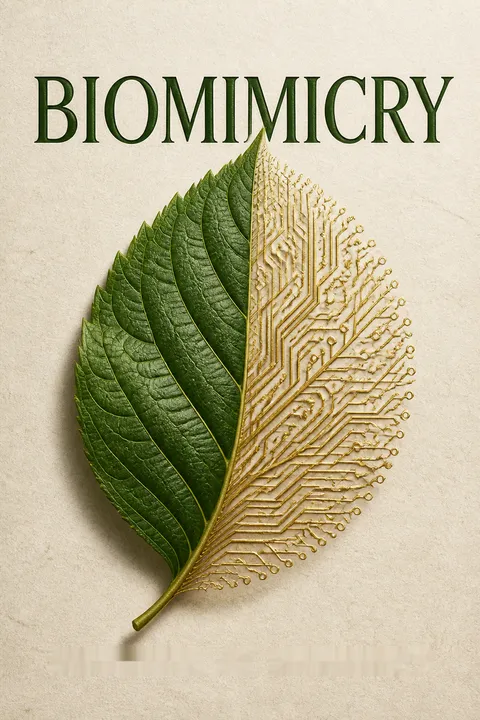


Key Takeaways
Treat nature as a design partner, not a warehouse of parts
Learn from life’s long trial. Biomimicry means studying living systems and adapting their designs or processes to human problems. It also asks whether an innovation fits ecological limits, not merely whether it works for people. Benyus points to life’s 3.8 billion years of experimentation: organisms have developed ways to gather energy, make materials, and sustain communities without exhausting the conditions they need to live.
Imitation needs humility. The book’s history of flight offers a warning. The Wright brothers studied birds to understand lift and drag, yet within eleven years, airplanes were being used to drop bombs. Learning from nature can improve a tool, but it cannot decide what the tool is for.
What's powerful here is the shift from treating nature as raw material to treating it as accumulated knowledge. That connects biomimicry to systems thinking: a design is judged by its effects on the surrounding network, not just by its immediate function. The caution is equally important. Evolution selects traits that help organisms reproduce in particular settings. It does not automatically produce designs that are ethical, harmless, or appropriate for human society. Inspiration still needs human judgment.
Replace annual monocultures with perennial communities adapted to place
Prairies protect what feeds them. A hailstorm in southwestern Minnesota shows the risk of planting vast fields with one crop at one stage of growth: a single event can damage nearly everything. A prairie absorbs disturbance differently. Its diverse plants include deep and shallow roots, nitrogen fixers, and species that thrive under different weather conditions. The book describes a 231-species prairie patch, nearly all perennial, whose roots hold soil and help water sink in.
Redesign the farm, not just the crop. The Land Institute sought to breed perennial grains and grow them in mixed communities, using the prairie as a model. The scale of soil loss in conventional farming makes the stakes clear: the book reports that North American prairie soils lost about one-third of their topsoil over a century, and that wheat fields produced eight times the runoff of prairie in comparable downpours. The alternative was promising research, not yet a ready-made replacement for every farm.
The prairie model links biodiversity to practical risk management. In finance, a portfolio spreads exposure; in ecology, mixed species spread vulnerability across different roots, seasons, and tolerances. The analogy is useful, but it should not flatten the farmer’s problem: perennial mixtures may require new harvesting methods, markets, and knowledge, while yields and income must remain dependable. The book’s strongest point is therefore not that every field should become a prairie, but that agriculture should imitate the local ecosystem’s functions.
Build energy systems that harvest today's sunlight, not ancient sunlight
Fossil fuel is stored sunlight. Plants capture light through photosynthesis, using it to make energy-rich sugars. Coal, oil, and gas are ancient biological material whose stored energy is released by combustion. Benyus argues that burning this inheritance rapidly, while current sunlight streams onto Earth, is both wasteful and damaging.
Copy the process, not just the panel. Researchers at Arizona State University built a five-part molecule, called a pentad, that separates electric charges after absorbing light. The book reports an 83 percent charge-separation yield, approaching the 95 percent cited for photosynthesis. Separating charges is only an early step toward useful fuel or chemical production. Another researcher’s photozyme concept used light-absorbing polymers to drive reactions in water. These examples were experimental prospects, not mature replacements for existing energy systems.
Photosynthesis reframes energy as a conversion problem: the challenge is not simply collecting sunlight, but storing it in a form that can do useful work. That distinction connects the chapter to the broader problem of intermittent renewable power. Benyus’s molecular examples are compelling because they pursue chemical storage, not only electricity. Still, a laboratory yield does not establish a competitive energy technology. Durability, manufacturing inputs, scale, and complete life-cycle impacts matter as much as the first successful reaction.
Copy nature's manufacturing process, not just its finished shapes
Gentle conditions can make formidable materials. Industrial manufacturing often relies on high heat, pressure, and harsh chemicals. Living systems build materials in water and at ordinary temperatures. Abalone nacre, for example, combines hard calcium-carbonate crystals with thin organic layers that help deflect cracks. The book describes it as twice as tough as known ceramics. Spider silk combines strength with stretch, while mussels produce adhesive that works underwater.
Study how the material forms. The book identifies self-assembly, layered structure, and protein templates as recurring natural strategies. A mollusk first arranges proteins into a framework, then guides mineral crystals into place. Simply copying the shell’s visible pattern would miss the process that makes it tough. Understanding that process could point toward materials made with less energy, fewer toxic byproducts, and less waste.
The focus on manufacturing rather than appearance is a crucial design insight. A shell’s geometry matters, but so do its materials, interfaces, and formation conditions. This resembles process engineering, where controlling a production pathway can matter more than copying a finished product. The caution is that biological materials are embedded in living systems that repair, renew, and source ingredients in ways factories may not. A responsible imitation must assess the entire production cycle rather than assume that a natural-looking material is automatically sustainable.
Let animals guide discovery, then test their clues rigorously
Wild species are experienced foragers. Primates select food with attention to taste, nutritional value, and plant toxins. The book describes chimpanzees seeking the bitter pith of Vernonia amygdalina when ill. Researchers found antiparasitic compounds in the pith, while other parts of the plant could be toxic. The animals’ precise selection suggested that dose and plant part mattered, not merely the species name.
Behavior can narrow the search. Zoopharmacognosy is the study of animals’ use of plants and other substances to prevent or treat illness. Benyus also argues that traditional healers and local knowledge can guide drug discovery. She reports that 74 percent of 121 clinically useful plant-derived prescription drugs came to researchers’ attention through traditional medicine. Animal behavior can generate promising leads, but laboratory and clinical testing must determine whether a treatment is safe and effective.
This approach turns observation into a research filter. Instead of screening plants randomly, investigators can ask why an animal chooses one part, season, or dose, then test the relevant chemistry. The method also challenges a narrow view of expertise by taking animal behavior and community knowledge seriously. Yet observed behavior does not prove medicinal intent or benefit. Careful experiments are essential, as are fair arrangements with communities whose knowledge helps identify valuable compounds.
Explore computation through molecular form and parallel interaction
Living systems process information differently. Michael Conrad proposed that molecules could compute by physically fitting together, much as puzzle pieces do. His imagined tactilizing processor would use molecular shapes to recognize patterns and assemble an answer. It was a research concept, not a finished computer. The book contrasts this with conventional digital systems, which process encoded instructions through controlled sequences of operations.
Molecules can search many possibilities together. In 1994, Leonard Adleman used DNA strands to represent routes between seven cities and assembled possible paths in a test tube. Filtering the results identified a route meeting the puzzle’s conditions. This demonstration showed how molecular interactions could explore many combinations in parallel. It did not make DNA a general-purpose computer, but it widened the idea of what computation could be.
The chapter’s lasting contribution is conceptual: computation need not be confined to silicon circuits and explicit symbols. Molecular recognition, DNA assembly, and neural networks illustrate different ways that physical systems can process information. The contrast should not become a simplistic ranking, however. Digital computers excel at tasks that require exact, repeatable operations, while biological systems are powerful in other contexts. The practical question is which computational style suits a problem, and whether a hybrid can combine their strengths.
Turn industrial waste into another company's feedstock
Mature ecosystems close loops. A fallen leaf becomes material for organisms that return nutrients to the soil. Industrial ecology applies that principle to commerce: one company’s byproduct can become another’s input, reducing the need for new resources and limiting waste. The book contrasts this with a linear economy that extracts materials, makes products, and discards what remains.
Kalundborg made the idea visible. In this Danish industrial network, a power company shared waste steam with a refinery and a pharmaceutical plant, and warm water supported fish farming. Nitrogen-rich residue from pharmaceutical production went to nearby farmers. Sulfur and other byproducts also found users. The network depended on cooperation and practical connections between businesses. It offered a working example of industrial exchange, not proof that every industrial waste stream can be reused safely or economically.
Industrial ecology makes a company’s boundaries look less like walls and more like membranes: materials that count as waste inside one firm may have value elsewhere. This is a strong systems-design principle because it aligns environmental aims with cost reduction. But exchange alone does not guarantee sustainability. Reusing a hazardous byproduct can spread risk, and efficiency can encourage greater total production. Effective circularity needs standards for safety, transparent accounting, and attention to absolute resource use.
Price ecological damage so clean production can compete
Rules shape business behavior. Industrial ecologists distinguish between asking companies to act altruistically and changing the conditions under which they compete. Take-back requirements can make manufacturers responsible for products after use. Pollution charges, green purchasing, and environmental accounting can make previously hidden costs visible. When prices reflect damage to land, air, and water, cleaner designs gain an advantage that they did not have under the old rules.
Prevention can save money. The book cites 3M’s pollution-prevention program, which encouraged employees to change products and processes before waste was created. The company reported thousands of projects, about $750 million in savings, and 1.2 billion pounds of avoided waste. The broader lesson is to design out pollution where possible, rather than rely only on expensive cleanup after production.
This is an institutional argument, not a plea for better individual intentions. Incentives, procurement, and producer responsibility can move environmental performance into ordinary business decisions. That aligns with ecological economics, which asks whether prices reflect costs that markets otherwise leave to the public. One limitation is that a firm’s savings do not prove a net reduction in environmental harm. Policy should track total emissions and material use, not just efficiency per unit of output.
Study a living system before trying to repair it
Observation changed the pond. Near the book’s close, Benyus describes a pond covered in duckweed. After failed attempts to remove the plants, she studied a healthier pond and noticed cold water moving through it. Investigating her own pond, she uncovered a buried spring blocked by incoming soil. Restoring the flow cleared the water and carried excess duckweed away. The solution came from identifying the system’s underlying condition, not attacking its visible symptom.
Make learning part of design. Benyus proposes four linked habits: spend time in nature, learn the organisms and their abilities, bring biologists and engineers together, and protect the living diversity that supplies ideas. Biomimicry depends on both studentship and stewardship. If habitats and species disappear, their useful designs and ecological relationships may disappear before they are understood.
The pond story distills the book’s method into a memorable sequence: pause, observe, infer, intervene, and care for the conditions that made the solution possible. It resembles adaptive management, where an intervention is treated as a test and the system’s response guides further action. The approach also has limits. Listening to nature cannot replace engineering measurements or public policy, and access to healthy ecosystems is unequal. Institutions must support observation and conservation, not leave the work to individual curiosity.
Analysis
Biomimicry is most persuasive as a discipline of attention. Its central move is not to claim that nature has already produced a ready-made answer to every human problem, but to change where designers look and what they count as success. A leaf, a prairie, or a mussel becomes more than an object of study when its operating context is examined: energy source, material flows, partnerships, and capacity to persist. This systems view links biology to engineering and makes environmental consequences part of design rather than an afterthought.
The book’s examples vary in maturity. Prairie-based agriculture, animal-guided drug discovery, and industrial byproduct exchanges draw on observed behavior or working trials. Artificial photosynthesis and molecular computing include promising experiments alongside ambitions that remain speculative. That range gives the narrative energy, but readers should distinguish demonstration from deployment. A successful molecular reaction is not yet an affordable energy system; a promising perennial crop does not immediately reorganize farm markets.
A deeper complication is that evolution optimizes for reproductive success within a particular environment, not for human values such as fairness, safety, or aesthetic preference. A biological strategy may be efficient for one species and costly for its neighbors. Biomimetic designs therefore need ethical and life-cycle evaluation, not automatic approval because a natural analogue exists. Likewise, circular production can reduce waste without reducing total extraction if consumption continues to rise.
The book’s most durable contribution is its combination of technical curiosity and restraint. Nature is presented as a source of models, a standard for questioning excess, and a living archive worth protecting. The resulting practice is neither romantic rejection of technology nor faith in invention alone. It asks engineers, scientists, businesses, and communities to learn the local system before redesigning it, then judge innovation by whether it can function without undermining the conditions that support life.
Review Summary
Biomimicry: Innovation Inspired by Nature receives mixed reviews. Many praise its innovative concepts and eye-opening exploration of nature-inspired technologies. Readers appreciate the book's insights into sustainable design and ecological solutions. However, some find the scientific details overwhelming and the writing style occasionally dense. Critics note that parts of the book feel dated, given its 1997 publication. Despite these drawbacks, most readers find value in the book's core message about learning from nature to solve human challenges.
People Also Read







Glossary
Biomimicry
Learning design from lifeThe study of living organisms and natural systems for ideas that can solve human problems. In Benyus’s account, the practice goes beyond copying a shape: nature can provide a model for design, a measure for judging whether an innovation fits ecological limits, and a mentor that shifts attention from extraction toward learning.
Natural Systems Agriculture
Farming modeled on ecosystemsAn approach to agriculture that imitates the structure and functions of the native ecosystem. In the prairie research described in the book, this means developing perennial food crops in diverse mixtures that protect soil, recycle nutrients, and resist pests. The method must be adapted to local climate, soil, vegetation, and culture rather than imposed uniformly.
Zoopharmacognosy
Animals' use of remediesThe study of how animals may use plants or other substances to prevent, manage, or treat illness. Researchers look for unusual feeding or rubbing behavior, then test whether the chosen material has relevant chemical or physical effects. The field treats animal behavior as a source of research clues, not as conclusive proof of medicinal benefit.
Photozyme
Light-powered chemical reactorJames Guillet’s name for a light-absorbing polymer system designed to gather energy and concentrate selected compounds in a water-based reaction space. The concept imitates aspects of photosynthetic antennas and enzymes. In the book, photozymes are experimental systems proposed for uses such as breaking down pollutants or making chemicals with sunlight.
Tactilizing processor
Shape-matching molecular computerMichael Conrad’s proposed computing system, in which molecules recognize patterns through physical shape matching. Complementary molecular pieces would assemble into a larger structure representing an input, while enzymes or other mechanisms would make the result measurable. The idea differs from conventional symbolic processing and is presented as a research vision rather than a completed device.
Industrial ecology
Industry organized like ecosystemsA way of designing economic and manufacturing systems around ecological principles. It seeks to reduce virgin resource use, reuse materials, limit pollution, and connect companies so one process’s byproducts can serve another. The aim is to replace a largely linear extract, make, discard pattern with systems that conserve materials and account for environmental effects.
Type I, Type II, and Type III systems
Stages of ecosystem successionA framework in the book for comparing developing ecosystems with mature ones. Type I systems grow rapidly where resources are abundant. Type II systems establish longer-lived plants and intermediate relationships. Type III systems are mature communities with more specialization, cooperation, feedback, and material recycling. The framework is used as an analogy for shifting industry away from rapid throughput.
Community assembly
Formation of persistent communitiesThe process by which species enter, interact, and either persist or disappear as an ecosystem develops. The Land Institute researchers used this idea to explore how mixtures of perennial crops might settle into stable agricultural communities. Because a mature ecosystem has a history, replanting its species does not necessarily recreate its structure immediately.
FAQ
What's Biomimicry: Innovation Inspired by Nature about?
- Nature's Solutions: The book explores how humans can learn from nature's designs and processes to solve complex problems, emphasizing that nature has perfected many systems over billions of years.
- Biomimicry Defined: Janine M. Benyus defines biomimicry as "the conscious emulation of life’s genius," where innovations are inspired by natural models, contrasting with traditional methods that exploit nature.
- Applications Across Fields: It covers various fields, including agriculture, energy, materials science, and medicine, showcasing how biomimicry can lead to sustainable practices and products.
Why should I read Biomimicry: Innovation Inspired by Nature?
- Urgent Relevance: The book addresses pressing environmental issues and offers nature-inspired solutions, making it timely and relevant.
- Inspiration for Innovation: It encourages readers to view nature as a mentor, leading to more sustainable and effective solutions.
- Diverse Examples: Filled with real-world examples, the book is both informative and engaging, showing biomimicry in action across industries.
What are the key takeaways of Biomimicry: Innovation Inspired by Nature?
- Nature as Model, Measure, Mentor: Benyus outlines using nature as a model for design, a measure for sustainability, and a mentor for learning.
- Lessons from Ecosystems: Ecosystems are self-sustaining and resilient, offering valuable lessons for human systems, such as "Nature runs on sunlight."
- Interconnectedness of Life: Understanding the interconnectedness of all living things can inform sustainable design and innovation.
How does Biomimicry: Innovation Inspired by Nature define biomimicry?
- Three Definitions: Biomimicry is defined as a model, a measure, and a mentor, each highlighting different aspects of learning from nature.
- Nature as Model: Focuses on imitating nature's designs and processes, like creating solar cells inspired by leaves.
- Nature as Measure: Uses ecological standards to evaluate sustainability, providing a benchmark for human designs.
What examples of biomimicry are discussed in Biomimicry: Innovation Inspired by Nature?
- Energy Solutions: Solar cells designed to mimic leaves' sunlight capture can lead to efficient, eco-friendly energy solutions.
- Sustainable Agriculture: Farming practices inspired by natural ecosystems, like self-fertilizing systems, promote resilience and sustainability.
- Medical Innovations: Observing animals for medical breakthroughs, such as new drugs from plant use, highlights nature's potential in healthcare.
How can biomimicry change the way we conduct business?
- Closing the Loops in Commerce: Businesses can create closed-loop systems that minimize waste, inspired by ecosystems.
- Nature-Inspired Business Models: Adopting models that mimic natural systems, like cooperation, enhances resilience and adaptability.
- Long-Term Thinking: A biomimetic approach shifts focus from short-term profits to long-term sustainability.
What role does nature play in innovation according to Biomimicry: Innovation Inspired by Nature?
- Nature as a Teacher: Nature's billions of years of innovation provide a wealth of knowledge for human design.
- Learning from Failures: Nature's failures are lessons, encouraging an experimental approach to innovation.
- Inspiration for New Technologies: Many modern technologies, like Velcro, are inspired by nature, driving sustainable advancement.
How does Biomimicry: Innovation Inspired by Nature address sustainability?
- Ecological Standards: Nature is used as a measure of sustainability, ensuring environmentally sound designs.
- Resilience and Adaptability: Natural systems' resilience and adaptability provide models for sustainable human systems.
- Holistic Perspective: A holistic view of sustainability considers the interconnectedness of all living things.
What challenges does Biomimicry: Innovation Inspired by Nature identify in adopting biomimicry?
- Cultural Resistance: Resistance to changing established practices requires education and advocacy for biomimicry's benefits.
- Need for Interdisciplinary Collaboration: Collaboration across disciplines is crucial but challenging in traditional structures.
- Balancing Innovation and Conservation: Biomimicry must be used respectfully to protect, not exploit, nature.
What is the significance of the phrase "the world is my body" in Biomimicry: Innovation Inspired by Nature?
- Interconnectedness: This phrase highlights humans as part of a larger ecological system, not separate from nature.
- Responsibility: It encourages individuals to take responsibility for their environmental impact, fostering stewardship.
- Cultural Shift: Calls for valuing and protecting the natural world, essential for humanity's and ecosystems' survival.
How does Biomimicry: Innovation Inspired by Nature address the concept of self-medication in animals?
- Animal Pharmacists: Animals like chimpanzees use specific plants for ailments, paralleling human medicinal practices.
- Learning from Behavior: Animals learn plant use through observation, suggesting humans can learn from these behaviors.
- Implications for Human Health: Encourages exploring traditional medicine and new pharmaceuticals by studying animal behavior.
What are the best quotes from Biomimicry: Innovation Inspired by Nature and what do they mean?
- "Nature knows best": Suggests that observing natural systems can lead to effective, sustainable technologies.
- "The world is my body": Emphasizes interconnectedness with the environment, advocating for responsibility and stewardship.
- "It is time to walk in the forest again.": Reminds us to reconnect with nature for insights and inspiration for sustainable living.
Download PDF
Download EPUB
.epub digital book format is ideal for reading ebooks on phones, tablets, and e-readers.








