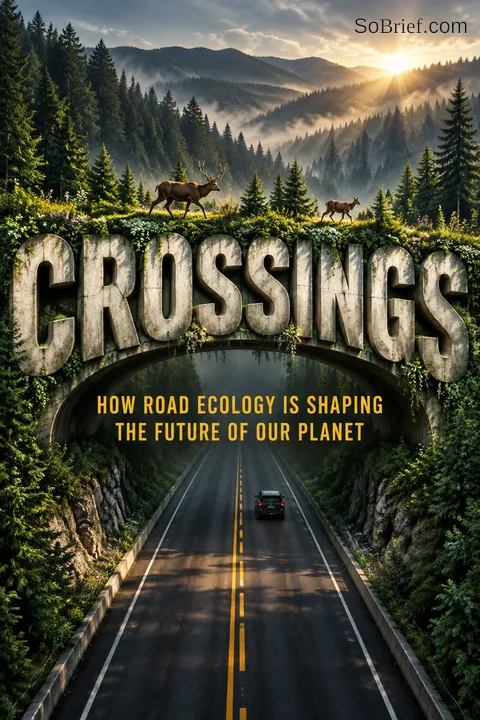


Key Takeaways
Treat roads as ecological forces, not just strips of pavement
The road’s shadow spreads. Roads occupy less than 1 percent of U.S. land, yet their ecological influence reaches roughly 20 percent. This surrounding area, called the road-effect zone, includes changes caused by noise, pollution, altered water flow, and human access. Invasive fungi hitch rides on tires; logging roads help ants spread through forests; animals avoid habitat near traffic even when they are far from the asphalt itself.
Survival can mean change. Cliff swallows gained nesting sites on bridges, but traffic also selected for birds with shorter, more maneuverable wings. The road became part of their evolutionary environment. Roads are not merely routes through nature. They reshape the conditions under which life feeds, moves, reproduces, and evolves.
The road-effect zone makes infrastructure’s hidden costs legible. A project’s footprint is not just the land beneath its pavement, but the much wider field of consequences it triggers. This resembles the idea of externalities in economics: a decision can produce costs that do not appear on the builder’s balance sheet. The swallow example sharpens the point because adaptation is not proof of harmlessness. A species may persist while its bodies, behavior, and options are altered. Resilience deserves recognition, but it should not become a convenient excuse for imposing avoidable stress.
Measure what traffic prevents, not only what it kills
A quiet road can be deadly. Animals respond to roads in different ways: some ignore traffic, some freeze, some avoid roads, and some try to dash between vehicles. Deer are among the dashers. At low traffic volumes, they may cross between cars; when traffic becomes dense, the gaps disappear. This traffic barrier is called the moving fence. In Wyoming, researchers found that deer generally needed more than a minute between vehicles to cross safely. Highways carrying over 10,000 vehicles a day can block movement for many species.
Starvation leaves no carcass. Interstate 80 cut across mule deer migration routes in Wyoming. One harsh winter, nearly 40 percent of a tracked herd died from malnutrition after the animals could not reach winter range. The road had killed them without striking them.
Collision counts are a poor proxy for a road’s total ecological harm. A decline in carcasses might mean a safer crossing, but it could also mean animals have stopped trying. This distinction resembles the difference between measuring visible incidents and measuring access to a necessary resource. Migration is not simply travel from point A to point B; it connects animals to seasonal food, breeding grounds, and changing weather. Planning that tracks only crash sites risks rewarding barriers for appearing clean. Movement data, habitat use, and population health belong in the same assessment.
Pair wildlife fences with crossings designed for the species using them
The combination matters. Fences alone can keep animals off pavement but also trap them on one side. Crossings without fences may go unused because animals reach the road rather than the passage. Together, the two direct animals toward safer routes. At Wyoming’s Nugget Canyon, wider, shorter underpasses with clear sightlines proved more inviting to mule deer than long, dark culverts. With fencing, roadkill fell from nearly ten animals a month to fewer than two.
Design is behavioral science. Pronghorn and grizzly bears often prefer open overpasses, while deer use suitable underpasses. On Montana’s U.S. 93, a network of crossings and fences reduced animal collisions by about three-quarters. Crossings can also save money: preventing crashes avoids medical costs, vehicle repairs, and other losses, not just animal deaths.
The strongest lesson is that mitigation is a system, not a structure. A bridge’s apparent elegance matters less than whether it fits the movement patterns and risk tolerance of the animals it is meant to serve. This is a useful corrective to infrastructure planning that treats design as a one-time engineering choice. It also implies an obligation to monitor use and maintain fences, passages, and escape ramps. Cost savings help build political support, but economic efficiency should not be the only test: species with little collision risk can still suffer from being cut off.
Keep populations connected before isolation reshapes their genes
A highway can become an island’s moat. The 101 freeway isolated mountain lions in California’s Santa Monica Mountains from nearby populations. Young cats struggled to disperse, while collisions removed others. With few newcomers to add genetic variety, some lions mated with close relatives. Researchers estimated the small population’s extinction risk at as high as 99.7 percent. One immigrant from the north every two years could substantially improve its prospects.
Crossings must connect lives. A passage is not successful merely because an animal walks across it. The crossing must enable dispersal, breeding, and genetic exchange. Banff researchers used hair samples to identify individual grizzly bears and found that bears crossed the highway and reproduced across it. In Los Angeles, the planned Liberty Canyon overpass aims to reconnect habitat, although even a crossing cannot compensate for development that removes the habitat beyond it.
This is landscape ecology at its most concrete: a line on a map can become a boundary in an animal’s family tree. The island analogy helps explain why small populations face compounding risks. Fewer individuals mean fewer potential mates, and inbreeding can make an already fragile population less resilient. Yet connectivity is not automatically beneficial in every context; passages need to connect viable habitat, and human activity can still deter wildlife at either end. Measuring crossings should therefore include who uses them, whether they reproduce, and whether the surrounding landscape remains habitable.
Treat road noise as habitat loss, even where pavement never reaches
Noise travels farther than asphalt. Traffic sound can mask warning calls and make it harder for predators to hear prey. A three-decibel rise in background noise can halve the area in which an animal can detect a signal. In an experiment at Idaho’s Lucky Peak, researchers played recordings of traffic from Glacier National Park along a roadless woodland. Bird numbers fell on noisy days, and some birds avoided the area. Warblers that stayed were thinner, likely because they spent more time watching for predators and less time feeding.
Protected land is not soundproof. A road through Glacier can cast a noise shadow nearly three miles wide. Slowing vehicles may reduce sound, but longer travel times can keep noise present for more of the day. Avoiding a road through sensitive habitat is often more effective than trying to quiet one after construction.
Noise reveals a form of habitat degradation that maps of land cover miss. The Phantom Road experiment is especially persuasive because it isolates sound from the other changes a road brings, such as lights, exhaust, and cleared vegetation. It also shows why animals may pay an energetic price without leaving: vigilance and feeding compete for time. Quiet is therefore not an aesthetic luxury reserved for visitors seeking solitude. It is a resource that can affect survival. At the same time, noise controls must be evaluated locally, since reducing loudness does not necessarily restore the full acoustic environment.
Roadside habitat can feed wildlife and funnel it into danger
The verge is an ecosystem. When prairie and wetlands disappeared across the Midwest, strips of native plants survived along roads and railways. These rights-of-way can connect otherwise isolated habitat and support insects, birds, and small mammals. The U.S. roadside ecosystem covers at least 17 million acres. Milkweed along highways may help monarch butterflies whose populations fell sharply as agriculture removed their food plants.
A refuge can become a trap. Roadside plants may draw insects close to traffic, while warm asphalt attracts reptiles. Road salt can enrich milkweed with sodium, but excessive exposure harms caterpillar survival and also contaminates freshwater. The central question is not whether roadsides are good or bad in general, but how their habitat value compares with collisions, noise, chemicals, and mowing. Better timing and selective maintenance can reduce some risks.
Roadside habitat complicates the familiar division between built space and nature. These strips can function as corridors, refuges, and ecological traps at once. The monarch example captures a conservation dilemma: habitat is being created in a dangerous place because safer habitat has been eliminated. That makes roadside planting useful, but not equivalent to restoring a healthy prairie. The distinction matters for policy claims. Habitat acreage alone says little about reproductive success or migration survival. Monitoring should count both what a verge supports and what it exposes animals to.
Remove obsolete roads to restore whole landscapes, not just scenery
Abandoned roads still alter nature. The U.S. Forest Service manages about 370,000 miles of roads, many built for logging or firefighting and no longer needed. Even unused tracks redirect water and destabilize soil. In Idaho’s Clearwater forest, more than 900 landslides followed severe storms in 1995, and over half were linked to old roads. Gates and closures could not undo the damage.
Restoration means taking roads apart. Crews removed roadbeds, reshaped slopes, and spread woody debris and native seeds. More than 500 miles disappeared from the Clearwater’s network. Studies found that restored soils absorbed water better, supported deeper-rooted plants, and suffered far less erosion. The Roadless Rule also protects large forest blocks from new construction. Access can remain on useful routes while redundant tracks are decommissioned.
Road removal changes the default assumption that infrastructure is permanent. The Clearwater project shows that restoration can involve subtraction: recovering natural drainage and connected habitat sometimes requires dismantling what engineering put in place. That insight fits a broader principle of ecological repair, where preventing further disturbance is often more effective than endlessly treating its symptoms. The political challenge is substantial because roads symbolize access, work, and local control. A credible program therefore needs transparent decisions about which routes remain useful, who relies on them, and how restoration work supports affected communities.
Repair culverts as habitat links and fulfill obligations to communities
A pipe can close a river. Poorly designed culverts create steep drops or fast currents that salmon cannot pass. In Washington, tribal nations argued that blocked salmon habitat undermined treaty-protected fishing rights as well as fish populations. After years of litigation, a federal ruling required the state to restore access to much of the habitat its culverts had blocked. Replacing narrow pipes with bridges or stream-shaped crossings can reopen routes for fish and reduce flood risks.
Shared benefits build support. Oregon’s Salmon SuperHighway has replaced culverts to reconnect spawning streams while helping protect rural roads from washouts. The same structures can serve terrestrial wildlife when equipped with ledges or dry passage. Treating culverts as ecological infrastructure turns routine repairs into opportunities to restore movement for fish, amphibians, and mammals.
The culverts dispute expands road ecology beyond wildlife management. A barrier in a stream can also interfere with livelihood, cultural practice, and legally recognized rights. That makes repair a question of justice as well as engineering. The most durable projects often align ecological and human benefits, such as fish passage and flood resilience, but shared benefits do not erase responsibility for past decisions. The case also illustrates why infrastructure ownership matters less to an ecosystem than continuity: a fish encounters the whole stream, not the jurisdictional boundary dividing its road crossings.
Turn roadside deaths into evidence, care, and pressure for change
Carcasses reveal hidden patterns. Roadkill records can show where animals travel, when migrations occur, and how diseases or populations change. Volunteer projects use phone photos and location data to collect observations across large areas. In one California analysis, volunteers correctly identified 97 percent of reported animals. Such data can help identify collision hotspots, although differences in survey methods and the rapid removal of carcasses can distort totals.
Care cannot replace prevention. In Tasmania, volunteers rescue orphaned marsupials from their mothers’ pouches and nurse them toward release. The work can be costly and emotionally exhausting, while the animals may return to roads that remain dangerous. Monitoring, rehabilitation, and public reporting matter, but they should support changes to road design rather than make private volunteers responsible for absorbing a systemic failure.
Citizen monitoring turns an ordinary commute into a form of public observation. Its value is scientific, but also civic: evidence collected by residents can make a diffuse problem visible to decision-makers and neighbors. The qualification is important. Opportunistic reports can overrepresent conspicuous species or heavily traveled routes, so robust conclusions require careful interpretation and, where possible, standardized surveys. Wildlife care adds a different kind of knowledge by making individual suffering difficult to dismiss. Both practices are strongest when they lead upstream, toward safer infrastructure, rather than merely documenting or repairing the injuries it produces.
Plan new roads before they lock in ecological and social damage
The largest opportunity is still ahead. More than 25 million miles of new road lanes are projected worldwide by 2050, much of it through intact habitat. Brazil illustrates the stakes: roads can open forests to logging, farming, mining, and settlement, while also disrupting wildlife and Indigenous communities. Crossings may reduce collisions, but they cannot protect a forest from land conversion after a highway makes it accessible.
Choose routes, not just remedies. Ecologists argue for avoiding intact habitat where possible, clustering new roads near existing infrastructure, and improving current routes before cutting into roadless areas. In Brazil’s Carlos Botelho State Park, night closures and a winding road that discourages high speeds prioritize wildlife movement over uninterrupted driving. These choices show that road planning can alter driver behavior and traffic access, not only add structures beside the road.
The distinction between mitigation and prevention is decisive. A wildlife bridge can reduce one road’s barrier effect, but it cannot neutralize the economic forces that may follow new access into a forest. This is why a hierarchy of choices matters: avoid sensitive places first, minimize unavoidable impacts, and repair what remains. Development needs are real, particularly where roads connect people to services and markets. The challenge is to make those benefits explicit and compare alternatives before construction turns a political decision into an entrenched landscape.
Rebuild cities for human connection, not just vehicle throughput
Roads shape human lives too. Mid-century freeways deliberately cut through Black neighborhoods, displacing residents and concentrating pollution. In Syracuse, the I-81 viaduct destroyed much of the 15th Ward and left nearby communities with lasting health and economic burdens. Replacing it with a street-level network offers a chance to reconnect the city, but without community control and protections against displacement, new amenities could bring green gentrification instead of repair.
The Anthropause exposed another model. During COVID-19 restrictions, reduced traffic lowered roadkill and noise, while cities reclaimed some streets for walking and cycling. The lesson is not that mobility should vanish, but that its amount and allocation are political choices. Wildlife crossings, public transit, safer sidewalks, and reparative investment can all make movement less dependent on private cars.
The book’s human and nonhuman stories converge on connectivity. A freeway can isolate a cougar population from potential mates and a neighborhood from its schools, shops, and social networks. Removing a barrier can repair access, but physical redesign alone does not distribute its benefits fairly. The Syracuse debate therefore usefully joins transportation planning to housing, ownership, and community governance. The Anthropause offers a rare demonstration that traffic patterns can change quickly, although an emergency shutdown is not a durable plan. Lasting repair requires institutions to decide whose movement counts and who bears its costs.
Analysis
Crossings is most powerful when it changes the scale at which a road is perceived. The reader begins with the familiar image of a dead animal on asphalt, then sees the road as a selective force that alters wings, migration, gene flow, water systems, soundscapes, and urban neighborhoods. Its strongest narrative strategy is to attach those abstractions to individual lives: a starving deer herd, an inbred mountain lion population, a salmon denied its spawning ground, and a community displaced by a viaduct. These stories make infrastructure consequential without reducing ecology to statistics alone.
The book also resists a simple anti-road conclusion. Roads deliver people and goods, yet their benefits have often been treated as universal while their costs are displaced onto wildlife and marginalized communities. Crossings, culvert repairs, and road removal show that design choices can reduce harm. But this optimistic engineering story has limits. A structure can reconnect a habitat without preventing nearby development, and a successful passage can be judged by animal counts while missing whether populations reproduce or remain viable. Likewise, replacing an urban freeway can improve public space while raising property values enough to displace the residents meant to benefit.
The central policy lesson is therefore more demanding than adding wildlife structures. It is to treat transportation as land-use governance. Decisions about where to build, which routes to retire, what forms of mobility to fund, and whose evidence counts determine the ecological and social outcome. The book’s cases suggest a practical ordering: avoid high-value habitat and communities where possible, reduce unavoidable barriers, restore damaged connections, and monitor results. That approach joins engineering with public accountability. Its memorable ethical shift is to stop treating the road as an unquestioned background and see it as a visitor whose presence must be justified to the lives already there.
People Also Read



Glossary
road ecology
Study of roads’ effectsRoad ecology studies how plants, animals, and ecosystems change in response to roads and nearby traffic. It combines biology, transportation engineering, landscape planning, and conservation. The field examines direct effects such as collisions, as well as less visible consequences including habitat fragmentation, noise, pollution, altered water flow, and barriers to migration.
road-effect zone
Area influenced by roadsThe road-effect zone is the area around a road where ecological effects extend beyond the paved surface. Traffic noise, pollution, changed drainage, invasive species, and human access can alter habitat at a distance. Its size and character vary by road and ecosystem, but the concept emphasizes that pavement alone understates a road’s footprint.
moving fence
Traffic barrier to movementA moving fence is the barrier created when dense, continuous traffic discourages wildlife from crossing a road. It can reduce visible roadkill because animals stop attempting to cross, while still preventing access to food, mates, or seasonal habitat. The term captures an indirect road impact that carcass counts alone can miss.
gap acceptance
Choosing a safe traffic gapGap acceptance describes how animals judge whether the space between passing vehicles is large enough to cross a road. The required gap depends on the species and its perception of traffic. Research on Wyoming deer found that short intervals between vehicles made crossings dangerous or unlikely, while longer gaps offered safer opportunities.
landscape dissection
Roads slicing connected habitatLandscape dissection describes the way roads divide a continuous habitat into separated pieces. The term emphasizes the precise, linear cut made by infrastructure. Dissection can restrict animal movement, reduce access to resources, isolate populations, and limit gene flow, even when the surrounding land remains undeveloped.
necrobiome
Community living around carcassesThe necrobiome is the community of organisms that gathers around and decomposes a dead body. It includes scavenging birds and mammals, insects, microbes, and other decomposers. Roadkill feeds these communities, although rapid carcass removal can interrupt the process and make roadside mortality harder for researchers to measure.
synanthropes
Wildlife using human resourcesSynanthropes are adaptable wild species that benefit from resources created by human activity. Around roads, scavengers such as ravens, vultures, and coyotes may feed on carcasses, while other species use roadside plants, drainage systems, or structures. Their success does not mean roads are harmless; these animals can also be killed by the traffic they exploit.
novel ecosystems
Human-shaped ecological communitiesNovel ecosystems are communities shaped by human activity that develop into environments with their own ecological relationships. Roadsides are one example: native plants, introduced species, insects, and animals interact in habitats created by clearing, mowing, drainage, and traffic. Such places may support wildlife while also exposing it to pollution, collisions, and other hazards.
Anthropause
Pandemic pause in human activityThe Anthropause is the sharp reduction in human movement and activity during COVID-19 restrictions. Researchers used this unusual slowdown to study how wildlife responded when traffic and other disturbances declined. Roadkill fell in several monitored places, while quieter urban soundscapes changed bird behavior, demonstrating how strongly routine human activity shapes wildlife conditions.
Download PDF
Download EPUB
.epub digital book format is ideal for reading ebooks on phones, tablets, and e-readers.








