

Key Takeaways
A paper cut is the latest chapter in life's four-billion-year family line.
A tiny repair, ancient roots. A paper cut sets off a coordinated emergency: nerves register pain, platelets form a clot, immune cells clear debris, and fibroblasts help rebuild tissue. The healed skin is not simply a plug in the gap. Cells organize a repair that restores the tissue as closely as possible to its former state.
Cells inherit from cells. Every new skin cell arose when another cell divided. Apart from the first cell in life’s history, cells have no independent beginning: their ancestry runs through an unbroken chain of reproduction. The paper cut is therefore a close-up of the book’s central idea. Living things make new living tissue from cells, and those cells continue a lineage stretching back billions of years.
What's striking is how a commonplace injury makes biological history tangible. The body is not a static object but a process maintained by countless cells coordinating repair. That view can sharpen attention to the difference between an organism and the cellular lineages it contains: most body cells end with an individual, while hereditary information can continue through reproduction. The story is evocative, but it should not blur those meanings. A cell's ancestry is continuous; a person's memories and identity are not thereby shown to persist. The book's image works best as a claim about biological continuity, not personal immortality.
Read biology through cells, inheritance, and selection, not separate creation stories.
Three discoveries converge. Antonie van Leeuwenhoek's microscopes revealed cells and tiny organisms. Robert Hooke gave the compartments he saw in cork the name cells, although he did not yet recognize their universal role. Later, Robert Remak observed cells dividing, establishing that new cells come from existing ones. Louis Pasteur's curved-neck flask helped discredit spontaneous generation: sterile broth stayed clear until airborne contamination could reach it.
Inheritance explains change. Gregor Mendel's pea crosses showed that traits pass in discrete units, while Darwin described how inherited variation can become more common when it improves reproductive success. DNA eventually supplied the molecular account of inheritance. Together, cell theory, evolution by natural selection, and molecular genetics explain both how life is built and how its forms change across generations.
This history resists the tidy myth that one genius delivers a complete theory in a flash. The account depends on instruments, experiments, accumulated observations, and arguments over credit. Remak's work, later popularized without adequate acknowledgment by Virchow, makes the human politics of discovery visible; Rosalind Franklin's role in DNA research makes the same point in a later era. Scientific methods can correct mistaken claims, but they do not automatically correct unequal recognition. The three linked ideas are powerful precisely because they emerged through different routes and then reinforced one another.
Shared cellular code points to one origin, though microbes scramble the trail.
Life shares a molecular grammar. Across known organisms, DNA uses the same four chemical bases, the code is read in triplets, and cells use ribosomes to build proteins. Life also shares striking molecular biases: proteins use left-handed amino acids, while DNA usually twists in a right-handed helix. These common features support descent from a common origin. Mitochondria add another clue: they retain their own DNA and resemble bacteria, consistent with the idea that an ancestral cell incorporated a bacterium.
The root is not a portrait. The Last Universal Common Ancestor, called Luca, is a reconstructed ancestor of all known cellular life, not a directly observed organism. Bacteria and archaea exchange genes horizontally, between unrelated cells, as well as inheriting genes from parent cells. This makes early evolutionary history resemble a tangled network more than a clean branching tree, limiting what researchers can confidently infer about Luca.
The shared code is persuasive evidence of common ancestry, while the tangled microbial record prevents that conclusion from becoming a simple family tree. The distinction matters: evidence for a shared root is stronger than certainty about the root's exact form, date, or location. Luca is best treated as a scientific reconstruction of shared features, not a literal first individual. Horizontal gene transfer also illustrates a broader point about evolution: inheritance can be networked as well as vertical. That complication does not erase common descent; it makes the history more interesting and harder to reconstruct.
Life needs a sustained energy gradient, not just a lucky chemical soup.
Ingredients are not enough. Stanley Miller's famous experiment exposed water, gases, and electrical sparks to conditions then thought to resemble early Earth. It produced amino acids, essential building blocks of proteins, but not a self-sustaining living system. A cell must continually capture energy and use it to maintain its organization. Without that ongoing flow, chemical reactions proceed toward equilibrium and the organized system breaks down.
The planet supplied turmoil. Earth's early history included intense meteor impacts, volcanic activity, and oceans that may have formed surprisingly early. Evidence for life appears in rocks roughly 3.8 billion years old, although the earliest traces are sparse and debated. One proposed setting is an alkaline hydrothermal vent, where chemical reactions between rock and seawater could create persistent proton gradients. Such vents offer a testable model for energy-driven chemistry, not a confirmed birthplace of life.
The energy-first perspective improves on the idea that life appeared when enough ingredients happened to be stirred together. It directs attention to sustained chemical disequilibrium, the kind of imbalance that can power organized reactions. That shift also reframes the origin question: researchers must explain not only how biological molecules formed, but how a system kept using energy to make and maintain them. Hydrothermal vents are attractive because they may provide both gradients and mineral surfaces, but fit is not proof. Competing origin models remain possible, and no experiment recreates the entire historical transition.
RNA could bridge chemistry and biology by storing information and doing work.
One molecule, two jobs. Modern cells use DNA to store inherited instructions and proteins to perform many cellular tasks. That creates a puzzle: DNA depends on proteins for copying, while proteins depend on DNA for their instructions. The RNA world hypothesis proposes an earlier stage in which RNA performed both roles. RNA can carry sequence information, and some RNA molecules, called ribozymes, can catalyze chemical reactions.
Possible beginnings in the lab. Researchers created an RNA molecule, R3C, that helps make copies of itself when supplied with the necessary ingredients. Other experiments selected useful RNA molecules from enormous pools of random sequences, showing how function could emerge and improve through variation and selection. These studies demonstrate plausible routes, not a record of exactly what happened on early Earth. The origin of RNA's building blocks remains part of the puzzle.
The RNA proposal is an elegant response to the code-and-protein paradox because it reduces the number of separate systems that must appear together. Laboratory ribozymes make the idea experimentally concrete: molecules can store sequence information and also affect reactions. Yet a successful modern experiment does not establish that the same pathway occurred in nature billions of years ago. Researchers control ingredients, concentrations, and selection conditions in ways an early environment did not. The useful conclusion is narrower and stronger: RNA-like chemistry can support functions that make a gradual transition from chemistry to heredity plausible.
Synthetic biology repurposes evolution's code; it does not conjure life from nothing.
Biology becomes a material. Genetic engineering uses the shared genetic code to move instructions between species. Freckles, a goat described in the book, carries a spider gene that makes silk proteins in her milk. The example is startling, but the cellular machinery doing the reading is the same in both species. Synthetic biology extends this approach by designing biological systems for specific jobs.
Construction still relies on inheritance. Craig Venter's team assembled a bacterial genome chemically and placed it into an existing cell, which then reproduced. This was a major demonstration of genome construction, not the creation of life from nonliving matter. Applications described include engineered yeast producing a precursor to the malaria drug artemisinin. A separate effort to produce diesel showed a central challenge: a genetic program can work in the lab while industrial-scale production remains economically difficult.
The distinction between building a genome and creating a living organism from scratch is essential to judging the achievement accurately. Synthetic biology makes inherited machinery available for deliberate redesign, much as engineering repurposes existing materials. That power has practical promise, from medicines to new materials, but intent does not guarantee benefit. The artemisinin project connects molecular design to access and distribution, while the fuel effort shows that laboratory success is not the same as a viable production system. Technical capability, manufacturing economics, and public value must be evaluated separately.
Program biological circuits, but expect living cells to add noise.
Cells can follow logic. Synthetic biologists have built DNA circuits inspired by electronic components. A cancer-targeting circuit described in the book checked for five molecular signals associated with HeLa cancer cells; only a matching pattern activated a cell-suicide response. Other designs made bacteria flash in repeating rhythms or synchronized pulses. These examples show that gene activity can be organized into conditional programs.
A cell is not a circuit board. Genes interact with one another and with changing environments, so identical designs may behave differently in different cells. The early biological clock, for instance, produced pulses that varied in brightness and timing. This unpredictability, called biological noise, complicates efforts to make standardized, interchangeable parts. The electronics analogy helps with design, but it can conceal how much cellular context influences a circuit's actual behavior.
The engineering analogy gives researchers a useful language for specifying inputs, conditions, and outputs. It also clarifies why a targeted biological response can be more precise than a broad intervention. But a cell is an open, evolving system, not a sealed device with fully controlled components. Its molecular parts are affected by context, and the circuit itself can change through mutation or interaction. Biological noise is not merely a nuisance to eliminate; it is evidence that a designed program operates inside a much larger system. Reliability therefore requires testing across contexts, not just a clean diagram.
Keep biological innovation open, tested, and publicly accountable.
Sharing can accelerate discovery. BioBricks and the iGEM student competition promote standardized biological parts, shared designs, and open records of both successes and failures. This resembles remixing in music: creators build on existing pieces rather than starting from nothing. The approach can widen participation, but poorly characterized parts and restrictive patents can frustrate the promise of easy reuse.
Openness needs safeguards. Engineered biology can bring medical, agricultural, and environmental benefits, but it is also a dual-use technology. The Asilomar conference in 1975 brought researchers and other participants together to set guidelines for recombinant DNA work. Later debates over engineered flu viruses showed that research can inform prevention while also raising questions about publishing sensitive methods. The book argues for evidence-based oversight and public discussion rather than reflexive bans or uncritical enthusiasm.
The case for openness is strongest when paired with credible accountability. Shared methods enable replication and scrutiny, while public deliberation gives communities a voice in decisions whose consequences are not confined to laboratories. The book's comparison between early recombinant DNA debates and newer synthetic biology is useful, but the conditions have changed: access is broader, commercial interests are larger, and potential applications are varied. That makes governance a continuing practice rather than a one-time agreement. The right question is not simply whether innovation should proceed, but under what evidence, safeguards, and public terms.
Expand life's alphabet only after understanding the machinery that reads it.
The code can be redesigned. Researchers have made DNA bases called Z and P that can be copied alongside the natural bases. Other teams engineered proteins that copy alternative genetic molecules, known as XNAs, which use different molecular backbones. These experiments show that heredity and evolution need not be limited to the exact molecular alphabet found in known life. Researchers have also adapted cells to insert unnatural amino acids into proteins.
Storage can outgrow biology. DNA can encode information that has no biological function. Craig Venter's synthetic bacterial genome contained hidden messages, and another project encoded a book as DNA fragments. These are early demonstrations, not practical replacements for ordinary digital storage. The larger point is that biology's code is both a living inheritance and a technology that humans can alter, redirect, or use as a data medium.
The experiments unsettle the idea that the familiar genetic alphabet is the only possible basis for heredity. They show that cells can be coaxed into copying unfamiliar molecules, and that genetic code can carry messages beyond its normal biological role. Still, these systems depend on existing cellular machinery and carefully engineered conditions. They do not yet amount to an independent biology. That distinction helps prevent both awe and alarm from outrunning the evidence: the boundary of what can be designed is expanding, but the design remains entangled with the life already here.
Analysis
The book's central move is to join two questions often treated separately: how life began, and how humans can now redesign it. Its narrative begins with a paper cut, a repair process that makes cellular coordination visible, then follows cells backward through scientific history toward common ancestry. It turns forward from origin research to engineering, where the same molecular regularities that support evolutionary reconstruction become tools for deliberate intervention.
The strongest conceptual thread is continuity. Cells arise from cells, inherited information changes through imperfect copying, and known life shares a molecular code. But continuity does not mean simplicity. Horizontal gene transfer tangles early microbial history, and the Last Universal Common Ancestor is a reconstruction rather than a directly observed first cell. The book handles this uncertainty productively by distinguishing what experiments demonstrate from what remains a plausible account of the past. Its account of origin-of-life research is most compelling when it shifts attention from a soup of ingredients to systems that capture energy, maintain gradients, and support repeated chemistry. RNA provides a potential bridge between information and function, while hydrothermal vents offer a setting where energy gradients might persist. Neither is established as the actual route to life. Their importance is methodological: they generate testable mechanisms instead of invoking a single miraculous event.
The second half extends that experimental mindset into synthetic biology. Freckles, engineered circuits, artemisinin production, and synthetic genomes show how shared cellular machinery can be redirected. The book also recognizes that engineering metaphors have limits: cells are variable, interconnected, and difficult to standardize. Its advocacy for progress is most persuasive when joined to its own cautions about economic feasibility, ecological uncertainty, ownership, and dual-use research. The enduring question is therefore not whether humans can alter life, but how accurately, responsibly, and fairly that power can be applied.
Review Summary
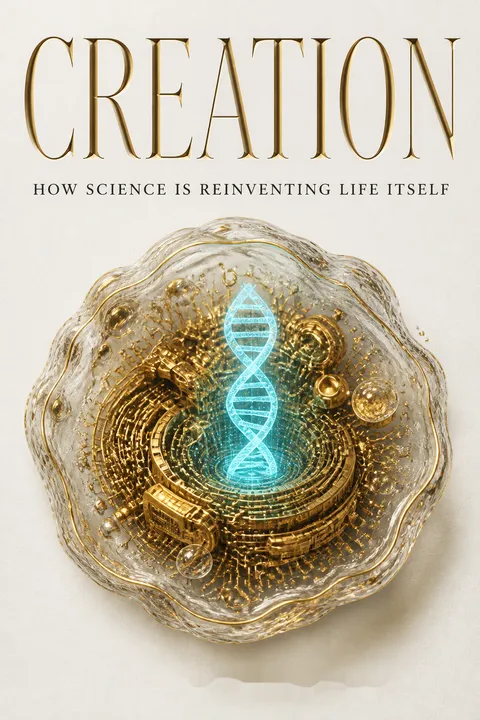
Creation: How Science is Reinventing Life Itself explores the origin of life and synthetic biology's potential future. Rutherford explains complex topics accessibly, covering cell theory, evolution, and DNA structure. The book's first half examines life's origins, while the second discusses genetic engineering and its applications. Readers praise Rutherford's engaging writing style and clear explanations of scientific concepts. Some found the book's format gimmicky, with its two halves printed upside-down to each other. Overall, reviewers recommend it as an informative introduction to modern biology and genetics for non-experts.
Glossary
Cell theory
Cells form and reproduce lifeThe biological principle that all living things are made of cells and that new cells arise through division of existing cells. Developed through centuries of microscopy and experimentation, it rejected spontaneous generation as an explanation for the ordinary appearance of new cells. Together with evolution and genetics, it provides a foundation for understanding both life's organization and its continuity.
Luca
Shared ancestor of known lifeThe book's name for the Last Universal Common Ancestor, the ancestral population or organism from which all known cellular life ultimately descends. Luca is inferred from features shared by bacteria, archaea, and complex organisms, including core genetic and protein-making systems. It is not a fossil or a fully known individual, and horizontal gene transfer makes its early history difficult to reconstruct.
RNA world hypothesis
RNA preceded DNA and proteinsA proposal that early life relied heavily on RNA before the modern division of labor between DNA and proteins. RNA can store sequence information, and some RNA molecules can catalyze chemical reactions. This combination offers a possible way around the puzzle that DNA needs proteins to copy it while proteins are encoded by DNA. Laboratory studies support plausibility, but do not establish the historical sequence.
Ribozyme
Catalytic RNA moleculeAn RNA molecule capable of catalyzing a chemical reaction, a function more commonly associated with proteins called enzymes. Ribozymes show that RNA can do more than carry genetic information. Laboratory examples include molecules selected to join RNA strands or assist in copying themselves. They are important to origin-of-life research because they could perform information-related and functional roles in an early RNA-based system.
Horizontal gene transfer
Genes move between cellsThe transfer of genes between organisms other than through ordinary parent-to-offspring inheritance. Bacteria and archaea can acquire genetic material from other cells, sometimes across species boundaries. This can spread useful traits rapidly, including antibiotic resistance, and complicates attempts to reconstruct early evolutionary relationships as a simple branching tree.
Synthetic biology
Designing biological systemsAn engineering-oriented field that uses biological components, especially genes and cells, to build or redesign systems for specific purposes. It extends genetic engineering from modifying organisms toward constructing programmable circuits, production systems, and other biological tools. The field's promise is constrained by the complexity and variability of living cells, as well as practical, ethical, legal, and safety concerns.
BioBrick
Standardized DNA componentA standardized biological part designed to be combined with other parts in new genetic constructs. The BioBrick project sought to make DNA components easier to share and reuse, much as standardized connectors allow mechanical or electronic parts to fit together. Its open framework encourages contribution and collaboration, although parts still require careful characterization because living cells may behave unpredictably.
Xeno-nucleic acids (XNAs)
Alternative genetic moleculesSynthetic genetic polymers that resemble DNA or RNA but use different molecular backbones, often built from alternative sugars. Researchers engineered copying systems that can transfer genetic information between DNA and some XNAs, and demonstrated that these molecules can support heredity and variation. Their altered chemistry may make them more resistant to breakdown, a property of interest for potential medical applications.
Genetic event horizon
Limit of genetic reconstructionA term for the point in deep evolutionary history beyond which gene comparisons become unreliable for reconstructing a clean branching ancestry. In early microbial life, horizontal gene transfer mixed genetic material among lineages. As a result, modern DNA can trace many relationships clearly, but the earliest history becomes a tangled network whose details cannot be confidently recovered by ordinary phylogenetic methods.
About the Author
Download PDF
Download EPUB
.epub digital book format is ideal for reading ebooks on phones, tablets, and e-readers.








