

Key Takeaways
Treat creativity as a way of being, not a special job
Creativity is a quality. Osho’s central claim is that creativity is not limited to painting, music, or writing. It is the quality of attention and care brought to any activity. A cook, gardener, cleaner, or friend can create when the work is done with presence and enjoyment rather than treated only as a chore or transaction.
A whole person creates. Osho describes a full life through three dimensions: consciousness, or awareness; compassion, or feeling; and creativity, or action. He argues that contemplative life without warmth or expression is incomplete, as is action without awareness. The goal is not for everyone to become a famous artist, but for each person to bring their distinct capacities into daily life.
The broad definition makes creativity available without pretending that every task is a masterpiece. It also shifts attention from product to process, a move compatible with research on intrinsic motivation: people often sustain effort when an activity is rewarding in itself. Still, enjoyment cannot be the sole test of value. Some essential work is tiring, and creative work can involve frustration. A more useful reading is that care and agency can give ordinary tasks meaning, even when pleasure is intermittent.
Spend energy on responsive action, not restless activity
Notice the difference. Osho distinguishes action, which responds to what the present situation calls for, from activity, which discharges inner restlessness without meeting a real need. Eating when hungry is his example of action; eating without hunger simply to keep busy illustrates activity. He also treats compulsive smoking, chatter, or repetitive fiddling as possible signs of this restless pattern, not as proof that every instance has the same cause.
Observe before forcing change. Osho recommends noticing what an urge is doing instead of merely replacing one habit with another. His argument is that awareness can reveal an activity’s function, while an imposed command to stop may become another form of compulsion. Rest, in this account, is not idleness but having energy available without needing to spend it immediately.
This distinction is useful because it asks what a behavior accomplishes emotionally, not just whether it looks productive. That resembles functional approaches to behavior, which examine the cues and consequences surrounding an action. Yet Osho sometimes assigns sweeping motives to habits such as smoking or talking. Such interpretations should remain hypotheses, not diagnoses. Restlessness can reflect stress, dependence, or circumstance, and observation is most helpful when paired with compassion rather than a moral verdict.
Stop performing for approval, and let attention return to the work
An audience can intrude. Osho tells of a Zen painter whose calligraphy goes badly while a disciple watches and judges each attempt. When the disciple steps out to prepare fresh ink, the painter produces his finest work. The story suggests that attention has split between making the painting and monitoring how it will be received.
Return to the task. Osho connects this self-consciousness to the fragile ego’s dependence on other people’s approval. In public speaking, art, or conversation, the effort to prove oneself can make a familiar skill feel awkward. The practical move is not to pretend that an audience does not matter, but to notice when imagined judgment has taken more attention than the activity itself.
The story captures a familiar performance effect: monitoring every movement can interfere with fluent action. This is especially plausible when a task is already learned and attention shifts from doing it to evaluating it. Audiences also provide useful feedback, so the answer is not indifference to others. The sharper distinction is between feedback that improves the work and approval-seeking that makes the self-image the main event.
Replace perfectionism with wholehearted participation in the work
Presence beats inspection. Osho contrasts perfectionism, which measures work against an ideal, with total involvement, which gives attention to the activity itself. He tells of dancer Vaslav Nijinsky, whose extraordinary leaps reportedly faded as he became increasingly conscious of how they looked. In Osho’s account, watching himself perform interrupted the absorption that had made the dancing possible.
Aim for completeness of effort. Perfectionism divides attention: one part acts, while another criticizes and compares. Osho argues that an artist is more fully engaged when the work is not treated as evidence of personal superiority. This does not mean careless work. It means practicing seriously without letting an imagined flawless result turn every moment into an exam.
The distinction between craft and perfectionism matters. Revision, standards, and error detection are often essential to good work; the problem is not high quality but evaluation that consumes the attention needed to produce it. Nijinsky’s story is best read as an illustration of performance anxiety, not evidence for Osho’s proposed supernatural explanation of grace. A creator can care deeply about quality while remaining willing to make imperfect drafts.
Use intellect as a tool, not a substitute for direct seeing
Knowledge can become a filter. Osho distinguishes intellect, meaning accumulated information and habitual reasoning, from intelligence, which he describes as alert perception and responsiveness to what is new. A person relying only on stored answers may meet a changing situation with outdated conclusions. Creativity, in his view, requires moments when the mind stops sorting experience into familiar categories.
Let thought serve experience. Osho is not asking readers to erase factual memory or language. He argues that they can first encounter something directly, then use knowledge to communicate or shape it. His example is seeing a rose without immediately describing it, then reaching for words or paint afterward. The aim is not ignorance, but a temporary pause in which experience is not crowded out by commentary.
This is strongest as a warning against confusing fluency with insight. Expertise can narrow attention when familiar categories dominate, but it can also help people notice patterns novices miss. Creativity typically needs both: enough knowledge to work with a medium and enough openness to revise its assumptions. Osho’s contrast between intellect and intelligence is therefore most useful as a balance, not a reason to distrust analysis or formal learning.
Keep experience open instead of mistaking old beliefs for truth
Leave room for revision. Osho argues that beliefs can make perception feel settled before a person has looked closely. Experience, by contrast, remains open to correction. He illustrates this with a king’s immaculate garden, where every fallen leaf has been removed. The king’s Zen teacher adds dry leaves back, restoring movement and sound. The garden’s flawless order had made it feel lifeless.
Let the unfinished breathe. Osho uses the garden to defend incompleteness, surprise, and fresh observation. A finished belief can act like a screen, encouraging people to see what they expect rather than what is present. His advice is to stay willing to learn from each situation instead of treating inherited rules as final. This is not a rejection of all convictions; it is an invitation to keep them answerable to experience.
The garden offers a memorable case for tolerating variation rather than optimizing every trace of disorder away. In design and learning, constraints can help, but excessive control often removes the very variation that reveals what a system can do. The same principle applies to beliefs: stable commitments support action, while revisability supports learning. Openness is not the absence of judgment; it is the willingness to update judgment when the evidence changes.
Make ordinary work rewarding before asking the world to notice
The work has its own value. Osho argues that creativity is damaged when recognition becomes the reason to create. He recounts Rabindranath Tagore’s poetry receiving little attention in Bengali until an English translation won the Nobel Prize. Tagore then objected when institutions praised him, in his view, for the prize rather than for work they had previously ignored. The story shows how public recognition can follow changing fashion rather than measure intrinsic worth.
Bring care to small tasks. Osho says cleaning, cooking, or offering a kind gesture can be creative when done with attention and love. He does not promise that such work will earn fame or money. The practical test is whether the activity matters to the person doing it, not whether it attracts an audience.
Intrinsic motivation protects creative work from being reduced to a bid for status, and it gives dignity to labor that awards rarely acknowledge. Recognition still matters: payment, publication, and praise can provide opportunity and signal that work has reached others. The useful distinction is between welcoming recognition and requiring it as proof that the work was worthwhile. Tagore’s story also warns that institutions often reward legibility and prestige as much as quality.
Learn technique, then let it become instinct through play
Mastery needs both phases. Osho presents a Zen teaching about learning painting carefully, then stepping away from technique long enough for it to become part of the body rather than a conscious checklist. His advice to a classically trained musician is to pause regular practice, explore other activities, and return when music feels alive again. Technical skill is necessary, but technique alone can produce only competent repetition.
Borrow from elsewhere. Osho calls movement between disciplines a form of crossbreeding: a musician who studies mathematics, for instance, may bring a fresh sense of structure back to music. He also praises a child’s imaginative misreading of a familiar religious scene as an example of play opening an unexpected path. The point is to risk experiments that established rules would discourage.
The learn-then-release sequence resembles a practical account of expertise: deliberate practice builds capacity, while flexible use requires more than repeating instructions consciously. Cross-disciplinary work can also expose assumptions hidden inside a single field. But leaving a discipline is not a universal cure for creative blocks, and playful novelty is not automatically valuable. The strongest version of Osho’s advice is to alternate focused practice with exploration, letting each challenge the other.
Let the silence after creation become recovery, not evidence of failure
Creation can leave space behind. A novelist asks Osho why completing a book brings emptiness and fear. He compares the feeling to the space left when furniture is removed from a crowded room. While writing, the mind is full of characters and decisions; once the book is finished, that occupation ends. The apparent void may be relief and room to recover, rather than proof that the creator has been used up.
Respect the pause. Osho likens a completed work to a birth: the creator has spent energy, and the finished work no longer needs to be carried in the mind. He advises accepting the quiet period instead of rushing to fill it or interpreting it as a crisis. Rest and renewed activity are both part of a creative rhythm.
This reframing can soften the pressure to turn every productive period into a permanent state. Recovery is not wasted time; it can restore attention and emotional capacity. Still, persistent despair after finishing a project deserves more care than a metaphor alone can provide. Creative depletion may be temporary, but serious or prolonged distress should not be romanticized as a necessary price of artistic depth.
Build meaning by participating broadly, not waiting for life to explain itself
Meaning is made through living. Osho rejects the idea that life contains a ready-made answer waiting to be uncovered. Meaning, he argues, grows through what people create, love, and contribute. That requires participation rather than spectatorship: to understand dance, dance; to learn music, play; to discover what a practice can mean, enter it rather than only watching others.
Keep life multidimensional. Osho tells of Socrates, who reportedly began composing verses and playing the flute while awaiting death, despite being known for philosophy. The story suggests that a person can leave important capacities unused by identifying too narrowly with one role. Trying different pursuits, including imperfectly, can make life richer and reveal forms of expression that a single identity would miss.
The emphasis on participation counters passive consumption and makes meaning something practiced rather than merely theorized. It also gives a rationale for hobbies and amateur work that produce no credential or income. The risk is turning self-created meaning into pressure to be constantly productive. Participation can include rest, care, and receptive attention; a life need not become a portfolio of achievements to be meaningful.
Treat money as a means to cultural richness, not a moral stain
Money is a tool. Osho challenges religious traditions that treat wealth itself as spiritually suspect. He describes money as a medium of exchange that makes it easier for people to trade what they have for what they need, unlike barter, which requires each person to want exactly what the other offers. Wealth, in his account, can also create time and access for music, literature, art, and other forms of life that poverty makes harder to pursue.
Separate means from ends. Osho’s argument is not that money can buy love or insight. He identifies those as values that cannot simply be purchased, while insisting that material security can support a fuller cultural life. His broader point is to avoid inherited shame about wealth and to judge money by how it is used.
This is a useful corrective to the idea that deprivation is automatically virtuous. Material security can widen choices and make education or artistic participation more accessible. Yet Osho’s defense of wealth underplays unequal access, exploitation, and the difference between creating wealth and accumulating it at others’ expense. Money is neither a moral stain nor a guarantee of flourishing. Its effects depend on how resources are produced, distributed, and spent.
Analysis
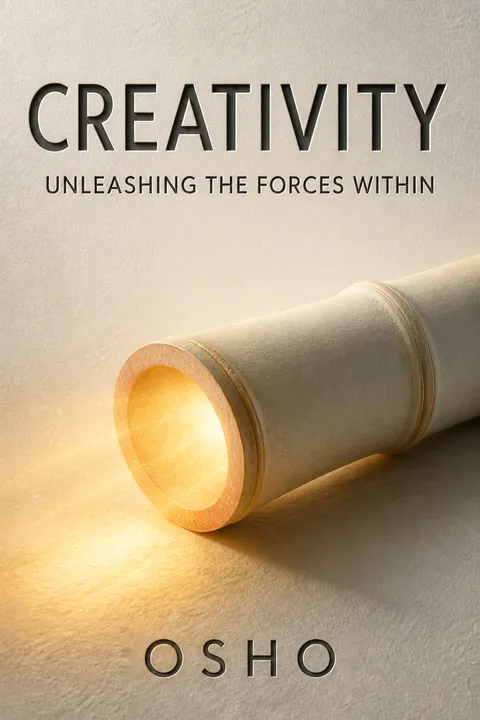
Creativity: Unleashing the Forces Within is less a manual for making art than an argument about how to live. Its recurring movement is from control toward receptivity: from performing to attending, from restless busyness to responsive action, and from fixed conclusions to renewed experience. Stories do much of the argumentative work. A painter falters under an observer’s judgment, a garden becomes lifeless through over-cleaning, and a writer mistakes the quiet after finishing a novel for depletion. Each story turns an abstract claim into a felt contrast. The book’s strongest practical insight is that creativity is not confined to prestigious outputs. It can appear in cooking, gardening, care, or ordinary work when attention and personal investment are present. This resembles ideas in flow and intrinsic motivation, where engagement depends partly on the activity itself rather than external reward. Osho’s critique of fame is valuable as a defense against letting status decide what deserves effort, though recognition and fair compensation remain important social goods.
The spiritual framework is also the book’s main limitation. Osho describes creativity as existence or God moving through a person. Readers need not accept that metaphysics to use the practical invitation to become less self-preoccupied and more responsive. His contrasts, however, can become too absolute: intellect is not simply sterile, ambition is not always destructive, and difficult effort is not necessarily ego-driven. His account of left and right brain hemispheres is especially reductive by contemporary standards. Creative thought involves interacting capacities, not a clean division between a logical half and an artistic half.
The most durable interpretation holds the paradoxes together. Skill matters, yet skill can become rigid. Standards improve work, yet self-surveillance can obstruct it. Money supports access, yet cannot purchase every kind of fulfillment. Osho’s value lies less in proving that ego must disappear than in prompting readers to notice when fear, status, or habit has displaced attention from the work and life at hand.
Review Summary
Creativity by Osho receives mostly positive reviews, with readers praising its thought-provoking insights on unleashing creative potential. Many find it life-changing, offering a new perspective on creativity beyond art. Some appreciate Osho's unique philosophy and writing style, while others criticize repetitiveness or disagree with certain ideas. Readers highlight the book's emphasis on meditation, mindfulness, and embracing one's true self. It's described as inspiring, illuminating, and challenging conventional thinking, though a few find it disconnected from reality or difficult to comprehend.
People Also Read




Glossary
The three C’s
Awareness, compassion, creativityOsho’s picture of a fully developed person with three linked dimensions: consciousness, or awareness and meditative presence; compassion, or feeling and love; and creativity, or action that expresses inner life in the world. He argues that focusing on only one dimension leaves a person incomplete.
action and activity
Response versus restless compulsionOsho distinguishes action as a relevant response to the present situation from activity as behavior driven by inner restlessness rather than present need. He proposes observing the motive behind repeated behaviors so energy can move toward responsive action instead of compulsive busyness.
no-mind
Awareness without mental clutterA state Osho describes as alert, immediate perception without being dominated by accumulated thoughts, memories, or ready-made conclusions. No-mind does not mean losing useful knowledge or becoming unconscious. It means allowing the mind to become quiet enough for direct experience and fresh response.
wei-wu-wei
Action through non-forcingA Taoist phrase Osho uses for action that arises without strained egoic control. A person may be intensely engaged in making or performing something, while inwardly not experiencing themselves as a separate controller. The idea joins vigorous activity with inward ease and receptivity.
psychological memory
Emotional residue from the pastOsho’s term for carrying an old event forward as a continuing emotional reaction, rather than simply remembering what happened. He contrasts it with factual memory, which preserves useful information. His example is meeting someone who previously caused hurt while responding to the person as if nothing has changed.
objective art
Art that supports meditationA term Osho attributes to Gurdjieff for art intended to evoke stillness, attention, or meditation in its audience. Osho contrasts it with work he regards as primarily cathartic or personally expressive. The book treats the distinction as spiritual and evaluative, not as a neutral artistic classification.
FAQ
What's "Creativity: Unleashing the Forces Within" about?
- Exploration of Creativity: The book by Osho delves into the nature of creativity, emphasizing that it is not limited to artistic endeavors but is a way of living.
- Individual Freedom: Osho argues that true creativity arises from individual freedom and breaking away from societal conditioning.
- Spiritual Dimension: Creativity is presented as a spiritual process, where one connects with the divine and allows it to flow through them.
- Practical Guidance: The book offers practical advice on how to cultivate creativity in everyday life, making it accessible to everyone.
Why should I read "Creativity: Unleashing the Forces Within"?
- Broaden Understanding: It provides a broader understanding of creativity beyond conventional definitions, applicable to all aspects of life.
- Personal Growth: The book encourages personal growth by advocating for a life lived with awareness, spontaneity, and joy.
- Spiritual Insight: Readers gain spiritual insights into how creativity can be a path to self-discovery and fulfillment.
- Practical Tips: Osho offers practical tips and exercises to help readers unleash their creative potential.
What are the key takeaways of "Creativity: Unleashing the Forces Within"?
- Creativity as a Lifestyle: Creativity is a way of life, not just an artistic pursuit, and involves living with awareness and spontaneity.
- Freedom from Conditioning: To be truly creative, one must break free from societal and psychological conditioning.
- Integration of Being: Creativity involves integrating being, feeling, and action, leading to a harmonious and fulfilling life.
- Spiritual Connection: True creativity is a spiritual process, where one becomes a conduit for the divine.
How does Osho define creativity in "Creativity: Unleashing the Forces Within"?
- Beyond Art: Creativity is not confined to art; it is about bringing a fresh perspective to any activity.
- Inner Quality: It is an inner quality that one brings to their actions, characterized by joy and love.
- Spontaneity and Freedom: Creativity involves spontaneity and freedom from rigid structures and norms.
- Divine Flow: It is about allowing the divine to flow through you, making every act a creative expression.
What are the "Three C's" mentioned in the book?
- Consciousness: Being aware and present in the moment, which is the foundation of creativity.
- Compassion: Feeling deeply and connecting with others, which enriches creative expression.
- Creativity: The action that arises from being conscious and compassionate, leading to a fulfilling life.
- Integration: Osho emphasizes the integration of these three aspects to achieve a balanced and creative life.
What are the "Five Obstacles" to creativity according to Osho?
- Self-Consciousness: Being overly concerned with oneself, which hinders spontaneous expression.
- Perfectionism: The pursuit of perfection can stifle creativity by creating fear of failure.
- Intellect: Over-reliance on intellect can block the intuitive and spontaneous aspects of creativity.
- Belief: Rigid beliefs can limit one's ability to explore new possibilities and ideas.
- The Fame Game: The desire for recognition can distract from the intrinsic joy of creative expression.
How does Osho suggest overcoming self-consciousness in creativity?
- Becoming a Child Again: Embrace the innocence and spontaneity of a child, free from self-judgment.
- Letting Go of Ego: Drop the ego and the need for approval, which allows for genuine creative expression.
- Living in the Present: Focus on the present moment rather than past experiences or future expectations.
- Embracing Vulnerability: Accept vulnerability as a part of the creative process, which leads to authenticity.
What role does meditation play in creativity according to Osho?
- Clearing the Mind: Meditation helps clear the mind of clutter, allowing for fresh and original ideas to emerge.
- Enhancing Awareness: It increases awareness and presence, which are essential for creative insight.
- Connecting with the Divine: Meditation opens the channel for divine inspiration to flow through the individual.
- Balancing Energy: It balances the mind and body, creating a harmonious state conducive to creativity.
What are the "Four Keys" to unlocking creativity in the book?
- Become a Child Again: Reconnect with the innocence and curiosity of childhood to foster creativity.
- Be Ready to Learn: Maintain an open mind and a willingness to learn from every experience.
- Find Nirvana in the Ordinary: Discover beauty and meaning in everyday activities, making them creative.
- Be a Dreamer: Allow yourself to dream and imagine, as this fuels creative expression.
How does Osho address the relationship between memory and creativity?
- Distinction Between Memories: Osho distinguishes between factual memory and psychological memory, advocating for the former.
- Psychological Memory as a Barrier: Psychological memory can hinder creativity by keeping one stuck in the past.
- Factual Memory as a Tool: Use factual memory as a tool for creative expression, not as a limitation.
- Living in the Present: Emphasizes the importance of living in the present to access true creativity.
What are some of the best quotes from "Creativity: Unleashing the Forces Within" and what do they mean?
- "Creativity is the fragrance of individual freedom." This quote highlights that true creativity arises from personal freedom and authenticity.
- "Life is an opportunity to create meaning." Osho emphasizes that meaning is not found but created through our actions and choices.
- "The real artist disappears utterly." This suggests that true creativity involves losing oneself in the creative process, allowing the divine to flow through.
- "Be a giver. Share whatsoever you can." Encourages generosity and sharing as essential aspects of a creative life.
How does Osho's vision of "Zorba the Buddha" relate to creativity?
- Integration of Opposites: "Zorba the Buddha" represents the integration of the material and spiritual, the earthly and the divine.
- Enjoyment and Serenity: It embodies the ability to enjoy life's pleasures while maintaining inner serenity and awareness.
- Creative Living: This vision encourages living creatively, balancing work and play, action and meditation.
- Holistic Approach: Osho's vision promotes a holistic approach to life, where creativity is a natural expression of one's being.
About the Author
Other books by Osho




Download PDF
Download EPUB
.epub digital book format is ideal for reading ebooks on phones, tablets, and e-readers.








