

Key Takeaways
Let love grow from inner fullness, not from a demand to be rescued.
Need versus gift. Osho distinguishes love from the urge to secure attention, soothe loneliness, or get something in return. He calls that needy exchange a counterfeit of love. What he considers genuine love grows from inner steadiness and becomes a willingness to share, without keeping score. It may be expressed through a partner, but it is not the partner’s property or a reward owed for good behavior.
A practical test. Notice whether care depends on praise, access, or obedience. If generosity vanishes when the other person does not comply, need may be masquerading as love. This test is deliberately demanding, though mutual care and clearly expressed needs do not automatically make love false.
The distinction shifts attention from romantic intensity to the motive beneath it. That is useful: a relationship can feel consuming while functioning mainly as a way to manage fear or self-doubt. The idea also resembles a broader distinction between connection as mutual recognition and connection as emotional regulation. Yet dependence is not always a defect. People inevitably need one another at times, and a strong bond can include both generosity and requests for support. The sharper question is whether care allows the other person to remain a person, rather than turning them into a solution.
Begin with self-respect, then use attention to see yourself clearly.
Love before looking. Osho reads a Buddhist teaching as a sequence: first accept and care for yourself, then observe your thoughts and actions. He calls this observation watchfulness, a steady awareness of what is happening without immediately repressing or judging it. In his account, self-condemnation makes honest attention feel threatening, while self-acceptance gives a person enough safety to look inward.
Practice in ordinary moments. Notice the body while eating, the mind during a conversation, or the impulse to react when irritated. Osho recalls a Buddhist monk who had recited a verse for years but overlooked its opening instruction to love oneself. The story makes his point: technique can become mechanical when its emotional foundation is skipped.
This approach joins compassion with observation rather than treating them as competing virtues. In contemporary terms, nonjudgmental attention is more likely to be useful when it is not confused with self-punishment. The sequence also guards against turning introspection into another performance of self-criticism. Still, self-acceptance need not mean approving every impulse or action. It can make accountability more possible, because a person can acknowledge a mistake without deciding that the whole self is worthless.
Let desire mature into mutual care instead of treating it as a moral failure.
From appetite to sharing. Osho describes love as developing beyond sexual attraction. At one level, desire can treat another person mainly as a means to gratification. At another, two people share pleasure and inner life as equals. His fullest sense of love is a quality of being that can extend beyond a particular partner. He argues that condemning desire does not create this deeper love; awareness and inner growth are what allow it to change.
Do not confuse stages. Physical attraction may begin a relationship without guaranteeing intimacy or lasting care. The book urges readers to examine what is happening rather than either glorifying every impulse or shaming themselves for having one. Desire is not the finished form of love, but it need not be denied as its possible starting point.
The argument offers a middle path between treating sex as the whole of love and treating it as an obstacle to spiritual life. That can reduce shame and make honest conversation easier. It also invites a useful distinction between attraction, mutuality, and care. However, spiritual language should not blur practical differences between these experiences. Desire does not automatically deepen into love, and no person owes a partner sexual access as proof of openness or growth. Consent, safety, and honest agreements remain essential.
Keep meeting your partner as a changing person, not a settled fact.
A verb, not a label. Osho contrasts a fixed relationship, which can encourage people to assume they already know each other, with relating, an ongoing act of discovery. People change, so intimacy requires renewed attention rather than relying on yesterday’s picture of a partner. The book’s image is of a honeymoon that stays alive because curiosity continues, not because a couple avoids difficulty.
Begin again. Ask what the other person is thinking or feeling now instead of treating familiar habits as the whole story. The aim is not endless novelty, but respect for the fact that a person cannot be fully mapped. Osho sees legal and social certainty as poor substitutes for this attention, although practical agreements may serve purposes beyond romance.
The emphasis on renewal corrects a common relational error: confusing familiarity with complete knowledge. Curiosity can interrupt the stale scripts through which partners interpret each other, and it makes ordinary conversation a practice of attention. The metaphor is strongest when it invites engagement, not when it demands perpetual romantic excitement. Long relationships also depend on reliability, shared work, and routines. These need not kill curiosity; they can provide the stable ground from which a couple keeps learning who the other is.
Give love room to breathe by protecting each person's freedom.
Space supports closeness. Osho draws on Kahlil Gibran’s image of lovers preserving space between them. He argues that suspicion, possessiveness, and demands for constant access turn affection into control. A partner is not property, and differences in interests or time alone need not signal rejection. In Rabindranath Tagore’s novel, a woman proposes that a couple live in separate houses on the same estate, meeting by choice rather than sharing every hour. The arrangement illustrates intimacy with boundaries.
Freedom needs honesty. Space does not excuse deception or broken agreements. Osho’s challenge is to make commitments expressions of care rather than tools for ownership. Partners can define what they have promised, then respect both the agreement and each other’s independence.
The book sees autonomy as a condition of intimacy, not its opposite. That insight is especially useful where jealousy gets praised as proof of devotion. But freedom is not simply the absence of rules. Clear agreements can protect people and make trust more realistic, especially when partners have unequal power or different expectations. The relevant distinction is between mutual commitments and unilateral control. Space nourishes closeness when both people can negotiate it honestly, not when one person uses it to evade responsibility.
Treat relationship friction as a mirror, then examine your own response.
Conflict reveals patterns. Osho calls relationship a koan, a puzzle that cannot be solved through control alone. Close partners can expose each other’s fear, defensiveness, and desire to dominate. He suggests that the other person acts as a mirror, making private habits visible. His advice is to notice what a conflict brings up and to pair love with meditation, the inward practice of observing oneself.
Reflection is not self-blame. A partner’s behavior may reveal something about one’s reactions, but that does not mean every conflict is caused by the person who feels hurt. The mirror image works best as an invitation to ask, What is happening in me? It should not be used to excuse mistreatment or erase the other person’s responsibility.
The mirror metaphor turns conflict from a simple contest over who is right into information about how each person responds under stress. That can deepen self-knowledge, especially when the same argument repeats across relationships. Its limit matters just as much: interpreting all pain as one’s own lesson can trap someone in a harmful situation. Reflection should accompany clear judgment about behavior, boundaries, and repair. A useful mirror reveals patterns on both sides; it does not make accountability disappear.
Meet sexuality without shame, but do not mistake appetite for love.
Energy, not a verdict. Osho argues that sexual desire is natural and that repression can feed preoccupation rather than produce freedom. He treats desire as material to understand, not a command to obey or a sin to suppress. In his view, meditation can change a person’s relationship to sexual energy, while forced celibacy risks becoming control without inner transformation. He criticizes traditions that condemn sex while leaving people unprepared to understand it.
Distinguish desire from care. Attraction can be real without creating mutual love, and sexual activity does not prove intimacy. The book’s argument is about awareness, not unrestrained behavior. Each person’s wishes and limits matter, and desire never overrides consent.
The critique of shame offers a valuable corrective to messages that make ordinary desire seem corrupt. It also distinguishes repression from genuine change, a distinction relevant to many forms of self-control. But the book sometimes generalizes about sexual development and social causes with more confidence than its evidence warrants. People vary in desire, timing, and preferred relationships. A humane account of sexual freedom therefore needs more than permission to explore: it requires consent, contraception where relevant, emotional honesty, and respect for different forms of intimacy.
Choose who you become instead of outsourcing your life to fate.
Freedom carries responsibility. Osho uses tabula rasa, or a blank slate, to express his view that people are not born with a fixed identity or destiny. He rejects explanations that make a person merely the product of God, history, or social forces. In his account, each choice helps shape the self, so freedom includes the risk of choosing badly as well as the possibility of growth.
Take authorship seriously. The book compares making a life to creating a work of art: satisfaction comes from taking part in the result rather than treating oneself as a finished object. This is not a claim that every circumstance is chosen. It is an argument against using inevitability as an excuse to abandon the choices that remain.
The emphasis on authorship gives existential force to ordinary decisions: identity is not only discovered but also formed through action. It can counter fatalism and encourage people to accept responsibility without waiting for an authority to define the right life. Yet the argument overstates individual freedom when it treats social and material constraints as secondary. Poverty, illness, discrimination, and caregiving obligations can sharply narrow options. Agency matters most when paired with an honest account of what limits it.
Turn solitude from an empty gap into a place of discovery.
Alone is not lonely. Osho distinguishes loneliness, the painful feeling that something is missing, from aloneness, a condition of being present with oneself without needing company to establish worth. He argues that people often fill silence with crowds, entertainment, or social identity because being alone can unsettle their sense of who they are. Meditation, in his usage, means observing experience until borrowed roles and labels lose their hold.
A lion remembers. In a parable, a lion cub raised among sheep believes it is one of them until another lion shows it its reflection. The tale presents self-knowledge as remembering what social surroundings obscured. It is a spiritual metaphor, not proof that a hidden, fixed identity lies beneath every influence.
The distinction helps separate chosen solitude from painful isolation, a difference that can change how a person responds to being alone. The lion story gives that distinction an accessible shape: belonging can teach habits without defining the whole self. Still, humans are social beings, and needing connection is not a failure of awareness. The useful aim is not independence from everyone, but the ability to be alone without panic and to seek companionship without making it the sole source of identity.
Design communities that share care without turning people into property.
A wider household. Osho proposes the commune as an alternative to the conventional family, which he believes can concentrate authority and possession. In his model, adults live together by choice, children receive care from the wider group, and relationships can end without treating separation as a social catastrophe. He imagines communities of roughly 5,000 to 50,000 people, with smaller groups dividing when they become too large for members to know one another.
Care beyond ownership. The proposal aims to give children varied role models and reduce the pressure on one household to meet every need. Osho does not say every family must disappear: he allows that loving, noncontrolling families can function well. The central question is how to provide care while preserving freedom.
The commune proposal makes the book’s private ideal political: if love depends on freedom, institutions should not reward ownership as the default. Shared caregiving could broaden a child’s sources of support and reduce the isolation of individual households. The model, however, leaves difficult questions about safeguarding, consent, conflict resolution, and responsibility for children. A wider care network is not automatically a safer or fairer one. Its value depends on accountable practices, not simply on replacing family ties with communal ones.
Move between intimacy and solitude instead of sacrificing either.
A living rhythm. The book’s conclusion rejects the choice between relationships and aloneness. Intimacy can draw attention outward; time alone can help a person regain quiet and perspective. In turn, solitude can create a wish to share, while close contact can make space for oneself necessary. Osho compares the two to complementary parts of a whole rather than rival ways of life.
Notice the need for space. Wanting time alone need not mean rejecting a partner, and wanting closeness need not mean failing at independence. The practical task is to communicate these shifts instead of treating them as evidence that love has ended. The book presents meditation and love as mutually enriching, not as competing destinations.
This rhythm offers a more flexible model than the familiar split between the self-sufficient individual and the person defined by relationships. It also reframes distance: space can be part of sustaining connection rather than a threat to it. The account is most persuasive when both partners can name what they need and respond without coercion. Not every withdrawal is restorative, however, and not every request for closeness is dependency. Context and communication distinguish healthy rhythm from avoidance or pressure.
Analysis
The book’s central move is to treat love, freedom, and aloneness as interdependent capacities rather than separate topics. Love is not primarily a feeling secured by a partner; it is presented as the outward expression of inner awareness. Aloneness is not social failure but the ground from which nonpossessive connection becomes possible. Freedom is therefore both relational and existential: people should not own one another, and each person must participate in shaping a life.
This argument has an existentialist edge. Like accounts of self-making, it refuses to let inherited roles settle the question of who a person is. Its spiritual metaphysics goes further, claiming that inward awareness can disclose unity with all existence. The movement from personal self-acceptance to cosmic oneness is meaningful as spiritual interpretation, but it should not be mistaken for an empirical conclusion. The book is most practically persuasive when it asks readers to observe need, fear, jealousy, and control in lived relationships.
Its strongest social critique concerns institutions that praise love while restricting intimacy, or that demand loyalty without cultivating care. Its weakest tendency is to explain too much through a single cause. Sexual repression, family structures, and social authority are treated as engines of widespread suffering, while evidence and counterexamples receive little scrutiny. The commune proposal extends the critique but underdescribes governance and protection for vulnerable people. Likewise, the insistence on absolute freedom can obscure how much human agency depends on material support and reciprocal obligations.
Read as a set of practices, the book is more useful than as a universal diagnosis. Observe without self-condemnation. Distinguish affection from possession. Allow closeness and privacy to coexist. These principles do not require rejecting marriage, family, or commitment; they invite examination of whether such forms serve people or merely preserve appearances. The lasting tension is productive: intimacy requires connection, while genuine connection requires recognizing that the other remains distinct.
Review Summary
Love Freedom and Aloneness receives largely positive reviews for its thought-provoking insights on love, relationships, and self-discovery. Readers appreciate Osho's perspective on aloneness as distinct from loneliness and his emphasis on self-love. Many find the book challenging conventional beliefs and inspiring personal growth. Some criticize Osho's views as contradictory or extreme, particularly regarding family and societal structures. The book's repetitive nature and unconventional ideas about sex and communes are divisive. Overall, readers find it a profound, if sometimes controversial, exploration of love and personal freedom.
People Also Read





Glossary
Aloneness
Self-presence without lackOsho uses aloneness to mean being present with oneself without depending on company to feel complete or meaningful. He distinguishes it from loneliness, which he describes as the painful sense that someone or something is missing. Aloneness is not necessarily physical isolation; in his account, a person can experience it while living among others.
Relating
Ongoing mutual discoveryRelating is Osho’s term for meeting another person as a changing, partly unknown individual. Unlike a fixed relationship, which can encourage partners to assume they already know each other, relating requires continued curiosity and attention. It describes a way of being together, not a guarantee that a partnership must last forever.
Tabula rasa
A life not prewrittenMeaning blank slate, tabula rasa is the metaphor Osho uses for his claim that human beings are not born with a fully determined identity or life script. He contrasts human freedom with the more fixed patterns he attributes to other animals. People, in this account, help create themselves through their choices and actions.
Koan of relationship
A puzzle that reveals the selfOsho calls relationship a koan because its conflicts cannot be permanently mastered through simple rules or control. A close partner can expose habits and insecurities that are difficult to see alone. The difficulty is not treated as proof that a relationship has failed; it can prompt self-observation and meditation, though it does not excuse harmful behavior.
sammasati
Right rememberingSammasati is a Pali term Osho explains as right remembering: remembering oneself through awareness rather than merely recalling facts or learned ideas. He associates it with the practice of observing thoughts and experience without being carried away by them. In the book, this kind of remembering supports the recognition of one’s deeper nature.
Brahmacharya
Transformed sexual energyOsho uses brahmacharya for a state of sexual transcendence that arises through inner transformation, not through forced abstinence or repression. He argues that sexual energy can change as awareness deepens and that imposed celibacy may simply suppress desire. His usage is a particular spiritual interpretation, not a neutral definition shared by every Hindu tradition.
Commune
Shared, nonpossessive communityOsho proposes a commune as a community that shares practical care, including responsibility for children, while allowing adults to form and leave partnerships by choice. He imagines relatively small communities that can divide when they grow too large for members to know one another. The commune is offered as an alternative to family structures organized around possession and authority.
FAQ
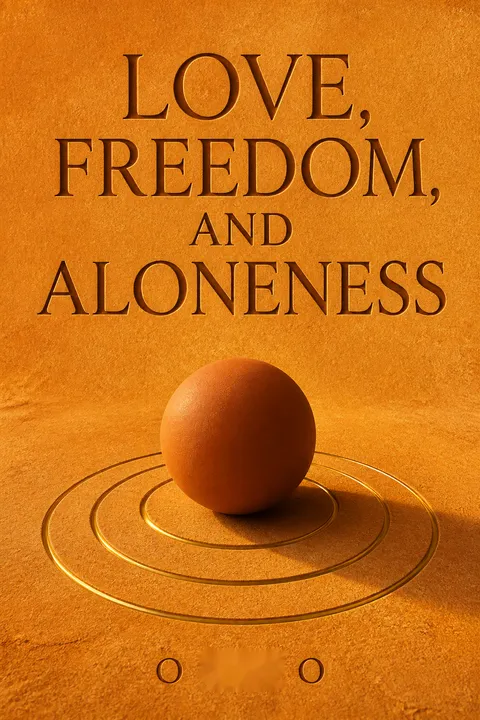
What's Love, Freedom, and Aloneness about?
- Exploration of Love's Nature: Osho examines the essence of love, differentiating it from lust and biological urges. He emphasizes that true love stems from consciousness rather than physical attraction.
- Freedom in Relationships: The book discusses the importance of freedom within love, arguing that genuine love should not create bondage or possessiveness but should allow individuals to grow independently.
- Understanding Aloneness: Osho addresses the concept of aloneness, suggesting that true fulfillment comes from within. He encourages readers to embrace solitude as a path to deeper self-awareness and love.
Why should I read Love, Freedom, and Aloneness?
- Transformative Insights: Osho offers profound insights into love, relationships, and personal freedom, which can lead to transformative changes in perception and experience.
- Practical Guidance: The book provides practical advice on navigating relationships, emphasizing self-love and awareness to cultivate healthier connections.
- Philosophical Depth: Osho's approach encourages questioning societal norms around love, fostering a deeper understanding of personal desires and motivations.
What are the key takeaways of Love, Freedom, and Aloneness?
- Love is Not Possessive: True love is free from attachment and possessiveness, allowing individuals to grow independently. Osho states, "Love is the only freedom from attachment."
- Self-Love is Essential: Loving oneself is a prerequisite for loving others. Osho explains, "A man who loves himself takes the first step toward real love."
- Embrace Aloneness: Aloneness is a natural state that can lead to greater self-discovery and fulfillment. Osho notes, "Aloneness is your nature."
What are the best quotes from Love, Freedom, and Aloneness and what do they mean?
- "Love is the only freedom from attachment.": This quote suggests that true love liberates rather than binds, focusing on sharing and connection, not control.
- "You cannot frustrate real love, because there is no expectation in the first place.": Genuine love is free from expectations, leading to fulfillment rather than disappointment.
- "Love yourself and watch—today, tomorrow, always.": Self-love is the foundation for all other forms of love, emphasizing the importance of understanding and accepting oneself.
How does Osho define love in Love, Freedom, and Aloneness?
- Love as Consciousness: Love arises from one's innermost being and consciousness, not just a biological urge. Osho contrasts lust with love, stating, "lust arises out of your body, love arises out of your consciousness."
- Unconditional Sharing: Love is described as unconditional sharing, where the joy of giving is paramount. Osho explains that "love knows only giving and never asks for anything in return."
- Dynamic and Evolving: Love is a dynamic process that evolves over time, encouraging continuous exploration and deepening of understanding.
What is the difference between love and attachment according to Osho?
- Attachment is Possessive: Attachment is rooted in possessiveness and fear of loss, while love is free and liberating. Osho states, "Unreal love is another name for attachment; real love is very detached."
- Love is Unconditional: Love does not rely on expectations or demands, contrasting with the conditional nature of attachment.
- Attachment Leads to Suffering: Attachment often leads to suffering and frustration due to unmet expectations, whereas real love brings fulfillment.
How can I cultivate love according to Love, Freedom, and Aloneness?
- Practice Self-Love: Loving oneself is the foundation for cultivating love for others. Osho advises, "Love yourself and watch," suggesting self-awareness is key.
- Embrace Vulnerability: Vulnerability in relationships allows for deeper connections. Osho states that "to be in love is to be on the wing."
- Let Go of Expectations: Letting go of expectations can lead to more fulfilling relationships. Osho explains that "you cannot frustrate real love, because there is no expectation in the first place."
What role does meditation play in understanding love in Love, Freedom, and Aloneness?
- Meditation as Self-Discovery: Meditation is essential for self-discovery and understanding one's true nature, crucial for loving others. Osho states, "Meditation means being with yourself."
- Awareness Enhances Love: Increased awareness through meditation allows individuals to experience love more deeply.
- Meditation and Love Connection: Love and meditation should go hand in hand, as both lead to a greater understanding of oneself and others.
How does Osho differentiate between ordinary love and spiritual love?
- Ordinary Love is Conditional: Often based on physical attraction or societal expectations, ordinary love can become sickening.
- Spiritual Love is Transcendent: Spiritual love transcends physicality and is rooted in a deeper connection to the self and the universe.
- Evolving Nature of Love: Spiritual love evolves from ordinary love as individuals grow in consciousness and awareness.
What does Osho say about the relationship between love and freedom?
- Love Requires Freedom: True love cannot exist without freedom, thriving in an environment of openness and non-attachment.
- Freedom Enhances Connection: When individuals are free, they can connect more deeply, leading to more fulfilling relationships.
- Interdependence of Love and Freedom: Love and freedom are interdependent; one cannot fully experience love without embracing freedom.
How can I overcome feelings of loneliness as discussed in Love, Freedom, and Aloneness?
- Embrace Aloneness: Aloneness is a natural state that can lead to greater self-discovery and fulfillment.
- Cultivate Self-Love: Understanding and accepting oneself is crucial in overcoming loneliness.
- Connect with the Universe: Recognizing one's connection to the universe can alleviate feelings of loneliness.
How does Osho view societal norms around relationships in Love, Freedom, and Aloneness?
- Critique of Conventional Relationships: Osho critiques societal norms that dictate relationship functions, particularly marriage, which often leads to dissatisfaction.
- Encouragement of Premarital Exploration: He advocates for exploring relationships before marriage to make more informed choices.
- Freedom from Possession: Love should not be possessive or controlling, allowing for individual freedom and growth.
About the Author
Other books by Osho







Download PDF
Download EPUB
.epub digital book format is ideal for reading ebooks on phones, tablets, and e-readers.








