

Key Takeaways
Treat maturity as reclaimed innocence, not a tougher social mask
Innocence regained. Osho distinguishes innocence from ignorance. Ignorance lacks knowledge but hungers for status, certainty, and approval. Innocence is open and unburdened by the need to prove itself. A child begins with this openness, he argues, but family, school, and culture train the child to fit their expectations. Maturity means recovering that openness with awareness of how it was lost, rather than returning to childish helplessness.
A second beginning. Osho invokes a story of Jesus choosing a child as an example of spiritual readiness. The point is not that children are already wise, but that adults can regain a child's unforced attention after seeing through the roles they inherited. Meditation is his proposed way to distinguish direct experience from borrowed beliefs.
What's compelling is the distinction between unguarded curiosity and mere lack of information. Developmental psychology likewise treats growing up as more than accumulating facts: people also learn to examine the assumptions that organize those facts. Yet social learning is not only a prison. Language, trust, and shared knowledge are inherited, too. A useful reading is not to discard everything taught by others, but to test it against experience and keep what supports genuine inquiry.
Turn experience into wisdom by noticing what happens while it happens
Aging is automatic. In Osho's account, maturity requires awareness: paying attention to an experience, examining its consequences, and learning from it. Without that attention, time passes but behavior can repeat. He uses anger as an example. Someone may flare up, regret it, promise to stop, and then repeat the same reaction when provoked. A conscious look at the anger's effects, he argues, can reveal its cost more deeply than a vow can.
Attention changes the lesson. The practical question is not simply what happened, but what was felt, done, and caused. Osho contrasts this learning with a life lived on autopilot, where experiences leave memories but little usable understanding. He presents awareness as the difference between getting older and growing inwardly.
This resembles reflective practice: experience becomes learning when a person reviews what occurred and adjusts future action. The useful distinction is between insight and resolution. A promise made in a calm moment may not survive stress, whereas noticing triggers and consequences can improve self-understanding. Still, awareness does not reliably erase anger after one encounter. Emotional habits can be reinforced by biology, circumstances, and repeated practice, so observation is a starting point, not a guaranteed cure.
Keep yourself open to pain if you want to feel pleasure fully
One door, both currents. Osho argues that people cannot shut out suffering while remaining fully available to joy. He pictures pain and pleasure as two streams linked to the same source: dull awareness to avoid hurt, and delight is dulled as well. Awareness means allowing the full range of experience, rather than demanding a life of pleasure without its contrasts.
Grief can coexist with insight. In one story, a Zen teacher's disciple weeps after the teacher dies. When others question the tears, he explains that he is mourning the teacher's physical presence, not denying his spiritual convictions. The anecdote makes room for both understanding and sorrow. Osho's point is that accepting pain need not cancel gratitude, love, or joy.
The argument usefully challenges the fantasy of emotional control as selective anesthesia. Research on emotional avoidance broadly supports the idea that efforts to suppress unwanted feelings can narrow experience and keep distress active. But acceptance is not the same as endorsing harm or declining treatment. Some pain signals danger, injustice, or illness and calls for action. The strongest version of this insight is to feel honestly while retaining the freedom to change what can be changed.
Build love from what you can give, not from what you demand
Three relationship patterns. Osho describes dependent love as a bargain in which each person seeks security, control, or validation from the other. Independence can avoid control but may turn into emotional distance. He calls a more mutual form interdependence: two people remain distinct while supporting one another. He also contrasts need-love, which asks another person to fill an inner lack, with being-love, which shares affection without treating it as payment.
Freedom matters. A mature relationship, in this view, does not make one partner smaller to reassure the other. Love should allow each person room to grow. The test is not whether partners have no needs, but whether care becomes possession, scorekeeping, or a tool for control.
The distinction between dependence and generosity is memorable, but the book's contrast can sound too absolute. Attachment research suggests that healthy adults do rely on one another; security often comes from being able to seek comfort without losing autonomy. Need itself is not evidence of immaturity. The more practical test is reciprocity: can both partners ask for support, give it, and disagree without turning closeness into leverage?
Give children security without scripting the person they must become
Respect before resemblance. Osho urges parents to treat a child as a distinct person, not a project to reproduce their beliefs, ambitions, or social standing. He favors curiosity over imposed certainty and wants children to encounter ideas through experience rather than accept them merely because an authority says so. His childhood anecdotes include resisting attempts to remove him when adults had guests, a small rebellion against being treated as an inconvenience.
An ideal, not proof. Osho also imagines a child conceived in meditative, loving circumstances as less likely to be conditioned. That is a spiritual claim, not a demonstrated account of how conception determines personality. The practical center of his advice is more grounded: love a child without demanding that the child become a copy of the parents.
The emphasis on autonomy aligns with developmental work on parental support for children's agency: children benefit when adults take their perspectives seriously and allow age-appropriate choice. But freedom is not the same as leaving a child without guidance. Boundaries protect safety and help children learn how to live with others. The most useful interpretation pairs respect with responsibility: offer limits transparently, invite questions, and avoid confusing obedience with proof of love.
Use life stages as prompts for reflection, not biological deadlines
A seven-year map. Osho presents life as a sequence of changing emphases. His outline moves from self-focus in early childhood, to peer interest and questioning around seven, sexuality in adolescence, and ambition in young adulthood. Around twenty-eight he associates people with settling down; around forty-two with questions about mortality and religion; and later decades with turning inward and loosening social commitments. He also claims that body and mind change in seven-year cycles.
A speculative framework. The map's value is as a prompt to ask what a phase of life is asking of a person: exploration, commitment, reflection, or release. Its age brackets should not be mistaken for a universal timetable. People develop differently, and the book's claim about complete cellular renewal every seven years is not established science.
Life-stage frameworks can help people name transitions, especially when a familiar role stops fitting. Their danger is turning a loose pattern into a verdict: someone who changes careers at forty or remains sexually active in later life has not thereby failed to mature. Contemporary developmental science finds substantial variation across individuals and cultures. The map works best as a set of questions about changing priorities, not a biological schedule that dictates what a person should want.
Move inward without abandoning ordinary life
Two directions of living. Osho calls outward pursuit the horizontal line: seeking more status, possessions, and achievement, all within time and mortality. The vertical line is a metaphor for inward attention, silence, and a sense of connection that is not measured by external success. Meditation, in this account, reveals the second direction without requiring a person to flee work or family.
The king cannot outrun death. In a story, a king hears that death will find him at sunset and rides far away on his fastest horse. At the destination, death is waiting where the king was meant to arrive. The tale makes a simple point: speed and distance cannot defeat mortality. Osho's spiritual answer is to change one's relationship to life, not to imagine that achievement can escape its limits.
The horizontal and vertical image gives a clear name to two dimensions of attention: what a person pursues and how a person inhabits experience. Existential thought similarly treats mortality as a pressure that can clarify priorities. The distinction becomes less persuasive if inwardness is treated as superior to practical work, since care, craft, and public responsibility can express deep values. Claims that meditation reveals literal immortality remain matters of belief, not established evidence.
Alternate deliberate effort with receptive attention to recover your center
Doing and receiving. Osho says inner integration is not something to manufacture but something to notice. He contrasts action, which changes the world through effort, with a receptive mode: allowing experience to arrive without immediately trying to control it. Looking quietly at a flower or watching thoughts pass can offer practice in this less forceful attention.
A simple sequence. His closing exercise begins with awareness of the body's movements, then turns to thoughts, and then to feelings and moods. He also proposes using enjoyment as a clue: when an activity feels dead, pause and examine why. This is not a demand to abandon every difficult task. It is an invitation to notice where habit has replaced genuine engagement.
Alternating focused action with receptive attention resembles the distinction between goal-directed cognition and open monitoring in meditation practice. Each can correct the other's excess: constant striving narrows attention, while unstructured passivity may avoid necessary choices. Enjoyment can reveal engagement, but it cannot be the sole compass. Parenting, care work, and long-term commitments sometimes matter precisely when they are tiring. The exercise is most useful as a way to notice, not as a license to quit.
Turn ordinary routines into deliberate occasions for attention
Make the familiar vivid. Osho argues that celebration need not wait for a holiday. He describes Japanese tea preparation as a ceremony: the setting is arranged with care, conversation pauses, and the drink is approached through its aroma, sound, and taste. The point is not that tea needs elaborate equipment, but that attention can change an ordinary act into a meaningful one.
Bring care into hard days. He extends the idea to clothing, meals, illness, and rest. A person recovering in bed might invite a friend, listen to music, or make the room more beautiful, rather than treating the day only as lost time. Osho presents celebration as a practiced way of meeting life, including its limits, rather than a mood reserved for special dates.
Rituals can make attention tangible. Repeated acts acquire meaning through sensory detail and shared participation, which helps explain why a simple meal or cup of tea can feel restorative when approached deliberately. The point is not that ceremony substitutes for medicine or solves material hardship. Nor are public holidays merely false compensation: they can sustain community and collective memory. A balanced reading keeps both scales in view, private attentiveness and shared celebration.
Analysis
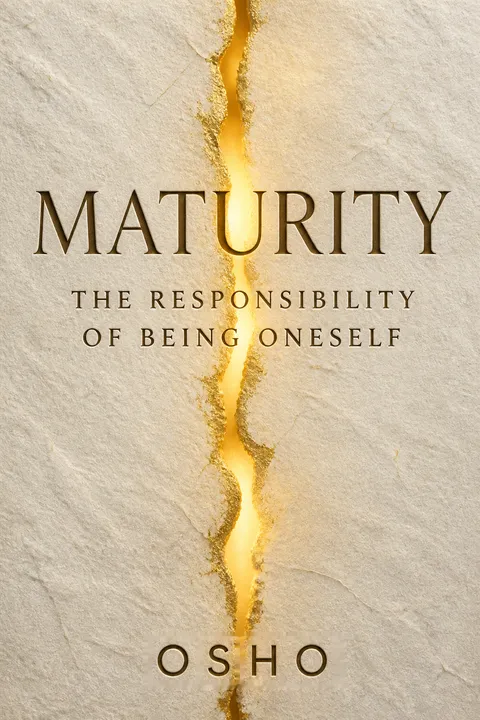
Maturity is a collection of talks organized around one recurring contrast: living on borrowed scripts versus inhabiting experience with awareness. Osho's argument moves from recovering childhood openness, through learning from pleasure and pain, toward relationships, aging, and death. The chapters do not build a tightly evidenced theory so much as circle a central spiritual proposition from multiple directions. That repetition gives the book its oral, exhortative force, but it also makes its claims easy to mistake for established psychology.
Its most useful practical thread is the insistence that elapsed time is not the same as learning. Attention to bodily action, thought, and emotion offers a concrete way to examine habitual reactions. The relationship chapters also contain a valuable ethical claim: love should not require possession or the erasure of another person's individuality. The image of celebration in ordinary activities translates the book's metaphysics into daily conduct.
The reader must separate these insights from assertions that the text does not substantiate. Seven-year biological cycles, claims about how sexual behavior should change with age, and certainty about postmortem immortality are presented with confidence, but they do not follow from the anecdotes or arguments offered. The book also treats society as chiefly corrupting, although language, education, and social bonds can enable autonomy as well as constrain it. Its account of maturity risks replacing one script, conformity, with another, an idealized inward sage.
A careful adaptation therefore keeps Osho's invitation to examine inherited assumptions, cultivate attention, and love without control, while reading his universal prescriptions as provocations rather than laws. The title's responsibility is best understood not as discovering a sealed, untouched self, but as becoming answerable for how one responds to experience. That interpretation preserves the book's existential energy without requiring agreement with its unsupported biology or metaphysical certainty.
Review Summary
Maturity by Osho receives mostly positive reviews, with an average rating of 4.10/5. Readers appreciate Osho's insights on personal growth, meditation, and embracing life's challenges. Many find the book thought-provoking and transformative, praising Osho's unique perspective on maturity as a return to one's true self. Some readers note the book's spiritual depth and its ability to challenge conventional wisdom. However, a few reviewers express concerns about certain ideas conflicting with their beliefs or find some concepts repetitive.
People Also Read





Glossary
Maturity
Awareness-grown inner developmentOsho uses maturity to mean inward growth through awareness, rather than simply age, experience, or social competence. It involves recovering openness and curiosity while seeing through borrowed beliefs and roles. In its fullest form, he describes it as discovering an inner stillness beyond habitual thought and identity.
Innocence
Open, non-craving attentionInnocence is Osho's term for an unforced openness to experience, distinct from ignorance. Ignorance, in his account, lacks knowledge while craving status or certainty; innocence is not driven by those cravings. Adult maturity can reclaim this quality with greater awareness than a child's initial innocence.
Seven-year cycles of life
A proposed life-stage mapOsho's proposed scheme divides life into successive seven-year periods, each associated with a different emphasis, such as self-focus, peer relationships, sexuality, ambition, security, and inward reflection. He presents the scheme as a natural pattern, but its age-specific claims should be treated as his framework rather than an established universal developmental law.
Being-love
Love shared from abundanceBeing-love is Osho's name for affection offered from a sense of inner fullness, rather than demanded from another person to satisfy a lack. He contrasts it with need-love, which can become possessive or transactional. Being-love does not require indifference to another's needs; its emphasis is on sharing without using love as leverage.
Horizontal and vertical
Outer pursuit and inner depthOsho's metaphor contrasts horizontal life, organized around time, worldly achievement, and the pursuit of more, with vertical life, organized around inward awareness, silence, and spiritual depth. He argues that a person can remain active in ordinary life while shifting inwardly, rather than escaping society or responsibilities.
Receptive mode
Allowing without forcingThe receptive mode is Osho's term for attending without immediately trying to alter, achieve, or control what is happening. It contrasts with action, which applies effort toward an outcome. Quietly observing a flower, bodily sensations, or passing thoughts illustrates this mode; it is meant to complement action, not replace it.
FAQ
What's "Maturity: The Responsibility of Being Oneself" about?
- Exploration of Maturity: The book delves into the concept of maturity, emphasizing the importance of self-realization and spiritual growth.
- Life's Journey: It discusses the journey from ignorance to innocence, highlighting the stages of life and the cycles of growth.
- Integration of Life and Spirit: Osho explores how maturity involves integrating spiritual awareness with everyday life, leading to a more fulfilled existence.
- Meditation and Awareness: The book emphasizes meditation as a tool for achieving maturity and understanding one's true self.
Why should I read "Maturity: The Responsibility of Being Oneself"?
- Self-Discovery: The book offers insights into understanding oneself and the journey towards self-realization.
- Spiritual Growth: It provides guidance on integrating spiritual practices into daily life to achieve maturity.
- Practical Advice: Osho offers practical advice on relationships, love, and personal growth, making it relevant for anyone seeking a deeper understanding of life.
- Unique Perspective: Osho's unique perspective combines Eastern wisdom with Western practicality, offering a holistic approach to personal development.
What are the key takeaways of "Maturity: The Responsibility of Being Oneself"?
- Maturity vs. Aging: Maturity is about inner growth and awareness, not just physical aging.
- Meditation as a Tool: Meditation is essential for self-discovery and achieving a mature state of being.
- Interdependence in Relationships: True love involves interdependence, where both partners grow together without losing individuality.
- Life's Cycles: Understanding the seven-year cycles of life can help in navigating personal growth and transitions.
How does Osho define maturity in "Maturity: The Responsibility of Being Oneself"?
- Reclaimed Innocence: Maturity is seen as reclaiming the innocence of childhood with the wisdom of experience.
- Spiritual Rebirth: It involves a spiritual rebirth, where one transcends beyond thoughts and feelings to a state of pure being.
- Integration of Self: Maturity is about integrating the heart and mind, leading to a balanced and fulfilled life.
- Ultimate Flowering: It is the ultimate flowering of meditation, where one achieves a state of inner peace and awareness.
What is the role of meditation in achieving maturity according to Osho?
- Path to Self-Discovery: Meditation is a tool for discovering one's true self and achieving spiritual maturity.
- Inner Silence: It helps in achieving inner silence and awareness, which are essential for maturity.
- Transcending the Mind: Meditation allows one to transcend thoughts and emotions, leading to a state of pure being.
- Foundation of Life: Osho emphasizes meditation as the first principle of life, with everything else being secondary.
How does Osho describe the seven-year cycles of life in "Maturity: The Responsibility of Being Oneself"?
- Stages of Growth: Life is divided into seven-year cycles, each representing a different stage of growth and development.
- Childhood to Old Age: These cycles cover the journey from childhood innocence to the wisdom of old age.
- Natural Transitions: Understanding these cycles helps in navigating life's natural transitions and achieving maturity.
- Integration and Awareness: Each cycle offers opportunities for integration and increased awareness, leading to spiritual growth.
What is the concept of interdependence in relationships as discussed in "Maturity: The Responsibility of Being Oneself"?
- Beyond Dependence: Interdependence is a mature form of love where both partners support each other's growth.
- Mutual Growth: It involves a balance where both individuals maintain their individuality while growing together.
- Spiritual Connection: True love is a spiritual connection that transcends mere dependence or independence.
- Paradise on Earth: When interdependence is achieved, it creates a harmonious relationship akin to paradise on earth.
What are the symptoms of maturity according to Osho in "Maturity: The Responsibility of Being Oneself"?
- Inner Peace: A mature person experiences inner peace and a sense of fulfillment.
- Freedom from Ego: Maturity involves freedom from ego and a deep understanding of one's true self.
- Compassion and Love: A mature individual radiates love and compassion, impacting those around them positively.
- Transcendence of Dualities: Maturity is marked by the transcendence of dualities such as pain and pleasure, leading to a balanced life.
How does Osho differentiate between ignorance and innocence in "Maturity: The Responsibility of Being Oneself"?
- State of Not Knowing: Both ignorance and innocence are states of not knowing, but they differ in their nature.
- Contentment vs. Desire: Innocence is content and fulfilled, while ignorance is desirous and seeks knowledge.
- Richness of Innocence: Innocence is rich and pure, while ignorance is poor and seeks fulfillment externally.
- Reclaiming Innocence: Maturity involves reclaiming the innocence of childhood with the wisdom of experience.
What are the best quotes from "Maturity: The Responsibility of Being Oneself" and what do they mean?
- "Growing up means moving every moment deeper into the principle of life." This quote emphasizes the continuous journey of self-discovery and spiritual growth.
- "Maturity means gaining your lost innocence again, reclaiming your paradise, becoming a child again." It highlights the idea of returning to a state of pure being with the wisdom of experience.
- "Meditation is simply a strange surgical method that cuts you away from all that is not yours." This quote underscores the transformative power of meditation in achieving self-awareness.
- "Love is not a passion, love is not an emotion. Love is a very deep understanding that somebody somehow completes you." It defines love as a deep spiritual connection beyond mere emotions.
How does Osho address the concept of aging in "Maturity: The Responsibility of Being Oneself"?
- Difference from Maturity: Aging is a physical process, while maturity is about inner growth and awareness.
- Natural Process: Aging is a natural process that should be embraced with grace and acceptance.
- Wisdom of Old Age: In the vertical line of life, old age is seen as a time of wisdom and spiritual growth.
- Celebration of Life: Osho encourages celebrating life at every stage, including old age, as part of the journey to maturity.
What is the significance of the crossroads metaphor in "Maturity: The Responsibility of Being Oneself"?
- Horizontal vs. Vertical: The crossroads represent the choice between the horizontal path of worldly pursuits and the vertical path of spiritual growth.
- Moment of Meditation: The metaphor highlights the moment when meditation allows one to see the two paths clearly.
- Path to Enlightenment: Choosing the vertical path leads to enlightenment and a deeper understanding of life.
- Integration of Life: The crossroads symbolize the integration of life's experiences with spiritual awareness, leading to maturity.
About the Author
Other books by Osho






Download PDF
Download EPUB
.epub digital book format is ideal for reading ebooks on phones, tablets, and e-readers.








