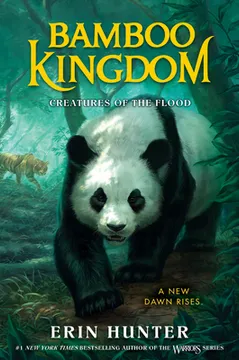


Plot Summary
Prologue
A year before the story begins, floodwater and landslides tear through the Bamboo Kingdom. Orchid Risingtree and her mate, Root, climb toward higher ground while Orchid prepares to give birth. Golden monkeys blame the pandas for failing to warn them, then attack.
Root fights them so Orchid can escape, but slips from the cliff into the flood. Alone, Orchid reaches a cave that seems safe until a huge, striped tiger steps inside. The flood has scattered families, destroyed territories, and left survivors uncertain whether the old order can protect them.
The opening makes disaster both physical and political. The flood destroys homes, but the monkeys’ accusation turns survival into a question of responsibility: pandas once carried the Dragon’s warnings, so their silence looks like betrayal. Root’s sacrifice gives Orchid a chance to protect her unborn cubs, yet she reaches shelter only to meet another danger. The scene establishes a world where inherited authority has failed at the moment it is most needed, while also planting the tiger as more than a passing threat.
Leaf Wants the Far Bank
A year after the flood, Leaf lives with her aunt Plum among the Northern Forest’s Slenderwood pandas. Their bamboo is scarce, their old territories are gone, and no one knows what happened to Sunset Deepwood, the Dragon Speaker who once delivered the Great Dragon’s warnings.
Leaf follows the Nine Feasts and listens to the elders’ memories, but she cannot understand why the Dragon failed to warn them of the flood. Her own unanswered question is closer: Plum says Leaf’s mother, Orchid, crossed the river with Leaf’s twin, and Leaf longs to reach the Southern Forest and find them.
Her red-panda friend Dasher joins her in climbing the Grandfather Gingko, where the river looks wide enough to divide not only two forests, but the life Leaf knows from the one she imagines.
Leaf’s longing begins as a practical wish to find her family, but it is also a challenge to the stories that organize her community. The Nine Feasts provide routine and belonging, yet the elders’ faith cannot explain the catastrophe that shaped Leaf’s whole life. Her questions are not simple disbelief; she wants tradition to account for lived evidence. The river makes that tension visible. It is both a dangerous boundary and the imagined route back to a family whose existence she has never been able to verify.
Sunset Returns to Prosperhill
On the Southern Forest’s Prosperhill, Rain spends her days swimming, teasing cubs, and sparring with her friend Pebble, who still grieves for his brother Stone. Their routine changes when Sunset Deepwood arrives, scarred but alive, and the older pandas acclaim him as their returned Dragon Speaker.
At a feast, Sunset recounts his survival and displays the blue Seeing Stone, which he says carries the Great Dragon’s guidance. His prophecy promises that the pandas will reunite and cross the waters together, giving Pebble hope that Stone may still live. Rain is less convinced.
She has already seen Sunset privately receiving unusual striped bamboo from Brawnshanks, a golden monkey who mocked panda authority only hours earlier. The Speaker’s return restores the group’s confidence, but Rain notices a bargain forming where she expected divine wisdom.
Sunset’s return answers a communal need before it answers any factual question. The pandas have lost family, territory, and the person who once translated danger into instructions; his familiar ritual offers them a way to imagine repair. Pebble’s hope is rooted in grief, so skepticism feels to him like an attack on the possibility of reunion. Rain sees the same ceremony from outside that emotional bargain. Her suspicion grows not from abstract cynicism, but from a mismatch between Sunset’s public authority and his private dealings with Brawnshanks.
Ghost Cannot Keep Pace
Far north, Ghost Born of Winter trains with his leopard littermates, Frost, Snowstorm, and Shiver, but his broad body, short tail, and awkward jumps make him an easy target for Brisk and Sleet Born of Icebound. Their mother, Icebound, confronts the cubs and challenges Ghost’s place in the mountains; Winter drives her away and comforts him without explaining why he looks unlike the others.
Ghost’s failure to hunt deepens his fear that he is useless. Then, after he asks the Snow Cat for help, paw-shaped marks appear in the snow and lead the family to a deer. Winter makes the kill, but lets Ghost deliver the final bite. For the first time, his siblings see him succeed, and Ghost believes the Snow Cat has shown him where he belongs.
Ghost’s insecurity grows from a mismatch between his body and the standards by which his community measures competence. He wants not merely praise, but evidence that his place is deserved. The deer gives him that evidence, although its meaning is more complicated than he can yet know: Winter makes the kill, and Ghost completes it. The episode shows how belief can steady a frightened young animal, while also creating a powerful expectation that a sign from the Snow Cat should explain his identity as well as his next meal.
The River Takes Its Toll
When poor bamboo growth pushes Plum to seek answers at Dragon Mountain, Leaf offers to go with her, but Plum refuses because she promised Leaf’s mother to keep the cub safe. Leaf stays behind, then joins Dasher in testing a fallen bamboo trunk as a bridge across the river.
It breaks loose and carries them downstream; both escape by grabbing roots near the bank, but the crossing fails. Later, Leaf finds the red panda Scratcher dead, his body mauled by a large predator.
She and Dasher soon see the striped animal moving silently beneath their tree, and Juniper identifies it as a tiger. Scratcher’s death makes the forest unsafe even in familiar places. Dasher now wants to cross the river for escape, while Leaf must face the danger on the side she has always called home.
The failed crossing turns Leaf’s private yearning into a physical risk, and its consequences expose how little control the young animals have over a landscape transformed by the flood. The river is not a simple obstacle that courage can erase; its current breaks the bamboo bridge and sends the friends downstream. The tiger then removes the comfort of staying put. Leaf’s choices are narrowed from both directions: the world across the water is unreachable, yet the world around her is no longer secure.
Rain Follows the Dream Leaf
Rain sees a three-headed shape rise from steam near a waterfall, then dismisses it as a dream. Meanwhile, Sunset sends search parties to find missing pandas. Rain volunteers with Pebble, but questions the mission and argues with him, so she leaves the group.
Pebble returns with Blossom and a starving orphan cub, Maple, whom Rain later rescues when Brawnshanks and his troop torment him. Sunset arrives and sends the monkeys away with striking familiarity. Rain follows Sunset to another meeting, where she hears him demand more dream leaf, the striped bamboo Brawnshanks supplies.
She climbs to its high-growing stalks and tastes the bitter leaves, finding no visions. The staged prophecies and monkey bargain convince Rain that Sunset is deceiving the pandas, although she still lacks proof strong enough to persuade Pebble.
Rain’s investigation is driven by care as much as suspicion. She risks alienating Pebble because she believes the Speaker’s authority may be harming the group, then acts decisively when Maple is threatened. Yet she also learns that seeing a pattern is not the same as persuading someone who needs the pattern to be false. Her experiment with dream leaf is a small act of empirical courage: she tests the supposed source of prophecy herself. The leaves yield no visions, but Rain’s certainty still has to contend with the community’s need for Sunset’s leadership.
The Dragon Shows North
With the tiger ranging near the Slenderwood, pandas and red pandas shelter in trees, then decide to travel north together in search of safety and Plum. Leaf leads the group through the forest while the tiger follows.
When a shape like a huge, scaled creature passes between the trees, it leaves a trail that guides the travelers to bamboo and climbable trees. The pandas take this as the Great Dragon’s help, and Leaf feels the warm presence again. They continue toward the mountains, where Leaf finds fur caught on a thornbush, a sign that Plum has passed that way.
Before the group can reach her, a roar and violent earthquake split the slope. Leaf and Dasher cling to the upper hillside as trees and rocks tumble below. When the shaking stops, their friends have vanished from sight.
The Dragon’s guidance offers a moment of shared direction, but it does not cancel the instability of the world. Leaf’s vision gives the migrants a usable route and briefly turns her into someone others can follow. The earthquake then breaks the group apart, showing that spiritual reassurance and physical safety are not interchangeable. The sequence also complicates leadership: Leaf can help others move, but she cannot guarantee their survival. Her next decision must be made without the community whose trust made her feel less alone.
Ghost Learns His Shape
While hunting with his littermates, Ghost finds them cornered by three sun bears and drives the larger animals back. The bears call him one of their kind, and Ghost later studies his reflection in ice, recognizing the heavy paws, short tail, and non-retractable claws that mark him as a bear rather than a leopard.
Wanting proof that he belongs among Winter’s cubs, he attempts the impossible leap across the Endless Maw. He falls onto a hidden ledge, and Winter climbs down to rescue him.
She admits she found him abandoned in a cave and raised him with her litter. As an earthquake shakes the crevasse, Ghost climbs out along her claw marks; Winter falls to her death. Blaming himself, Ghost leaves the mountain, but Shiver follows, refusing to let her brother travel alone.
Ghost’s revelation is not simply a correction of species; it reorders every failure he has interpreted as personal inadequacy. Winter’s protective lie spared him the pain of difference in one sense, but forced him to judge himself by standards he could not meet. The Maw becomes his attempt to make belonging measurable, and its danger makes that strategy fatal for Winter. Shiver’s choice to follow does not solve Ghost’s identity crisis, but it preserves a relationship not dependent on resemblance or performance.
Rain Challenges the Speaker
Rain confronts Sunset beside the river after discovering that his visions rely on the monkeys’ dream leaf. She also rejects his attempt to persuade her that a reflection in the water proves the Great Dragon has chosen her as his second-in-command.
Sunset drops his gentle manner and forces Rain underwater. As she begins to drown, a powerful, unseen force wraps around her paw and pulls her away from him, deep into the flood.
Rain glimpses the bones of animals drowned in the old riverbed, then sees a vision of Orchid facing a striped tiger in a cave and another of herself walking toward Dragon Mountain with two indistinct pandas. The current finally releases her near the far bank. Exhausted and barely conscious, she collapses without knowing where she has landed.
Rain’s skepticism becomes a moral risk when she confronts an authority figure who can physically overpower her. Sunset’s attack makes the conflict unmistakable: his fraud is no longer merely a private deception but a threat to anyone who challenges him. The visions that follow complicate Rain’s position, since she has to admit that a genuine supernatural force may exist even though Sunset’s prophecies are false. Her rescue also binds personal survival to the kingdom’s buried history, as the drowned bones make the flood’s losses tangible rather than legendary.
Shadowhunter Names the Triplets
After losing the other migrants in the earthquake, Leaf and Dasher shelter from sleet in a formation of standing stones. The tiger who once killed Scratcher enters, but does not attack. He identifies himself as Shadowhunter and explains that he promised Leaf’s mother during the flood to find her and reveal her identity.
He says Orchid gave birth to three cubs in his cave, and that all three were separated for their safety. According to Shadowhunter, the Great Dragon has chosen the triplets as its new Dragon Speakers.
Leaf cannot absorb the claim at once; she wants proof and, above all, wants to find Plum. Shadowhunter recognizes Plum’s scent on a tuft of fur and agrees to track it, turning Leaf’s frightening encounter with the tiger into an uneasy alliance.
Shadowhunter’s revelation shifts Leaf’s search from a family mystery toward a public responsibility, but the two concerns remain entangled. She does not accept a title simply because a powerful animal assigns it to her; she asks for the immediate, concrete task of finding Plum. That response protects her from being swallowed by prophecy before she has understood her own history. Shadowhunter, meanwhile, earns limited trust through action: he uses his tracking skill to pursue the aunt whose safety matters most to Leaf.
Leaf Finds Her Sister
Shadowhunter’s trail leads Leaf and Dasher to Plum, badly wounded after a frightening encounter with a pale bear in a cave. Dasher recognizes that purple leaf, a medicinal bamboo found near the river, may help her, but the nearest growth is far below.
Shadowhunter stays with Plum while Leaf and Dasher race down the mountain. At the riverbank, they find Rain unconscious in the shallows, one paw marked with a white pad like Leaf’s. Leaf pulls her clear; Rain wakes confused and remembers Sunset’s attack.
Leaf recognizes her as the sister she has searched for, then gathers the purple leaf needed for Plum. In the epilogue, Rain’s report confirms Sunset is dangerous, while Shadowhunter reveals he had promised the former Speaker to protect the triplets. The third sibling remains missing.
The reunion arrives through bodily evidence and urgent care, not through a ceremonial recognition scene. Leaf identifies Rain by the unusual pad, but first she has to pull her from the river; the mark becomes meaningful because it coincides with an act that keeps her sister alive. Plum’s injury forces the new family bond to carry practical weight immediately. The epilogue widens the danger again: finding two triplets does not resolve the prophecy, and Shadowhunter’s promise now obliges him to protect them from the very Speaker who once trusted him.
Ghost Meets Sunset Deepwood
After leaving the White Spine, Ghost and Shiver struggle through the warm, muddy forest, where leopard hunting methods fail and every scent seems to lead in a different direction. Ghost accidentally wounds a large black-and-white bear while defending Shiver in a cave, then continues toward the sound of water.
At the immense river, he meets a panda on the opposite bank. The stranger recognizes Ghost as a panda, giving him a name for the body he has spent his life misunderstanding.
Ghost tells him he has lost Winter and left his littermates; the panda responds with kindness rather than judgment. Only then does he introduce himself as Sunset Deepwood. Their meeting gives Ghost a first glimpse of belonging beyond the mountain, even as Sunset’s return places him near the danger Rain has just survived.
Ghost’s encounter with Sunset offers a gentler answer to the question of identity than the one he found in the mountains. The stranger does not demand proof of competence or resemblance; he recognizes Ghost and listens to his grief. That acceptance matters, but it is also precarious because the reader knows Sunset’s kindness has concealed violence elsewhere. The river functions here not as an impassable barrier but as the site of a meeting, linking Ghost’s search for a community to the parallel crisis among the pandas.
Epilogue
Shadowhunter leaves the reunited pandas to search for the third triplet and investigate Sunset’s betrayal. He recalls that, before the flood, Sunset told him a prophecy foretold three cubs who would succeed him as Dragon Speakers, then asked him to guard them.
Shadowhunter had believed the succession would be straightforward; now he must protect the cubs from a former friend who tried to drown one of them. He also wonders whether the prophecy includes someone beyond the triplets. With the family still divided and Sunset’s motives unexplained, Shadowhunter heads into the Bamboo Kingdom to find answers and keep his promise.
The epilogue reframes the novel’s central mystery as a failure of succession and trust. Shadowhunter’s loyalty began with Sunset, whose request made him a protector of the next generation; now that same loyalty has to survive evidence that Sunset may be its threat. The final uncertainty about whether the prophecy involves another Speaker prevents the reunion from becoming a closed resolution. Safety is provisional, and the watcher’s duty shifts from guarding one cub to understanding why the kingdom’s spiritual order has fractured.
Analysis
Creatures of the Flood builds its adventure around the consequences of a catastrophe that has altered both geography and social trust. The flood widens the river, erases territories, scatters families, and leaves animals arguing over whether their former ways can still guide them. The Nine Feasts, the missing Dragon Speaker, and the search for lost relatives are not separate concerns: each is an attempt to make a damaged community legible again.
The three young protagonists respond to uncertainty in sharply different ways. Leaf looks outward, climbing and following trails because she believes answers may lie beyond the familiar forest. Rain tests claims, especially when authority asks her to surrender judgment. Ghost turns inward, measuring himself against a community whose standards make him feel defective. Their struggles converge on identity, but the novel does not treat identity as a hidden label that settles everything. Ghost’s discovery of what he is cannot undo the pain caused by Winter’s secrecy or make his mountain home simple again. Belonging depends on how others respond to difference, and on whether love leaves room for truth.
The Dragon motif makes that question more difficult rather than easier. Sunset uses ritual and the Seeing Stone to exploit the pandas’ grief, while genuine signs appear to Leaf, Ghost, and Rain in forms they cannot control. The book distinguishes belief from obedience: Rain’s refusal to accept a false prophecy is morally necessary, but her skepticism cannot account for every supernatural event. Likewise, faith offers comfort and direction, but it does not prevent earthquakes, drowning, or loss.
The story’s strongest ethical contrast is between authority performed and care enacted. Sunset can command attention, yet Rain protects Maple and questions his conduct. Shadowhunter is terrifying by appearance, yet he keeps a promise and helps the young pandas. The novel leaves its characters in motion rather than restoring the old order. Families begin to reunite, but one triplet is still missing, Sunset’s motives remain unclear, and the survivors must decide what forms of trust can survive the flood.
Review Summary
Creatures of the Flood receives mixed but generally positive reviews, averaging 4.03 out of 5. Fans of Erin Hunter's previous work appreciate the animal-driven storytelling, world-building, and multiple panda perspectives. Many readers highlight Ghost as a standout character. Common criticisms include slow pacing in the first half, difficulty tracking numerous characters across alternating POVs, and a formulaic plot structure. The book is widely recommended for middle-grade readers and animal lovers, with many noting it as a promising series opener despite some predictability and lack of narrative variety.
Characters
Leaf
The searching climberLeaf is an adventurous young panda raised by her aunt Plum in the Northern Forest. She climbs with unusual confidence and longs to cross the river to find the family Plum says lies beyond it. Curious and persistent, she questions the old stories when they fail to explain the flood, but she is not indifferent to belief: she wants the Great Dragon to be real if it can help the animals around her. Her loyalty to Dasher and Plum repeatedly pulls her beyond safety. Leaf’s central tension is between wanting an answer for herself and learning that other creatures may need her to act before she has one.
Rain
The skeptical swimmerRain is an independent young panda from Prosperhill, a strong swimmer with a taste for mischief and little patience for authority she cannot test. She loves her mother, Peony, and is deeply attached to her friend Pebble, though she struggles to show care without disguising it as teasing or argument. Her skepticism about the Great Dragon makes her alert to the gap between what leaders claim and what they do. Rain’s courage is investigative as well as physical: she follows suspicious behavior, protects vulnerable cubs, and risks her standing with others to expose what she believes is a lie.
Ghost
The mountain outlierGhost is a large, white-furred cub raised among snow leopards on the White Spine Mountains. His unusual body makes ordinary hunting and jumping difficult, and taunts from other cubs teach him to interpret difference as failure. He wants to be useful to Winter and accepted by his littermates, so he often pushes himself into tests he is not ready to face. Ghost is strong, protective, and earnest, but his longing to prove that he belongs can overpower caution. His story examines the cost of measuring a young creature by abilities that may never have been his to develop.
Dasher
Leaf’s loyal red pandaDasher is Leaf’s red-panda friend, nimble in trees and quick to turn fear into a plan. He shares Leaf’s wish to find a way across the river, but he is also attentive to the emotional cost of her choices. When danger threatens his extended family, he insists on helping rather than staying safely behind. Dasher’s loyalty is practical: he scouts, finds food, and stays beside Leaf when larger animals and unfamiliar landscapes frighten him. His small size does not make his courage ornamental; he repeatedly contributes skills Leaf does not have.
Plum
Leaf’s protective auntPlum raises Leaf among the Slenderwood pandas and carries the habits of an older generation: ritual, patience, and faith in the Great Dragon. She is tender without being indulgent, willing to refuse Leaf’s company when a journey seems too dangerous. Plum’s decision to seek answers at Dragon Mountain comes from responsibility for a struggling community, not a taste for adventure. Her affection for Leaf is shaped by earlier loss, which makes protection both a gift and a source of conflict.
Sunset Deepwood
The returning Dragon SpeakerSunset is the absent Dragon Speaker whose return restores hope to the pandas of Prosperhill. He is experienced, composed, and skilled at making a frightened community feel seen. His stories of surviving the flood give the older pandas a shared account of grief, while his use of the Seeing Stone renews their confidence in the Great Dragon. Sunset’s authority rests not only on ritual but on the emotional needs of those around him. His relationship with Pebble and Rain shows how differently a leader’s promise can land on people seeking comfort and people seeking evidence.
Shadowhunter
The searching tigerShadowhunter is a powerful tiger who moves through the Bamboo Kingdom with the patience and confidence of a practiced tracker. His size makes him frightening to smaller animals, but he understands that trust cannot be demanded by strength alone. He binds himself to promises and treats protection as a duty, even when the animals he guards fear him. Shadowhunter’s seriousness sometimes makes him seem remote, yet he is capable of restraint and tenderness. His position between predator and guardian complicates the animals’ instinctive assumptions about which creatures are safe.
Pebble
Rain’s grieving friendPebble is Rain’s close friend, a gentle young panda whose grief for his missing brother Stone makes Sunset’s promises especially powerful. He wants to believe the pandas can recover their scattered families, and he is willing to join a search even when the outcome is uncertain. Pebble can mistake Rain’s questioning for selfishness because hope feels fragile to him. His attachment to her remains real beneath their arguments, but he needs time to hear concern that does not arrive in the form he expects.
Winter
The devoted leopard motherWinter is a protective snow leopard who raises four cubs on the White Spine Mountains. She teaches them to hunt and leap, but her deepest instinct is to keep them safe and united. Her care for Ghost is especially patient because he struggles with tasks his littermates manage easily. Winter believes encouragement can give a cub room to grow, though her choices also show the risks of deciding what another creature is ready to know.
Shiver
Ghost’s steadfast sisterShiver is the smallest cub in Winter’s litter and often has to pause to catch her breath, but she meets Ghost’s difference with warmth rather than suspicion. Cheerful and observant, she notices when he is isolated and tries to draw him back toward the family. Her courage is not based on physical dominance; it comes from choosing closeness even when the path ahead is frightening.
Peony
Rain’s careful motherPeony is Rain’s mother and a steady presence among the crowded pandas of Prosperhill. She values cooperation because the flood has forced former neighbors to share limited space, and she tries to guide Rain without crushing her independent nature. Peony’s tenderness is expressed through practical warnings, food, and attention to the young. She understands that survival now requires habits different from those her generation inherited.
Brawnshanks
The sharp-tongued monkeyBrawnshanks is a golden monkey with a torn ear, quick hands, and a talent for provoking pandas. He moves comfortably through the canopy and leads a troop that can reach resources larger animals cannot. His mockery of panda authority makes his later dealings with Sunset especially unsettling. Brawnshanks is an opportunist who enjoys controlling what others cannot easily obtain.
Orchid Risingtree
The flood survivorOrchid is a strong, expectant panda caught in the flood that reshapes the Bamboo Kingdom. She keeps climbing despite rain, mud, and the loss of her mate, focusing on finding shelter before her cubs arrive. Her instinct to protect the young gives the prologue its emotional urgency. Orchid’s brief appearance establishes the cost of the disaster before the story’s young protagonists understand how deeply it has altered their families.
Root
Orchid’s courageous mateRoot is Orchid’s mate, a strong panda who places himself between her and the angry golden monkeys during their climb from the flood. His instinct is to protect his family, even when the slippery slope makes escape uncertain. Root’s brief role establishes the sacrifice and grief that shape the survivors’ world.
Snowstorm and Frost
Ghost’s leopard littermatesSnowstorm and Frost are two of Winter’s cubs, capable hunters who follow the expectations of leopard life more easily than Ghost can. They tease and play with their siblings, but their confidence in familiar measures of skill can make them impatient with Ghost’s struggles. Their bond with him is genuine, even as their understanding of his difference remains incomplete.
Icebound
The hostile leopard motherIcebound is the mother of Brisk and Sleet and a territorial snow leopard who regards Winter’s family as a threat. She turns her anxieties about status and territory into aggression toward Ghost and his siblings. Her behavior shows how adult fear can be passed down as bullying.
Brisk and Sleet
The mountain bulliesBrisk and Sleet are Icebound’s cubs. They mock Ghost and Shiver for their differences, echoing their mother’s hostility. Their taunts give shape to the social pressure Ghost feels to prove that he belongs among the leopards.
Maple
The rescued orphan cubMaple is a small, newly orphaned panda found during one of Sunset’s searches. Frightened and weak, he needs protection from both the wilderness and the golden monkeys. His vulnerability draws out Rain’s protective instincts and exposes the difference between claimed leadership and actual care.
Scratcher
The predator’s first victimScratcher is a red panda whose death reveals that a dangerous predator is moving through the Northern Forest. His loss makes the threat immediate for Dasher and his extended family, prompting them to consider leaving the home they know.
Juniper
The skeptical elderJuniper is an older Slenderwood panda who remembers the territories lost to the flood. He resists being treated as though his old identity no longer matters, yet he also shares the community’s uncertainty about its future. His complaints give voice to the grief hidden inside seemingly small disputes.
Plot Devices
The Nine Feasts
Ritual as daily structureThe pandas divide the day into nine meals, each accompanied by a blessing to the Great Dragon. The feasts give scattered survivors a repeated practice that preserves community and faith when their territories and routines have disappeared. They also show how tradition can comfort and constrain: the pandas continue the rituals even when food is scarce, while red pandas traveling with them struggle to adapt to the schedule. The Feasts become a measure of stability, and their interruption signals how thoroughly danger has unsettled ordinary life.
The Seeing Stone
Authority made visibleThe small blue stone carried by Dragon Speakers is presented as an object connected to the Great Dragon’s cave. Sunset raises it while delivering a prophecy, and its age and symbolic importance persuade the pandas that his authority has returned with him. The stone works as a visible focus for belief, allowing the community to gather around a shared sign. Its presence does not, by itself, prove the truth of every message delivered in its name.
Dream Leaf
A counterfeit source of visionsThe striped bamboo known as dream leaf grows high on a rocky column and is supplied to Sunset by Brawnshanks’s troop. Rain learns that Sunset wants it to help produce the visions behind his prophecies. Her attempt to test the bitter leaves gives her evidence that his supernatural performance is false, though the experiment alone cannot explain the genuine Dragon-shaped experiences she later has. The plant separates Sunset’s deception from the possibility that the Great Dragon exists.
The White Paw Pad
A mark linking siblingsLeaf and Rain each have a white grip pad among otherwise dark paw pads. The unusual marking allows Shadowhunter to identify Leaf as the panda he has been searching for, then helps Leaf recognize Rain at the riverbank. The mark turns a physical detail into evidence of kinship and destiny. It does not erase the sisters’ different histories or instantly create trust, but it gives them a concrete reason to consider a family connection neither could have discovered alone.
About the Author




Download PDF
Download EPUB
.epub digital book format is ideal for reading ebooks on phones, tablets, and e-readers.








