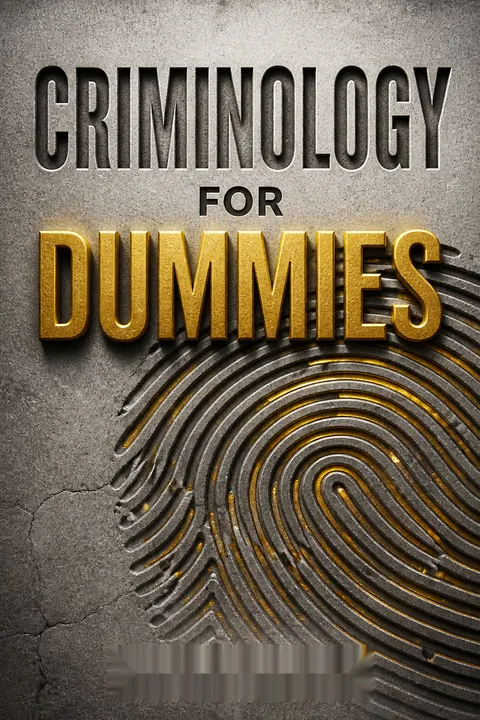


Key Takeaways
Treat crime as a legal boundary that societies continually redraw
Law draws the line. Crime is not simply any harmful or immoral act. Legislatures define offenses, and the possibility of losing liberty distinguishes criminal conduct from many other legal violations. A criminal offense generally requires a voluntary act and a culpable mental state, such as intent, knowledge, recklessness, or negligence. Some offenses are exceptions, including certain strict-liability crimes.
Values shape the boundary. The book calls inherently wrongful conduct mala in se, such as murder, and conduct prohibited mainly by regulation malum in prohibitum, such as driving without a license. Laws change with politics, place, and social values. The text illustrates that change with court decisions that invalidated laws against same-sex intimacy and abortion.
What's striking is that criminology begins before a suspect is arrested: it begins with the political choice of what counts as crime. This distinction helps separate moral judgment from legal status, and it explains why the same conduct can be treated differently across jurisdictions or eras. It also raises a useful question: who benefits when a new offense is created, and who bears its enforcement costs? The book notes that public consensus matters, while organized interests can influence regulation. That tension makes criminal law both a tool for protecting people and a record of power.
Use crime statistics as imperfect maps, not a census of reality
Every measure misses something. The book reports that fewer than half of violent crimes and fewer than 40 percent of property crimes were reported to police. The FBI's Uniform Crime Report collected data on nine serious offense categories, but agencies could report only the most serious crime in an incident. Arrest totals measure police activity as well as crime, so fewer arrests do not necessarily mean fewer offenses.
Surveys fill part of the gap. The National Crime Victimization Survey questioned roughly 76,000 households annually about victimization, including incidents never reported to police. It helped show national patterns, but its sample could not reliably establish trends for every city or state. In the book's historical figures, violent crime fell from 758 per 100,000 people in 1991 to 467 in 2007.
Crime data are not neutral windows. They depend on definitions, reporting decisions, police priorities, and the design of surveys. Combining administrative records with victim surveys is therefore a stronger approach than treating one number as the truth. The distinction also matters for policy: a decline in arrests might reflect fewer offenses, less enforcement, or a shift to crimes that are harder to detect. The book's figures are from its 2009-era context, so they should be read as an illustration of measurement, not as a current crime report.
Explain offending through interacting choices, pressures, and vulnerabilities
No single cause explains crime. Rational choice theory treats offending as a decision shaped by perceived risks and rewards, such as money, status, excitement, or revenge. Social theories add the influence of opportunity, neighborhood conditions, strain, and learned behavior. Differential association theory, for example, argues that people can learn criminal techniques and justifications from close associates. Social control theories emphasize bonds and self-restraint that can hold impulses in check.
Biology is one influence, not a verdict. The book discusses genetics, brain development, nutrition, mental illness, and personality disorders, while stressing that environment also matters. Its adoption-study figures show more criminal conduct when biological and adoptive parents both had criminal records than when neither did. Such correlations suggest interacting influences, not an inherited criminal destiny.
The strength of this plural account is that it resists the tempting search for one villainous trait. A decision model can clarify why opportunity and perceived consequences matter, while social and developmental accounts explain how preferences and options are formed. The harder task is distinguishing cause from correlation: poverty, neighborhood disorder, trauma, and policing patterns can cluster together, making any one factor look decisive. An effective explanation must therefore be specific about mechanisms and open to several levels of analysis, from individual judgment to institutional conditions.
Protect social bonds before youthful misconduct becomes a criminal identity
Neighborhoods shape opportunity. Social disorganization theory links higher crime with weakened local structures, including poor schools, unemployment, vacant buildings, and high residential turnover. Shaw and McKay's Chicago research found crime concentrated in neighborhoods where social ties were fragile. Social bond theory adds four restraints: attachment to people and institutions, commitment to conventional goals, involvement in community activities, and belief in shared rules.
Labels can deepen trouble. Labeling theory distinguishes an initial offense from later conduct that may follow when someone is treated as permanently criminal. Diversion programs try to interrupt that process by allowing eligible people to complete conditions without a conviction. These approaches do not deny responsibility. They ask whether a response can hold someone accountable without needlessly cutting off school, work, or supportive relationships.
This is a useful shift from asking only why an individual breaks a rule to asking what relationships and institutions make lawful choices sustainable. Schools, families, and community groups can supply supervision, belonging, and routes to recognition that gangs or delinquent peers may otherwise provide. Yet neighborhood conditions should not be mistaken for individual destiny. Most people in disadvantaged areas do not offend, and some affluent people do. The practical challenge is to strengthen local resources without turning entire communities into objects of surveillance.
Give victims practical support and a voice in the justice process
Harm outlasts the incident. Crime can leave physical injury, fear, trauma, lost wages, medical bills, and damage to family life. The book describes the growth of organized victim services in the 1970s and 1980s, including a presidential task force, the federal Office for Victims of Crime, and the 1984 Victims of Crime Act. State compensation programs may help with medical care, counseling, lost wages, or funeral costs, usually after other sources of payment are used.
Rights need real access. Many states allow victims to receive hearing notices, speak at release or sentencing hearings, seek no-contact orders, protect their addresses, and request restitution. Victim advocates help explain procedures and connect people to shelters and services. But laws do not guarantee consistent enforcement, and victims may still experience the justice system as intimidating or impersonal.
Victim services recognize that a criminal case is not merely a dispute between the state and the accused. A person harmed by crime must navigate recovery while confronting hearings, evidence requests, and uncertainty about an offender's release. Advocacy can reduce that burden and improve the quality of participation. At the same time, victim voice should not be confused with control over prosecution or sentencing. A fair system must take victims seriously while preserving the defendant's rights and avoiding the conversion of grief into a substitute for evidence.
Disrupt criminal networks by tracing relationships, routes, and proceeds
Arrests alone rarely dismantle a network. Organized crime groups can replace members and continue operating, whether they traffic drugs, sell counterfeit goods, extort businesses, or launder money. Drug distribution may run from production and border transport through wholesale dealers to street sellers. Terrorist activity can involve planned cells, but the book also warns of lone actors inspired by an ideology. Each structure demands different intelligence and investigative methods.
Follow connections and resources. Task forces share information across jurisdictions. Investigators may use informants, undercover work, wiretaps, and conspiracy or RICO laws to connect separate acts to an organization. Forfeiture can remove money or property linked to crime. Drug policy also needs more than enforcement: the book describes prevention, treatment, and enforcement as interdependent parts of the response.
Network thinking explains why removing one visible participant may leave the underlying enterprise intact. Investigators gain leverage by identifying dependencies, such as supply routes, trusted brokers, financial channels, or communication links. This approach also makes coordination essential because criminal activity crosses agency boundaries more easily than bureaucracies do. There is a countervailing risk: broad network investigations can sweep up peripheral people or intrude deeply on privacy. Strong judicial oversight and evidence thresholds are necessary companions to the expanded reach of task forces and surveillance.
Give white-collar crime investigators time and financial expertise
Respectability can conceal serious harm. Edwin Sutherland used the term white-collar crime for offenses committed by people of status in their work. The book adopts a broader description: illegal or unethical conduct that violates trust for personal or organizational gain. Examples include embezzlement, securities fraud, tax evasion, environmental offenses, price fixing, and government corruption. A retail-industry estimate cited in the book put employee theft above $19 billion in 2006.
Complex cases need specialized capacity. A robbery may require witness interviews and a report; an embezzlement investigation can require months of financial records, accounting analysis, and expert testimony. Local agencies often lack trained investigators, while civil or administrative remedies may be easier to pursue than criminal charges, which require proof beyond a reasonable doubt. This combination can leave substantial misconduct less visible and less consistently prosecuted.
White-collar crime exposes an institutional asymmetry: offenses involving paperwork and trusted positions can produce broad financial damage, yet they are difficult to investigate with ordinary patrol resources. The challenge is not simply that wealthy defendants can hire strong lawyers. It is also that misconduct may be normalized inside organizations, records are technical, and victims may not know they were cheated. Specialist investigators and clear reporting channels can narrow the gap. Still, criminal prosecution should not be the only measure of accountability; regulatory penalties and restitution can matter when criminal proof is unavailable.
Trust evidence built by procedure, not television-speed forensic certainty
A case begins with disciplined observation. Officers secure scenes, separate witnesses, record statements, collect physical evidence, and write reports for prosecutors. A chain of custody documents who handled evidence from collection to court, helping show it was not altered or substituted. Searches generally require probable cause and a judge's warrant, with limited exceptions. These rules protect privacy while shaping what evidence can be used.
Science helps, but it has limits. DNA, fingerprints, cell records, blood patterns, and digital devices can support an investigation, but samples may be mixed, incomplete, or wrongly interpreted. The book describes a backlog of forensic evidence and notes that DNA testing takes far longer than television suggests. The so-called CSI effect captures jurors' raised expectations for forensic proof, even when ordinary testimony or direct observation is more relevant.
Forensic evidence is most powerful when its limits are made explicit. A DNA match can connect a person to biological material, but it does not automatically establish when or why that material arrived at a scene. The same distinction applies to cellphone location records and fingerprints. Scientific evidence should be interpreted alongside witness accounts, timelines, and alternative explanations. Popular crime dramas can make careful procedures seem dull, but their unglamorous details, documentation, contamination controls, and disclosure, are what make evidence trustworthy.
Preserve due process while resolving most cases outside the courtroom
The process balances power. Prosecutors decide whether evidence supports charges and have an ethical duty to seek justice, not simply convictions. Defense attorneys protect the accused from government overreach. Judges review searches, manage hearings, rule on evidence, and impose sentences. At trial, the government must prove guilt beyond a reasonable doubt, a higher standard than those used in civil cases.
Most cases end by agreement. The book cites a 2005 survey in which only 3 percent of state felony cases ended in jury trials, with most resolved by guilty pleas or negotiated agreements. A plea can reflect strong evidence, but it may also be shaped by the risks of trial, potential sentence, and limited defense resources. Pretrial hearings can exclude evidence obtained unlawfully or statements that should not be used.
Plea bargaining is a practical response to a court system that could not try every case, but efficiency does not make each agreement equally voluntary. The threat of a much harsher sentence after trial can influence a defendant's decision, especially when counsel has little time to investigate. At the same time, victims may prefer a timely resolution, and a negotiated agreement can secure restitution or treatment. The central question is not whether pleas exist, but whether defendants understand the evidence, receive competent advice, and have a meaningful chance to contest the state's case.
Judge punishment by its purpose, costs, and effects on future crime
Punishment serves competing aims. Retribution seeks a proportionate consequence; deterrence aims to discourage crime; incapacitation prevents an offender from harming the public while confined; rehabilitation tries to support lawful life after release. These purposes can conflict. A long sentence may incapacitate, but it costs money and may expose people to prison violence or criminal networks. The book reports more than 2.3 million people in U.S. jails and prisons in 2008, and an average state-prison cost of $22,650 per inmate annually in 2001.
Measure outcomes, not slogans. The text cites a study finding that about two-thirds of released prisoners were rearrested for felonies within three years. Probation and treatment offer alternatives for some lower-level offenses, while the death penalty raises separate questions about justice, deterrence, error, and expense. No single theory answers every case.
A punishment policy should be judged against its stated aim. If deterrence is the goal, severity is not the only relevant factor; the perceived certainty and speed of consequences matter too. If rehabilitation is the goal, programs need credible evaluation rather than hopeful labels. High incarceration can reduce opportunities for some offenders to commit crimes outside, yet it carries fiscal and social costs that require accounting. The book's strongest implication is methodological: compare outcomes across interventions and populations instead of treating either treatment or confinement as universally effective.
Treat young offenders as developing people, not small adults
Development changes responsibility. The book connects juvenile offending to still-developing judgment and impulse control, noting that brain maturation can continue into the mid-twenties. Its cited figures show that people under 25 account for a large share of violent and property crime arrests. The separate juvenile system grew from the view that children are less mature and more open to intervention than adults.
Use the least restrictive response that works. Many cases can be handled informally through a counselor, community service, or treatment. Serious cases may go to formal adjudication, and some offenses allow transfer to adult court. Juvenile judges can tailor conditions around education, family problems, substance use, or mental health. The system's challenge is to protect the public without making a young person's first mistake a permanent barrier to school and work.
Developmental science strengthens the case for distinguishing adolescent judgment from adult judgment, but it should guide individualized assessment rather than become a blanket excuse. Young people vary greatly in maturity, background, and risk, and serious harm to victims remains real. The juvenile system's advantage is its capacity to involve families, schools, counselors, and courts in one plan. That capacity only matters if services are accessible and coordinated. A label of potential for change is not enough; the system must provide concrete opportunities to learn, repair harm, and reenter the community.
Analysis
The book's central achievement is to make criminology legible as a connected public system rather than a parade of notorious offenders. Its sequence moves from the legal definition of crime to measurement, causes, prevention, investigation, trial, and punishment. That structure matters because each stage changes the next: lawmakers define offenses, reporting systems shape what officials see, theories shape policy, and policy determines who is policed, charged, and confined.
The book is strongest when it resists single-cause explanations. Rational choice, neighborhood disorganization, social learning, biology, and labeling each illuminate part of the problem, while none explains why every person in similar circumstances makes the same choice. This pluralism is more useful than a tidy theory, though it creates a challenge: readers need evidence that distinguishes mechanisms rather than a list of correlations. The book also foregrounds institutional asymmetries. Financial crimes can be hard to investigate despite large losses, victims may lack meaningful support, and criminal defendants rely on procedural protections against state power. These are not side issues. They shape what justice can achieve.
The practitioner's perspective makes the legal process concrete, especially the mundane labor of reports, evidence handling, plea negotiations, and probation. The same perspective can give enforcement concerns more weight than structural critiques or defense experiences. Reading the book critically means keeping both perspectives in view: police and prosecutors face real resource constraints, and their discretion can still produce unequal outcomes.
Finally, the text is a 2009 reference work. Its figures, agency descriptions, legal examples, and accounts of drug routes are a historical snapshot, not current guidance. Its lasting value is less a set of up-to-date statistics than a way to ask better questions: What is being measured? Which theory explains this case? Who bears the costs? Does this intervention reduce harm, and at what price? Those questions make the book useful beyond its original moment.
Review Summary
Criminology For Dummies receives generally positive reviews, with readers praising its accessibility and comprehensive overview of the criminal justice system. Many find it useful for beginners and students in the field. The book is commended for its clear explanations of complex theories and use of real-life examples. Some criticize its focus on the American system and occasional outdated information. While some readers find it too basic, others appreciate its user-friendly approach and breadth of topics covered, making it a solid introduction to criminology.
People Also Read




Glossary
mala in se
Inherently wrongful actsA legal term for conduct considered wrong in itself, rather than wrong only because a law prohibits it. The book uses murder, rape, theft, and assault as examples. These offenses are generally understood as harmful across broad social consensus, although their precise legal definitions and penalties can still vary.
malum in prohibitum
Acts prohibited by regulationA legal term for conduct treated as criminal because a statute prohibits it, not because the conduct is inherently immoral. Examples in the book include driving without a license and hunting without a license. Such rules regulate behavior and can reflect changing policy choices, local conditions, or political priorities.
Uniform Crime Report
Police-reported crime statisticsAn FBI program that compiles annual crime statistics submitted by participating police agencies. Its traditional system focused on nine serious offense categories and also collected arrest information. Because offenses may go unreported and the system has limits on how incidents are counted, it offers a partial view rather than a complete count of crime.
National Crime Victimization Survey
Household victimization surveyA federal survey that asks people in sampled households about crimes they experienced, including incidents never reported to police. The book describes a yearly survey of about 76,000 households and notes that it helps estimate national patterns. Its sample is not large enough to establish reliable trends for every state or locality.
Rational choice theory
Crime as perceived calculationA criminological theory that treats many offenses as decisions shaped by perceived risks, rewards, and personal needs. Rewards can include money, status, excitement, or revenge, while costs can include arrest and punishment. The theory does not claim offenders make wise choices, and it has limits when conduct is driven by addiction, mental illness, or intense emotion.
Social disorganization theory
Neighborhood structure and crimeA theory linking higher crime levels to neighborhoods where social institutions and relationships are weakened. The book describes indicators such as poor schools, unemployment, vacant or vandalized buildings, and population turnover. The theory treats local conditions as influences on collective capacity and opportunity, not as proof that any individual resident will offend.
Differential association theory
Crime learned through close relationshipsEdwin Sutherland's theory that people learn criminal skills, motives, attitudes, and justifications through interaction with others, especially family and close friends. The duration, frequency, and intensity of these associations matter. The theory applies across social classes and helps explain how conduct can seem acceptable within one person's social circle.
Social bond theory
Social ties restrain offendingTravis Hirschi's theory that connections to people and institutions help restrain criminal behavior. It identifies attachment to others, commitment to conventional goals, involvement in community activities, and belief in shared rules. When these bonds are weak, a person may feel less invested in following society's expectations.
Labeling theory
Labels can reinforce offendingA theory that examines how society's response to an offense can affect a person's identity and future behavior. It distinguishes an initial act of deviance from later conduct that may develop after someone is treated as a criminal. Diversion and expungement are among the practices intended to reduce the lasting effects of a criminal label.
Restorative justice
Repair harm and relationshipsAn approach that seeks to address crime by making victims whole, holding offenders accountable, and involving the community in repair. It may use structured meetings or diversion rather than relying only on incarceration. The book presents it as promising for appropriate cases, while recognizing that dangerous offenders may still require confinement.
RICO laws
Prosecute organized criminal activityRacketeer Influenced and Corrupt Organizations laws allow prosecutors to connect separate offenses to a broader criminal enterprise. They were developed to address organizations whose members could be replaced after individual arrests. The laws can reach participants who perform different roles in furthering an organization's criminal activity, although investigations can be lengthy and complex.
chain of custody
Documented evidence handlingA record of who collected, stored, transferred, tested, and presented physical evidence. It helps establish that an item shown in court is the same item recovered during an investigation and that it was not altered or substituted. Careful seals, logs, and testimony from handlers can support this account.
culpable mental state
Required criminal mental responsibilityThe legally relevant state of mind associated with an act, such as acting intentionally, knowingly, recklessly, or negligently. The required state depends on the offense and jurisdiction. In general, greater awareness or intent can mean greater legal responsibility, while some narrow offenses impose strict liability without proof of a particular mental state.
FAQ
1. What is "Criminology For Dummies" by Steven Briggs about?
- Comprehensive crime overview: The book provides a thorough guide to understanding crime, its causes, and how law enforcement investigates and prosecutes criminals.
- Real-world application: Steven Briggs, a career prosecutor, offers practical insights into the criminal justice system, demystifying complex legal and forensic concepts.
- Wide crime coverage: It explores various crime types, including violent, property, white-collar, organized crime, and terrorism, giving readers a broad understanding of criminal behavior and justice responses.
2. Why should I read "Criminology For Dummies" by Steven Briggs?
- Accessible expert knowledge: Written in clear, jargon-free language, the book is suitable for students, professionals, and general readers interested in criminology.
- Insider perspective: Briggs shares insights from his experience as a prosecutor, including real-life cases and law enforcement strategies.
- Practical and balanced: The book provides honest discussions of crime prevention, victim rights, and career options, as well as the challenges and rewards of working in criminal justice.
3. What are the key takeaways from "Criminology For Dummies" by Steven Briggs?
- Understanding crime and justice: Readers gain a foundational grasp of crime types, causes, and the workings of the criminal justice system.
- Theories and real-world application: The book connects criminological theories to practical law enforcement and legal procedures.
- Victim and offender perspectives: It highlights the impact of crime on victims, the rights movement, and the complexities of prosecuting offenders, especially in white-collar and organized crime.
4. How does "Criminology For Dummies" by Steven Briggs define crime and its categories?
- Legal definition: Crime is defined as conduct punishable by jail time, distinguishing it from non-criminal illegal acts like traffic violations.
- Two main categories: Crimes are classified as mala in se (inherently wrong, e.g., murder) and malum in prohibitum (wrong because prohibited, e.g., unlicensed driving).
- Elements of crime: A crime requires a voluntary act and a culpable mental state, with distinctions between misdemeanors and felonies.
5. What are the main types of crime discussed in "Criminology For Dummies" by Steven Briggs?
- Violent crimes: Includes homicide, assault, rape, robbery, and kidnapping, with explanations of degrees and circumstances.
- Property crimes: Covers theft, burglary, arson, vandalism, and auto theft, exploring causes like addiction and economic need.
- White-collar and organized crime: Discusses embezzlement, securities fraud, environmental crime, and the operations of groups like the Mafia and street gangs.
- Terrorism and drug trafficking: Examines the global narcotics trade and domestic/international terrorism threats.
6. How does "Criminology For Dummies" by Steven Briggs explain why people commit crimes?
- Rational choice theory: People weigh risks and rewards before committing crimes, with deterrence depending on perceived punishment.
- Sociological theories: Social disorganization, strain, and social learning theories explain how environment and social bonds influence criminal behavior.
- Biological and psychological factors: Genetics, brain chemistry, mental illness, and personality disorders can predispose individuals to crime.
- Critical perspectives: Labeling theory and feminist perspectives explore how societal reactions and inequalities affect crime and justice.
7. What criminological theories are covered in "Criminology For Dummies" by Steven Briggs?
- Rational choice and deterrence: Offenders make calculated decisions based on perceived benefits and risks.
- Social structure and learning: Theories like social disorganization, strain, and social learning focus on environmental and peer influences.
- Biological and psychological influences: The book discusses genetic predispositions, brain function, mental illness, and personality disorders such as psychopathy.
- Critical and labeling theories: Explores how power structures, labeling, and gender dynamics shape crime definitions and responses.
8. How does "Criminology For Dummies" by Steven Briggs describe the criminal justice process?
- Step-by-step walkthrough: The book explains the process from crime measurement and investigation to prosecution, trial, and punishment.
- Roles of key players: Details the functions of police, prosecutors, defense attorneys, judges, and appellate courts.
- Courtroom procedures: Covers plea bargaining, pretrial hearings, trial stages, and verdict interpretation.
- Juvenile justice: Explains the separate juvenile system, its focus on rehabilitation, and the science behind adolescent brain development.
9. What investigative and forensic techniques are explained in "Criminology For Dummies" by Steven Briggs?
- Crime scene investigation: Procedures for securing scenes, collecting evidence, and maintaining chain of custody.
- Forensic science tools: Use of fingerprints, DNA analysis, blood stain patterns, handwriting comparison, and electronic evidence.
- Interviewing and interrogation: Best practices for questioning witnesses and suspects, including legal and ethical considerations.
- Specialized methods: Explains polygraph tests, search warrants, wiretaps, and the role of crime labs.
10. How does "Criminology For Dummies" by Steven Briggs address organized crime, gangs, and the global narcotics trade?
- Organized crime operations: Explains loan sharking, extortion, violence, and money laundering tactics used by groups like the Mafia.
- Law enforcement response: Describes the use of intelligence, task forces, wiretaps, and informants to combat organized crime.
- Drug trafficking structure: Details the production, distribution, and smuggling of major drugs, and the challenges of disrupting these networks.
- Social and economic impact: Highlights the costs of drug abuse and organized crime on communities and the justice system.
11. What does "Criminology For Dummies" by Steven Briggs say about victims and their rights?
- Historical neglect: Victims were once overlooked by the justice system, receiving little support or compensation.
- Victim impact: Crime causes physical, emotional, and financial harm, with victims often suffering PTSD and fear.
- Victims’ rights movement: Modern laws grant rights to notification, participation, restitution, and protection, supported by advocates and nonprofits.
12. What career options and realities in criminal justice are highlighted in "Criminology For Dummies" by Steven Briggs?
- Diverse career paths: Includes police officer, corrections officer, forensic scientist, crime analyst, probation officer, juvenile counselor, victim advocate, and legal support roles.
- Job realities: The book provides honest insights into the challenges, risks, and rewards of criminal justice careers.
- Educational pathways: Emphasizes the importance of understanding the system and obtaining relevant education and training.
- Insider advice: Offers practical guidance for those considering or entering the field, based on the author’s extensive experience.
Download PDF
Download EPUB
.epub digital book format is ideal for reading ebooks on phones, tablets, and e-readers.








