

Key Takeaways
Listen for the need beneath the words, not just the words.
Hearing is not understanding. Hearing registers sound; listening requires attention, interpretation, and an effort to grasp what the message means to the speaker. Repeating someone’s words perfectly can still miss the point if their feelings, context, or unfamiliar language remain unclear.
The book opens with two teenagers fighting over one orange. Their mother asks what each needs it for: one wants the juice, the other the rind for a cake. The apparent competition disappears once their actual needs are understood. Listening can reveal solutions that are invisible when each person argues only for a position.
The orange story captures a central insight of negotiation: stated demands often conceal different interests. Asking what a person needs can expand the solution space, rather than merely divide scarce resources. The same move is useful in families, teams, and customer conversations. Still, better understanding does not guarantee agreement. Some needs genuinely conflict, or one party may have more power. Listening is a way to discover the real problem, not a promise that every problem has a satisfying compromise.
Treat your interpretation as a draft, not a fact.
Perception has a frame. A frame is the broad context through which someone understands a situation. A filter is the focus they bring to it, such as emphasizing benefits while overlooking risks. Both shape what a listener notices and how the same words land. Past experiences and assumptions can make those processes automatic.
Two people looking through a large window may disagree: one attends to the ocean view, the other to the dirt on the glass and lack of privacy. Neither sees the whole scene. The book’s ACES Decision-Making Technique prompts people to examine their assumptions, desired criteria, possible solutions, and missing information. Asking when the opposite of an assumption could be true can loosen a rigid interpretation.
This approach resembles cognitive debiasing: noticing an interpretation, generating an alternative, then seeking evidence. It is particularly valuable in relationships, where one painful history can turn neutral remarks into apparent criticism. The method does not require forced optimism. A person may be accurately detecting disrespect or manipulation. The point is to distinguish evidence from the story built around it, then check that story with a question rather than treating the first explanation as settled truth.
Catch your listening failure before the speaker has to name it.
Attention has recognizable failures. The book describes seven listener patterns: the Preoccupied, who multitasks; the Out-to-Luncher, who mentally drifts; the Interrupter, who waits to speak; the Whatever, who seems indifferent; the Combative, who listens for ammunition; the Analyst, who rushes to advise; and the Engager, who tries to understand the speaker’s perspective.
These are patterns, not permanent identities. A person can become preoccupied because of a deadline or combative because a subject touches a nerve. Distractions can be sensory, such as a buzzing phone, or emotional, such as replaying an earlier argument. Noticing the distraction creates a chance to return attention, set aside a device, or ask for a better time to talk.
The categories are memorable because they turn a vague accusation, you never listen, into observable behavior. That makes self-correction easier: an interrupter can pause, while an advice-giver can first ask what kind of support is wanted. The labels should remain temporary descriptions, not diagnoses. A colleague who looks distracted may be processing a serious concern, and visible enthusiasm is not proof of comprehension. A useful check is whether the speaker feels accurately understood, not whether the listener performs attentiveness.
Choose whether to hear facts, prepare a reply, or understand a person.
Listening has different aims. Pretending to listen gives the appearance of attention while the mind wanders. Listening to prepare a response gathers material for a defense or explanation. Listening to learn selectively seeks useful information, as when a student concentrates on language instruction. Listening for empathy seeks to understand the whole person, including motives and circumstances not stated directly.
In one example, a human resources director hears that an employee is exhausted at work. Rather than scold him for dozing, she learns he walks several miles before catching an early bus because his family shares one car. Her understanding leads her to suggest a coworker might offer him a ride. The shift is from judging a behavior to discovering the conditions behind it.
These modes clarify that listening is not one undifferentiated virtue. A technical briefing may call for information gathering, while a distressed friend may need understanding before advice. Confusion often arises when one person offers solutions and the other wants recognition. A simple question about the desired kind of response can prevent that mismatch. Empathy also has limits: understanding why someone acted harmfully does not excuse the harm or require the listener to take responsibility for fixing it.
Translate the message for the person, pressure, and decision style.
Messages are shaped before they arrive. Encoding means turning an idea into words, gestures, and tone. A person might discuss quitting a job emotionally with a friend, collaboratively with a spouse, simply with a child, and in problem-solving language with a manager. Power, culture, relationships, and the setting affect what can be said and how.
Environmental load means the stress created by pressures such as time limits, uncertainty, or important consequences. Decision styles also differ. The Driver Decision Style Model distinguishes people who want little or much information, and one preferred solution or several. It names four combinations: Decisive, Hierarchic, Flexible, and Integrative. A hurried Decisive listener may need the bottom line, while a Hierarchic listener may want evidence and careful analysis.
Communication often fails not because a message is irrational, but because its packaging mismatches the recipient’s needs. This is familiar in interface design: good systems make essential information legible under real conditions. Yet style categories work best as hypotheses, not boxes. A person who usually wants detail may need brevity during a crisis. Asking how much context someone wants, and what decision they need to make, is more reliable than inferring a fixed style from a label.
Interrupt conflict while it is still an interpretation, not a fight.
Conflict tends to escalate in stages. The book uses a five-part model: latent conflict, the possibility of disagreement; perceived conflict, recognition that a problem exists; felt conflict, emotional upset; manifest conflict, visible argument or hostility; and conflict aftermath, the effects on the relationship. Earlier stages offer more room to change course.
A canceled weekend between a woman and her boyfriend becomes a fight because they interpret the same news differently. He sees an unexpected custody responsibility and proposes a family trip. She sees another interruption of their scarce time together. Their histories with his ex-wife and children intensify the moment. The book also describes Lion, Ostrich, Dog, and Fish conflict styles, from competing to avoiding, accommodating, and collaborating, plus a Chameleon who adapts temporarily.
The stage model helps people notice that escalation is a process, not a switch that flips at the first disagreement. Naming the emotional turn can create a pause before blame becomes the only available language. The conflict styles add a practical vocabulary for different priorities, including winning, avoiding disruption, preserving harmony, or finding shared gains. Their usefulness depends on flexibility. Collaboration is not always possible or safe, and persistent accommodation can conceal an unequal relationship rather than resolve it.
Understand their side completely before asking them to understand yours.
Order changes the conversation. The book’s conflict-resolution approach has three phases: explore the other person’s viewpoint, explain your own, then create resolutions together. Exploration means asking about thoughts and feelings, restating what was heard, and inviting correction before defending a position.
In the weekend dispute, the couple first clarifies that the girlfriend is upset about a recurring pattern, not simply this one change of plans. The boyfriend then explains why he does not want to ask his former wife to take the children. Once both feel understood, they can consider options, such as taking the children skiing and planning a separate trip together. The problem becomes something they face side by side, rather than a contest over whose plan wins.
This sequence aligns with interest-based negotiation, where parties identify underlying concerns before trading proposals. A restatement is more than polite repetition: it tests whether the listener has understood accurately enough for the speaker to correct the record. That can reduce defensive guessing. The approach does require enough time and good faith. In urgent situations, or where someone is being threatened, safety and decisive action may matter more than completing every conversational phase.
Climb from facts to questions that reveal significance.
Questions can deepen attention. The Question Staircase moves from Elementary Questions, which establish basic facts, to Elaborative Questions, which explore implications, and Evaluative Questions, which invite judgments and opinions. A question about a meeting time gets information; a question about what matters most in the meeting reveals priorities.
The book’s Innerview technique offers another route: factual questions about a person’s background, causative questions about why events or choices occurred, and values-based questions about what mattered. Small prompts such as asking for an example or inviting someone to say more can reopen a conversation that has stalled. The goal is not to interrogate. It is to ask questions that help the other person express what a quick factual exchange would miss.
Good questions make listening active without making it self-centered. They can uncover priorities that are otherwise hidden beneath a position, much as a clinician asks about a patient’s lived experience rather than relying only on a symptom list. But questions can also feel like cross-examination, especially when they arrive too quickly. A pause, a reflection of what has been heard, and permission to decline a personal question help preserve curiosity without turning intimacy into data collection.
Read body language in clusters, against that person’s baseline.
Nonverbal cues add context. Posture, facial expression, movement, and tone can help a listener notice comfort, discomfort, or a change in attention. The book recommends reading behaviors in context, comparing them with a person’s usual behavior, and looking for clusters rather than treating one gesture as proof. A tense mouth, for example, may indicate stress without revealing its cause.
The SOFTEN method names six ways to signal attention: smile, open posture, forward lean, touch, eye contact, and nod. These behaviors can help another person feel welcomed, but they need to fit the relationship and setting. The book’s broader point is to attend to more than spoken words, while observing the whole interaction rather than trying to decode a single gesture.
Nonverbal awareness is valuable because people communicate through timing, expression, and posture as well as words. The baseline-and-cluster approach is a useful safeguard against simplistic body-language decoding. Even then, discomfort does not establish deception, and gestures vary across cultures, personalities, and physical conditions. Treat a cue as a reason to check in, not as a verdict. An open question about whether the conversation feels comfortable is often more accurate than confidently assigning meaning to crossed arms or a glance away.
Treat texts as low-context messages, not transparent windows into intent.
Writing removes useful signals. Text and email omit vocal tone, pace, facial expression, and much of the setting that helps people interpret speech. A message about canceling plans might express care, avoidance, or irritation, depending on the history and assumptions brought to it.
A study cited in the book found that recipients identified whether emailed statements were serious or sarcastic 56 percent of the time, while voice recordings were interpreted correctly 73 percent of the time. The book recommends waiting before replying to an upsetting message, using words or symbols to clarify tone, and considering a more generous interpretation before responding. If the intent remains important, a direct conversation can restore missing context.
Written communication invites readers to supply tone from their own expectations. That makes digital conflict less a failure of intelligence than a predictable gap between a sparse message and a rich interpretation. Emojis and punctuation can help, but they are not universal or foolproof. A safer habit is to separate impact from intent: acknowledge how a message landed, then ask what the sender meant. High-stakes or emotionally charged topics usually benefit from a channel that carries more interpersonal information.
Treat intuition as fast pattern recognition, not supernatural certainty.
A gut feeling may carry learned information. The book describes intuition as rapid, largely unconscious processing shaped by experience and emotional cues. It is different from deliberate insight and from instinctive, hard-wired reactions. A military service member may sense danger before consciously identifying the signals that produced the feeling.
The book recounts Greer Epstein taking an unusual cigarette break before the September 11 attacks, a choice that put her outside her office when the plane struck the South Tower. The story illustrates how a small impulse can matter, but cannot prove that intuition predicted the attack. Quiet reflection, close observation, creative activity, and attention to values are offered as ways to notice subtle information rather than drown it in busyness.
Intuition is most credible when understood as compressed experience: familiar patterns can be recognized before a person can explain them. Its reliability depends on the domain and the quality of past learning. A seasoned practitioner may notice meaningful anomalies; an inexperienced person may mistake anxiety or prejudice for insight. The useful response to a gut feeling is neither automatic obedience nor automatic dismissal. Treat it as a signal to investigate, then compare it with observable evidence and alternative explanations.
Practice one listening behavior daily until attention becomes a habit.
Improvement comes through repetition. The book ends with a fourteen-day listening plan: one week focused on workplace conversations, then one week at home. Exercises include noticing effective and ineffective listening, identifying personal frames, practicing emotional control, asking people to elaborate, observing nonverbal cues, and disagreeing while first naming a point of agreement.
The exercises make listening concrete. A person might spend one day noticing when coworkers interrupt, then practice asking for more detail the next day. At home, a charades exercise draws attention to nonverbal expression, while a color-naming game encourages close attention to another person’s cues. The plan treats listening as a learnable skill, improved through small, deliberate attempts rather than a one-time promise to be more attentive.
The practice plan turns an abstract virtue into behaviors that can be observed and repeated. Short exercises also make it easier to discover which habits break down under pressure, instead of relying on a flattering self-image. The book notes that people may overrate their own listening, so feedback from others matters. A daily exercise should not become a performance checklist, however. Its purpose is to increase genuine attention, not to make every conversation feel like a training session.
Analysis
The book’s strongest contribution is its insistence that listening is a communication system, not a passive trait. Meaning is shaped by the receiver’s expectations, the sender’s choices, the relationship, the environment, and the channel. That model explains why simply hearing words, maintaining eye contact, or repeating a sentence may not make another person feel understood. The book also gives readers useful points of intervention: notice an assumption, ask a deeper question, reflect a viewpoint, or change the timing and form of a message.
Its conflict advice is especially practical because it reverses a common conversational instinct. People often defend themselves before they have established what the other person is actually upset about. Exploring the other person’s perspective first can reduce uncertainty and make disagreement less threatening. The orange story supplies a memorable miniature of this method: ask what the demand is for before dividing the resource.
Some frameworks are best treated as maps rather than measurements. Listener categories, decision styles, and conflict styles simplify behavior to make it easier to discuss, but people shift across situations. A label can become a shortcut that replaces curiosity if applied too confidently. The body-language material needs the same caution. Cues may signal tension, but they rarely identify its cause, and discomfort is not evidence of dishonesty. Likewise, intuition can reflect valuable experience, but it can also carry bias and fear.
The book is most persuasive when it turns these models into questions instead of verdicts. What might this person be focusing on? What am I assuming? Does this summary match their meaning? That stance combines empathy with intellectual humility. Listening does not mean agreeing, excusing misconduct, or endlessly accommodating another person. It means understanding well enough to respond to the actual situation rather than to an imagined one.
Review Summary
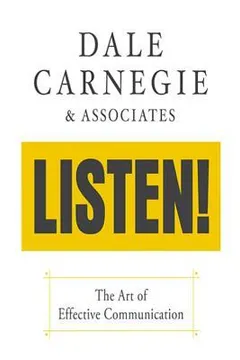
Reviews for Dale Carnegie & Associates' Listen! are generally positive, averaging 3.67 out of 5. Many readers appreciate the book's practical frameworks, including listener types, decision-making styles, and conflict resolution tools. The structured exercises and real-life examples are frequently praised. Some critics find it dry, overly theoretical, or too reliant on the Carnegie name without matching his classic works. Audio format listeners note frustration with references to charts and figures. Overall, it's considered a solid, accessible resource for improving listening and communication skills, particularly for those new to the subject.
Glossary
Frames
Broad interpretive contextA frame is a person’s broad understanding of a situation or topic. It influences what a message means to them and is shaped by experience, assumptions, relationships, culture, and other factors. Frames often operate unconsciously, so two people can hear identical words yet interpret them differently.
Filters
Selective focusA filter is the focus a person gives to some parts of incoming information while giving less attention to others. Unlike a broad frame, which supplies general context, a filter directs attention within that context. Filters are not inherently good or bad, but they influence what a listener notices.
ACES Decision-Making Technique
A method for reframing assumptionsACES stands for Assumptions, Criteria, Evoked Set, and Search. The technique helps a person examine the assumptions shaping a problem, identify what they want, consider possible solutions, and determine what information is missing. Reversing an assumption and asking under what conditions its opposite could be true can reveal alternative interpretations.
Seven Types of Listeners
A map of listening behaviorsThe framework names the Preoccupied, Out-to-Luncher, Interrupter, Whatever, Combative, Analyst, and Engager. The first six describe common ways attention can fail or become unhelpful, such as distraction, indifference, interruption, argument, or premature advice. The Engager represents deliberate attention to the speaker’s perspective. These are situational patterns, not fixed personality diagnoses.
Driver Decision Style Model
A map of decision preferencesThis model distinguishes decision-makers by how much information they use and whether they focus on one solution or several. It names four combinations: Decisive, Hierarchic, Flexible, and Integrative. The categories describe differing preferences for speed, detail, analysis, and alternatives, which can affect how people communicate and make decisions together.
Environmental load
Pressure in the immediate settingEnvironmental load is the stress a person experiences from immediate pressures such as time limits, uncertainty, complexity, fatigue, or significant consequences. As pressure rises, some people want only essential information, while others seek to examine every option. A mismatch between those needs can create misunderstanding.
Stages of Conflict
Five steps in escalationThe model describes latent conflict, perceived conflict, felt conflict, manifest conflict, and conflict aftermath. These stages move from the possibility of disagreement to recognizing a problem, feeling upset, expressing conflict through behavior, and experiencing its effects. Recognizing early stages can help people intervene before tension becomes open hostility.
Conflict Styles
Patterns for handling disagreementThe book names the Lion, Ostrich, Dog, Fish, and Chameleon styles. The Lion competes, the Ostrich avoids conflict, the Dog accommodates to preserve the relationship, and the Fish seeks collaboration. The Chameleon adapts temporarily to communicate with people using other styles. These describe choices in particular situations, not immutable traits.
Question Staircase
Questions that deepen understandingThe Question Staircase moves through Elementary Questions, which establish facts; Elaborative Questions, which explore significance and implications; and Evaluative Questions, which invite opinions and judgments. Its purpose is to help a conversation progress from basic information toward a clearer understanding of what matters to the other person.
Innerview
A structured conversation techniqueAn Innerview is a series of questions designed to deepen understanding of another person. It uses factual questions about experiences, causative questions about why events or choices occurred, and values-based questions about what mattered. The technique aims to reveal the context and values behind a person’s answers, rather than merely collect biographical facts.
SOFTEN
Nonverbal signals of attentionSOFTEN is an acronym for Smile, Open posture, Forward lean, Touch, Eye contact, and Nod. These behaviors can communicate receptiveness and attention during conversation. Their appropriateness depends on the relationship, culture, and setting, so the acronym is a flexible guide rather than a universal script.
Role Style
Behavior suited to a roleRole Style is the way a person behaves when consciously trying to meet expectations associated with a public or social role. Someone may present differently in a job interview, with a supervisor, or among friends. The style reflects what the person believes is appropriate in that situation, rather than necessarily reflecting their usual behavior.
Operating Style
A person’s natural decision styleOperating Style is a person’s more natural way of thinking, deciding, and communicating when they are less focused on managing how they appear. It may differ from Role Style, which is shaped by expectations in a particular setting. The distinction helps explain why behavior can change between public and private situations.
About the Author
Other books by Dale Carnegie








Download PDF
Download EPUB
.epub digital book format is ideal for reading ebooks on phones, tablets, and e-readers.








