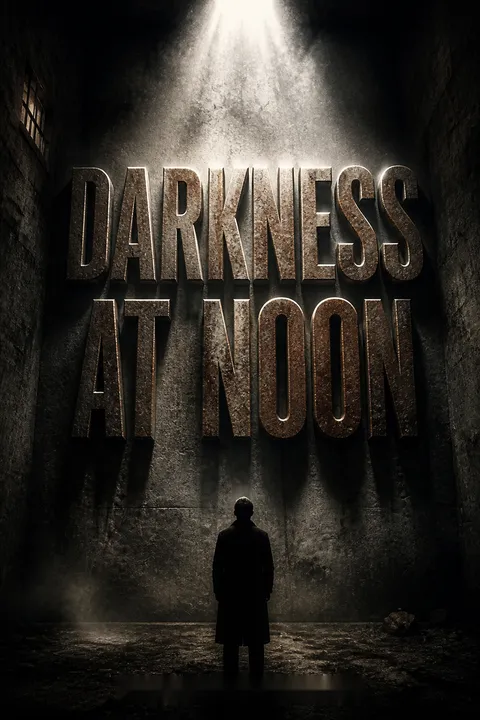


Plot Summary
The Old Guard Arrested
At dawn, Interior Commissariat officers break into Nicolas Salmanovitch Rubashov's apartment and arrest the former revolutionary commander. The elderly porter, Wassilij, recognizes the man he once followed in the Civil War, while the young officer treats him as a relic from another political age.
Rubashov dresses without resistance and rides through the sleeping capital to a new model prison, where his name is already fixed above cell 404. He expects eventual execution, yet studies the room's fittings and settles into its routines with the composure of a veteran prisoner.
His first requests for food and writing materials meet bureaucratic obstruction. Then a neighbor taps through the wall, offering Rubashov his first contact with the world outside his cell.
The arrest is not a surprise so much as the collapse of an old protection. Rubashov once helped build the state that now classifies him as a threat, and the young officer's bluntness shows how thoroughly the revolution has replaced its founders with successors who know only its settled authority. His attention to cell details is a survival reflex, but also a remnant of managerial confidence: he assumes that even imprisonment can be understood as a system. The prison's advance preparation, including his name card, makes his fate feel administratively decided before any evidence is examined. Personal history has been converted into a file.
Richard Left to Wolves
The tapping neighbor's curiosity sends Rubashov back to 1933, when he met Richard, a young underground organizer, in a museum. Richard's pregnant wife, Anny, had been arrested, and he still believed his clandestine group could survive by telling workers the truth about its defeats.
Rubashov already knew that Richard's shelter and circle were compromised, but focused instead on the unauthorized pamphlets and expelled him from the Party. He warned Richard away from the cinema operator's lodging without explaining that the operator was an informant.
A taxi driver later offered to help the abandoned young man; Rubashov paid the fare and left. A week afterward, Rubashov himself was arrested. The memory returns as evidence that his loyalty to the organization repeatedly outweighed care for individuals.
Richard's expulsion condenses Rubashov's moral method into one encounter. He can recognize the practical danger around the young organizer, yet treats the most immediate offense as doctrinal disobedience because the Party's categories have trained him to see candor as sabotage. His silence about the informant is not simple ignorance: he knows enough to protect the organization, but not enough, or not willingly enough, to protect Richard. The taxi driver's modest kindness exposes the distance between Rubashov's grand political calculus and ordinary responsibility. What makes the memory painful is not that he acted irrationally. It is that he acted consistently, and the consistency itself became a form of betrayal.
The Black Fleet Arrives
Two years after Richard's expulsion, Rubashov is sent to a Belgian port to secure the unloading of Soviet cargo. The dockworkers had once supported a boycott of a European dictatorship, only to discover that the revolutionary state was secretly supplying it with strategic materials.
Now another boycott targets a southern European power's war in Africa, and the same black fleet is approaching with petrol for the aggressor. Rubashov explains the leadership's decision as necessary for industrial development, but the dockers recognize the resemblance to strikebreaking.
Little Loewy, the local organizer whose years of exile and Party neglect have made him wary of official assurances, sides with them. The leadership orders the cargo unloaded, expels the dissenting dockers, and brands Loewy an agent. Soon afterward, Loewy takes his own life.
The port episode turns ideological abstraction into an object that can be seen and unloaded: fuel in a ship's hold. Rubashov can defend the policy through strategic reasoning, but the dockers measure it against the solidarity they have risked their jobs and bodies to uphold. Their refusal reveals a form of political knowledge that the central leadership dismisses as unsophisticated, though it is grounded in the consequences of policy. Loewy's history of bureaucratic abandonment makes the final denunciation feel less like an isolated injustice than the endpoint of a system that consumes its most useful people. Rubashov's assignment requires him to make an expedient look principled, deepening the gap between purpose and practice.
Arlova's Empty Desk
After the port mission, Rubashov becomes head of a trade delegation abroad, where Arlova serves as his quiet, capable secretary. Their private intimacy grows, but the political atmosphere tightens: portraits and books vanish, and colleagues scrutinize Arlova's work as librarian for signs of disloyalty.
Her relatives are arrested, and a Party meeting dismisses her from the library post. Rubashov senses the danger but cannot identify a safe action, so he withdraws rather than defend her. When the leadership later recalls her under suspicion, she names him as a possible witness for her defense.
Rubashov remains silent until the Party demands a declaration of loyalty. He then publicly condemns the opposition, a statement that helps seal Arlova's fate. Ivanov later recounts this history during Rubashov's interrogation.
Arlova's story makes the political system intimate without making intimacy redemptive. She is close enough to Rubashov to trust him, yet his habits of caution and institutional obedience prevent that trust from becoming protection. The disappearing books and portraits are not merely ominous scenery: they show that political conformity reaches into memory, controlling which texts and people may remain visible. Rubashov's silence is framed as a way to preserve his usefulness, then becomes a direct instrument in the judgment against her. His later self-accusation is therefore not manufactured from nothing. The state invents crimes, but it can exploit real acts of abandonment to make its moral coercion persuasive.
The Prisoners' Secret Signals
In cell 404, Rubashov learns the prison's tapping code from No. 402, a monocled former officer who mixes monarchist defiance with bored, intimate questions. Across the other wall, a new prisoner repeats a broken revolutionary song. No.
402 identifies him as a teacher who spent twenty years in solitary confinement, was released by amnesty, and was arrested soon after returning to the country he had imagined from afar. During exercise, the old teacher draws the country's map from memory, even with his eyes closed, and confides that he believes he was sent to the wrong station.
A barber slips Rubashov a brief warning to meet death quietly. These prisoners give him companionship, but their different codes of honor sharpen his uncertainty about what a decent death would mean.
The prison's communications create a fragile counterpublic, a community made from taps, scraps, and glances that official authority cannot fully silence. No. 402's etiquette and the old teacher's faithful map offer Rubashov alternatives to the Party's abstract account of loyalty: one grounded in personal honor, the other in a hope preserved through decades of isolation. Yet neither provides an easy answer. The teacher's mistaken-station belief is both delusion and survival strategy, preserving an imagined destination when reality has become unbearable. The barber's warning adds a third possibility, silence as dignity. Rubashov's usual talent for entering other minds fails to resolve these differences, exposing how little political theory can substitute for another person's lived experience.
Bogrov's Last Passage
No. 402 warns Rubashov that political prisoners are being executed that night. News travels cell to cell through the walls until the prisoners learn that the condemned man is Michael Bogrov, Rubashov's old comrade and former commander of the eastern fleet.
They begin a muffled drumroll against their doors as Bogrov is dragged past, injured and barely able to stand. Rubashov joins the rhythm, then sees the prisoner's slack body and hears Bogrov call his name.
The sound breaks through Rubashov's practiced belief that individual deaths can be balanced against historical necessity. He remembers how he once treated Arlova's fate as a small cost in a larger calculation. By morning, his former certainty has become a physical burden he can no longer dismiss as sentiment.
The drumming briefly transforms isolated prisoners into witnesses. Their solidarity cannot stop the execution, but it refuses the state's preferred abstraction of a person reduced to a political case. Bogrov's voice matters because Rubashov knows him as a comrade, yet the scene also reactivates Arlova and the others whose deaths he had processed as necessary outcomes. Sensory experience defeats the clean arithmetic of ideology: a voice, a body dragged over stone, and the prisoners' synchronized blows cannot be contained within a strategic argument. The episode does not instantly make Rubashov innocent or morally certain. Instead, it makes his old reasoning harder to inhabit, because the human cost has become present rather than hypothetical.
Ivanov Offers a Bargain
Ivanov, Rubashov's former college friend and military comrade, summons him for an unofficial interrogation. He admits that Bogrov was deliberately taken past Rubashov's cell, though he blames the tactic on the harsher investigator, Gletkin.
Ivanov explains that Bogrov was executed after defending large submarines, a policy associated with renewed international revolution, against the leadership's preference for coastal defense. He argues that the state cannot tolerate opposition when it believes its survival is at stake.
Because Rubashov has never joined an organized opposition, Ivanov proposes a limited confession: acknowledge dissent, deny the alleged assassination plot, and perhaps secure a public trial instead of a secret administrative sentence. He offers a possible route back to political life, but leaves Rubashov to decide whether the bargain is another betrayal.
Ivanov is dangerous to Rubashov because he is not an alien voice. They share the same political formation and can understand each other's arguments from the inside. His proposal is both humane and manipulative: he wants to spare his friend, but only by using the machinery of confession that has already destroyed others. Bogrov's technical dispute over submarine design shows how policy questions acquire lethal force once the state treats disagreement as evidence of treason. The promise of a public trial offers Rubashov time, not freedom from the system. Ivanov's appeal tests whether Rubashov still believes that service to the collective can justify personal abasement, even after he has begun to feel the cost of that belief.
History's Final Calculation
After Ivanov's visit, Rubashov revisits the logic that has governed his life. He writes a theory that political understanding develops more slowly than economic change, leaving the masses vulnerable to dictatorship and making immediate democratic opposition futile.
During exercise, a peasant prisoner describes resisting government officials who tried to vaccinate village children, and Rubashov sees how little his theory can account for the man's fear and deprivation. Still, he concludes that public recantation is more useful than a futile stand.
He sends the prosecutor a declaration abandoning his opposition, hoping the Party will give him time to develop his ideas in political exile. No. 402 regards this as a surrender of honor. Rubashov accepts that their standards differ, but does not withdraw his decision.
Rubashov's capitulation is not presented as simple cowardice. He reconstructs a theory of mass political immaturity that makes authoritarian rule seem historically necessary, then uses that theory to justify his own submission. The peasant's account should complicate the abstraction, because it reveals a person responding to state intrusion in concrete, local terms. Yet Rubashov absorbs this encounter into his larger model rather than allowing it to overturn the model. His decision retains the old revolutionary habit of treating the self as expendable material, now directed toward a hoped-for future intellectual task. The conflict with No. 402 exposes the cost of that habit: Rubashov calls usefulness honor, while the officer insists that integrity has value beyond utility.
Gletkin Makes It Concrete
Ivanov is removed, and Gletkin takes charge of Rubashov's case. Under a blinding lamp and repeated sleep deprivation, Rubashov first admits that his opposition was politically harmful, then faces accusations of conspiracy, foreign collusion, assassination, and industrial sabotage.
Michael Kieffer, the son of historian Professor Kieffer, appears as a wrecked prisoner and claims Rubashov urged him toward violence against the leader. Rubashov remembers their earlier meeting and realizes that his own arguments about removing a dictator could have led the young man toward such a conclusion, even though the alleged instruction is false.
He accepts guilt in that broad ideological sense, while successfully refuting the sabotage charge. During the prolonged questioning, Gletkin reports that Ivanov has been arrested and later confirms his execution.
Gletkin's method differs from Ivanov's not because it abandons reason, but because it uses physical exhaustion to make reason serve a predetermined script. The accusation fuses documented fragments, such as Rubashov's political conversations, with invented links that transform dissent into criminal conspiracy. Kieffer unsettles Rubashov because the young man's alleged actions seem to embody the consequences of Rubashov's own earlier logic. This recognition is morally serious, but the state exploits it to erase the distinction between responsibility for ideas and guilt for fabricated acts. Rubashov's lone victory over the sabotage charge is deliberately narrow. It shows that the interrogation still has rules, but only rules designed to make a coerced confession appear exact.
The Scripted Trial
At the public trial, Rubashov and Kieffer face a tribunal whose evidence rests on their own preliminary confessions. Kieffer repeats his account and asks the judges to spare him; Rubashov declines to question him or request a defense.
He presents his political errors as a warning to the public and accepts responsibility for opposing the Party, while the prosecutor recasts his past acts as treason. The court sentences both men to death and orders their property confiscated. Outside, Wassilij's daughter Vera reads the trial report at home and supports the factory resolution demanding punishment for alleged traitors.
Wassilij signs it under pressure, though he remembers the revolutionary leader Rubashov had once been and doubts the public account. The trial turns a private interrogation into a lesson imposed on the whole country.
The trial's central product is not a reliable account of events but a public performance of certainty. Rubashov's confession lends the state credibility precisely because he is a respected revolutionary, while Kieffer's frightened testimony supplies a human body for the accusation. Rubashov's refusal to challenge him may be understood as a final act of solidarity, but it also leaves the official narrative uncontested. The scene at Wassilij's home shows how that narrative enters ordinary life: Vera has learned to treat institutional declarations as proof, while her father must weigh memory against the risks of dissent. The trial thus distributes complicity beyond the courtroom, asking citizens to sign, repeat, and privately doubt the same verdict.
The Last Walk
Returned to his cell, Rubashov no longer tries to rescue his life through argument. He taps the sign for the first person singular against the empty neighboring wall, but receives no answer. Looking through the barred window at a patch of sky, he questions the arithmetic that once made suffering seem acceptable when charged to humanity as a whole. No.
402 keeps him company through the wall and helps him prepare for the final walk, even asking what he would study if pardoned. Rubashov says astronomy. Guards handcuff him and lead him downstairs. His pince-nez falls and breaks on the stair, leaving him nearly blind as he enters the execution passage. A blow to the back of his head drops him to the floor; a second ends his life.
The ending strips away the institutions that once gave Rubashov's actions a ready-made meaning. His unanswered signal to the self marks a search for an individual consciousness that the Party's language had trained him to suppress. Astronomy, the abandoned study of his youth, offers no political solution, but restores a form of curiosity not organized around power or usefulness. His broken glasses make the final passage materially uncertain, while the guards proceed with administrative precision. The violence is not redeemed by a final revelation or public gesture. Rubashov reaches the end with his moral certainty unsettled, and the novel leaves the reader facing the difference between a promised historical future and the people sacrificed in its name.
Analysis
Darkness at Noon examines what happens when a political movement treats moral limits as obstacles to historical progress. Rubashov and his former comrades do not begin as simple villains. They believe that power can be used to end exploitation, and that political choices must be judged by consequences on a vast scale. The danger lies in converting that belief into a system where the individual counts only as a variable. Once every sacrifice can be defended by a future benefit, no evidence from the present can disprove the doctrine.
The novel makes this reasoning intimate through recurring human encounters. Richard's honest pamphlets, Little Loewy's battered loyalty, Arlova's trust, and Bogrov's suffering each expose a cost that Rubashov once managed to classify as necessary. His capacity to imagine an opponent's perspective, formerly a political asset, becomes a way of recognizing how his own choices looked to those he abandoned. Yet recognition does not grant him a clean escape. He has helped build the logic that now turns his past words into a case against him.
The contrast between Ivanov and Gletkin shows how institutions outlive the people who create them. Ivanov retains irony and traces of personal memory, while Gletkin applies the same political premises with less hesitation and no comparable attachment to the past. The new authority is not a betrayal from outside the revolution; it is an inheritance of its methods, stripped of its founders' remaining doubts.
Rubashov's end does not settle whether political action can ever be free of compromise. It does challenge the claim that abstract humanity can justify every concrete injury. The state can force him to perform its account of his guilt, but it cannot make the suffering he remembers disappear. The novel's lasting question is whether ends remain liberating when their pursuit teaches people to deny the moral reality of the means.
Review Summary
Darkness at Noon is widely praised as a powerful critique of totalitarianism, particularly Stalinist Russia. The novel follows Rubashov, a former Communist leader imprisoned and interrogated during Stalin's purges. Readers appreciate Koestler's exploration of political ideology, morality, and the human condition. The book's philosophical debates and psychological insights are highlighted as strengths. While some find the writing dense, many consider it a classic of 20th-century literature, drawing comparisons to works by Orwell and Kafka.
People Also Read


Characters
Nicolas Salmanovitch Rubashov
The exhausted party strategistRubashov is an experienced revolutionary, former commissar, and political operator whose intelligence has long been matched by his capacity to subordinate private feeling to collective strategy. He studies opponents by imagining their point of view, a skill that once made him effective and now exposes the human consequences of his choices. His memories of colleagues, lovers, and subordinates complicate his belief that historical necessity can excuse individual suffering. Prison narrows his world to a cell, a wall, and his own thoughts, forcing him to confront the moral self he had treated as politically irrelevant. His defining struggle is not simply whether he believes in the Party, but whether reason can remain humane when it claims authority over every personal cost.
Ivanov
The pragmatic old comradeIvanov is an examining magistrate, former commander, and Rubashov's old friend from the revolutionary years. He shares Rubashov's education in strategic politics and argues with the ease of someone who recognizes the logic he is using. Beneath his wit and apparent cynicism is a man shaped by injury, loss, and a continuing belief that the state must survive. He approaches Rubashov as both friend and interrogator, offering a path through the legal machinery while defending the assumptions that made the machinery possible. His presence gives the novel its most intimate ideological opposition: not innocence against evil, but two veterans trying to decide whether their common principles can still justify their consequences.
Gletkin
The disciplined new interrogatorGletkin is a younger investigator whose severe discipline reflects the political generation that inherited the revolution without sharing its founders' memories. A scar from his own imprisonment marks his capacity to endure pain, while his belief in physical limits makes him willing to use exhaustion as an instrument. He considers personal sympathy a distraction from state necessity and treats procedure as a means of producing politically useful conclusions. Unlike Ivanov, he has little taste for irony or private doubt. His manner is rigid, but his reasoning is not mindless: he can explain why a population might accept simple myths more readily than difficult truths. He represents an efficient authority that no longer needs the older revolutionaries' emotional attachments.
No. 1
The absent party rulerNo. 1 is the country's paramount leader, appearing chiefly through portraits, official rhetoric, and the decisions attributed to him. His power depends on an image of unshakable certainty, which makes political disagreement appear not merely mistaken but dangerous. Rubashov sees in him a rival understanding of historical survival: preserve the revolutionary state first, even if its original international hopes must be delayed or distorted. No. 1 remains physically distant from the prison's proceedings, yet his authority shapes every accusation and confession. The gap between the leader's carefully managed public image and the human costs of policy gives him a presence larger than his limited appearances.
Richard
The young underground organizerRichard is a young locksmith and clandestine Party organizer whose work continues after the movement has been crushed in his country. He is devoted to his small group and deeply worried about his pregnant wife, Anny, but tries to hide vulnerability behind procedural discipline. His homemade leaflets reflect a practical conviction that workers need an honest account of defeat, not official optimism. He trusts senior Party figures to understand the danger he faces, which makes his encounter with Rubashov a test of political loyalty and personal trust. Richard's earnestness highlights the distance between underground activists and leaders who can convert local suffering into strategic language.
Arlova
The trusted private secretaryArlova is Rubashov's secretary at a foreign trade delegation, valued for her quiet competence and steady presence amid a deteriorating political climate. She records his work, manages a politically sensitive library, and notices dangers that her superior tries to treat as passing absurdities. Their private relationship is marked by unequal power: she gives him trust, while he often mistakes her silence for ease and her loyalty for permission. Arlova does not make herself conspicuous, but her clear attention to changing risks contrasts with the evasions around her. She represents the intimate lives that political organizations claim to protect while demanding that members place institutional survival first.
Little Loewy
The displaced dockside organizerLittle Loewy is a hunchbacked Party organizer who has survived exile, poverty, repeated arrests, and years of bureaucratic indifference. A gifted speaker and a familiar face among dockworkers, he builds community through practical help and shared political work. His experiences have made him skeptical of official assurances, though he remains attached to the movement that has repeatedly failed him. He can make hardship sound almost comic, but the humor protects a deep weariness. Beside Rubashov, Loewy embodies the human cost of a political apparatus that praises sacrifice while treating individual members as expendable.
Michael Bogrov
The veteran fleet commanderBogrov is a revolutionary veteran and former commander of the eastern fleet, connected to Rubashov through years of political struggle and personal loyalty. His disagreement with the leadership concerns naval strategy, but the dispute carries a larger question about whether the revolution should pursue expansion or defend what it has already won. Bogrov belongs to a generation for whom policy debate once took place among comrades who shared danger and purpose. His presence reminds Rubashov that such relationships do not disappear when the state reclassifies its opponents. The loyalty between the two men gives political repression a personal scale.
No. 402
The monocled wall neighborNo. 402 is a former officer and political prisoner who communicates with Rubashov through a coded tapping system. He holds to a personal code of honor and can be both provocative and unexpectedly kind, shifting from monarchist slogans to jokes, gossip, and practical advice. His confinement has left him hungry for conversation, yet his convictions differ sharply from Rubashov's utilitarian habits. He gives Rubashov information about the prison and offers companionship without pretending they share a politics. Their exchanges make the cell wall a boundary between rival moral languages, and eventually a thin means of care.
The old teacher
The mapmaker in solitaryThe old teacher is a former sociology instructor who spent decades imprisoned after a short-lived revolution in his homeland. Released into a world changed beyond his knowledge, he is quickly detained again and seems to retreat into a belief that he has simply been sent to the wrong station. He can still draw his country's map from memory, even with his eyes closed, and carries a gentle, childlike manner into the prison yard. His maps preserve both an imagined destination and a fragment of identity. Through him, Rubashov encounters endurance that cannot be reduced to political usefulness.
Michael Kieffer
The historian's vulnerable sonMichael Kieffer is the son of Professor Kieffer, a respected historian of the revolution, and grew up close to political ideas he could not always interpret safely. He is intelligent, impressionable, and shaped by his father's intellectual world, but possesses less power to control how that world is used. His youth and vulnerability contrast with the seasoned confidence of Rubashov's generation. He is not naturally suited to the brutal political roles others assign him, and his predicament raises questions about how radical ideas travel from abstract discussion into the lives of people with little agency.
Professor Kieffer
The stubborn revolutionary historianProfessor Kieffer is an older revolutionary historian and Rubashov's friend, known for his work recording the movement's past. His scholarship becomes increasingly difficult as official accounts change and demand that earlier events be rewritten around current leadership. He is attached to evidence and memory in a political culture that treats both as adjustable. His relationship with his son Michael binds the public struggle over history to a private parental one. Kieffer represents the intellectual generation that believed political inquiry could coexist with revolutionary commitment.
Anny
Richard's pregnant wifeAnny is Richard's seventeen-year-old wife, a member of his underground circle and the person whose arrest leaves him frightened for their future. Her pregnancy makes the risks of clandestine work immediate and bodily, while her relationship with Richard gives his political commitment a domestic center.
Wassilij
The porter and old partisanWassilij is an elderly porter who fought under Rubashov during the Civil War and still remembers the commander behind the official speeches. His daughter reads political news to him, and his loyalty is divided between cherished memory, religious instinct, and fear of the authorities. He is cautious because he depends on the room where he lives, but his private judgment survives even when public conformity seems safer. His memories offer a quiet counterweight to the polished version of Rubashov circulated by the state.
Vera Wassiljovna
The dutiful factory workerVera is Wassilij's daughter, a factory worker and Party member who reads official news aloud at home and gathers signatures for political resolutions. She believes that public discipline protects the revolutionary state, and her practical need for a home makes her attentive to what the Party expects. Her confidence clashes with her father's memories and doubts.
The peasant prisoner
The village dissenterThe unnamed peasant prisoner comes from a remote eastern province and describes resisting a government campaign that included compulsory vaccination for village children. He is anxious, devout, and attached to the memory of an older rural life. His account gives Rubashov a glimpse of political resistance grounded in local fear rather than organized doctrine.
Herr von Z.
The diplomatic sounding boardHerr von Z. is a foreign embassy official whom Rubashov encounters at a diplomatic lunch. Their seemingly casual conversation touches on the possible price of a future political change. His easy manners and nostalgia for an older social world make the exchange appear harmless, though its implications depend on the political context surrounding it.
The barber
The discreet prison messengerThe prison barber is a broad-faced tradesman who treats Rubashov with quiet respect while shaving him under a guard's eye. He communicates through a concealed scrap of paper, taking a small personal risk to offer a warning. His brief act contrasts with the prison's routines of surveillance and control.
The prison doctor
The indifferent medical officerThe prison doctor examines Rubashov's damaged tooth and identifies the broken root causing his pain. He is brusque and poorly equipped, treating illness as one more item in the prison routine. His matter-of-fact approach makes bodily suffering visible without offering meaningful comfort.
Plot Devices
The quadratic tapping code
A wall becomes a networkPrisoners use a five-by-five letter grid to tap messages through the cell walls. Rubashov first reaches No. 402 this way, then receives information about other prisoners, executions, and the routines of the building. The code makes communication slow and physical, requiring listeners to count taps and pass information onward. It also creates a fragile form of collective witness: prisoners who cannot see or rescue one another can still relay names and mark a condemned person's passage with a shared rhythm.
The staged confession
A coerced story becomes proofThe investigation turns Rubashov's political disagreements and real conversations into a prosecutable narrative of treason. Some accusations are invented, while others attach false meanings to genuine events. Gletkin uses exhaustion, a blinding lamp, and a carefully managed witness appearance to obtain a confession that can be presented as voluntary. The public trial then circulates this confession as confirmation of the Party's version of events. The device exposes how a legal form can manufacture certainty when the state controls evidence, language, and the accused's capacity to resist.
The prison routine
Isolation measures political timeBugle calls, ration rounds, exercise circles, spy-holes, and locked doors give the prison a measured rhythm. That routine limits what Rubashov can know and makes a day feel like a sequence of institutional permissions. The repeated walks also provide space for his memories to surface, while the fixed cell dimensions make his thinking seem physically trapped. The prison is not merely a setting: its procedures model a political order that reduces individual life to schedules, categories, and controlled access.
The memory fragments
Past choices return as evidenceRubashov's memories are triggered by bodily pain, gestures, sounds, and objects: his toothache, the folded hands of a religious painting, the smell of a port, or a voice in the corridor. These recollections do not arrive as a neutral chronology. Each one revises his understanding of decisions he once defended, connecting Richard, Loewy, Arlova, and Bogrov to the present interrogation. Memory thus functions as an internal counter-investigation, revealing moral consequences that official political reasoning had filed away as necessary costs.
Historical necessity
The end licenses each sacrificeRubashov's revolutionary generation reasons that political action must be judged by its long-term usefulness to history, rather than by private intentions or immediate suffering. This principle explains both his earlier choices and the regime's later purges. The novel tests it through disputes over dockworkers, military policy, industrial failure, and individual lives. As Rubashov's confidence erodes, the same reasoning that once justified sacrificing others becomes the logic used to demand his own confession. The idea is a political doctrine and the engine of the story's moral conflict.
Download PDF
Download EPUB
.epub digital book format is ideal for reading ebooks on phones, tablets, and e-readers.








