

Plot Summary
A Girl Vanishes on Ice
During a bitter Fenland freeze, Martha, a beautiful young villager, stays on the river after her friends leave. A watcher has followed her skating from the reeds, waiting until she is alone; he approaches and touches her, and she disappears. The village searches, then assumes she has fallen through the ice and drowned.
Months later, nobody can explain why her body has not been found. The fear surrounding the new bishop, William Longchamp, feeds rumors of witchcraft and worse, but no one has evidence. Martha's disappearance becomes the unanswered wound beneath the story: a young woman gone from a landscape where water can hide almost anything.
The opening makes disappearance itself the first mystery. The frozen river looks solid enough to invite play, yet its surface conceals danger and erases evidence. Martha's beauty draws attention, but attention offers no protection; the watcher can wait unseen until the village's ordinary safeguards, friends and daylight, have vanished. Rumors about Longchamp and witchcraft show how a frightened community turns uncertainty into supernatural explanation. The reader, unlike the villagers, knows that a person deliberately took Martha, creating tension between what the community believes and what the opening has shown.
A Daughter Sent East
At Wolvercote Manor, physician Adelia and her adult daughter, Allie, investigate a dead hare while arguing over Adelia's habit of teaching medicine through animal dissection. Their old friend Gyltha is gravely ill in the Fens, but Adelia has broken her ankle and cannot travel. Allie volunteers to take her place, despite her father Rowley's fear that an unmarried woman is vulnerable without a protector.
He agrees after Penda, Gyltha's sister, offers to introduce Allie to the wealthy young Lord Peverell. Allie accepts the journey for Gyltha, not for a husband. Rowley is summoned back into the political struggle over Longchamp, leaving his daughter to travel with Penda toward the distant marshes.
The journey begins at the intersection of care and control. Allie chooses to answer Gyltha's need, while Rowley interprets the same journey as an opportunity to secure her future through marriage. Their disagreement is not simply a generational quarrel: he has seen how quickly protection can disappear, while she has inherited Adelia's belief that competence can substitute for permission. Adelia's medical teaching links their family intimacy to practical knowledge, but her injury forces Allie to act without her. The Fenland assignment therefore becomes both a rescue mission and Allie's first test of independence.
Home in the Fenland Fog
Penda and Allie reach Elsford after a hard journey, and Allie finds Gyltha frail but still sharp enough to scold the people who sent for help. Allie examines her, gives her Adelia's remedies, and begins rebuilding her strength. She reunites with Ulf, the village reeve, and meets his daughter Hawise, a gifted storyteller who becomes her companion.
Hawise tells her that Martha vanished while skating and that villagers fear other girls have disappeared too. Allie also sees Danny Wadlow, a volatile young outcast, lurking in the marsh and threatening Hawise. At the manor, Penda manages her estate with exacting authority, while Allie notices that people fall silent whenever the missing girls come up.
Elsford offers Allie both belonging and exclusion. Gyltha's recovery gives her a familiar emotional anchor, while Hawise's quick affection lets her enter village life through stories rather than status. Yet that warmth sits beside a disciplined silence: people know enough to be afraid but not enough, or not safely enough, to speak openly. Danny's hostility appears at first to fit the community's suspicions of outsiders and troublemakers. Allie's instinct is to read what people conceal, but the Fenland's social structure makes knowledge dangerous. She must earn trust before she can distinguish genuine threat from the village's convenient scapegoats.
Matilda's Thorn
When Lord Peverell is thrown from his horse, Matilda, Allie reaches the animal first and removes a deep thorn from its hoof. Peverell, a handsome young lord recently returned from the Crusade, is impressed by her skill, and Penda helps him limp back to Dunstan. The encounter gives Allie a glimpse of his humor and tenderness, while his steward, Sir William, treats her with conspicuous reserve.
Later, at Peverell's lavish feast, Allie struggles with the courtly crowd but finds herself drawn to her host. Afterward she seeks Matilda in the stable and spots a man watching from the shadows. Peverell finds her there and explains away the watcher, then asks to visit Elsford, leaving Allie hopeful and uneasy.
The horse is more than a romantic introduction: it reveals Allie's competence before anyone can reduce her to a marriage prospect. Peverell responds to that competence with attention, and their shared concern for Matilda creates a connection grounded in care rather than formal courtship. Sir William's chill and the unseen observer complicate the warmth of the feast, though Allie has no clear reason to connect them to danger. Her attraction grows alongside her unease, a combination that makes her increasingly vulnerable to the social charm of Dunstan and its lord.
The Wrist Bears Letters
Ulf secretly brings Allie to a young woman's body found in the river. The girl has been missing for weeks, yet Allie's examination shows that she entered the water only recently. Bruising and a small fracture in her throat point to strangulation, and defensive marks show that she fought back. On her wrist, Allie finds two deliberately cut letters, DV.
The sheriff ignores the injuries and rules the death a drowning, allowing the village to avoid the burden of a murder inquiry. Allie suspects the victim was killed by whoever took Martha and other girls, then left their bodies in the river. Penda begins teaching Allie archery, while Ulf fears that the killer is still close.
Allie's examination gives the dead girl a voice that official procedure refuses to hear. The sheriff's verdict is not merely a mistake; it protects the community from legal and social costs by making a murder disappear into an accident. Allie's medical reasoning opposes that convenience with observable evidence, especially the mismatch between the length of the disappearance and the body's brief time in water. The marks DV offer a clue but not yet a meaning. Penda's archery lessons make the response practical: knowledge may expose the danger, but Allie also needs a way to defend herself.
Hawise Disappears Too
As Allie grows closer to Hawise, Penda tightens security and teaches her to use a crossbow. At a feast at Dunstan, Allie and Peverell draw nearer, though Sir William remains hostile and a shadow in the stable unsettles her. Soon afterward, Hawise leaves alone to check her mole traps and never returns.
Ulf and Rosa lead a desperate search through the marsh, while Allie and Penda join them. No trace appears. Adelia arrives to find her daughter grieving and Gyltha terrified for the family. The disappearance confirms that Martha's case was not isolated, but the search yields no clue to Hawise's location or captor. Allie is now fighting not only for justice, but for someone she loves.
Hawise's disappearance converts an investigation into a personal emergency. Earlier, the missing girls were evidence; now Allie must face the possibility that evidence has a face she knows, jokes with, and expects to see again. The contrast between Penda's new precautions and Hawise's solitary errand makes danger feel both preventable and brutally arbitrary. Adelia's arrival reunites the medical partnership, but it cannot reverse the loss. The family and village are left with a form of helplessness that their usual rituals of searching cannot soothe.
A Churchyard Without Burial
Adelia and Allie compare the autopsy notes and reason that the killer delays death, perhaps because he first imagines the girls as ideal companions. Longchamp's interdict soon forbids local priests from burying the dead or administering the last rites. When a poor girl, Epona, begs for help, the two physicians save her mother from a throat abscess that would have suffocated her.
Rowley arrives and recognizes DV as the Crusader phrase Deus vult, meaning God wills it. The clue narrows their attention to men who fought in the Holy Land, including Penda's falconer Peter. Adelia and Allie discreetly watch him, but he gives them no proof. The investigation has a theory, not yet a culprit.
This section places two kinds of institutional failure side by side. Longchamp uses religious authority to punish a whole diocese, while local justice has already dismissed a murder as drowning. Against both, Adelia and Allie practice medicine as immediate, material care, saving Epona's mother without waiting for permission. Rowley's interpretation of the wrist letters gives the inquiry direction, but the suspicion of Peter remains provisional. The family's method is powerful precisely because it refuses certainty too soon. Their medical knowledge can establish how someone died; motive and identity still require patient inference.
Stories Keep Hawise Alive
Hawise survives in an underground chamber by telling her hooded captor stories, especially a tale of a knight who kills beautiful maidens. She learns that his interest in the story keeps him from killing her, but weeks of confinement leave her weak and frightened. After a feast at Dunstan, Danny Wadlow approaches Allie and says he knows where Hawise is.
Allie follows him through a hidden passage beneath Elsford, then hides in his coracle as he rows upstream. She finds Hawise battered and barely conscious after the girl has tricked her captor with the story's final reversal. Allie gets her into the boat and rows toward home. Rowley and the search party find them at dawn.
Hawise's storytelling is neither decorative talent nor simple escape. It becomes a form of negotiation in which she studies her captor's attention and uses narrative suspense to postpone violence. The story she invents gives her a narrow measure of agency, but it cannot make the captivity safe. Allie's rescue depends on Danny's knowledge and her willingness to trust him despite his reputation. The hidden passage turns Elsford's architecture into a route between domestic safety and concealed brutality. Survival here is collective, improvised, and costly.
The Laugh in the Hall
As Hawise recovers, she tells Allie and Adelia that her captor wore a monk-like hood and had a distinctive laugh. Penda then reveals that she was raped as a child during the Anarchy and learned archery after a mercenary rescued her. The confession explains why she has trained Allie and why she refuses to leave women defenseless.
A search for Hawise's prison finds its entrance sealed. Rowley leaves to meet Queen Eleanor, who returns with him to address the interdict and political unrest. During a royal banquet at Elsford, Hawise hears the laugh again. She identifies Lord Peverell, the man Allie has trusted and admired, and points him out before he slips from the hall.
Hawise's memory supplies the sensory clue that medicine could not recover, while Penda's confession reveals the private history behind her insistence on readiness. Her past does not make violence simple or triumphant; it explains the discipline she built to survive its aftermath. The sealed passage frustrates physical investigation, so recognition must come through human memory instead. Peverell's apparent charm has allowed him to move close to Allie without attracting suspicion. The revelation ruptures not only the investigation but Allie's emerging trust in him.
Penda's Arrow Ends Him
Peverell escapes into the snow, and Penda follows with Allie close behind. They catch him injured on the causeway, where he jokes as if his flight were still a game. Penda aims at his head rather than his heart, killing him with the crossbow skill she has spent a lifetime honing.
Allie is left facing the man she had admired as a murderer, while Penda refuses to let her mistake him for someone worthy of grief. The hunt ends, but no courtroom will examine his crimes, and his death cannot undo what he did to Hawise or the other girls. The women who survived must live with a justice delivered by their own hands.
The final confrontation reverses the earlier rescue scene: Penda once helped Peverell after his fall, but now her skill determines whether he can continue harming others. Her shot is both the culmination of her training and an answer shaped by her own history. It is not a neat restoration of order. Peverell is stopped, but the law never names his crimes, and Allie's private grief has no simple object. The book makes self-defense necessary while refusing to present it as a painless substitute for justice.
Epilogue
Eleanor keeps her promise and has the interdict lifted. Peverell's body is found, but a fire destroys Dunstan Castle before his funeral, and rumors place Danny nearby without proving his involvement. A horse identified as Matilda appears at Elsford, and Allie decides to keep her.
She leaves for Wolvercote with Adelia, Rowley, and Hawise, who is recovering, while her future remains open. The return home offers a pause rather than a final answer: Allie has survived the mystery, but she still has to choose what kind of life she wants.
The closing events resolve the public crisis while leaving the private future unsettled. Eleanor's intervention restores burial and religious rites, but the social order does not provide a formal reckoning for Peverell's murders. Dunstan's destruction and the rumors surrounding Danny let the community turn an uncomfortable truth into a story it can live with. Matilda's return gives Allie a tangible remnant of the relationship she lost, yet the horse is not a replacement for trust or certainty. Going home with Hawise marks recovery as shared work, not a return to innocence.
Analysis
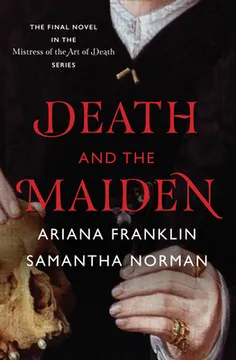
Death and the Maiden sets two kinds of investigation against each other. Adelia and Allie approach death through anatomy, timing, and observable marks; the village approaches it through rumor, religious fear, and the desire to avoid disruptive truths. The contrast is not a simple triumph of science over superstition. Medical evidence can establish that a girl was strangled, but it cannot compel a sheriff to recognize murder or make a community safe. The women must combine bodily knowledge with trust, memory, and local relationships.
The story also examines protection as a contested form of love. Rowley wants marriage to secure Allie's future, while Allie sees the proposal as a threat to self-determination. Penda's experience complicates both positions: she has built independence through skill and authority, but that independence began in response to violence. Hawise's imagination offers a different defense. Her stories cannot free her outright, yet they let her study and manipulate the person holding her captive. Each woman survives by converting a quality others might underestimate into practical power.
The Fenland setting gives these conflicts physical shape. Water carries bodies, hides routes, and makes communities dependent on local knowledge. The interdict shows how institutions can intensify vulnerability, while the official drowning verdict shows how indifference can do the same. Peverell's charm makes the mystery's central danger intimate: the threat is not only concealed in the landscape but present within respectable relationships. Penda's final shot prevents further harm, but it cannot restore the dead or supply the public justice the system withheld. The ending therefore offers resolution without pretending that violence has been repaired. Allie returns home with Hawise and Matilda, but her future remains a choice she must make for herself.
Review Summary
Death and the Maiden receives mixed reviews, averaging 3.76/5. Fans of the Mistress of the Art of Death series appreciate the closure it provides but note significant weaknesses, including a lack of detective work, unexplained villain motives, and characters feeling diminished compared to earlier books. The shift in focus from Adelia to her daughter Allie divides readers. While some praise Samantha Norman's seamless continuation of her mother's work, others feel the mystery lacks tension and the ending resolves too abruptly.
People Also Read


Characters
Allie
Fenland physician and daughterAlmeison Picot, usually called Allie, is the daughter of Adelia and Rowley. Raised around medical inquiry, she can examine bodies, treat illness, and handle horses, yet her knowledge must be used cautiously in a world quick to call an unconventional woman a witch. Allie values independence and resists her father's effort to arrange her marriage, but she is deeply attached to the people who raised her, especially Gyltha. Her curiosity makes her an investigator; her tenderness keeps that work from becoming abstract. As she moves between family loyalty, professional confidence, and romantic uncertainty, she has to decide how much of her life she will let others define.
Adelia
Salernitan doctor and motherAdelia is an Italian physician whose expertise in anatomy and forensic examination has served rulers as well as ordinary people. She taught Allie to observe bodies without allowing pity to obscure evidence, though her own fierce attachments reveal how difficult that discipline can be. Her love for Rowley and their daughter coexists with a lifelong insistence on personal freedom, and she worries that the protections she once enjoyed will not be available to Allie. Direct, impatient, and capable of treating a life-threatening abscess with improvised tools, she meets crises by acting. She is both Allie's teacher and a mother learning that her daughter must become her own authority.
Rowley
Devoted bishop and fatherRowley is the Bishop of St. Albans, a seasoned political envoy and Allie's father. He loves Allie and Adelia intensely, but expresses that love through plans for security, especially his hope that Allie will marry well. His caution comes from years of watching political danger and from knowing how exposed an unmarried woman can be. He is not immune to tenderness or humor, though exhaustion and anxiety often make him seem stubborn. His political work connects the Fenland murders to the larger struggle around Longchamp, John, and Eleanor.
Penda
Archer and Fenland landholderPenda is Gyltha's sister and the formidable lady of Elsford Manor. She manages her land with a sharp eye for accounts and obligations, rides hard, and handles a crossbow with practiced confidence. Her blunt manner can look like indifference, but she assumes responsibility for the people in her care and takes threats to them personally. Penda distrusts conventional expectations of women's lives, including marriage, and has built a place for herself through competence rather than a husband's authority. Her relationship with Allie begins as a practical escort arrangement and grows into a protective alliance grounded in mutual respect.
Gyltha
Allie's Fenland protectorGyltha is an older Fenland woman who has been a constant presence in Allie's life. She is earthy, sharp-tongued, and affectionate, with a gift for reading the people around her and a practical understanding of village life. Her bond with Adelia and Allie is familial rather than formal, and her home has served as a refuge through years of upheaval. Though illness makes her dependent on others for a time, her personality remains forceful. Gyltha's loyalty is expressed through small acts of care, pointed advice, and an unwillingness to let people she loves pretend they are unaffected.
Hawise
Storytelling reeve's daughterHawise is the daughter of Ulf and Rosa, a young Fenland woman known for inventing stories that hold the attention of children and adults alike. She is warm, lively, and generous with Allie, but she is not merely a cheerful companion. Her imagination is agile, and she can read the emotional temperature of a room even when others mistake her talkativeness for frivolity. Hawise's close ties to her family and village give the mystery its personal stakes. She embodies a kind of intelligence that is not scholarly or medical, but strategic: she understands how stories can change what another person does.
James Peverell
Crusader lord and suitorJames Peverell is the young lord of Dunstan, a wealthy landholder and former Crusader whose scar and confident bearing mark him as a man shaped by distant campaigns. He is sociable, attentive, and openly interested in Allie, and his care for his horse offers her a natural point of connection with him. Peverell's place among the local elite gives him influence as well as access to the people around him. He appears to combine charm with a capacity for tenderness, qualities that make him compelling to those who meet him and leave his motives difficult to assess.
Ulf
Village reeve and fatherUlf is Elsford's reeve, Hawise's father, and a trusted intermediary between villagers and the manor. He has dealt with death and local disputes throughout his life, which makes his certainty that the girls' deaths are unnatural especially significant. He loves his family deeply but is often more comfortable acting than explaining what he fears. Ulf respects Adelia's medical skill and recognizes Allie's ability, even when he worries that exposing her knowledge will draw accusations. His loyalty to the community requires him to uphold procedures he knows can fail the vulnerable.
Rosa
Watchful mother of HawiseRosa is Ulf's wife and Hawise's mother. She is loving, practical, and prone to sudden waves of dread, a fear sharpened by the deaths and disappearances around Elsford. Her attachment to Hawise makes her alert to dangers others dismiss, though superstition and anxiety sometimes distort what she sees. Rosa's feelings are shaped by the knowledge that a child can be lost despite every effort to protect her. She offers a domestic counterpoint to the public machinery of the manor and church, showing how political decisions and village violence reach directly into family life.
Danny Wadlow
Outcast and dog handlerDanny belongs to the impoverished Wadlow family and is treated by many villagers as an ignorant nuisance. He is physically capable, adept with dogs, and difficult to read because anger and defiance are often the only expressions he shows the community. His reputation makes him an easy target for suspicion, especially when livestock goes missing or rumors of witchcraft circulate. Danny's relationship to Allie is shaped by an unexpected debt, and his choices test whether she can distinguish social contempt from actual evidence.
Peter
Falconer under suspicionPeter is Penda's falconer, skilled in training birds and familiar with the marsh. His competence and quiet confidence attract Allie's notice, though she finds something in his manner unsettling. Once the letters on a victim's wrist are connected to the Crusades, Peter becomes one of the men worth watching. He is a useful reminder that suspicion is not proof: his trade and past may make him relevant to an inquiry without establishing guilt.
Sir William
Peverell's wary stewardSir William is Peverell's steward and a former Crusader who manages the lord's affairs. He is controlled, capable, and sparing with warmth, particularly toward Allie. His loyalty to Peverell is fierce, and he often seems to watch over his master's movements. His experience of war gives him an understanding of violence that the younger villagers lack, while his reserve makes him hard for Allie to interpret.
Eleanor
Queen and political regentQueen Eleanor is an experienced ruler whose authority carries weight across the political conflicts surrounding Richard, John, and Longchamp. She can move from ceremony to blunt statecraft without losing her command of a room. Her relationship with Adelia and Allie is affectionate but not simple, shaped by shared history and competing expectations. Eleanor's arrival brings the needs of the Fenland community into direct contact with national power, showing how much local suffering depends on decisions made far beyond the marsh.
Martha
Beautiful Fenland skaterMartha is a young villager whose beauty and grace on the ice attract attention. She is friends with Hawise and part of the close-knit circle of Fenland girls who skate together. Her disappearance unsettles that circle and gives the village its first unanswered loss. Martha matters to the story not as an abstract victim, but as a young woman whose ordinary pleasures and friendships are interrupted.
Brother John
Young monk and admirerBrother John is a young almoner at Ely Cathedral and an artist who repairs religious images. His shyness makes him vulnerable to the girls' teasing, and his feelings for Martha are visible to those around him. He provides a quieter view of the social world in which Martha lived.
Epona
Desperate daughter and helperEpona is a poor young villager who seeks help when her mother is dangerously ill. She is frightened but follows Adelia and Allie's instructions, then helps them care for her family. Her appeal reveals how the interdict and poverty affect people with little power.
Emma
Wolvercote hostess and allyEmma is Lady of Wolvercote and a close friend to Adelia. Generous, organized, and fond of order, she frequently tries to manage the people she loves for their own good. Her concern about Allie's future reflects the social pressures that Adelia resists and Allie must confront.
Plot Devices
Forensic examination
The dead testifyAdelia's medical training teaches Allie to examine bodies for evidence that a hurried official might overlook. Signs of decomposition establish how long a body has been in the water, while a throat fracture and bruising distinguish strangulation from drowning. This method lets the investigation challenge the sheriff's convenient verdict, but it cannot identify the killer on its own. The story treats forensic work as a disciplined practice of observation, vulnerable to social prejudice and official refusal.
The letters DV
A mark narrows suspectsAllie finds two letters cut into a victim's wrist after death. The mark initially offers no clear explanation, so it becomes a clue that must be interpreted alongside the pattern of the crimes. Rowley recognizes the letters as the initials of a Latin Crusader phrase, directing attention toward men who took part in the campaigns. The clue narrows the field without immediately identifying the culprit, making it a bridge between physical evidence and motive.
Hawise's stories
Narrative buys survivalHawise discovers that her captor wants stories and uses that need to delay violence. She invents a long romance about a knight who kills maidens, stretching its episodes whenever her captor demands an ending. The story's final reversal gives Hawise a way to imagine resistance even when she is physically trapped. Storytelling therefore serves simultaneously as a clock, a bargaining tool, and an expression of her intelligence. Its influence is limited, but it creates the opening Allie needs to reach her.
The Fenland waterways
Landscape hides movementRivers, drains, marsh paths, and hidden passages shape both the crimes and the search. Bodies can travel downstream, while the maze of waterways makes a journey difficult to retrace. Elsford's old underground route reaches a postern by the river, allowing secret movement beyond the manor walls. The same terrain that conceals people also supplies clues through currents, landmarks, and local knowledge. The Fenland is not simply atmosphere; its geography determines who can travel, who can disappear, and who can find a way back.
Longchamp's interdict
Power burdens the innocentThe interdict forbids local clergy from performing religious rites, including burial and the last sacrament. Longchamp uses it as a political weapon against those who opposed him, but its consequences fall on ordinary families, who cannot bury the dead or comfort the dying through familiar rituals. The edict deepens the community's fear and disorder while demonstrating the distance between political authority and human cost. Eleanor's intervention eventually makes its removal possible, linking the Fenland crisis to the larger struggle over power.
Download PDF
Download EPUB
.epub digital book format is ideal for reading ebooks on phones, tablets, and e-readers.








