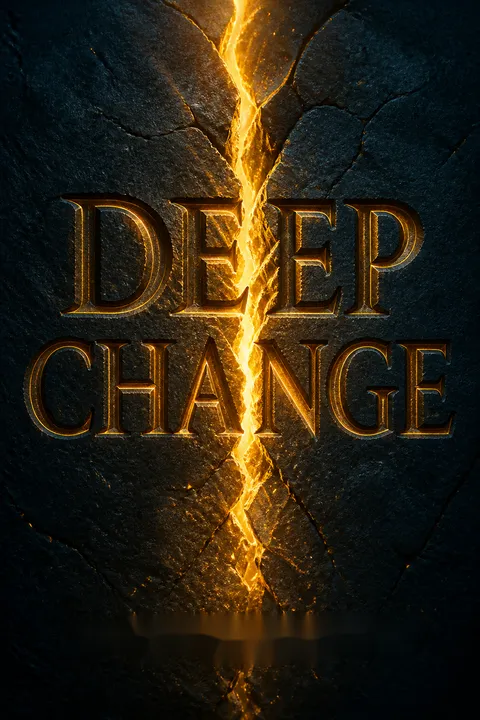


Key Takeaways
Choose disruptive reinvention over the slow erosion of a familiar life
Change breaks the old pattern. Incremental change extends familiar behavior through planned, often reversible steps. Deep change is different: it alters basic assumptions, requires unfamiliar actions, carries significant risk, and offers no guarantee of control. Quinn argues that people and organizations face a recurring choice: adapt or preserve routines that are losing their fit with reality. A public agency study found dramatic turnarounds, but every transformational leader examined had at some point broken a state rule. The point is not that rule-breaking is admirable. It is that meaningful change can challenge established boundaries and expose the person who initiates it.
The cost runs both ways. An organization that avoids needed change may shrink, lose relevance, or collapse; people inside it can become detached and powerless. Personal and organizational change also reinforce each other: external pressure pushes institutions to adapt, while individual initiative can alter institutions from within.
What's striking is the book's refusal to treat comfort as neutral. A familiar routine can quietly become costly when the environment around it changes. This resembles adaptive systems, where survival depends on adjusting internal patterns to new conditions. The caution is equally important: disruption is not automatically progress, and the story of rule-breaking should not become a license for reckless conduct. A useful test is whether the challenged rule protects a necessary value or merely preserves a stale procedure. Deep change asks for judgment, not rebellion for its own sake.
Change your own conduct before demanding that others change
Orders rarely create commitment. A senior team returned from a quality seminar with plans to transform its company. When asked what behavior its members would change, the executives could name changes they expected from everyone else, but none they would make themselves. Their silence exposed a familiar gap: leaders often diagnose others as the problem while treating themselves as outside the system.
Model the risk you request. Quinn contrasts telling, which can work for small or welcome adjustments, with coercion, which may produce temporary compliance but often damages trust. He draws on a psychotherapist's account of stepping beyond prescribed professional rules when a client needed a different response. The therapist's willingness to risk personal change made the relationship more credible. In workplaces, a leader's actions can make a request believable in a way a memo cannot.
This is a practical version of systems thinking: an influential person is not outside the pattern being criticized, but one of its participants. Modeling can reduce the distance between stated priorities and observed behavior, a distance that employees quickly learn to discount. Still, example alone is insufficient. A manager who changes personally but leaves impossible workloads, conflicting incentives, or punitive rules untouched may simply ask others to endure more. Credibility grows when personal example is paired with changes to the conditions that shape everyone's conduct.
Treat falling vitality as evidence your familiar strategy has stopped working
Effort can turn against you. Bill, a newly hired executive, won approval by working relentlessly. His success encouraged him to work still more, until his wife and colleagues signaled that the cost was mounting. At a retreat, he drew a dying pine and recognized that he was neglecting his own need for renewal. The same pattern appears in Quinn's parable of a woodcutter who keeps sawing with a dull blade because stopping to sharpen it feels like lost time.
Notice the reversal. The logic of task pursuit is the habit of prioritizing immediate output over reflection and maintenance. Early effort may improve performance, but after the situation changes, repeating the same effort can produce diminishing returns. Quinn recommends monitoring vitality, stepping back from the task, and reconsidering motives and methods before strain becomes the only signal.
The woodcutter's dilemma captures a classic feedback problem: a strategy that once worked becomes self-defeating, yet its earlier success makes it harder to abandon. In organizations, maintenance is often invisible while immediate output is easy to count, so the short-term incentive favors the dull blade. The argument should not turn exhaustion into a character flaw. Low energy can reflect illness, caregiving, unsafe work, or excessive demands, not merely a failure of reflection. The useful move is to treat depletion as information, then examine both personal habits and surrounding conditions.
Replace the map that earned your success when the terrain changes
Old strengths can mislead. Jason drove the same road for eleven years, then noticed familiar scenery he had never seen when he borrowed a taller vehicle. A changed vantage point altered his map. Quinn's organizational example is an engineer promoted for technical skill who struggled when senior management required political judgment, patience, and attention to how others interpreted events. His old definition of good work no longer explained the new terrain.
Revise the story of self. Quinn uses the term remythologizing for retelling a defining personal or organizational story from a new perspective, so past experience can be integrated with present needs. He describes writing about his dying father and seeing the story anew during his own midlife questions about contribution. The point is not to erase the past, but to reconsider what it means now.
The map metaphor helps explain why experience can become a liability: expertise compresses attention around what used to matter. A new role or environment may demand capacities that earlier success never tested. Narrative psychology adds a useful lens here: people make identity coherent by interpreting events, and reinterpretation can open new actions. Yet stories are not substitutes for evidence. A revised self-understanding should be tested through behavior and feedback, rather than accepted simply because it feels meaningful.
Use self-scrutiny to close the gap between values and behavior
Integrity is tested under pressure. Steve Thompson, a project manager on a North Sea diving operation, faced pressure from his boss to keep divers working as the weather worsened. He chose schedule and approval over safety, then recognized that his behavior contradicted his image of himself as an ethical leader. His written account helped expose this integrity gap, the mismatch between a person's self-concept and actual choices.
Study the decision, not just the outcome. Thompson examined what he felt, what he feared, and how he framed success. Quinn presents this kind of self-study as a way to notice assumptions while action is underway, rather than discovering them only after damage is done. The goal is confidence grounded in the ability to revise a mistaken strategy, not confidence that every initial judgment is correct.
The episode shows how ethical failure can emerge through ordinary pressures: pleasing a superior, meeting a deadline, and redefining success narrowly. Written reflection creates a record that is harder to smooth over than memory alone. Contemporary safety practice similarly distinguishes individual accountability from system design: clear stop-work authority and realistic schedules can make ethical choices easier. Introspection remains vulnerable to self-serving interpretation, however. It becomes stronger when paired with candid feedback from colleagues and rules that protect people who raise risks.
Repair the rules that recreate failure, not just its visible symptoms
The source may be inside the routine. A CEO told a downsizing company to remove unnecessary work as well as employees. Everyone agreed, but a year later the workload had grown. The formal instruction had collided with implicit expectations that rewarded activity and preserved existing procedures. Quinn argues that organizational culture is not simply what leaders announce; it is also the pattern people reproduce through daily decisions.
Do not confuse expertise with contribution. The tyranny of competence describes a technically excellent individual whose narrow definition of the job ignores the damage done to cooperation. A company may depend on one indispensable specialist while morale and teamwork deteriorate around that person. Likewise, downsizing can improve short-term finances without changing the assumptions that produced the underlying problem. Diagnosis must reach the governing rules, incentives, and relationships that keep the pattern alive.
This section connects organizational change to path dependence: once routines and rewards reinforce one another, a sensible directive can be absorbed without changing behavior. It also challenges a common accounting bias, where measurable individual output can conceal costly relational damage. The remedy is not to dismiss expertise or hierarchy wholesale. Reliable systems need skill, accountability, and coordination. The sharper question is whether a practice still serves its purpose, and whether the organization has a safe way to test alternatives before another round of cuts disguises the same failure.
Pair transactional discipline with transformation, not one instead of the other
Management and leadership solve different problems. Quinn distinguishes a transactional view, focused on organizational exchange, position, and effective negotiation, from a transformational view that treats the organization as a moral system and puts shared purpose ahead of personal security. The second view does not erase the first. Leaders still need operational judgment and an understanding of politics, but they must also be willing to challenge conventions when those conventions obstruct the organization's purpose.
The strongest executives combine roles. In a study of more than 900 CEOs, taskmaster behavior was most common but was not associated with the performance measures examined. Analyzer behavior and vision setting were associated with business performance and organizational effectiveness; motivating behavior was associated with all three measured areas. The highest-performing CEOs showed strength across all four roles: vision setter, motivator, analyzer, and taskmaster.
The book's most useful leadership claim is integrative rather than heroic: vision without execution is fantasy, while execution without direction can efficiently preserve decline. This resembles organizational ambidexterity, the capacity to exploit reliable operations while exploring new possibilities. The CEO findings support the value of role range, but association does not prove that adopting every role causes superior performance. Context matters, too. The practical implication is to notice which role dominates by habit and which capability the present challenge actually requires.
Find the vision in the truths the organization avoids
A slogan is not a direction. Quinn calls the organization's inner voice the accumulated truth people know but cannot easily say together. In one troubled company, interviews surfaced eight persistent issues, including silence around problems, self-interest, weak leadership cohesion, and the absence of a believable vision. The CEO listened during sessions where employees named the problems rather than immediately correcting them. By the end, participants could articulate a direction grounded in the organization's actual condition.
Make difficult topics discussable. An undiscussable issue is important but too threatening for a group to address openly. In a team exercise, executives competed for money even though cooperation would have benefited everyone; the debrief revealed how distrust had become normal. Quinn's Gandhi example makes a related point: a vision resonates when it speaks to people's concrete needs, not merely lofty language.
A vision gains credibility when it explains lived experience, including facts that threaten leaders' preferred image of the organization. This is close to the idea of psychological safety: people need enough interpersonal security to raise problems before they become crises. Yet candor is not automatically constructive. Unstructured confrontation can humiliate individuals or entrench factions. Skilled facilitation, clear confidentiality, and attention to power differences help turn difficult speech into shared diagnosis, rather than simply rewarding whoever speaks most forcefully.
Turn individual initiative into shared power with trust, clarity, and room to act
One person can start a larger shift. John Woolman, an eighteenth-century Quaker, spent more than twenty years persuading fellow Quakers to reject slaveholding through patient questions rather than public attack. By 1770, Quakers no longer owned slaves. Quinn uses the story to show how persistent individual action can change a community's norms.
Make initiative repeatable. The transformational cycle moves through initiation, uncertainty, transformation, and routinization. People and organizations can get stuck in illusion, panic, exhaustion, or stagnation along the way. In Ford's LEAD program, middle managers took on change projects despite bureaucratic barriers; research on empowerment found that empowered employees reported greater innovation and effectiveness. Empowerment itself cannot simply be handed down. It grows when people have meaningful work, confidence, discretion, influence, clear direction, teamwork, and support.
Woolman's story makes bottom-up change concrete, while the organizational examples show why a heroic individual cannot be the whole strategy. Sustainable initiative needs structures that protect experimentation, clarify responsibility, and make learning visible. The cycle is especially useful because it treats uncertainty and routine as phases rather than permanent states. Still, empowerment can become an empty demand if authority delegates risk without resources or protection. The fairest test is whether people gain genuine influence over work and whether leaders share the consequences when experiments fail.
Analysis
Deep Change is both a leadership argument and a manual for seeing how people become complicit in the systems they resent. Its central move is to shift the unit of analysis: a stagnant workplace is not merely an external obstacle, because its members reproduce it through what they reward, avoid, and call realistic. That makes change personal without reducing organizational failure to personal weakness. Rules, incentives, authority, and workload still matter.
The book's strongest narrative pattern is the conversion of crisis into a new perspective. The engineer learns that technical correctness is not enough in senior management. The diving project manager sees the distance between ethical identity and an unsafe decision. The CEO discovers that a vision is credible only when it reflects the organization's neglected realities. These stories make abstract change legible as a sequence of disorientation, self-examination, experiment, and revised action.
Its tension is also its most valuable caution. Quinn celebrates risk, deviation, and self-authorization because organizations often reward conformity after their assumptions have expired. But risk is not intrinsically virtuous. Rule-breaking can harm people, and an internally driven leader can mistake conviction for wisdom. The book is strongest when risk is disciplined by moral purpose, feedback, and responsibility to others, rather than treated as proof of leadership.
The frameworks work best as diagnostic tools, not universal laws. The transformational cycle can help a team identify whether it is avoiding uncertainty or mistaking routine for health. The four CEO roles counter the simplistic idea that vision alone leads. The empowerment discussion similarly insists on both discretion and structure. Together, these ideas imply a practical discipline: identify the pattern that no longer fits, examine one's own contribution, invite evidence that challenges the preferred story, and experiment in ways that distribute both agency and accountability. Deep change is neither a dramatic speech nor a private epiphany. It is a change in the shared practices that determine what people can notice, say, and do.
Review Summary
Deep Change receives mostly positive reviews, with readers praising its insights on personal and organizational transformation. Many find it applicable to various settings, including business and spirituality. Readers appreciate Quinn's emphasis on the importance of individual change to drive organizational change. Some criticize repetitiveness and outdated concepts. The book's questions for reflection are highly valued. Overall, reviewers find it thought-provoking and potentially life-changing, though a few feel it lacks novelty in its core message.
People Also Read




Glossary
Deep change
Discontinuous personal or organizational changeA major change that alters basic assumptions, ways of thinking, or established behavior. Unlike incremental change, it is not simply an extension of the past, is generally difficult to reverse, and involves risk and reduced control. Quinn treats it as necessary when a person or organization no longer fits the conditions around it.
Slow death
Decline through avoided changeThe gradual deterioration that follows when people recognize a need for significant change but preserve the status quo. In organizations, it can appear as lost relevance, shrinking resources, and worsening morale. For individuals, it can mean diminished vitality, meaning, and agency. The term emphasizes that avoiding disruption does not avoid its eventual cost.
Hero's journey
Transformation through uncertaintyA change pattern drawn from Joseph Campbell's account of myth: a person leaves familiar conditions, encounters challenges in an unfamiliar realm, gains new understanding, and returns with a capacity to affect the surrounding world. Quinn uses it as a framework for personal and organizational transformation, not as a claim that change is comfortable or predictable.
Logic of task pursuit
Output over reflection and maintenanceThe tendency to keep pursuing immediate tasks even when stopping to reflect, repair, or reconsider strategy would improve results. Quinn illustrates it with a woodcutter who continues using a dull saw because pausing seems unproductive. The pattern can trap individuals and organizations in busyness while underlying tools, motives, or systems deteriorate.
Integrity gap
Mismatch between values and conductThe discrepancy between how a person understands their own character and how they actually behave in a particular situation. Quinn presents written reflection on consequential decisions as a way to notice this gap, including the pressures and assumptions that shape action. Recognizing the mismatch can support more responsible choices and greater readiness to revise mistaken judgments.
Tyranny of competence
Expertise that undermines cooperationA condition in which an individual's technical skill becomes so valued that harmful effects on relationships, teamwork, or the wider organization are ignored. The competent person may define a job only as task completion and resist feedback about collaboration. Quinn argues that technical excellence cannot compensate for behavior that poisons the collective work environment.
Transformational paradigm
Purpose-led organizational changeA way of understanding leadership in which an organization is also a moral system, not only a technical operation or political exchange. The leader prioritizes a meaningful shared vision, acts consistently with stated values, and may challenge established conventions at personal risk. It differs from transactional management but does not eliminate the need for operational competence.
Transformational cycle
Four phases of deep changeQuinn's model of change through initiation, uncertainty, transformation, and routinization. A person or group begins with a desire to improve, experiments without knowing the outcome, develops a new understanding or pattern, and stabilizes the new practice. The cycle can be interrupted by illusion, panic, exhaustion, or stagnation, making renewed learning necessary.
Undiscussable issue
Important topic a group avoidsAn issue that matters to a group but feels too threatening to discuss openly. Members may avoid it because of prior conflict, fear of damaging relationships, concern for status, or anxiety about authority. Avoidance can weaken trust and decision-making while allowing the underlying problem to grow. Quinn recommends structured, supported discussion rather than pretending the issue is absent.
Inner voice of the organization
Collective truth beneath formal statementsThe underlying understanding shared by organizational members about what is working, what is failing, and what changes are needed, even when those truths are not spoken collectively. Quinn describes surfacing it through listening to people across the organization and identifying recurring themes. It can challenge official narratives and provide a more credible basis for vision.
FAQ
What's "Deep Change: Discovering the Leader Within" about?
- Exploration of Change: The book delves into the concept of deep change, which requires new ways of thinking and behaving, as opposed to incremental change that is reversible and limited in scope.
- Personal and Organizational Levels: It examines deep change at both personal and organizational levels, highlighting the interconnectedness of the two.
- Leadership and Transformation: The book emphasizes the role of leadership in initiating and sustaining deep change, focusing on the transformation of self and organizations.
- Framework for Change: It provides a framework for understanding and implementing deep change, using real-life examples and theoretical insights.
Why should I read "Deep Change: Discovering the Leader Within"?
- Insightful Frameworks: The book offers valuable frameworks for understanding and implementing change, both personally and organizationally.
- Leadership Development: It is particularly useful for those in leadership roles or aspiring to be leaders, as it provides guidance on becoming an internally driven leader.
- Practical Examples: The book is filled with real-life examples and case studies that illustrate the principles of deep change in action.
- Personal Growth: Readers interested in personal development will find the book's focus on self-transformation and integrity particularly beneficial.
What are the key takeaways of "Deep Change: Discovering the Leader Within"?
- Deep Change vs. Incremental Change: Deep change requires a fundamental shift in thinking and behavior, while incremental change is more about small, reversible adjustments.
- Role of Leadership: Effective leadership is crucial for initiating and sustaining deep change, and it often involves taking significant risks.
- Personal Transformation: Personal growth and self-reinvention are essential for aligning oneself with a changing environment and achieving meaningful impact.
- Empowerment and Integrity: Empowerment comes from within, and maintaining integrity is key to leading others through change.
How does Robert E. Quinn define "deep change"?
- Fundamental Shift: Deep change involves a major shift in thinking and behavior, requiring new perspectives and approaches.
- Irreversible and Risky: It is discontinuous with the past and generally irreversible, often involving significant risks and uncertainty.
- Personal and Organizational Levels: Deep change can occur at both personal and organizational levels, with insights from one level informing the other.
- Surrendering Control: It requires surrendering control and embracing uncertainty, often leading to personal and organizational transformation.
What is the "hero's journey" in the context of personal change?
- Mythological Framework: The hero's journey is a mythological framework that describes a process of personal enlightenment and transformation.
- Journey into Uncertainty: It involves leaving the comfort zone and venturing into unknown territory, facing challenges and gaining new insights.
- Transformation and Realignment: Through the journey, individuals undergo a transformation, realigning themselves with their environment and emerging empowered.
- Empowering Others: The journey not only transforms the individual but also empowers them to inspire and lead others.
What role does integrity play in "Deep Change: Discovering the Leader Within"?
- Foundation of Leadership: Integrity is seen as the foundation of effective leadership, essential for building trust and credibility.
- Confronting the Integrity Gap: The book emphasizes the importance of confronting and closing the gap between one's values and actions.
- Continuous Observation: Building integrity involves the continuous observation of one's lack of integrity and making necessary adjustments.
- Empowerment and Influence: Leaders with integrity are more likely to empower others and have a positive influence on their organizations.
How does "Deep Change: Discovering the Leader Within" address the concept of empowerment?
- Internal Process: Empowerment is described as an internal process that cannot be granted by others but must be developed from within.
- Dimensions of Empowerment: The book identifies four dimensions of empowerment: meaning, competence, self-determination, and impact.
- Empowering Environment: Creating an empowering environment involves strategic alignment, clear expectations, conflict resolution, and participation.
- Personal Responsibility: Individuals are encouraged to take responsibility for their own empowerment by aligning their internal and external worlds.
What is the "transformational cycle" and its significance in the book?
- Dynamic Process: The transformational cycle is a dynamic process that involves initiation, uncertainty, transformation, and routinization.
- Continuous Evolution: It emphasizes the need for continuous evolution and adaptation to maintain organizational and personal health.
- Traps and Challenges: The cycle highlights potential traps such as illusion, panic, exhaustion, and stagnation that can lead to slow death.
- Path to Excellence: Successfully navigating the transformational cycle is key to achieving and sustaining excellence.
What are the best quotes from "Deep Change: Discovering the Leader Within" and what do they mean?
- "Deep change or slow death": This quote encapsulates the central dilemma faced by individuals and organizations, emphasizing the necessity of embracing change to avoid stagnation.
- "Walking naked into the land of uncertainty": This metaphor highlights the vulnerability and courage required to embark on a journey of deep change.
- "Excellence is a form of deviance": This statement suggests that achieving excellence often requires deviating from norms and embracing unconventional methods.
- "If you are not risking your job, you are not doing your job": This quote underscores the importance of taking risks and challenging the status quo to drive meaningful change.
How does "Deep Change: Discovering the Leader Within" differentiate between transactional and transformational leadership?
- Transactional Leadership: Focuses on maintaining the status quo, emphasizing efficiency, control, and short-term goals.
- Transformational Leadership: Involves vision realization, moral integrity, and self-authorization, aiming for deep change and long-term impact.
- Role Integration: Effective leaders integrate both transactional and transformational roles to address competing demands and achieve high performance.
- Personal Transformation: Transformational leaders undergo personal transformation, aligning their values and actions with their vision.
How does "Deep Change: Discovering the Leader Within" suggest overcoming resistance to change?
- Understanding Barriers: The book identifies common barriers to change, such as bureaucratic culture, embedded conflict, and time constraints.
- Empowerment and Initiative: Encourages individuals to empower themselves and take initiative, despite organizational pressures to conform.
- Cycle of Empowerment: Describes a cycle of empowerment involving redefining roles, taking risks, and learning from experiences.
- Leadership and Vision: Emphasizes the role of leadership in providing a clear vision and fostering an environment that supports change.
What is the significance of "a vision from within" in the book?
- Internal Alignment: A vision from within involves aligning internal values with external realities, leading to meaningful and sustainable change.
- Bread and Salt: The concept of "bread and salt" represents the core issues and values that resonate deeply with individuals and organizations.
- Dialogue and Discovery: Finding a vision involves dialogue and discovery, engaging both top-down and bottom-up processes.
- Empowerment and Commitment: A compelling vision inspires empowerment and commitment, driving individuals and organizations toward excellence.
About the Author
Other books by Robert E. Quinn




Download PDF
Download EPUB
.epub digital book format is ideal for reading ebooks on phones, tablets, and e-readers.








