

Key Takeaways
Define your mission by the change people should experience
Purpose before activity. A mission explains why an organization exists and what difference it aims to make, not simply the services it provides. Drucker recounts a hospital that first described its emergency room mission as health care. A closer look showed that many visitors chiefly needed reassurance. That insight changed the practical priority: each person needed prompt attention from someone qualified to assess them. A useful mission is brief, understood throughout the organization, and connected to real choices.
Match purpose to reality. The organization must find the overlap between a meaningful need, what it can do well, and what people are committed to doing. A mission should guide work now while enduring long enough to anchor future change. Its test is not whether the wording sounds inspiring, but whether it helps people decide what to do and what to decline.
A mission works like a coordination device: it lets people make local decisions without referring every choice to the top. The emergency-room example shows why purpose needs operational consequences, not just elegant language. In organizational design, a broad aim becomes useful when it changes priorities, staffing, and the experience of service. There is also a risk: leaders can treat a mission statement as proof of impact. The stronger test is whether customers experience the promised difference and whether staff can explain how their work contributes to it.
Protect the purpose, but keep methods open to reinvention
Separate core from custom. Jim Collins develops the distinction between an organization's enduring purpose and the methods it uses at a particular moment. Values and basic reason for being can stay steady while programs, structures, and routines change as circumstances shift. A university might preserve freedom of inquiry while revising how it organizes academic work. The mission, in this view, is an anchor for change, not an excuse to resist it.
Use the mission to say no. Frances Hesselbein kept the Girl Scouts focused on helping girls develop their potential, and declined a proposed charity activity that did not fit that purpose. The opportunity may have been attractive, but availability alone did not make it strategically right. A mission earns credibility when it guides both action and refusal.
This distinction resembles the difference between a system's invariants and its adjustable parameters. In complex organizations, preserving a few principles can make experimentation safer because people know which commitments are not being traded away. The challenge is deciding what genuinely belongs in the core. If leaders label current habits as sacred, mission becomes a defense of inertia. Regularly comparing stated purpose with changing needs helps separate identity from nostalgia.
Name one primary customer before trying to please everyone
Put the beneficiary first. Drucker uses customer to mean someone whose needs must be met for the organization to achieve its purpose. A primary customer is the person whose life the organization's work is meant to change. Supporting customers are people whose cooperation is also necessary, such as staff, volunteers, funders, partners, and referral sources. Keeping one primary customer in view prevents an organization from confusing many important interests with a single central purpose.
Focus need not mean narrow demographics. A workforce organization serving people with multiple barriers to employment included people with disabilities, single parents, older displaced workers, and people facing mental illness or addiction. Its unifying customer was defined by a shared barrier, and it assessed programs by whether participants could obtain and keep productive work. Some primary customers, such as future generations or endangered species, cannot speak directly, but identifying them still clarifies priorities.
This is a useful antidote to stakeholder lists that treat every constituency as equally central. Strategy requires choices, while governance requires attention to those who enable or constrain the work. The distinction also exposes a representation problem: the person most affected may have the least power to speak in meetings. Organizations therefore need more than a label for the primary customer. They need credible ways to hear from that group, including people who are absent, disengaged, or difficult to reach.
Ask customers what matters; good intentions are not evidence
Test the organization's assumptions. Leaders may sincerely believe they know what customers value, but their beliefs are not a substitute for asking. Drucker recommends a systematic conversation with customers and involving board members, staff, and customers in interpreting what they say. At a homeless shelter, leaders assumed meals and clean beds were the central value. Interviews revealed a deeper priority: a safe place to rebuild a life. The shelter changed its rules to allow longer stays and worked with residents on their goals.
Listening can change the service itself. At Sinai-Grace Hospital, patients faced long waits and an unwelcoming environment. The hospital separated urgent chest-pain care from less urgent cases and created an express-care area. Wait times fell by more than 75 percent. Renovations and more attentive treatment also improved customer ratings, staff morale, and community confidence. The lesson is not to copy these interventions, but to investigate the actual experience behind complaints.
Customer interviews are a form of organizational sense-making: they reveal where professional assumptions diverge from lived experience. The shelter example is especially instructive because listening changed both the service and what residents were expected to contribute. Still, feedback is not automatically representative. People who depend on a service may hesitate to criticize it, and the loudest voices may not reflect the greatest need. Interviews become stronger when paired with observation, multiple channels of input, and a clear account of whose perspective remains missing.
Measure changed lives, not activity, with numbers and stories
Count outcomes, not motion. Results are the changes an organization produces outside itself, such as shifts in health, behavior, circumstances, hope, or capability. A mental-health center serving people diagnosed with schizophrenia tracked immediate signs of progress, including participation and fewer hospital stays, alongside longer-term changes such as returning to family life, holding a job, or completing graduate study. The point was to judge whether lives changed, not merely whether programs were busy.
Use two kinds of evidence. Quantitative measures show counts or rates, while qualitative evidence explains the depth and context of change. A museum visitor's account of how an exhibit opened new possibilities may reveal something a headcount cannot. Judith Rodin warns against choosing only easily measured work: plans need measurable outcomes and room for correction, but simple output counts can reward activity without meaningful impact.
The tension here is familiar from measurement theory: what gets counted can become a substitute for what matters. Numbers make comparisons and accountability possible; stories help identify mechanisms, uneven effects, and outcomes that resist simple scoring. Neither form is sufficient alone. A disciplined evaluation asks whether a measure reflects the mission, whether it can be distorted by incentives, and whose outcomes it captures. The balance is particularly important in human services, where a clean metric can conceal a complicated life.
Stop funding yesterday's programs just because they once worked
Make room for renewed effort. Planned abandonment means deliberately ending programs, policies, or practices that no longer serve the mission or produce adequate results. It is difficult because people become attached to work that once mattered, or to projects that never succeeded but consumed years of effort. Drucker argues that need or tradition alone does not justify continuing. Resources, including staff competence and attention, should go where the organization can make a meaningful difference.
A good cause can still be the wrong assignment. Drucker describes advising a local church council to stop running a farmers' market after it had become successful and other people could manage it well. The original intervention had met a need; continuing to own it was no longer necessary. The question is not whether a program is worthwhile in the abstract, but whether this organization is still the right one to deliver it.
Abandonment is the portfolio-management side of strategy. Without it, every new commitment is layered onto old ones, and the organization gradually loses the capacity to do any of them well. A regular review can make endings less personal by applying the same criteria to every program: mission fit, customer value, results, and comparative competence. The caution is that short-term evidence can undervalue prevention or slow-building benefits. Ending work should follow careful appraisal, not merely a preference for whatever produces quick, visible returns.
Limit strategy to a few goals, then assign accountable owners
Turn direction into commitments. A plan connects purpose to action through a mission, a small set of long-range goals, measurable objectives, specific action steps, a budget, and ongoing appraisal. Drucker recommends three to five overarching goals; beyond that, priorities can become too diffuse to guide resource choices. In an art museum example, goals covered collection care, public understanding, audience growth, facilities, and financial security.
Separate governance from execution. The board approves the mission, goals, and resource commitments. Management develops objectives, action steps, and the supporting budget. People responsible for implementation should help shape the work, with named individuals accountable for what gets done and by when. This distribution gives the board strategic oversight without turning it into a committee that dictates every operational move.
A short list of goals reduces the cognitive burden of choosing among competing projects. The board-management distinction also reflects a sound principle of delegated authority: accountability is clearer when decision rights are explicit. Yet a small number of goals can still become slogans if objectives lack resources, owners, or meaningful deadlines. The budget is not an administrative appendix. It is the concrete statement of what the organization has decided to prioritize, and what it is willing to leave unfunded.
Treat plans as feedback loops, not predictions carved in stone
Plan for learning. Planning does not mean accurately forecasting the future. It means choosing a direction, deciding what to do now, and adjusting as conditions and evidence change. Drucker's planning process includes ending ineffective work, strengthening successful work, exploring innovation, choosing risks, and analyzing uncertain areas before committing. These are recurring decisions, not a one-time planning event.
Monitor causes, not just totals. V. Kasturi Rangan describes a museum trying to attract visitors with special exhibitions. If an exhibit unexpectedly draws many first-time visitors, the team can shift resources toward turning them into members and investigate what attracted them. If attendance misses expectations, reviewing the program can prevent repeated mistakes. Monitoring individual programs helps explain how overall results were achieved and improves the next round of strategy.
This approach aligns with adaptive management, in which action and evaluation are deliberately linked because conditions cannot be fully predicted in advance. It turns a plan into a testable set of choices rather than a promise that every assumption is correct. The useful discipline is to specify in advance what signals would justify changing course. Without that, flexibility can become improvisation driven by the newest anecdote, while excessive adherence can preserve a failing design simply because it was approved.
Make disagreement safe enough to improve decisions before action
Use dissent as preparation. Drucker cautions that immediate agreement on a consequential decision may mean the group has not examined it carefully. Constructive disagreement surfaces assumptions, objections, and alternatives before the organization commits. In cause-driven organizations, criticism can feel like a judgment of someone's motives, so leaders must make open debate safe enough to prevent disagreements from turning into private feuds.
Build participation into assessment. Self-assessment is a structured review of purpose, customers, value, results, and future direction that should lead to action. It works best when board members, staff, and customers contribute rather than receiving a finished plan. Frances Hesselbein adds practical elements of organizational change: scan the environment, revisit the mission, challenge inherited practices, communicate a few clear messages, share leadership, model the desired conduct, and assess performance.
Dissent is valuable when it improves the information available to a decision, not when it becomes a ritual of opposition. Research on group decision-making often distinguishes psychological safety, the ability to raise concerns without fear of humiliation, from comfort or universal agreement. That distinction fits the book's argument: trust can support candor rather than suppress it. Participation also costs time, and not every decision requires a full deliberative process. Leaders must match the breadth of consultation to the stakes and the people affected.
Analysis
The book's strongest contribution is its sequence of questions as a practical logic of organizational accountability. Purpose identifies the intended difference. Customer definition locates whose life or experience matters most. Listening tests whether the organization understands that customer. Evaluation asks whether the work changes anything, and planning turns the answers into resource choices. The sequence is valuable because it interrupts a familiar institutional habit: treating activity, reputation, or internal agreement as evidence of success.
Its sharpest correction is aimed at mission-driven organizations that assume moral intent guarantees useful work. In settings without a single financial bottom line, managers must construct an honest account of results. The book therefore resists both sentimentalism and managerial vanity. A meal, a class, or a counseling session may be important, but the organization must still ask what changed for the person who received it. Equally, a measurable output is not necessarily a meaningful outcome. The book's use of both qualitative and quantitative evidence recognizes that accountability requires rigor without pretending that human change is reducible to one score.
The framework also contains productive tensions. A primary customer clarifies focus, but supporting customers can have genuine power over whether the service continues. A stable mission enables adaptation, but leaders may misuse it to protect familiar programs. Measurable targets improve learning, but they can draw attention toward what is easy to count. These tensions are not defects to eliminate. They are governance questions that require explicit judgment, transparent evidence, and representation of people who experience the consequences.
The most useful interpretation is therefore not a five-step worksheet completed and filed away. It is a recurring discipline of inquiry and revision. Its practical test is whether the organization can explain who benefits, what benefit means to them, what evidence supports the claim, and how the next allocation of people and money follows from that evidence. That standard applies beyond nonprofits, while the book's strongest examples remain rooted in the distinctive accountability problems of social-sector work.
Review Summary
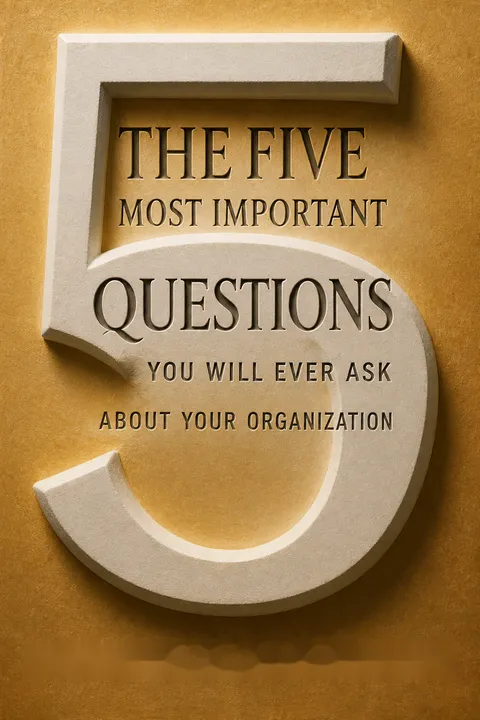
The Five Most Important Questions You Will Ever Ask About Your Organization receives mostly positive reviews, with readers praising its concise focus on essential organizational questions. Many find it valuable for leadership teams, non-profits, and self-assessment. Some criticize its brevity, suggesting it could be condensed further. Readers appreciate the book's emphasis on customer value, mission clarity, and continuous planning. While some note its lack of biblical references, others highlight its applicability across various sectors. Overall, it's considered a useful tool for organizational reflection and improvement.
People Also Read









Glossary
Self-assessment
Organizational review for actionA structured examination of an organization's purpose, customers, the value it provides, its results, and its future direction. It is intended to produce decisions and action, not merely a report. The process draws on board, staff, and customer perspectives, and can be repeated as conditions and evidence change.
Primary customer
Person whose life should changeThe person or group whose life is intended to change through the organization's work. Identifying one primary customer helps an organization focus its choices and judge whether its programs are effective. The primary customer may not be able to speak directly, as when the intended beneficiary is an infant, an endangered species, or a future generation.
Supporting customers
People essential to performancePeople and groups who must also be satisfied for an organization to achieve results. They can include employees, volunteers, members, funders, partners, and referral sources. Their needs matter because they enable, support, or influence the work, but identifying them does not replace the need to clarify the primary customer.
Planned abandonment
Deliberate ending of obsolete workA purposeful decision to stop programs, policies, or practices that no longer fit the mission, meet customer needs, or produce sufficient results. It frees people, money, and organizational attention for more effective work. The approach treats endings as a normal part of renewal rather than as proof that the original effort was misguided.
Results
Changes beyond the organizationThe effects of an organization's work on people or conditions outside the organization. In the social sector, results can include changes in behavior, health, circumstances, hopes, competence, or capacity. They should be defined in relation to the mission and customer, and assessed using evidence that captures both measurable scale and meaningful context.
Objectives
Measurable levels of achievementSpecific, measurable achievements that move an organization toward its broader goals. Objectives translate long-range direction into work that management can plan, resource, and appraise. They are distinct from goals, which establish fundamental direction, and from action steps, which specify tasks, responsibilities, and timing.
Vision
Picture of a desired futureA description of the future an organization seeks to help create when its mission is fulfilled and its goals are achieved. A vision can give a plan emotional force and help people imagine the purpose behind near-term work. It is useful when it clarifies direction, rather than replacing concrete goals and action.
FAQ
What's "The Five Most Important Questions You Will Ever Ask About Your Organization" about?
- Purpose of the Book: This book by Peter F. Drucker is a guide for organizations to conduct a strategic self-assessment. It focuses on asking five essential questions to improve performance and effectiveness.
- Target Audience: It is aimed at leaders and managers in nonprofit, business, and government sectors who are looking to enhance their organizational impact.
- Core Concept: The book emphasizes the importance of asking the right questions to drive meaningful action and results within an organization.
Why should I read "The Five Most Important Questions You Will Ever Ask About Your Organization"?
- Improve Organizational Effectiveness: The book provides a framework for leaders to evaluate and improve their organization's performance.
- Timeless Wisdom: Drucker's insights are considered timeless and applicable across various sectors, making it a valuable resource for any leader.
- Action-Oriented: It encourages leaders to not only ask questions but also to take action based on the answers, leading to tangible improvements.
What are the key takeaways of "The Five Most Important Questions You Will Ever Ask About Your Organization"?
- Five Essential Questions: The book revolves around five critical questions: What is our mission? Who is our customer? What does the customer value? What are our results? What is our plan?
- Focus on Mission: Organizations should have a clear and compelling mission that guides all actions and decisions.
- Customer-Centric Approach: Understanding and delivering what the customer values is crucial for achieving results and fulfilling the mission.
What are the best quotes from "The Five Most Important Questions You Will Ever Ask About Your Organization" and what do they mean?
- "The most important thing is to ask these questions." This quote emphasizes the power of inquiry in driving organizational success.
- "The ultimate test is your performance." It highlights that the effectiveness of an organization is measured by its results, not just its intentions.
- "Trust requires that dissent come out in the open." This underscores the importance of open communication and constructive dissent in fostering innovation and commitment.
What is the self-assessment process in "The Five Most Important Questions You Will Ever Ask About Your Organization"?
- Purpose: The self-assessment process is designed to evaluate what an organization is doing, why it is doing it, and what it must do to improve.
- Methodology: It involves asking the five essential questions and using the answers to guide strategic planning and decision-making.
- Outcome: The process leads to a plan that aligns with the organization's mission and goals, ensuring accountability and measurable results.
How does "The Five Most Important Questions You Will Ever Ask About Your Organization" define 'mission'?
- Definition: The mission is the organization's purpose and reason for being, reflecting what it wants to be remembered for.
- Characteristics: An effective mission statement is short, focused, and should fit on a T-shirt, inspiring everyone in the organization.
- Role in Strategy: The mission guides the organization in setting goals and mobilizing resources to achieve desired outcomes.
Who is considered the 'customer' in "The Five Most Important Questions You Will Ever Ask About Your Organization"?
- Primary Customer: The primary customer is the person whose life is changed through the organization's work.
- Supporting Customers: These include volunteers, members, partners, funders, and others who must be satisfied for the organization to achieve results.
- Dynamic Nature: Customers are not static; their needs and demographics change, requiring organizations to continually reassess who their customers are.
What does "The Five Most Important Questions You Will Ever Ask About Your Organization" say about understanding customer value?
- Customer Perspective: The book stresses that only customers can define what they value, and organizations should seek this information directly from them.
- Avoid Assumptions: Leaders should not assume they know what customers value; instead, they should engage in systematic inquiry.
- Impact on Strategy: Understanding customer value is crucial for aligning organizational efforts with what truly matters to those they serve.
How does "The Five Most Important Questions You Will Ever Ask About Your Organization" suggest measuring results?
- External Measurement: Results are measured outside the organization in terms of changed lives and conditions.
- Qualitative and Quantitative: Both qualitative and quantitative measures are necessary to fully understand the impact of the organization's work.
- Continuous Appraisal: Organizations should regularly assess whether they are achieving meaningful results and adjust their strategies accordingly.
What is the role of planning in "The Five Most Important Questions You Will Ever Ask About Your Organization"?
- Strategic Alignment: Planning involves setting goals and objectives that align with the organization's mission and vision.
- Flexibility: While goals should be steadfast, the execution of plans should be flexible to adapt to changing circumstances.
- Action-Oriented: Plans should include specific action steps, responsible individuals, and a budget to ensure accountability and progress.
How does "The Five Most Important Questions You Will Ever Ask About Your Organization" address leadership?
- Transformational Leadership: The book advocates for leadership that is adaptable, visionary, and committed to continuous improvement.
- Encouraging Dissent: Leaders should foster an environment where constructive dissent is encouraged to drive innovation and commitment.
- Self-Assessment: Leadership involves ongoing self-assessment to ensure alignment with the mission and responsiveness to customer needs.
What additional resources does "The Five Most Important Questions You Will Ever Ask About Your Organization" provide?
- Contributors' Insights: The book includes contributions from thought leaders like Jim Collins and Philip Kotler, offering diverse perspectives on the five questions.
- Practical Tools: It provides a self-assessment tool and suggested questions to explore, aiding organizations in conducting their evaluations.
- Further Reading: The book lists additional resources and publications for those interested in deepening their understanding of organizational leadership and management.
About the Author
Other books by Peter F. Drucker







Download PDF
Download EPUB
.epub digital book format is ideal for reading ebooks on phones, tablets, and e-readers.








