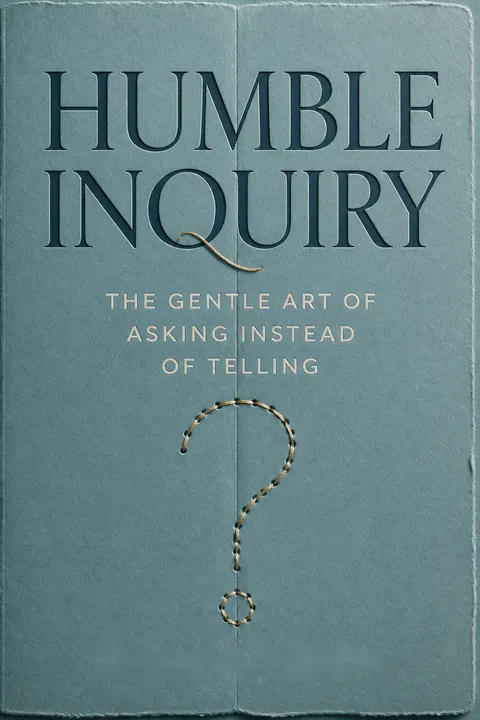


Key Takeaways
Ask what you do not know before telling people what they should know
An assumption shut the door. One of Schein’s executive students was studying when his six-year-old daughter knocked. He snapped at her for interrupting, assuming she had ignored his instructions. In fact, she had been sent to say goodnight and offer him coffee. A simple question about why she had come would have prevented the hurt and revealed her real purpose.
Curiosity changes the exchange. Schein calls this Humble Inquiry: asking about something the questioner genuinely does not know, with real interest in the other person’s answer. Telling can imply that the listener is uninformed; asking gives the other person room to contribute. The question is only the opening move. Listening, acknowledging the answer, and responding to it are what make the exchange feel respectful rather than like a disguised lecture.
The daughter’s visit shows how quickly a plausible interpretation can become a damaging response. In cognitive science, this resembles premature closure: settling on an explanation before gathering enough evidence. A clarifying question creates a small pause in which the other person can correct the story. But questions are not inherently respectful. A pointed question can shame or manipulate as effectively as a blunt statement. The useful test is whether the asker is genuinely prepared to hear an answer that complicates the first impression.
Treat dependence as a leadership fact, not a status failure
Rank does not remove dependence. Schein distinguishes Here-and-now Humility from deference to elders or admiration for exceptional achievement. It is the temporary humility of needing another person’s knowledge or help to complete a chosen task. A relay team illustrates the point: a leader who assumes a teammate can take the baton in a particular hand may discover too late that the hand is injured.
The need is mutual. In an operating room, a senior surgeon may rely on a nurse or technician to notice a confusing monitor or a possible error. Formal rank does not cancel that dependence. A leader who asks how the team can coordinate acknowledges the practical reality and makes it easier for others to share information. The point is not to abandon authority, but to see where the work itself makes each person reliant on others.
This reframes humility as accurate role perception, not modest self-presentation. Complex systems often distribute knowledge more widely than authority: the person nearest a machine, patient, or customer may see a problem first. Leaders who recognize this can make better use of expertise that hierarchy otherwise suppresses. There is a limit, however. Mutual dependence does not mean equal responsibility in every moment. Clear decision rights still matter, especially in emergencies. The stronger model combines accountable leadership with active curiosity about information held elsewhere.
Use questions to discover the real problem, not display expertise
Start with what is unclear. At a lunch meeting, Shell Australia executives debated whether Peter should become vice president of administration. They liked his abilities but felt uneasy about the appointment. Schein asked what the role actually involved. When the group listed its responsibilities, the sticking point emerged: public relations. The executives separated that function into a distinct role and concluded Peter fit the remaining job.
Ignorance can be useful. The question did not supply an answer or defend a preferred candidate. It exposed an assumption hidden inside the group’s vague concern. In another example, a caller requested directions to a street, but Schein first asked where she was trying to go. She wanted downtown Boston and was already on the right road. The stated question was not necessarily the underlying need.
These examples show how a good question can change the frame of a problem, not merely collect facts within the existing frame. That is valuable in consulting, diagnosis, and design, where the first description often embeds assumptions about what needs fixing. The skill is to ask without making the other person feel foolish for having framed it differently. Curiosity should widen the search, not turn every ordinary request into an interrogation. In time-sensitive situations, a brief clarifying question may be enough to avoid solving the wrong problem.
Make it safe for lower-status people to interrupt your certainty
Bad news travels uphill reluctantly. Schein describes repeated failures in hazardous industries and health care in which lower-ranking workers had information that could have reduced harm, but did not speak up or were ignored. A hypothetical surgical team makes the pressure visible: a nurse may notice a possible error by a senior surgeon, yet fear humiliation or punishment if she challenges him.
Leaders shape the permission. A general statement that everyone should speak up is weak if daily reactions teach people otherwise. The higher-status person can invite correction, ask what seems unclear, and respond to concerns without retaliation or contempt. Trust is built through repeated exchanges in which the contribution is acknowledged and taken seriously. A leader’s welcoming words matter less than the consequences people observe when they actually deliver unwelcome information.
The insight aligns with research on psychological safety, the shared sense that interpersonal risk-taking is acceptable within a group. Yet safety is not simply a warm atmosphere or a leader’s open-door policy. It depends on what happens after someone raises a concern: whether the issue is investigated, whether the speaker is respected, and whether the process changes when needed. Formal checklists and escalation routes can help, but they cannot anticipate every surprise. The most robust organizations combine reliable procedures with relationships that let people question authority in real time.
Check your observations before emotions become decisions
Perception is not a transcript. Schein uses the ORJI cycle to describe four linked processes: Observation, Reaction, Judgment, and Intervention. People register some parts of a situation, react emotionally, interpret what it means, and act. A driver cut off by another car may feel threatened, decide the other driver was deliberately rude, then speed up to block the merge. The judgment can feel logical even when the original interpretation is wrong.
Inquiry interrupts the rush. Before acting, a person can pause to identify what they are feeling and ask whether the facts are clear. If a boss says a presentation went badly, asking which part seemed weak gathers more useful information than immediately defending the work. Schein also recommends asking oneself what is happening, what one wants, and who depends on whom before intervening.
The ORJI model is useful because it places observation, emotion, interpretation, and action in sequence, giving people a practical place to pause. It also resists the comforting idea that careful reasoning automatically produces sound conclusions: reasoning cannot repair evidence that was misread at the start. Still, emotion is not merely noise. Anxiety or irritation can flag a meaningful boundary or risk. The goal is not to suppress feeling, but to treat it as a signal that deserves checking before it becomes a verdict about someone else’s intent.
Separate open curiosity from questions that steer or accuse
Questions carry different force. Schein distinguishes four forms of inquiry. Humble Inquiry invites the other person’s account without prescribing its direction. Diagnostic inquiry guides attention toward feelings, causes, actions, or other people’s reactions. Confrontational inquiry places the asker’s own idea inside a question, often nudging the listener toward a conclusion. Process-oriented inquiry asks about the conversation itself, such as whether the discussion has become uncomfortable.
Steering can be useful. Asking what someone tried already may help solve a shared problem, but it directs their thinking more than an open invitation does. Asking why they failed to speak up can sound accusatory. A question about whether the exchange is working can reset a tense conversation. These forms are not equally suitable in every situation. The asker should notice when a question is gathering information and when it is quietly offering advice or taking control.
This taxonomy corrects the popular but shallow advice to simply ask more questions. A question can be a genuine invitation, a diagnostic tool, or a statement wearing a question mark. Naming that difference helps speakers examine their motives and listeners recognize the pressure embedded in phrasing. The categories are best used as a guide, not a rigid etiquette code. A direct, leading question can be appropriate when immediate action is required or when the relationship supports candor. The key is to know what the question is doing and accept responsibility for its effect.
Personalize professional contact without forcing intimacy
Roles can hide whole people. Schein contrasts task-oriented relationships, organized around getting a job done, with person-oriented relationships, where people also seek human connection. Personalization means recognizing someone beyond a job title, without assuming that every colleague wants closeness. His wife’s oncologist asked about the couple’s travel plans before arranging treatment. They felt treated as people with lives beyond the illness, which increased their confidence in him. A later, more technical doctor showed less interest in that context, and the patient felt more anxious.
Small gestures can open the door. A leader might learn how a teammate prefers to coordinate or invite colleagues to share how they work best together. Schein notes that some effective surgical teams spent time together outside the operating room, including at lunch. The point is not compulsory friendship. It is enough recognition and shared understanding to make honest task communication easier.
Person-centered care and relational coordination both emphasize that work improves when people understand one another’s circumstances as well as their formal roles. This does not require disclosure of private details. Asking about travel plans was relevant because treatment needed to fit into the patient’s life; personal questions without such relevance could feel intrusive. The distinction matters in workplaces, where a manager has power to make supposedly friendly exchanges feel compulsory. Respectful personalization lets the other person set boundaries while showing that their context is not invisible.
Stop rewarding solo heroics when the work depends on handoffs
Teamwork can lose to incentives. Schein describes a culture that praises teamwork but often rewards the individual star more visibly than the group. In a relay race, excellent runners still depend on passing the baton cleanly. In organizations, complex work likewise depends on people coordinating across roles, yet promotions and prestige may center on individual achievement. The result is a mismatch between what leaders say matters and what the system actually recognizes.
Relationships are part of the work. Teams facing complex or unpredictable tasks need more than a checklist, because procedures cannot specify every response to an unexpected event. Members need enough trust to ask for clarification, share concerns, and learn how others do their jobs. Leaders can use inquiry to discover where groups rely on each other and where coordination is breaking down. Collaboration is not a pleasant extra when the task itself is interdependent.
The argument points to a familiar organizational problem: cooperation is requested rhetorically while individual performance is measured and rewarded. Those incentives can make helpful behavior costly, especially when it takes time or gives credit to someone else. Changing conversation habits helps, but it cannot fully offset promotion systems that punish collaboration. A useful test is whether the organization recognizes the work of handoffs, shared problem-solving, and early warning, not only visible individual output. The book’s emphasis on relationships becomes more powerful when institutions reinforce it.
Create a cultural island before expecting a diverse team to speak freely
Make room to renegotiate the rules. Schein calls a cultural island a setting where people can temporarily loosen ordinary expectations about rank, authority, and trust. A leader might bring a mixed-background team together for an informal meal and ask members to describe how people in their own workplaces respond when a superior makes a mistake. Those accounts reveal differences without requiring the leader to rely on stereotypes.
Agree on what happens next. The team can then discuss how to handle corrections, uncertainty, and bad news in its actual work. Schein suggests that a leader model dependence on the group and ask what would make honest communication possible. The goal is not to erase cultural differences or demand personal disclosure. It is to find shared working agreements before a high-pressure moment makes those differences dangerous.
A cultural island functions like a rehearsal space: people can surface expectations and practice new interaction rules before the stakes rise. That is especially useful when a team’s members have learned different ways of showing respect or challenging authority. But a one-time meal cannot neutralize entrenched power or guarantee candor. Agreements need reinforcement in everyday meetings, and reporting channels must remain available to people who still feel unsafe. The strongest approach treats relationship-building as preparation, while also designing formal protections for speaking up.
Analysis
Humble Inquiry’s central contribution is to treat asking as a relational act, not merely a technique for extracting information. A question signals that the other person may know something important, and the asker accepts a small risk by becoming dependent on the answer. That exchange can shift a conversation from status performance toward shared work. Schein’s examples make this concrete: the executive who misunderstood his daughter, the department chair who trusted faculty to investigate phone charges, and the medical team whose members must communicate across rank.
The book’s strongest insight is its account of leadership as structurally dependent on knowledge held by people with less formal power. This helps explain why good intentions and declared openness are insufficient. Workers learn whether speaking up is safe from the response to actual dissent, not from a leader’s self-description. The practical challenge is therefore both interpersonal and organizational: leaders need to ask with genuine curiosity, while systems must avoid punishing the people who answer honestly.
The framework also has boundaries. Humble Inquiry is not a universal substitute for clear instructions, expertise, or rapid decisions. In an emergency, direct orders may be necessary; in routine work, endless questioning can waste time or shift the burden of leadership onto subordinates. Nor does every professional relationship need personal intimacy. Schein’s more defensible claim is that people need enough mutual understanding and trust to exchange task-relevant information, especially when work is interdependent and surprises are likely.
The book is most useful when read as a discipline of attention. Before telling, the speaker asks what is actually known, what remains uncertain, and whose knowledge is missing. That pause improves both accuracy and dignity. Its deeper organizational implication is that communication quality cannot rest on individual charm. Incentives, rank norms, team routines, and the consequences of raising concerns all determine whether inquiry becomes a real practice or merely a leader’s preferred style.
Review Summary
Humble Inquiry receives mostly positive reviews for its simple yet profound message about building relationships through asking questions and showing genuine interest. Readers appreciate the practical advice and insights on effective communication, particularly in leadership roles. Some criticize the book for repetitiveness and oversimplification. Many find value in its emphasis on curiosity, humility, and open-ended questions to foster trust and collaboration. The book's brevity and accessibility are generally praised, though a few readers feel the content could have been condensed further.
People Also Read








Glossary
Humble Inquiry
Curiosity-based relationship buildingA way of asking that begins with genuine interest in information the asker does not already have. It aims to draw out another person without steering the answer toward the asker’s preferred conclusion. By listening and acknowledging the response, the asker shows respect and creates conditions for trust, communication, and collaboration.
Here-and-now Humility
Temporary dependence on anotherThe humility that arises when a person needs someone else’s knowledge, skill, or action to accomplish a task. It is not based on birth, title, or admiration of achievement. Because this dependence can exist across any rank relationship, leaders may need to recognize that they rely on subordinates even when formal authority suggests otherwise.
Diagnostic inquiry
Questions that guide attentionA form of questioning that directs another person’s thinking toward a particular aspect of a situation, such as feelings, causes, actions, or other people’s responses. It can help clarify a problem, but it is more controlling than an open invitation. Whether it is helpful depends on the task, the relationship, and whether the direction is appropriate.
Confrontational inquiry
An idea phrased as a questionA question that introduces the asker’s own interpretation, proposal, or preferred action into the conversation. It can sound like a request for information while quietly pressuring the other person to accept or defend an idea. With sufficient trust, it may be useful, but it can also create defensiveness and restrict what the other person feels able to say.
Process-oriented inquiry
Questions about the interactionA form of inquiry that shifts attention from the topic being discussed to the conversation itself. It can check whether the exchange is working, whether a boundary has been crossed, or what should happen next. Used with humility, it allows participants to pause, clarify expectations, and repair a strained interaction.
Johari Window
Map of interpersonal knowledgeA model associated with Joe Luft and Harry Ingham that divides information about a person into four areas: what is known to self and others, known to self but hidden from others, visible to others but not recognized by self, and unknown to both. Schein uses it to explain why communication includes unintended signals and why personal disclosure and feedback can be difficult.
ORJI cycle
Perception-to-action sequenceSchein’s model of four connected processes: Observation, Reaction, Judgment, and Intervention. A person notices selected information, reacts emotionally, interprets what it means, and acts. Because errors in observation or unexamined feelings can distort later judgments, the model encourages people to pause, check their interpretation, and gather information before acting.
cultural island
Temporary space for new normsA setting in which a team can temporarily loosen its ordinary rules about status, authority, and trust to examine how members communicate. Informal meals or activities can help people describe their expectations and explore shared agreements. The aim is not to erase cultural differences, but to prepare the group to work across them more openly.
learning anxiety
Fear of changing familiar behaviorThe apprehension people feel when learning a new way of acting may bring temporary incompetence, social discomfort, or disapproval from others. Schein contrasts it with survival anxiety, the perceived risk of failing to adapt. Change becomes easier when learning anxiety is reduced through practice, guidance, support, and opportunities to build confidence.
FAQ
What's "Humble Inquiry: The Gentle Art of Asking Instead of Telling" about?
- Core Concept: The book by Edgar H. Schein explores the art of asking questions to build relationships rather than simply telling others what to do. It emphasizes the importance of curiosity and interest in others.
- Purpose: It aims to improve communication and collaboration in various settings, particularly in complex, interdependent, and culturally diverse environments.
- Application: The book provides practical examples and case studies to illustrate how humble inquiry can be applied in personal and professional contexts to foster trust and openness.
Why should I read "Humble Inquiry" by Edgar H. Schein?
- Improved Communication: The book offers insights into enhancing communication skills by focusing on asking rather than telling, which can lead to better relationships and outcomes.
- Leadership Development: It challenges leaders to rethink their approach to managing teams, emphasizing the importance of humility and inquiry in leadership.
- Cultural Relevance: In today's diverse and interconnected world, the book provides valuable strategies for navigating cross-cultural interactions effectively.
What are the key takeaways of "Humble Inquiry"?
- Value of Asking: Asking questions can empower others and build trust, while telling can often put others down and create barriers.
- Cultural Challenges: The book highlights how cultural norms, especially in the U.S., often prioritize telling over asking, which can hinder effective communication.
- Leadership Insight: Leaders should embrace Here-and-now Humility, recognizing their dependence on others and fostering open communication through humble inquiry.
How does Edgar H. Schein define "Humble Inquiry"?
- Definition: Humble Inquiry is the art of drawing someone out by asking questions to which you do not already know the answer, fostering a relationship based on curiosity and interest.
- Purpose: It aims to build trust and facilitate open communication, especially in hierarchical or culturally diverse settings.
- Contrast with Telling: Unlike telling, which can imply superiority, humble inquiry empowers others and encourages collaboration.
What are the different types of inquiry discussed in "Humble Inquiry"?
- Humble Inquiry: Focuses on genuine curiosity and interest in the other person, minimizing bias and preconceptions.
- Diagnostic Inquiry: Involves steering the conversation to explore specific areas of interest or concern.
- Confrontational Inquiry: Uses questions to introduce one's own ideas or challenge the other person, often leading the conversation.
How does "Humble Inquiry" address cultural challenges in communication?
- Cultural Biases: The book discusses how U.S. culture often values task accomplishment over relationship building, which can inhibit humble inquiry.
- Cross-Cultural Interactions: It emphasizes the need for understanding and adapting to different cultural norms around authority and communication.
- Building Trust: Humble inquiry is presented as a tool to bridge cultural gaps and build trust in diverse teams.
What role does humility play in "Humble Inquiry"?
- Three Types of Humility: The book distinguishes between basic humility, optional humility, and Here-and-now Humility, with the latter being crucial for humble inquiry.
- Dependency Recognition: Here-and-now Humility involves recognizing one's dependence on others to accomplish tasks, fostering a more collaborative environment.
- Leadership Application: Leaders are encouraged to practice humility to create a climate of openness and trust within their teams.
How can leaders apply the principles of "Humble Inquiry"?
- Building Relationships: Leaders should focus on building relationships with their team members through personal engagement and humble inquiry.
- Creating Safe Environments: By practicing humble inquiry, leaders can create a psychologically safe environment where team members feel comfortable sharing information.
- Encouraging Openness: Leaders are advised to model humility and curiosity, encouraging their teams to communicate openly and collaborate effectively.
What are some practical examples of "Humble Inquiry" in action?
- Case Studies: The book provides examples such as a CEO asking a tough question to a subordinate, or a task force using humble inquiry to gain commitment from members.
- Everyday Scenarios: It includes everyday situations like giving directions or addressing departmental issues, illustrating how humble inquiry can lead to better outcomes.
- Organizational Change: Examples of initiating culture change through humble inquiry demonstrate its impact on organizational dynamics.
What are the best quotes from "Humble Inquiry" and what do they mean?
- "Humble Inquiry is the fine art of drawing someone out..." This quote encapsulates the essence of humble inquiry as a tool for building relationships through genuine curiosity.
- "In a culture that overvalues telling..." Highlights the challenge of practicing humble inquiry in environments that prioritize telling over asking, emphasizing the need for cultural change.
- "Building relationships between humans is a complex process..." Reflects the book's focus on the importance of relationships in effective communication and task performance.
How does "Humble Inquiry" suggest overcoming cultural and personal barriers to asking questions?
- Cultural Awareness: The book advises increasing awareness of cultural norms and biases that may inhibit asking questions.
- Personal Reflection: Encourages individuals to reflect on their own communication habits and biases, fostering a more open and curious mindset.
- Creating Cultural Islands: Suggests creating environments where cultural rules are temporarily suspended to facilitate open communication and relationship building.
What are the implications of "Humble Inquiry" for organizational culture?
- Cultural Shift: The book advocates for a shift in organizational culture from a focus on telling to one that values asking and relationship building.
- Enhanced Collaboration: By fostering humble inquiry, organizations can improve collaboration and communication across hierarchical and cultural boundaries.
- Leadership Development: Encourages organizations to develop leaders who practice humility and inquiry, leading to more effective and engaged teams.
About the Author
Other books by Edgar H. Schein
Download PDF
Download EPUB
.epub digital book format is ideal for reading ebooks on phones, tablets, and e-readers.








