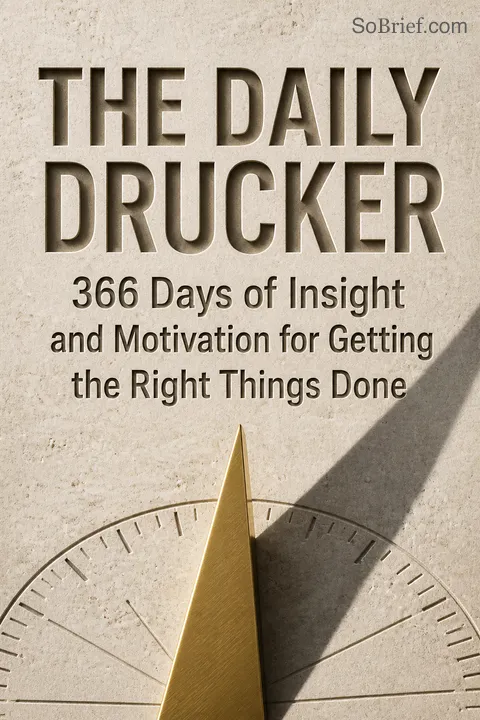


Key Takeaways
Judge management by the results an institution exists to deliver
Results define the mission. Management is a practical discipline for organizing people and resources to achieve an institution's purpose. A business must create customers and economic performance; a hospital must care for patients; a school must enable learning. Success is not measured by how busy the organization looks, but by the contribution it makes beyond itself.
Performance earns authority. Organizations are tools for social tasks, not ends in themselves. Their objectives should be clear enough that people can assess results and understand why the institution deserves trust. Drucker treats management as essential because specialized knowledge and effort produce little until coordinated toward a shared outcome.
The emphasis on external results is a powerful antidote to bureaucratic self-preservation: institutions can mistake activity, procedure, or growth for purpose. It also raises a difficult question: who defines success when outcomes conflict? A hospital may improve throughput while diminishing patient experience. Robust evaluation therefore pairs measurable results with informed judgment from the people an institution serves. Accountability works best when it clarifies purpose rather than reducing it to a single score.
Read reality before forecasting, especially changes already underway
Notice emerging realities. Drucker calls his approach social ecology: studying changes in human institutions and society much as an ecologist studies changes in a natural environment. The task is not to predict every event, but to notice shifts in values, demographics, technology, and behavior that have begun but whose full effects are not yet visible. The postwar US GI Bill, which opened college to returning veterans, helped signal a new role for knowledge in work and society.
Test your assumptions. A theory of the business is the set of beliefs about the environment, the organization's purpose, and the capabilities needed to succeed. These beliefs must fit together and be checked against evidence. A once-successful company can falter when it treats yesterday's assumptions as permanent.
This is a form of strategic foresight grounded in signals rather than prophecy. It resembles scenario planning, which asks organizations to prepare for several plausible futures instead of betting everything on one forecast. The approach is most useful when weak signals are examined across different fields, not just inside an industry. Its limit is interpretive: the same demographic or technological shift can support several competing explanations, so observation needs disciplined testing.
Stop funding yesterday when it starves tomorrow
Make stopping deliberate. Abandonment is the planned decision to end a product, service, process, or activity that no longer justifies the resources it consumes. Drucker suggests asking whether the organization would choose to begin it now, with current knowledge. A fading offering may demand disproportionate attention precisely because it is fading. Its history, sunk costs, or accounting status do not make it valuable.
Free capable people. The case for ending an activity is strongest when it blocks investment in something more promising. Drucker recommends making review routine rather than waiting for a crisis. Organizations that cannot stop doing obsolete work may preserve the familiar while leaving too few skilled people and resources for new opportunities.
The principle counters escalation of commitment, the tendency to invest more in a failing course because so much has already been spent. Regular reviews make exit decisions less personal and less dependent on a leader's appetite for conflict. Yet abandonment should not become a reflexive cost-cutting ritual. Some activities create resilience, trust, or learning that is hard to quantify. A sound review asks what value remains, not merely what can be removed.
Give knowledge workers autonomy, then make results explicit
Define the work first. Knowledge-worker productivity means making specialized knowledge produce useful results. Because knowledge workers control much of their own expertise and methods, managers cannot simply prescribe every step. Workers and managers need to clarify the task, the expected contribution, the quality standard, and the deadline. Autonomy without accountability is drift; accountability without autonomy is micromanagement.
Build learning into work. Drucker highlights continuous learning, innovation, and teaching colleagues as part of knowledge work. A worker should identify what knowledge must stay current and what coworkers need to understand. Management by objectives and self-control supports this approach: people agree on objectives, then use results to guide and assess their own performance rather than relying only on supervision.
This model fits work where expertise is distributed and the person closest to a problem often knows most about how to solve it. It also clarifies that flexibility is not the same as absence of standards. Shared goals and feedback help coordinate independent judgment. The challenge is that many outcomes, especially in research or care, are difficult to attribute to one person. Measures should therefore recognize team contribution and quality, not just count individual output.
Hire for proven strengths, but never compromise on integrity
Match people to assignments. Drucker argues that performance grows from strengths, so hiring and promotion should begin with the work to be done and evidence of what candidates have done well. General George Marshall reportedly selected hundreds of officers for World War II roles by matching demonstrated ability to the assignment, even when candidates had obvious limitations. A weakness matters most when it blocks the strength the job requires.
Treat integrity as a threshold. Character shapes what employees learn from leaders, especially when senior people make decisions about hiring and promotion. Drucker advises using a careful process: define the assignment, compare qualified candidates, examine performance, consult people who have worked with them, and make expectations explicit. If a placement fails, the manager who made it must take responsibility and correct it.
The focus on evidence over intuition aligns with structured hiring, which reduces the influence of charisma, similarity, and snap judgments. Strength-based placement also gives people a fairer chance to excel than treating every weakness as a defect to repair. Integrity is harder to measure than past performance, however. It is best assessed through patterns of conduct and the consequences of choices, not through confidence, polished language, or a leader's personal affinity.
Innovate by testing customer value, not novelty
Search systematically. Systematic innovation is the organized search for useful opportunities, not a wait for inspiration. Drucker identifies seven places to look: unexpected successes and failures, gaps between expectations and reality, needs inside a process, changes in markets or industries, demographic shifts, changing perceptions, and new knowledge. A technology can also come from outside its apparent home: Corning's work with glass helped transform communications through fiber-optic cable.
Test before scaling. An idea is not an innovation until it creates value for customers or users. A small pilot can reveal practical obstacles and unexpected uses before a large commitment is made. New ventures should follow customer response rather than insist that buyers use a product exactly as its designers imagined.
The method combines opportunity recognition with a form of real-options thinking: small experiments buy information while limiting the cost of being wrong. It also broadens innovation beyond laboratory invention to include new services, distribution, and organizational practices. The difficulty is that early customer response can favor familiar improvements over transformative ideas. Pilots need a clear learning question, while decision-makers remain open to evidence that challenges the original concept.
Define the business from the customer's changing idea of value
Start outside the company. A business is defined by the need it satisfies, not by its product label or internal structure. The customer determines what counts as value, and a business may serve several customer groups. A consumer brand, for instance, may need both shoppers to want a product and retailers to stock it. Managers should ask customers directly rather than assume they know what buyers value.
Translate value into design. Activity-based costing is a way of tracing the costs of activities across the work required to deliver a product or service, helping identify which activities create value for customers. Pricing should also begin with what customers are willing to pay, then guide allowable costs. This reverses the habit of calculating costs first and expecting the market to accept the resulting price.
Customer definition is more than a marketing exercise: it determines which competitors matter, what capabilities are needed, and where resources belong. Considering several customer groups also exposes hidden dependencies, such as retailers, distributors, or service partners. But customer preference is not the sole standard of value. Safety, privacy, and long-term reliability may matter even when buyers do not request them explicitly, so listening must be balanced with professional and social responsibility.
Treat profit as fuel, and measure the future it finances
Profit sustains the work. Drucker treats profit as a test of performance, a buffer against risk and obsolescence, and a source of money for future investment. It is not a complete definition of success. A company that maximizes near-term returns by neglecting innovation, productivity, or people may weaken its ability to survive. He recommends setting objectives across areas such as market position, innovation, resources, profitability, employee development, and public responsibility.
Track wealth creation. Economic value added is a measure of whether returns exceed the full cost of capital used. It can reveal whether a business is creating or consuming wealth, though it cannot explain by itself why performance is strong or weak. Results should be considered over both short and long time horizons, with evidence from customers and operations as well as financial statements.
This view resists both extremes: treating profit as morally suspect and treating it as the only outcome that matters. Multi-measure scorecards can make tradeoffs visible, particularly when current earnings compete with investment in future capability. Yet every metric has blind spots. Financial measures are comparable and consequential, while learning, trust, and social costs are harder to capture. Good governance makes those tensions explicit instead of pretending one number settles them.
Turn decisions into accountable action, then inspect the results
Diagnose before choosing. Effective decisions begin by defining the problem and the result required. Drucker distinguishes recurring problems, which need a general rule, from genuinely unusual situations that require a specific response. He recommends establishing the ideal outcome before considering compromises, and inviting disagreement so alternatives and overlooked evidence can surface.
Assign the follow-through. A decision is unfinished until someone is responsible for acting, the people affected know what is required, and a deadline is set. Decision-makers should record what they expect to happen, then compare those expectations with actual results. Drucker notes that military organizations use direct checks because an order issued is not proof that anything changed.
This process resembles the scientific habit of stating a hypothesis before observing results. It limits hindsight bias and makes learning possible even when a decision fails. Organized dissent is equally important because agreement can reflect shared assumptions rather than sound reasoning. Still, not every decision merits elaborate analysis. Reversible choices can be made quickly; decisions with broad, lasting consequences deserve more diagnosis, alternatives, and follow-up.
Manage your time and career as assets you must renew
Begin with actual time. Drucker's practical sequence is to record where time goes, remove activities that produce nothing important, and gather the remaining time into blocks large enough for substantial work. He also advises focusing on contribution: what result can a person deliver that matters to the organization?
Learn how you work. Feedback analysis is the practice of writing down the results expected from important decisions or actions, then comparing them with outcomes months later. It helps identify strengths, habits to improve, and work that is a poor fit. Because knowledge and organizations change, people must keep learning and take responsibility for their next roles. Values matter too: a job that rewards performance at the cost of a person's core commitments is not a durable fit.
The approach treats career development as an ongoing cycle of observation, learning, and adjustment, rather than a ladder supplied by one employer. That is especially useful when roles change faster than formal job descriptions. Recording time also reveals organizational demands, not just personal inefficiency. A caveat: the individual cannot solve every structural problem through self-management. Employers still shape opportunity, security, and access to learning.
Design organizations around the whole, not departmental efficiency
Coordinate specialized work. An organization is a system: improving one department does not necessarily improve the whole. A hospital's specialists, for example, need a shared purpose and timely information to coordinate care. Drucker's federal decentralization gives operating units meaningful autonomy and responsibility while central leaders retain decisions about overall direction, capital, and key people. The units are accountable for their contribution to shared results.
Make structure fit the task. The British civil administration in India illustrates how a flat organization could operate through detailed monthly reports linking expectations, results, and next steps. Structure should clarify who decides, who is responsible, and how work connects. Different organizations require different designs; no single chart is right for every mission.
Systems thinking cautions against optimizing local targets at the expense of the institution's purpose. Decentralization can improve speed and use local expertise, while common objectives and information prevent units from becoming isolated fiefdoms. The design challenge is to decide which decisions belong near the work and which affect the whole. Autonomy without reliable coordination can fragment performance; central control without local discretion can suppress knowledge and initiative.
Make institutional authority answer to contribution and competence
Responsibility has boundaries. Organizations affect workers, customers, communities, and the environment, so they cannot treat economic output as their only concern. But good intentions do not excuse taking on work an organization cannot perform or allowing social projects to undermine its core mission. Authority and responsibility should match: leaders should be accountable for the decisions they are competent and empowered to make.
Measure social work too. Nonprofits need clear missions, capable management, and evidence of results, particularly because they lack the market's profit test. Drucker cites a Salvation Army program for people facing their first prison term in Florida that reportedly rehabilitated about 80 percent through a strict work program. The example illustrates his point that public benefit requires organization and performance, not benevolent intentions alone.
This argument offers a useful middle ground between unchecked corporate power and the assumption that every social need belongs to government. Specialized institutions can contribute in different ways, but their legitimacy depends on public accountability and demonstrable competence. The reported rehabilitation result is an illustration, not enough by itself to establish effectiveness across settings. Social outcomes need transparent definitions, comparison, and attention to who bears costs as well as who benefits.
Analysis
The Daily Drucker is an anthology of 366 short readings, drawn from a career spanning management, economics, social theory, and personal effectiveness. Its calendar format encourages daily use, but makes the work harder to summarize than a conventional argument: ideas recur in different contexts, examples are compressed, and some predictions belong to the period in which they were written. The most coherent thread is a practical ethic of responsibility. Organizations exist to perform a social task; managers must align people, resources, and decisions with that task; individuals must know their strengths and manage their own contribution.
Drucker's most distinctive move is to connect managerial technique with institutional legitimacy. Clear objectives, capable people, continuous innovation, and disciplined abandonment are not merely efficiency measures. They help institutions justify the authority they exercise in a society where work, education, health, and public services increasingly depend on organizations. This gives otherwise familiar advice a political dimension: an institution that cannot perform invites either public distrust or tighter control.
The book is strongest when it turns abstractions into questions that force decisions: What result is this activity for? Would it be chosen again? What does the customer value? Who owns the action, and when will its outcome be checked? These questions travel well across businesses, nonprofits, and government. The repeated emphasis on autonomy is also balanced by accountability, a pairing that avoids equating freedom with managerial absence.
Some claims deserve contextual care. Market profitability supplies an unusually sharp feedback mechanism for business, but social institutions often pursue outcomes that are plural, delayed, or difficult to quantify. Drucker's own insistence on distinct measures for different institutions points toward a solution, though designing credible measures remains difficult. His social and economic forecasts are best read as historically situated prompts for inquiry, not current data. The enduring value lies less in accepting every forecast than in adopting his habit of testing assumptions against results, revising purpose when reality changes, and treating management as a human responsibility rather than a collection of techniques.
Review Summary
The Daily Drucker receives an overall positive rating of 4.1/5, praised for its accessible, bite-sized daily format that distills Drucker's management wisdom into digestible readings with reflective action points. Readers appreciate its insights on leadership, knowledge workers, and organizational management. Common criticisms include some content feeling dated, repetitiveness, and the format occasionally lacking the depth and context found in Drucker's full-length works. Most recommend it as an ideal introduction to Drucker, particularly for managers and entrepreneurs, though seasoned Drucker readers may find it redundant.
Glossary
social ecology
Study of social changeDrucker's term for examining the human-made environment of institutions, communities, and society. Like natural ecology, it attends to relationships and changes across a whole system. The practitioner looks for shifts in social structure, values, technology, and behavior, then asks what those changes mean and what opportunities or risks they create.
theory of the business
Assumptions behind an organizationThe connected assumptions an organization makes about its environment, its mission, and the capabilities it needs to succeed. These assumptions explain what the organization believes customers or society value and how it expects to contribute. Drucker treats the theory as a testable hypothesis, not a permanent doctrine, because conditions can change.
Abandonment
Deliberate ending of obsolete workA management practice of systematically ending products, services, processes, or activities that no longer justify the resources they use. It asks whether the organization would choose to begin the work now and whether preserving it blocks more valuable opportunities. Abandonment releases people, time, and capital for work with greater potential.
knowledge-worker productivity
Useful results from knowledge workThe effective application of specialized knowledge to produce organizational results. It requires clarity about the task and its quality, autonomy for the worker, personal accountability, continuous learning and innovation, and treatment of the worker as an asset. Output volume alone is insufficient because the quality and usefulness of knowledge work matter.
feedback analysis
Compare expectations with outcomesA learning practice in which a person records the results expected from important decisions or actions, then compares those expectations with actual outcomes months later. Repeated comparisons reveal strengths, areas for improvement, and tasks that may be a poor fit. Drucker applies the method to both personal development and decision-making.
systematic innovation
Organized search for opportunityA disciplined practice of looking for opportunities to create new value rather than waiting for inspiration. Drucker identifies seven sources: unexpected events, incongruities, process needs, industry or market changes, demographic shifts, changes in perception, and new knowledge. The method emphasizes observation, analysis, and testing ideas in practice.
federal decentralization
Autonomous accountable business unitsAn organizational design in which distinct operating units have substantial responsibility for their own results, while central management retains authority over the organization's overall direction, capital, and key people. The units are autonomous but remain accountable to shared goals and common measures. Drucker presents the model as a way to develop managers and keep large organizations manageable.
activity-based costing
Trace costs across activitiesA method of examining the activities and related costs required to deliver a product or service to a customer. Instead of focusing mainly on production costs, it follows the broader value-creating process, helping an organization identify costs that add customer value and those that may be redesigned or removed.
economic value added
Returns beyond capital costA measure of whether an organization earns more than the full cost of the capital it uses. Positive returns above that cost indicate wealth creation; returns below it indicate that resources are being consumed without adequate compensation. The measure can flag performance problems, but cannot explain their causes by itself.
Management by Objectives and Self-Control
Objectives guide self-assessmentA management approach in which people work toward clearly defined objectives and use results to assess and direct their own performance. Its purpose is to align individual effort with organizational contribution without relying solely on supervision. Objectives provide direction and accountability, but should be revised when circumstances invalidate their assumptions.
About the Author
Other books by Peter F. Drucker





Download PDF
Download EPUB
.epub digital book format is ideal for reading ebooks on phones, tablets, and e-readers.








