

Key Takeaways
Treat grammar as a living agreement, not a museum of prohibitions
English keeps moving. Grammar is a shared system for arranging words so people understand one another, not a permanent list of sacred rules. English has absorbed words from many languages, and its usage changes as speakers adopt new conventions. The book points to singular they: once rejected by some authorities, it is now accepted for an unknown person, as in referring to what somebody forgot to bring. The grammar foundation changes more slowly than vocabulary and usage, but neither is frozen.
Rules earn their keep. A useful rule prevents confusion. A rule that makes ordinary speech awkward without improving meaning deserves scrutiny. Dictionaries record how words are used, including slang and nonstandard forms, so a dictionary entry alone does not certify a word as appropriate in formal writing. Check the label and context, not just the spelling.
The book’s strongest premise is that usage is a practical agreement among speakers, not a natural law. That view helps explain why a language can preserve stable structures while changing particular forms. It also guards against the false choice between total permissiveness and rigid correction. Still, conventions matter because readers make judgments from them, sometimes unfairly. The useful question is not simply whether a form is technically allowed, but whether it fits the audience, purpose, and level of formality.
Choose the form that makes your meaning clear, not the one that sounds grand
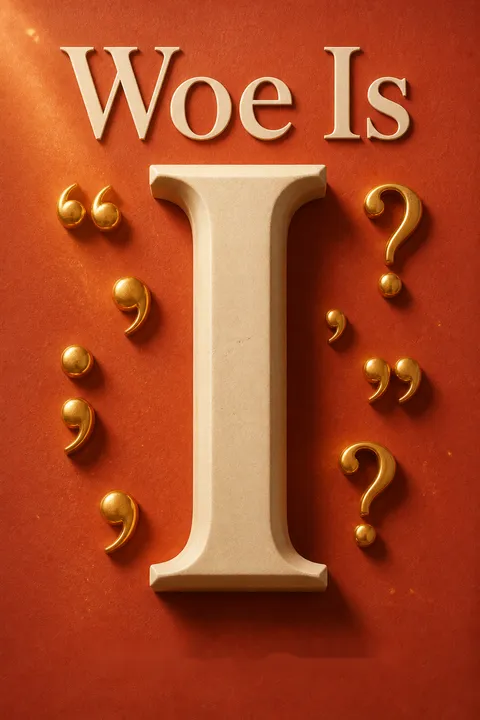
Correctness can overshoot. O’Conner uses the title’s grammar puzzle to challenge the belief that the most formal-sounding choice is always best. A speaker saying “Woe is me” is not making a mistake merely because a schoolroom rule might favor “I.” Likewise, “It’s me” and “It is I” are both grammatical, though the second sounds stiff in ordinary conversation. The goal is useful English, not a performance of grammatical status.
Watch for overcorrection. People sometimes replace a correct object pronoun with “I” because they have learned to think it sounds more proper. That creates errors such as using “you and I” after a preposition. Remove the other person mentally: if “against me” works, then “against you and me” works too. In simple comparisons, both “than me” and “than I” can be acceptable.
This is a useful distinction between competence and ceremony. Hyperformal choices can signal education in certain settings, but they can also make a sentence sound less natural without making it clearer. The book’s advice is especially valuable when speakers confuse prestige with correctness. At the same time, context still shapes how a phrase lands: the relaxed form that works in conversation may not suit a legal document or an edited report. Good judgment includes both grammar and audience awareness.
Use quick substitutions to solve pronoun and apostrophe traps
Test the word, not your nerves. Many small-word mistakes become manageable when a sentence is checked with a simple substitution. If “it is” fits, write “it’s”; if not, use “its” for possession. Apply the same test to “who’s” and “whose,” or “you’re” and “your.” These pairs sound alike, but their jobs differ. A quick expansion often exposes the right choice more reliably than trying to remember a rule about apostrophes.
Find the pronoun’s job. In formal writing, “who” is the subject doing something, while “whom” is the object receiving the action. Substitute “he” or “him” to check: “he” points to who, “him” to whom. For possessives, singular nouns usually take apostrophe-s, while plural nouns already ending in s take an apostrophe alone. Pronouns such as its and hers do not use apostrophes for possession.
A substitution test turns abstract grammar into a small diagnostic procedure. That is cognitively efficient: instead of holding a label such as subject or possessive in memory, the writer checks whether the sentence survives a concrete replacement. It also exposes a broader lesson in editing: reliable tests are often better than intuition when familiar words sound alike. The limitation is that tests work only when the writer understands the intended meaning. A technically correct substitution cannot repair an unclear sentence.
Locate the real subject before deciding what its verb should be
Ignore the distractions. A subject and its verb must agree, but extra phrases can hide the subject. In a sentence such as “The parade, with its floats and marching bands, begins at noon,” the subject is “parade,” not the nearby plural nouns. Mentally remove inserted descriptions, and the sentence’s basic frame becomes easier to see. With subjects joined by “or” or “nor,” the verb generally agrees with the nearer subject.
Let meaning guide number. Words such as “all,” “none,” “couple,” “majority,” and “number” can refer either to a whole group or to its members. “The couple” typically treats the pair as a unit; “a couple of guests” refers to individuals. “None” is plural when it means not any of several things, and singular when it means no amount. The same attention to meaning helps with tense, such as using “had called” rather than “would have called” after “I wish.”
The advice to strip a sentence to its grammatical core resembles debugging: isolate the moving parts before diagnosing the fault. It is especially helpful because proximity can mislead readers into matching a verb with the nearest noun rather than the actual subject. The book also resists mechanical singularity where meaning is collective or indefinite. That flexibility improves naturalness, though long sentences may still need rewriting rather than grammatical detective work. Simpler structure can remove the trap entirely.
Make punctuation show readers how your ideas fit together
Punctuation carries meaning. A comma can change who appears responsible for an action, or whether someone stopped speaking or quit a job. It is not decoration. Use commas to separate items in a series and to join clauses connected by words such as “and” or “but.” The final comma in a series can prevent confusion, especially when the last items might be mistaken for an explanatory phrase.
Choose the right pause. A semicolon can join two complete, closely related clauses when there is no connecting word, or separate list items that already contain commas. A colon introduces a list, explanation, or quotation after a complete lead-in. Question marks and exclamation points belong where the question or exclamation actually ends. The book’s central image is practical: punctuation works like road signs, telling readers when to pause, proceed, or expect a turn.
Punctuation is a visual model of sentence structure. Readers use it to infer which information belongs together, much as listeners use pauses and emphasis in speech. That is why comma decisions can affect interpretation rather than merely polish. The road-sign analogy captures this functional role without turning every mark into a rigid stop. Yet punctuation conventions vary somewhat by style and publication. For writers, consistency and intelligibility matter more than treating every comma choice as a moral test.
Attach every opening phrase to the person or thing doing it
Find the dangling subject. A dangler is a word or phrase positioned so that it seems to describe the wrong thing. “Walking through the park, the fountain came into view” accidentally makes the fountain the walker. The fix is to name the walker immediately after the opening phrase, or rewrite the sentence so the relationship is unmistakable: “Walking through the park, I saw the fountain.”
Check the sentence’s hitch. Opening phrases beginning with an ing word, an infinitive such as “to prepare,” or a preposition such as “at the age of ten” deserve extra attention. Ask who is performing the action or experiencing the condition, then place that person or thing close to the phrase. Some familiar introductory expressions apply to the whole statement and do not need a literal actor, but less familiar modifiers should be attached carefully.
The dangling modifier is funny because grammar briefly assigns agency to the wrong object, but it can also undermine trust in serious prose. The diagnostic question, who is doing this, is a compact way to catch a mismatch before it reaches the reader. The principle extends beyond grammar: information should be placed where its relationship is easiest to infer. Not every opening phrase needs repair, however. Conventional expressions can modify a whole statement without producing genuine confusion.
Pick words for their exact meaning, and check what software misses
A dictionary needs judgment. Words can have several meanings, and some familiar distinctions have shifted. “Enervating” means draining, not energizing; “bemused” traditionally means puzzled, not simply amused; “unique” once meant one of a kind, though broader uses are now common. If a disputed word could be read in conflicting ways, choose a clearer alternative. A dictionary can show current meanings and register, but its entries include slang and nonstandard usage too.
Spell-check is not an editor. Software may catch a misspelled word but accept the wrong sound-alike, such as “desert” where “dessert” is intended. It cannot reliably recognize that a person, rather than a dog, is meant to be described as guilty. Consult a reputable dictionary for uncertain spellings, and read the whole sentence yourself. Knowing pronunciation and usage before a high-stakes moment also prevents avoidable embarrassment.
The distinction between a tool’s capability and a writer’s responsibility is increasingly important in automated writing environments. Spell-check can detect forms, but meaning depends on context, reference, and intent. The book’s examples show why a green check mark is not evidence that a sentence communicates correctly. Its caution also has a humane side: language changes, and older definitions do not always control present use. When usage is contested, clarity can be more useful than winning the argument.
Put the reader first: write directly, then revise for clarity
Make the path easy. Clear writing is not the same as simple thinking. A complicated idea can be expressed plainly if its parts are organized. Start with the point instead of a throat-clearing introduction, prefer a direct verb to an abstract noun, and keep the subject near its verb. Put descriptions beside what they describe, and replace pronoun clusters with names when readers could lose track of who did what.
Revise for the reader. Remove padding and redundancies, but do not cut words merely to make every sentence short. Repeating the right noun is better than reaching for an inaccurate synonym. Check the order of ideas, clarify time and place, and read the message again before sending it. These habits apply to email as much as formal prose: a specific subject line, a clear point, and a final reread prevent speed from becoming confusion.
The section frames revision as an act of cooperation. The reader should not have to reconstruct the sentence’s cast, timeline, or central claim. This aligns with a basic principle of information design: reduce needless effort so attention can go to the idea itself. The advice is not a demand for uniformly short or plain sentences. Rhythm and complexity can be valuable when they serve meaning. The real test is whether the reader can follow the thought without rereading for avoidable reasons.
Keep vivid language fresh, and let one metaphor lead at a time
Use familiar phrases deliberately. A cliché is a once-vivid expression worn smooth by repetition. The book does not call for eliminating every familiar phrase. A conventional expression can be efficient and apt, but a tired one may make prose feel automatic. Be especially careful when writing about grief or death, where stock euphemisms can sound evasive when direct language would be more sincere.
Keep images compatible. A mixed metaphor combines images that compete rather than reinforce one another. A sentence that puts a “silver lining” at the “end of a tunnel” asks the reader to picture incompatible scenes at once. Two images can coexist if they belong to the same scene, but piling them on usually muddies the point. If a familiar phrase is worth using, use it accurately instead of dressing it up with a strained variation.
Metaphors help readers understand an idea through a concrete scene, so repetition does not automatically make them useless. A familiar phrase can function like a well-known sign: quick to recognize, if not especially memorable. The sharper question is whether it adds precision or merely occupies space. The warning about euphemisms also shows that style carries ethical weight. In moments requiring candor, polished avoidance can feel less compassionate than plain speech.
Verify the facts, figures, and implied relationships before publishing
Check what can be checked. Names, dates, places, events, and statistics are easy to repeat incorrectly. The book recounts a young writer confusing abolitionist John Brown with entertainer James Brown, a mistake that a fact check could have caught. If a number seems startling, calculate it rather than trusting the wording. A decrease from fifty to ten is an 80 percent drop, not a 500 percent drop; the denominator matters.
Make comparisons precise. Distinguish a percentage from a percentage point, and state what is being compared. A change from 50 percent to 60 percent is an increase of 10 percentage points, or 20 percent relative to the original figure. Also distinguish mean, the arithmetic average, from median, the middle value in an ordered set. Correct grammar cannot rescue incorrect facts or misleading arithmetic.
The final quality check moves beyond sentence mechanics to the truth conditions of the message. Grammar can make a false claim elegant, but it cannot make the claim sound. The examples also expose how numerical wording can mislead without containing an arithmetic error: the choice of baseline changes the apparent size of a shift. Readers benefit when writers name the comparison and show the relevant denominator. This is especially important in public communication, where concise claims can travel farther than their qualifications.
Analysis
Woe Is I is a practical usage guide, but its deeper subject is how people negotiate authority through language. Its central distinction is between grammar as a system that helps people understand one another and grammar as a collection of inherited status signals. That distinction gives the book coherence across topics as varied as pronouns, commas, spelling, clichés, and email. The memorable tests work because they replace vague anxiety with small acts of reasoning: expand a contraction, identify the true subject, or ask which noun a modifier describes.
The book’s conversational humor is not merely decorative. It lowers the emotional cost of learning rules that many readers associate with correction or embarrassment. Its examples make grammatical errors visible as problems of meaning, not proof of personal failure. That approach anticipates a useful editorial principle: people revise more effectively when feedback identifies a repairable feature instead of labeling the writer incompetent.
There is also a productive tension. O’Conner rejects outdated prohibitions and insists that usage evolves, yet she still advises readers to avoid some accepted forms in formal settings. This is not necessarily a contradiction. Standard English functions as a shared convention in institutions, and knowing its expectations can give writers access. But those expectations are social, not neutral. A reader should therefore distinguish a genuine clarity problem from a preference maintained by a particular audience or publication.
The book is strongest when it teaches transferable diagnostics rather than isolated corrections. Its writing advice, especially keeping subjects near verbs and modifiers near their targets, applies beyond grammar to interface design, instructions, and public information. Its limitation is scope: a compact guide to standard usage cannot fully represent regional, multilingual, or community varieties of English. Still, as a handbook for readers who need to move between informal speech and edited prose, it offers a humane and memorable method: understand the rule’s purpose, test the sentence’s meaning, and choose the form that serves the reader.
Review Summary
Woe Is I receives mixed reviews. Some praise its witty, accessible approach to grammar, finding it helpful for both novices and experienced writers. Others criticize its outdated rules, arbitrary judgments, and condescending tone. Many appreciate the humor and clear explanations, especially for common grammatical errors. However, some find it lacks depth and comprehensive coverage. The book is generally recommended for those seeking a light, entertaining grammar guide, but more serious writers may prefer other resources. Overall, it's seen as a useful reference, albeit with limitations.
People Also Read

Glossary
Dangler
Misattached sentence modifierA word or phrase placed so that it appears to describe the wrong person or thing. An opening phrase such as “Walking along the trail” should be followed by the person walking. If it is followed by a noun that cannot perform the action, the modifier dangles and the sentence may become confusing or unintentionally comic.
Hypercorrectness
Overcorrection toward formalityThe tendency to use a form believed to be more proper even when it is grammatically wrong or unnatural. O’Conner illustrates it with people choosing “I” in a phrase such as “between you and I,” because they mistakenly treat “I” as more genteel than “me.” The cure is to identify the word’s actual role in the sentence.
Sentence adverbs
Adverbs expressing a speaker’s stanceAdverbs such as “fortunately,” “frankly,” and “hopefully” can comment on an entire statement rather than describe the action of a verb. In “Hopefully, the trip will go well,” the word conveys the speaker’s hope. This use differs from an adverb describing how someone performs an action, as in speaking hopefully.
Flat adverbs
Adverbs without an ly endingAdverbs that have the same form as their related adjectives. English has long accepted forms such as “go slow,” “work hard,” and “arrive late.” The absence of an ly ending does not make these forms incorrect. In many cases both forms exist, as with “slow” and “slowly,” and the choice depends on customary usage and sentence style.
Slender Yellow Fruit Syndrome
Forced synonym variationA humorous label for replacing a clear, repeated noun with an awkward or inaccurate synonym in an effort to avoid repetition. For example, after mentioning an apple and a banana, a writer might call the banana “the slender yellow fruit.” The label cautions writers to prefer the right word again over a strained substitute.
Subjunctive mood
Verb form for wishes or demandsA verb form used in certain expressions of wishes, conditions contrary to fact, and demands or suggestions. Examples include “I wish I were there,” “If she were older,” and “They requested that he be quiet.” The form signals that the statement is imagined, desired, or required rather than presented as an ordinary fact.
Download PDF
Download EPUB
.epub digital book format is ideal for reading ebooks on phones, tablets, and e-readers.








