

Key Takeaways
Edit until the prose sounds more like its author, not like a rulebook
Copyediting is attentive collaboration. Dreyer describes the copy editor’s job as improving clarity and flow without replacing a writer’s voice with the editor’s preferences. That means catching mechanical errors, but also noticing when a sentence drags, a paragraph loses its force, or a joke has been flattened by an overzealous correction.
The author keeps the final say. When novelist Richard Russo asked to retain a construction his copy editor considered incorrect, Dreyer agreed, even though he still disliked it. Editing Shirley Jackson’s unpublished work, he set strict limits on how much he would change, then left an awkward paragraph untouched after realizing its rhythm was intentional. The editor’s task is not to make every text sound the same. It is to help each piece become a clearer version of itself.
What's striking is that this approach treats editing as interpretation, not repair. It resembles good coaching: the coach notices what the performer is trying to do, then removes obstacles without taking over the performance. That distinction matters because consistency can improve readability while also sanding away a writer's characteristic timing or strangeness. The practical test is not simply whether a change is defensible by a rule, but whether it serves the work's purpose. That requires humility, and it also leaves room for disagreement between editor and writer.
Delete weak intensifiers before they start doing the sentence's work
Make every word earn its place. Dreyer challenges writers to draft without habitual softeners and intensifiers such as “really,” “quite,” “very,” and “just,” then remove them during revision. The point is not that these words are forbidden. It is that they often announce emphasis without supplying it. If a claim needs force, choose a more exact verb or detail rather than adding verbal padding.
Trim duplication, too. Copy editors remove repeated information and phrases whose meaning already contains the extra word. A machine at a cash point does not need an added “machine” after its abbreviation, and plans are about the future by definition. Such redundancy may seem harmless, but accumulated clutter slows a reader and weakens emphasis. Deleting it is not merely shortening. It is a way to make the remaining words carry more weight.
This is a useful application of information theory: repeated signals can reduce the contrast that makes important information noticeable. Removing verbal padding gives a sentence a cleaner signal, much as removing noise makes a recording easier to hear. Still, a word that looks expendable in isolation can perform a social function, such as softening a disagreement or conveying hesitation. The strongest revision therefore asks what the word contributes in context, not whether it appears on a blacklist. Precision is the aim, not austerity for its own sake.
Treat rules as tools for clarity, not badges of grammatical virtue
English resists total regulation. Dreyer separates useful conventions from inherited prohibitions that needlessly constrain writers. He rejects blanket bans on starting sentences with “and” or “but,” splitting an infinitive, ending with a preposition, using contractions, or writing a fragment. These choices can be clumsy, but none is automatically wrong. The question is whether the sentence communicates effectively and sounds suited to its context.
Some conventions still earn their keep. Subject and verb agreement, parallel structure, and punctuation can prevent genuine confusion. Dreyer groups the reasons for observing such standards as convention, consensus, clarity, and comprehension. He also recommends reading prose aloud: if a sentence is difficult to say or follow, it may need restructuring. Learn a rule before breaking it, but do not mistake obedience for good writing.
The distinction between a convention and a superstition is valuable because language advice often presents social preferences as natural laws. A rule can be useful even when its history is shaky, especially if readers expect it in a particular setting. Conversely, enforcing a rule without regard to audience can make prose less clear. This view aligns with audience design: speakers and writers adjust their choices to the people they hope to reach. The risk is that “sounds right” can reflect habit as much as clarity, so reading aloud should inform judgment, not replace it.
Punctuate for the reader's route through meaning, not decoration
Punctuation guides interpretation. A comma, colon, semicolon, or parenthesis does more than mark a pause. Each helps readers understand how ideas relate and where emphasis belongs. Dreyer strongly favors the series comma because it makes lists easier to parse, while warning that punctuation cannot rescue a sentence whose structure is ambiguous. If a list could suggest an unintended relationship between its members, rewrite it instead of piling on commas.
Small marks can change the facts. A comma can distinguish an additional description from information needed to identify a person or object. In a sentence about someone’s child, for instance, punctuation can signal whether the child’s name is essential to identifying which child is meant. Read the sentence for its intended meaning, not just its grammatical pattern. Punctuation should keep readers from having to backtrack.
Punctuation functions like a lightweight interface: it lets readers predict how a sentence is organized before they reach its end. The best marks reduce cognitive load by making relationships visible, especially in lists and interruptions. Yet no punctuation convention is universally shared across English varieties. Dreyer's preferred American practices are useful for readers working in that setting, but global audiences may bring different expectations. The deeper principle travels better than any single house style: identify the likely misreading, then choose the simplest form that prevents it.
Fix sentence architecture before polishing individual words
Make the parts fit. Parallelism means expressing ideas with matching grammatical forms when they play matching roles. A person might plan to “cook, clean, and raise children,” rather than mixing two verbs with a noun phrase. Readers may understand the uneven version, but the mismatch makes the sentence harder to process. The same attention to structure helps with paired constructions such as “either this or that.”
Give modifiers a clear owner. A dangler is an introductory phrase that appears to describe the wrong subject. In “Walking through the station, the train seemed enormous,” the train is grammatically doing the walking. Name the person walking or recast the sentence. Also watch pronouns: repeating a character’s name can be clearer than asking readers to guess which “she” or “they” is meant. Reading aloud exposes many such snags.
These examples show why grammar is not just ceremonial correctness. Parallel forms and well-attached modifiers help readers build a stable mental picture while moving through a sentence. Psycholinguistic research broadly supports the idea that readers use syntax to anticipate meaning, so structural confusion imposes real processing costs. But not every asymmetry is a flaw: deliberate variation can create emphasis, and a fragment can set a scene with force. The editor's judgment depends on distinguishing purposeful disruption from an accidental stumble.
In fiction, verify reality and continuity as carefully as prose
Stories need internal logic. Fiction gives writers freedom to invent, not freedom from consistency. A character’s age should match the dates, a journey should fit the available time, and a person should not leave a glass in one room and drink from it elsewhere without explanation. Dreyer describes copy editors checking chronology, appearance, movement through rooms, and the details of real places and historical periods.
Specificity creates risk. A novel that names a film, street, technology, or postal format invites readers to notice if it did not exist when the story takes place. One author changed a historically accurate business name after readers repeatedly questioned it. That choice shows the tradeoff: factual accuracy matters, but an unnecessary detail can cause a distracting reader hiccup. When a detail adds little, less precision may make the story more convincing.
Continuity checking is a form of quality control for a fictional world. Readers may forgive an invented premise, but contradictions inside that premise weaken the trust that lets them suspend disbelief. This resembles simulation design: the creator establishes constraints, and every later event must remain compatible with them. There is also a useful warning here about false precision. More detail does not automatically create realism; it creates more opportunities for error. Writers can strengthen credibility by researching consequential details and omitting decorative facts they cannot support.
Let usage evolve, but choose words with readers' reactions in mind
Language changes through use. Dreyer accepts that words and spellings shift as speakers adopt them, and dictionaries record those changes rather than issuing commands from above. A word may gain a new meaning, lose an old one, or shed a hyphen as common usage changes. The book’s treatment of disputed usages is deliberately mixed: some changes are harmless, while others blur useful distinctions or distract readers who are likely to object.
Audience matters more than victory. Dreyer often recommends avoiding a contested expression when a simple alternative will keep attention on the writer’s point. He also recognizes that some supposed errors are merely peeves, including restrictions against “different than” or the singular use of “data.” The goal is not to appease every self-appointed language judge. It is to spend the reader’s attention on the subject, not an avoidable argument about wording.
This is a practical compromise between descriptivism, which studies how people use language, and prescriptivism, which recommends choices for particular contexts. Dictionaries provide evidence about usage, but evidence alone does not settle questions of tone, audience, or institutional expectations. A term can be accepted in everyday speech yet feel distracting in a formal document. Dreyer's strongest advice is strategic rather than purist: understand the convention, then decide whether breaking it advances the message enough to justify the attention it attracts.
When a word can be wrong but spelled correctly, check the dictionary
Spellcheck catches only some mistakes. A computer may accept a correctly spelled word that is wrong for the sentence. Writers can confuse words that sound alike or differ by a letter, such as a term for quoting a source and a term for a location. They may also type a real word where another is intended. These errors survive automated checks because the software sees a valid spelling, not the intended meaning.
Use reference tools without shame. Dreyer says professional editors consult dictionaries and stylebooks, including for words they have checked before. That habit is especially useful for irregular spellings, unfamiliar terms, and fine distinctions such as “imply” versus “infer.” The practical lesson is simple: do not rely on memory when a quick lookup can resolve uncertainty. A dictionary is not a remedial device; it is part of careful writing.
The distinction between spelling and word choice anticipates a broader limitation of automated writing tools: a system can detect patterns without knowing what a writer intended to say. The same principle applies to grammar checkers and predictive text. They can flag candidates for review, but human judgment remains necessary when context determines meaning. Consulting a reference also interrupts overconfidence, a common source of preventable errors. The only caution is that dictionaries document competing usage rather than always providing one uncontested answer.
Check names, dates, and counts; small factual slips break trust
Verify what looks familiar. Dreyer’s list of easily misspelled names grew from real editorial near misses. Familiar people, places, titles, and brands can be surprisingly easy to misrender, and capital letters are a reminder to check rather than guess. The same discipline applies to dates and historical details. A scene set on a particular weekday should match the calendar; a character should not use a technology before it existed.
Audit the numbers you promise. If a chapter advertises a dozen points, count them. Dreyer admits that a chapter title in this very book promised more punctuation entries than the chapter actually contained. That small discrepancy illustrates the broader point: proofreading includes checking claims about the text itself. Search, count, and verify names against reliable references before the final draft goes out.
Factual checking protects more than accuracy. It signals respect for the reader and preserves the credibility earned by the surrounding prose. Names and dates are especially potent because they are easy to verify and often matter to people personally connected to them. Dreyer's own counting mistake adds a useful note of realism: expertise reduces error but cannot eliminate it. A robust process therefore relies on repeatable checks, not confidence alone, and prioritizes facts whose mistakes would most damage the work.
Analysis
Dreyer's book is a practical guide to editing, but its deeper subject is judgment. Its form reflects that argument: rather than imposing one comprehensive grammar system, it moves among rules, exceptions, preferences, anecdotes, and reference lists. This makes it unusually readable for a style manual, though it can also make the guidance feel inconsistent. Dreyer favors stable conventions when they help readers, yet openly admits that some recommendations are matters of taste and that writers may reasonably reject them.
The most durable idea is the distinction between correctness and improvement. A grammatical correction can make a sentence technically defensible while weakening its voice; a deliberate fragment can be more effective than a complete sentence. Dreyer's accounts of editing Shirley Jackson and negotiating with Richard Russo put this tension into practice. They also show that an editor's expertise does not grant ownership of the text. The writer's intention remains central, but intention must be inferred through close attention rather than assumed.
The book's practical advice is strongest when it explains consequences. Misplaced modifiers produce accidental meanings. Repeated fillers dilute emphasis. A missed comma can alter which person or object a sentence identifies. Such guidance gives writers a reason to revise beyond the vague command to follow rules. The recurring invitation to read aloud is especially useful because it joins syntax, rhythm, and comprehension in one test. Dreyer's preferences are also shaped by American book publishing. His insistence on certain punctuation and his impatience with some usages should not be mistaken for universal English law. The book is most helpful when read as an experienced editor's map of decisions: learn conventions, notice their purpose, consult references, and consider who will read the result. Its wit makes that process memorable, while its candor reminds readers that a style guide can advise, but cannot replace an ear for the sentence in front of them.
Review Summary
Dreyer's English receives mostly positive reviews for its witty, entertaining approach to grammar and style. Readers praise Dreyer's humor, clear explanations, and practical advice. Many find it both informative and enjoyable to read, unlike typical dry style guides. Some criticize the organization and repetition, while a few dislike the political commentary. Overall, reviewers recommend it for writers, editors, and language enthusiasts, though some suggest it's not for complete beginners. The book's unique blend of humor and expertise makes it stand out among grammar guides.
People Also Read

Glossary
Four C's
Reasons to follow conventionsDreyer's shorthand for four reasons to observe established writing conventions: convention, consensus, clarity, and comprehension. The first two describe shared expectations, while the last two describe the practical aim of helping readers understand. The phrase is a reminder that rules are useful when they support communication, rather than ends in themselves.
Wan Intensifiers and Throat Clearers
Words that weaken sentencesDreyer's label for habitual modifiers and verbal fillers that often add little force or meaning, including terms such as “very,” “really,” “quite,” and “just.” He recommends drafting without them for a period, then deleting them during revision unless a particular instance has a clear purpose. The exercise trains writers to make emphasis more precise.
the “only” comma
Comma marking nonessential identificationDreyer's informal name for commas that surround information about a noun when the noun is already uniquely identified. If the information is needed to specify which person or thing is meant, the commas are omitted. The distinction can change a sentence's meaning, such as whether a named child is the only child or one among several.
dangler
A modifier with the wrong subjectDreyer's informal term for a modifier that appears grammatically attached to the wrong part of a sentence, often because an opening phrase does not match the subject that follows. A sentence about “driving through fog” followed by a subject such as “old memories” accidentally makes the memories seem to be driving. Recast the sentence so the modifier's subject is explicit.
peeververein
A community of language peeversA term Dreyer credits to his colleague John E. McIntyre for a group of self-appointed language authorities who loudly object to supposed errors, often when the usage is acceptable or the distinction is trivial. The word captures the social performance of language policing, while the book distinguishes such peeves from editorial choices that genuinely improve clarity.
FAQ
What's Dreyer's English about?
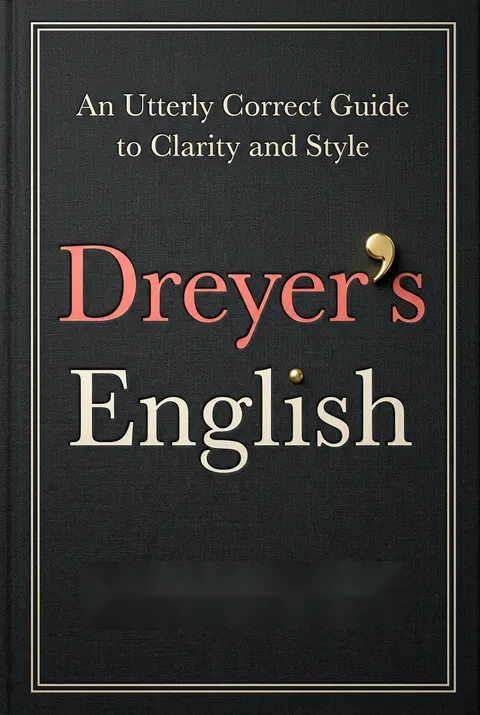
- Focus on Clarity and Style: Dreyer's English is a guide to writing with clarity and style, emphasizing the importance of precise language. Benjamin Dreyer, a seasoned copy editor, shares insights from his extensive experience in the publishing industry.
- Practical Advice: The book offers practical tips and rules for grammar, punctuation, and style, making it accessible for writers at all levels. Dreyer aims to help readers improve their writing without overwhelming them with jargon.
- Engaging Narrative: Beyond just rules, Dreyer includes anecdotes and humor, making the reading experience enjoyable. His conversational tone invites readers to engage with the material more personally.
Why should I read Dreyer's English?
- Improve Writing Skills: This book is ideal for anyone looking to enhance their writing skills, whether for professional or personal purposes. Dreyer provides actionable advice that can lead to immediate improvements in clarity and style.
- Learn from an Expert: As a copy editor for Random House, Dreyer has worked with numerous authors and has a wealth of knowledge to share. His insights are grounded in real-world experience, making them credible and relevant.
- Fun and Informative: The book is not only educational but also entertaining, filled with witty observations and engaging stories. This combination makes it a pleasure to read while learning valuable lessons.
What are the key takeaways of Dreyer's English?
- Clarity is Key: One of the main messages is that clarity should be the primary goal of writing. Dreyer emphasizes that "a good sentence...is one that the reader can follow from beginning to end."
- Punctuation Matters: Dreyer discusses the importance of punctuation in conveying meaning and rhythm in writing. He states, "If words are the flesh, muscle, and bone of prose, punctuation is the breath."
- Rules and Nonrules: The book distinguishes between essential rules of grammar and style and those that are more flexible. Dreyer encourages writers to understand the rules but also to know when to break them for effect.
What are some common grammar mistakes discussed in Dreyer's English?
- Misuse of "Who" and "Whom": Dreyer clarifies the difference between "who" (subject) and "whom" (object), advising readers to think of "who" as the cousin of "I" and "he."
- Dangling Modifiers: The book highlights the issue of dangling modifiers, which can confuse readers. Dreyer explains that "a sentence’s introductory bit and its main bit need to fuse correctly."
- Parallelism: Dreyer stresses the importance of parallel structure in writing, particularly in constructions like "not only x but y."
What punctuation rules does Dreyer's English emphasize?
- Series Comma: Dreyer advocates for the use of the series comma (also known as the Oxford comma) to avoid ambiguity. He states, "Only godless savages eschew the series comma."
- Avoiding Comma Splices: The book advises against using commas to join two independent clauses without a conjunction. Dreyer explains that "a comma splice is the use of a comma to join two sentences when each can stand on its own."
- Proper Use of Dashes: Dreyer discusses the correct use of em dashes and en dashes, explaining their distinct purposes in writing.
What stylistic tips does Dreyer's English offer?
- Be Concise: Dreyer encourages writers to eliminate unnecessary words and phrases to enhance clarity. He suggests avoiding "very," "really," and similar qualifiers.
- Use Active Voice: The book promotes the use of active voice over passive voice for stronger writing. Dreyer explains that "a sentence written in the passive voice is one whose subject would, in a sentence constructed in the active voice, be its object."
- Read Aloud: Dreyer recommends reading writing aloud to catch awkward phrasing and improve flow.
What are some common spelling errors mentioned in Dreyer's English?
- Confusing "Accessible" and "Accommodate": Dreyer points out that words with double letters can be tricky, such as "accommodate" and "acknowledgment."
- "Aficionados" Spelling: The book emphasizes the correct spelling of "aficionados," which is often misspelled.
- "Ad Nauseam": Dreyer clarifies that this phrase is often incorrectly spelled as "ad nauseum."
What are the best quotes from Dreyer's English and what do they mean?
- "A good sentence...is one that the reader can follow from beginning to end.": This quote encapsulates Dreyer's emphasis on clarity in writing. It serves as a reminder that the primary goal of writing is effective communication.
- "Only godless savages eschew the series comma.": This humorous quote highlights Dreyer's strong advocacy for the series comma. It underscores the importance of clarity and precision in writing.
- "If words are the flesh, muscle, and bone of prose, punctuation is the breath.": This metaphor illustrates the vital role punctuation plays in writing.
How does Dreyer's English address the evolution of language?
- Language is Fluid: Dreyer acknowledges that language evolves over time and that writers should be aware of contemporary usage.
- Embrace Change: The book encourages writers to adapt to changes in language and usage while maintaining clarity.
- Respect Tradition: While advocating for modern usage, Dreyer also respects traditional grammar and style rules.
What unique insights does Dreyer's English offer about copyediting?
- Copyediting as a Craft: Dreyer describes copyediting as a nuanced craft that goes beyond mere correction.
- Listening to the Author: He emphasizes the importance of understanding the author's voice and intentions.
- Attention to Detail: The book highlights the meticulous nature of copyediting, where small details can significantly impact the final product.
What specific methods does Dreyer's English recommend for improving writing?
- Look Up Unfamiliar Words: Dreyer advises writers to look up words they are unsure about, rather than guessing.
- Read Aloud: He suggests reading your writing aloud to catch errors and awkward phrasing.
- Embrace Revision: Dreyer emphasizes the importance of revising and editing one's work.
How can I apply the lessons from Dreyer's English to my writing?
- Practice Regularly: Apply the lessons by practicing writing regularly and consciously implementing the tips provided in the book.
- Seek Feedback: Share your writing with others and seek constructive feedback.
- Revise and Edit: Make revision and editing a regular part of your writing process.
Download PDF
Download EPUB
.epub digital book format is ideal for reading ebooks on phones, tablets, and e-readers.








