

Key Takeaways
A lucrative exit can still leave the founder asking what success means.
Money solved the wrong problem. Hsieh's first major company, LinkExchange, sold to Microsoft for $265 million in 1998. The deal looked like the finish line, but staying on at Microsoft for the required year felt less like victory than waiting out a clock. A cruise with friends brought the same question into focus: once he had the home theater, computer, and trips he wanted, what was the money for?
Work had to feel worth doing. Looking back, Hsieh found that his happiest memories were about making things, sharing time with friends, and having vivid experiences, not accumulating wealth. He left Microsoft, giving up more money, because he wanted to build something again. The book's larger claim begins there: a business can make money and still miss the point if its work gives people no reason to care.
What's compelling is the distinction between a financial milestone and a satisfying life. Research on hedonic adaptation supports the caution: people often adjust to new possessions and status faster than they expect. Yet passion alone is not a reliable compass; enjoyable work can be poorly paid, unstable, or exploitative. Hsieh's lesson is strongest when read as a demand to examine what money enables, not as a claim that money is unimportant. Security can support meaningful choice, but more wealth does not automatically supply meaning.
Treat early wins as evidence to investigate, not proof you have mastered the game.
Small ventures taught real lessons. As a child, Hsieh tried several businesses. A mail-order button offer, placed in a book for kids seeking free items, grew to about $200 a month and taught him that customers could be reached without face-to-face selling. He even passed the work to his brothers. But a later magic-trick ad cost $800 and produced just one order. The button business had not made him invincible; its audience, offer, and economics were different.
Failure needs diagnosis. Hsieh learned to distinguish repeatable demand from a lucky break, and attractive revenue from actual profit. His button operation worked because the cost per order was low and the offer reached people looking for unusual products. The expensive ad failed despite his confidence in the trick. Each attempt became useful when he asked what the result revealed, rather than turning success or failure into a verdict on his talent.
This is an early version of experimental thinking: test an offer, observe response, and update the next decision. The distinction resembles modern venture methods that separate a hypothesis from its validation. A few sales cannot establish durable demand, and a failed test can reflect weak distribution rather than a bad product. Hsieh's story usefully highlights the need to track unit economics and channel fit. It also cautions against treating persistence as a virtue by itself; stopping a costly experiment can be the most rational learning outcome.
Choose a market worth winning before optimizing how you compete.
Poker begins before the first hand. Hsieh studied limit hold'em and learned that a sound decision can lose an individual hand while still paying off across many plays. More important, he found that selecting the table mattered more than perfecting every move. Business has the same constraint: excellent execution cannot rescue a market too small to support the company, or a contest where a stronger rival controls the rules.
The shoe market looked bigger than it seemed. Hsieh initially doubted that people would buy shoes online. Founder Nick Swinmurn pointed out that US footwear was a $40 billion industry and that mail-order catalogs already accounted for about $2 billion. That evidence made online sales plausible, though not guaranteed. Zappos then had to persuade brands to try direct shipping, a new arrangement for the footwear business. Market size opened the door; the team still had to build a workable business.
The table metaphor connects strategy to industrial organization: a firm's prospects depend partly on market structure, not merely managerial skill. Choosing a large arena can create room to grow, while differentiation can avoid a direct price war with entrenched competitors. But market size is not proof of accessible profit. Customer acquisition costs, supplier power, returns, and working capital can make a huge category unattractive. The stronger decision rule is to ask both whether the market is large and whether this particular team can reach customers in a distinctive, sustainable way.
Growth without culture-fit hiring can make success feel like the wrong workplace.
Rapid hiring changed LinkExchange. In its early days, the company grew through friends who shared the excitement of building something new. After an initial team of about twenty-five, hiring accelerated. Many newcomers were capable, but some primarily wanted a résumé boost or a lucrative exit. As the company passed one hundred employees, Hsieh felt its atmosphere shift toward politics and self-interest. He could not point to one disastrous hire; the damage came from many small mismatches.
A successful company can become a place its founder avoids. Hsieh recognized his dread of going to work from his earlier Oracle job. At LinkExchange, revenue and scale had not protected the experience of working there. The episode shaped his later insistence that a company's culture cannot be treated as decoration. Hiring decisions help create the daily norms that employees experience, and those norms affect whether growth feels energizing or corrosive.
The story makes culture concrete by showing it as the accumulated result of selection and everyday behavior, rather than a slogan. This aligns with organizational research on person-organization fit: shared expectations can improve coordination and commitment. Fit, however, can become a euphemism for hiring people who resemble current insiders. Healthy culture needs room for disagreement, varied backgrounds, and correction from below. The relevant test is not whether new hires are socially similar, but whether they can contribute while respecting the behaviors the organization genuinely needs.
When survival demands it, rebuild the business model and own the bottleneck.
Zappos changed its economics under pressure. The company first relied heavily on brands shipping shoes directly to customers. That avoided inventory costs, but product feeds were often inaccurate and orders could arrive slowly. Hsieh and merchandising leader Fred Mossler decided to stock inventory themselves, despite the cash required. Gross merchandise sales rose from $1.6 million in 2000 to $8.6 million in 2001, then $32 million in 2002.
Control mattered as much as growth. A third-party warehouse, eLogistics, failed to process and ship shoes reliably. Zappos built its own Kentucky operation, called WHISKY, short for WareHouse Inventory System in KentuckY. The team moved inventory there and took direct responsibility for accuracy and speed. The broader lesson was not to own everything, but to identify which operation most directly shaped the customer promise and could not safely be left to a weak partner.
The pivot illustrates how a business model is a set of linked choices, not a sacred identity. Inventory increased financial risk, but it also improved product availability and control over fulfillment. This resembles the resource-based view of strategy, where advantage can come from capabilities competitors cannot easily reproduce. The boundary is important: owning a function is not inherently superior to outsourcing it. A firm should internalize an operation when it is strategically central and external providers cannot meet the required standard, while rigorously measuring the added cost and risk.
Turn service into the experience customers remember, not a cost center.
Zappos made service part of the product. The company offered free shipping both ways and a 365-day return window, reducing the risk of buying shoes without trying them on. Its phone number appeared prominently across the website, and representatives were available around the clock. Rather than push callers to end conversations quickly or upsell them, employees were trusted to solve the customer's problem, even when that meant directing someone to a competitor with the right shoe in stock.
A good interaction could market the brand. Zappos sometimes upgraded shipments without charging extra and ran its warehouse around the clock to get orders moving sooner. The company treated the cost as an investment in trust and word of mouth. Its Customer Loyalty Team, or CLT, was the customer-service group expected to deliver that experience. Representatives were also encouraged to create a Personal Emotional Connection, or PEC, through genuine, individual conversation.
This approach treats service as relationship infrastructure. In services marketing, trust and reduced perceived risk can be especially valuable when customers cannot inspect a product before purchase. A conversation that resolves a problem may build loyalty even without an immediate sale. The model is not free of tradeoffs: generous shipping and long returns can be costly, and unstructured calls can produce uneven experiences. Its logic depends on selecting the right customers, tracking repeat behavior, and ensuring that the emotional promise is supported by reliable operations rather than improvisation alone.
Make stated values strong enough to cost you a hire.
Values only guide behavior when they have consequences. Zappos gathered employee views of its culture in an annual Culture Book, leaving contributions largely unedited so positive and critical opinions could both be seen. The company later defined ten core values, including service, learning, openness, teamwork, and humility. These were meant to guide decisions, not decorate a wall. Managers were expected to consider them when hiring and evaluating employees.
The practices made the promise visible. Candidates faced separate interviews for job skill and culture fit. New hires went through four weeks of training, including two weeks answering customer calls. During that period, they could accept $2,000 to leave; fewer than one percent did. An anonymous monthly Ask Anything newsletter let employees raise questions openly. These mechanisms made culture something employees could experience, question, and reinforce.
The strongest feature is institutional consistency: hiring, training, communication, and performance expectations all point toward the same stated priorities. That is more credible than a values poster because people see what the organization rewards and tolerates. Yet a culture-fit screen can suppress dissent if leaders confuse disagreement with disloyalty. Unedited feedback and open questions help counter that danger, but only if criticism changes decisions. Values become useful when they constrain leaders too, especially when doing so is inconvenient or expensive.
Grow future leaders from entry level instead of importing every skill.
Zappos built a people pipeline. The company saw a weakness in relying on individual employees as its main assets: people leave, and fast growth can make existing roles outgrow someone's current skills. Its alternative was a Pipeline, a structured path for developing people at different levels so that successors are being prepared before a position opens.
Training linked advancement to learning. In merchandising, Zappos hired entry-level assistants and used a three-year development program to train and certify them for greater responsibility, including buyer roles. Passion for a product category mattered at entry; the company aimed to provide more of the technical knowledge in-house. Courses across the business covered subjects such as communication, finance, coaching, and leadership. The broader ambition was to make growth inside the company a real possibility, rather than assuming every senior hire had to arrive fully formed.
A talent pipeline turns development into operating infrastructure, much like succession planning in public institutions or skill ladders in technical organizations. It can preserve institutional knowledge and make promotion criteria more transparent. It also requires patience, capable mentors, and honest assessment; internal promotion is not automatically better than external recruitment. The approach works best when organizations develop people while remaining open to outside expertise that challenges established habits. Training should expand opportunity, not become a promise of promotion regardless of performance.
Choose investors who want the same destination, not merely the same return.
Different goals can turn capital into conflict. Zappos's leaders wanted to keep building the brand and culture, while some board members increasingly favored a financial exit. Hsieh recognized that agreement on growth numbers was not enough; the parties also needed compatible time horizons and beliefs about what the company was for. He advised founders to examine investor involvement, exit expectations, decision rights, and whether investors supported the company's mission.
Amazon offered a different kind of deal. Zappos and Amazon shared a focus on customers, though one emphasized high-touch service and the other technology, selection, and convenience. Rather than treating the transaction as a simple cash sale, Zappos pushed for an all-stock exchange and continued to operate as a distinct subsidiary. The acquisition, valued at over $1.2 billion when it closed, was presented as a way to gain resources while preserving the Zappos brand and culture.
This is a governance lesson as much as a fundraising lesson. Investors influence an organization through board seats, voting rights, and the timelines attached to capital. Shared enthusiasm during a pitch is not enough; expectations must be tested against actual control structures and difficult scenarios. Still, alignment cannot guarantee that a partnership will preserve independence in practice. Leaders need measurable commitments, communication channels, and a clear understanding of what happens when priorities diverge. The Amazon arrangement was promising because the parties had a plausible shared interest, not because trust removed all risk.
Build happiness from agency, progress, connection, and purpose, not trophies.
Happiness became an operating idea. Hsieh describes four contributors: a sense of control, visible progress, close relationships, and meaningful participation in something larger than oneself. Zappos applied these ideas by letting service representatives choose training skills that could raise their pay, and by replacing a single large promotion with smaller steps that made progress easier to see.
Different rewards last for different lengths of time. The book distinguishes pleasure, which depends on short-lived stimulation; passion, the absorbed state often called flow; and higher purpose, the feeling of contributing to something meaningful. Hsieh's first rave offered an unexpected experience of shared energy, while his later community-building efforts showed that social connection needs more than parties: people also need a shared direction. The company's stated mission expanded from selling shoes toward delivering happiness to customers, employees, and vendors.
The framework combines individual psychology with organizational design. Autonomy, competence, and relatedness are also central needs in self-determination theory, a major account of human motivation. Making progress visible can help sustain effort, while shared purpose can connect routine tasks to a larger story. Still, happiness is not a single measurable output, and employees may value different things or reject a company's mission. The framework is most useful as a set of design questions, not as a universal formula for making every person happy.
Analysis
Delivering Happiness is a business memoir that turns a founder's uneven path into an argument about organizational design. Its narrative matters: the worm farm, profitable button business, failed magic-trick ad, LinkExchange sale, poker tables, shoe inventory crisis, and Zappos acquisition are not ornamental anecdotes. Each marks a change in how Hsieh interprets risk, work, or success. The book's central proposition is that profit, passion, and purpose can reinforce one another when customer experience and employee culture are built into how the company operates.
The most persuasive evidence is operational rather than inspirational. Zappos accepted inventory risk to improve availability, built its own warehouse after a logistics provider failed, and invested in customer support rather than treating every service interaction as a cost to minimize. Its culture was made legible through hiring practices, training, employee feedback, and development paths. These choices show how an abstract brand promise can be translated into routines and resource allocation. The account also recognizes that strategy includes governance: founders need investors whose expectations match the company's intended horizon.
The case has limits. Zappos's results cannot establish that this culture model caused its growth, because the company also benefited from a growing e-commerce market, strong timing, committed founders, and access to capital. The narrative is told by a successful CEO, so survivorship bias is unavoidable; a similar bet-the-company decision could have ended differently. Nor will an unusually high-touch service model fit every product, labor market, or customer base. The book's useful contribution is less a universal recipe than a discipline of alignment: make the customer promise, internal culture, operating capabilities, and capital structure support one another. Its happiness framework adds a valuable test: does the business create agency, progress, connection, and meaning for the people doing and receiving the work? Claims about happiness should still be treated as hypotheses to assess with employee and customer evidence, not as proof that one purpose can satisfy everyone.
Review Summary
Delivering Happiness receives mostly positive reviews, with readers praising Hsieh's candid storytelling and insights into building a successful company culture. Many find the book inspiring and appreciate its focus on creating happiness for employees, customers, and vendors. Some criticize the writing style or find certain sections less relevant. Readers appreciate the personal anecdotes and business lessons, though a few feel the book becomes less engaging towards the end. Overall, it's considered a valuable read for entrepreneurs and those interested in company culture.
People Also Read










Glossary
Brand, Culture, Pipeline (BCP)
Three connected advantagesZappos's name for three capabilities it believed could sustain long-term advantage: a recognizable brand built through customer experience, a culture that guides employee behavior, and a pipeline that develops talent from entry level into more senior roles. The idea is that products and processes can be copied more easily than a coordinated identity, shared ways of working, and trained people.
Culture Book
Collected employee perspectivesAn annually produced collection of employee reflections on what Zappos's culture meant to them. Contributions were published largely as written, with corrections mainly for typos, so readers could see a range of views rather than only a polished company statement. The book served as an orientation tool and a way to notice where employees' experiences matched or diverged from the company's intended culture.
Customer Loyalty Team (CLT)
Zappos customer service groupThe name Zappos used for its customer service team. The label reflected a broader approach: representatives were not simply expected to process calls quickly, but to build customer trust through helpful, personal interactions. Zappos trained employees across departments in customer service and gave representatives discretion to resolve problems without relying on scripts or aggressive sales targets.
WHISKY
Kentucky warehouse systemAn internal acronym for WareHouse Inventory System in KentuckY, the operation Zappos created after an outside fulfillment provider failed to handle its inventory and orders reliably. Zappos ran the warehouse itself and developed systems for receiving, tracking, and shipping shoes. The experience reinforced the company's view that fulfillment was central to its customer promise and should not be left to an unreliable provider.
Personal Emotional Connection (PEC)
Individual customer bondZappos's term for the personal rapport a customer service representative could create with a customer. The goal was not simply to complete a transaction, but to make the interaction feel attentive and human. Representatives were encouraged to use their judgment and personality, rather than follow scripts, so conversations could respond to the actual person and situation.
Pleasure, Passion, and Higher Purpose
Three forms of happinessA framework Hsieh uses to distinguish short-lived enjoyment from more sustained forms of happiness. Pleasure comes from immediate stimulation and fades when the stimulus ends. Passion describes absorbed engagement, often called flow, when attention and challenge align. Higher purpose comes from contributing to something meaningful beyond oneself. Hsieh argues that a life or business can pursue all three, while giving purpose priority.
FAQ
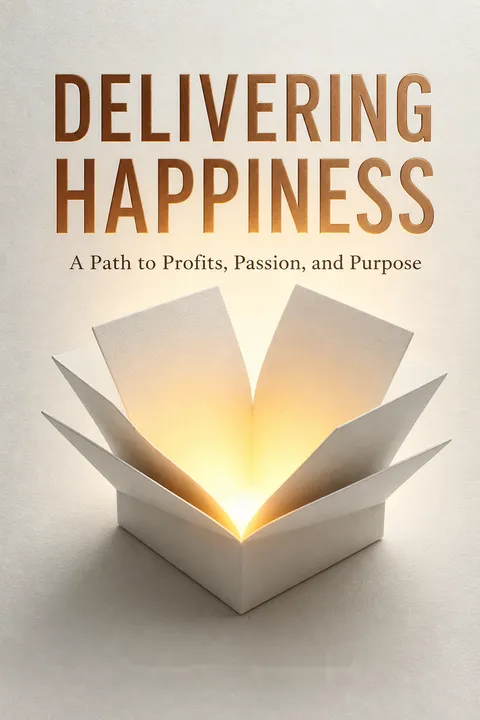
What's Delivering Happiness: A Path to Profits, Passion, and Purpose about?
- Tony Hsieh's Journey: The book details Tony Hsieh's path from childhood entrepreneurship to leading Zappos, a billion-dollar online shoe retailer.
- Happiness in Business: It emphasizes the role of happiness for customers, employees, and stakeholders, suggesting that a happy workplace enhances performance and success.
- Three Pillars: The narrative is structured around profits, passion, and purpose, arguing that businesses can achieve financial success while fostering a culture of happiness.
Why should I read Delivering Happiness?
- Inspiring Leadership: Tony Hsieh's insights into leadership and company culture offer valuable lessons for business leaders.
- Real-Life Examples: The book is rich with anecdotes from Hsieh's life and Zappos' journey, providing relatable and engaging content.
- Practical Advice: Hsieh provides actionable advice on creating a positive work environment and building a successful business.
What are the key takeaways of Delivering Happiness?
- Happiness Drives Success: Focusing on the happiness of employees and customers leads to greater business success.
- Embrace Change: The book encourages adaptability and openness to change, crucial for navigating entrepreneurship.
- Build a Strong Culture: Establishing a strong company culture based on core values is essential for attracting and retaining talent.
What are the best quotes from Delivering Happiness and what do they mean?
- “There’s a difference between knowing the path and walking the path.”: Emphasizes the importance of action over mere knowledge.
- “A great company is more likely to die of indigestion from too much opportunity than starvation from too little.”: Warns against overextending a business.
- “You can’t stop the waves, but you can learn to surf.”: Encourages resilience and adaptability in the face of challenges.
How does Tony Hsieh define happiness in Delivering Happiness?
- Happiness as a Strategy: Happiness is a key component of a successful business strategy, enhancing productivity and engagement.
- Core Values: Aligning personal and company values fosters happiness and a supportive work environment.
- Customer Experience: Prioritizing customer satisfaction builds loyalty and drives sales.
What challenges did Tony Hsieh face while building Zappos?
- Financial Struggles: Hsieh faced financial challenges, especially during economic downturns, requiring tough decisions.
- Cultural Shifts: Maintaining the original company culture became difficult as Zappos grew.
- Operational Issues: Hsieh had to adapt the business model to address logistics and inventory management challenges.
What is the significance of the Zappos culture in Delivering Happiness?
- Core Values: Zappos' culture is built around ten core values guiding employee behavior and decision-making.
- Employee Empowerment: Empowering employees to make decisions leads to greater job satisfaction and commitment.
- Customer-Centric Approach: Exceptional customer service is integral to Zappos' success, with employees encouraged to ensure customer happiness.
How does Tony Hsieh suggest businesses can create a culture of happiness?
- Define Core Values: Clearly define and communicate core values that reflect in every aspect of the company.
- Encourage Open Communication: Foster an environment where employees feel comfortable sharing ideas and feedback.
- Invest in Employee Development: Provide opportunities for personal and professional growth to enhance job satisfaction.
How does Delivering Happiness address the concept of failure?
- Learning from Mistakes: Failure is an essential part of the entrepreneurial journey, offering opportunities for learning and growth.
- Resilience: Encourages resilience in the face of setbacks, with perseverance leading to eventual success.
- Redefining Success: Challenges traditional notions of success, focusing on happiness and fulfillment over financial gain.
What role does storytelling play in Delivering Happiness?
- Building Connections: Storytelling connects with readers and illustrates key concepts through personal anecdotes.
- Cultural Reinforcement: Stories about Zappos' journey reinforce the company's culture and values.
- Inspiring Action: Hsieh's stories inspire readers to take action in their own lives and businesses.
How does Zappos approach customer service according to Delivering Happiness?
- Customer-Centric Philosophy: Zappos prioritizes customer service as a core aspect of its business model.
- Empowerment of Employees: Customer service representatives are empowered to enhance the customer experience without strict scripts.
- Surprise and Delight: The company often goes above and beyond, such as offering surprise upgrades, to create memorable experiences.
What is the significance of the Zappos Culture Book mentioned in Delivering Happiness?
- Employee Contributions: The Culture Book compiles employee reflections on Zappos culture, showcasing diverse perspectives.
- Transparency and Growth: It serves as a tool for transparency, allowing employees to express thoughts and contribute to culture.
- Recruitment Tool: The Culture Book attracts potential employees by providing insight into the company’s values and environment.

Download PDF
Download EPUB
.epub digital book format is ideal for reading ebooks on phones, tablets, and e-readers.








