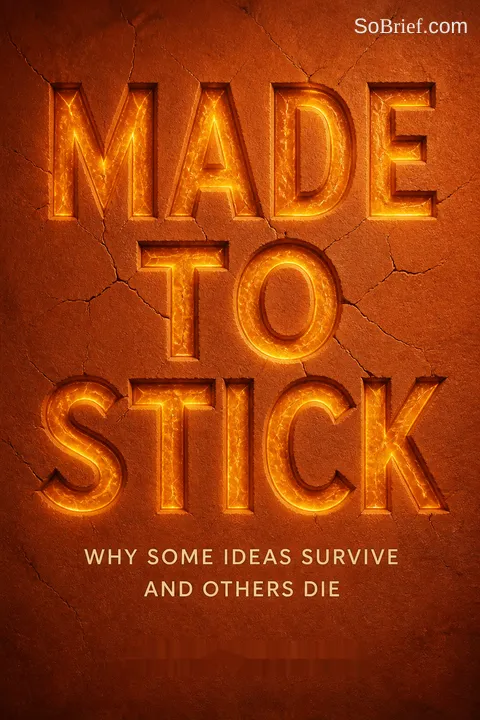


Key Takeaways
Design the idea itself, not merely the performance that carries it.

Stickiness is designed. The book asks why a lurid kidney-theft legend travels easily while useful workplace messages vanish. Its answer: an idea sticks when people understand it, remember it, and can use it to change what they think or do. A public-health campaign made the risk of movie popcorn vivid by comparing one serving with a whole day of fatty meals. The story spread widely, and major theater chains changed the oil they used.
Six useful tests. The authors group their advice under SUCCESs, a mnemonic for six qualities: a clear core, surprise, concrete details, credibility, emotion, and story. These are not a guaranteed recipe. They are prompts for revising ideas that currently sound abstract, predictable, or forgettable.
The popcorn example makes an important distinction between a message that is merely accurate and one that gives accuracy a usable shape. Communication research often separates exposure from comprehension and behavior; a memorable comparison can help bridge those stages. Yet vividness can also mislead. Comparisons need to be fair, and a striking image should clarify the evidence rather than overwhelm it. The book's standard is strongest when stickiness serves a worthwhile, truthful claim, not when it simply wins attention.
Assume your audience hears taps, not the tune in your head.

Knowledge creates blind spots. The Curse of Knowledge is the difficulty experts face imagining what a novice does not know. In Stanford researcher Elizabeth Newton's tapping experiment, people tapping familiar songs expected listeners to identify them about half the time. Listeners guessed correctly only three times in 120 attempts. The tapper heard the melody internally; the listener heard isolated knocks.
Translate, do not repeat. Leaders, teachers, and specialists make the same mistake when they use language that carries a whole history of meaning for them but little meaning for others. The cure is to reshape the message with familiar references, concrete examples, and audience feedback. More repetition rarely fixes a message whose meaning never arrived in the first place.
This is an unusually practical account of expertise as both an asset and a communication hazard. Cognitive science describes related gaps between expert and novice mental models: experts organize knowledge into connected structures, while beginners encounter separate pieces. That difference helps explain why jargon feels efficient to insiders and opaque to everyone else. The answer is not to strip away every technical distinction. It is to test whether newcomers can reconstruct the intended meaning, then add detail in layers.
Choose one governing idea people can use when plans break.

A core guides choices. The Army's Commander’s Intent is a concise statement of an operation's desired end state, not a step-by-step script. When events disrupt the plan, people can still improvise toward the goal. Southwest Airlines used a similar principle: its defining priority was low fares. When an employee proposed adding a meal to a flight, the question was whether it supported that priority. If not, the meal was out.
Short is not enough. A useful core is both central and compact. A slogan can be brief but empty; a decision rule helps people choose among competing good options. Newspaper publisher Hoover Adams used a community-first rule to steer coverage toward local people and events. One clear priority can coordinate many decisions without requiring a manager to approve each one.
The strongest version of simplicity here is not simplification for its own sake, but a boundary that enables local judgment. This resembles a principle in resilient organizations: specify the objective, then let people closest to changing conditions adapt the means. The risk is that a single priority can become a blunt instrument. Low fares, for example, cannot answer every question about safety or service. A core works best when it is genuinely central and its limits are understood.
Break expectations with insight, then keep curiosity open.
Surprise earns attention. A flight attendant got passengers to listen to routine safety instructions by disrupting the familiar announcement with humor. But surprise alone is a stunt unless it helps the audience understand the point. The book recommends challenging an assumption connected to the message, then making the new explanation satisfying.
Curiosity sustains attention. The Gap Theory of Curiosity describes interest as a felt difference between what someone knows and what they want to know. An astronomer drew readers into a long explanation by asking what Saturn's rings were made of and why scientists disagreed. Sony's ambition to make a radio small enough to carry in a pocket also opened a productive question for engineers: how could a seemingly impossible product be built?
Surprise works like a signal that a prediction has failed, while an open question gives attention somewhere to go. That combination helps explain why a mystery can hold interest longer than a startling fact. It also clarifies the boundary between curiosity and clickbait: a gap should be real, relevant, and eventually closed. Surprise that has no connection to the central claim may be memorable while leaving the audience no wiser.
Translate abstractions into objects, actions, and sensory scenes.
Concrete details create common ground. A schema is a stored pattern of knowledge that helps people interpret something new. Calling a pomelo a very large grapefruit uses an existing schema to make an unfamiliar fruit easier to picture. The Nature Conservancy faced a similar challenge when protecting large areas it could not simply purchase. Naming a distinctive region the Mount Hamilton Wilderness turned a colored map area into a place people could discuss and support.
Give ideas something to cling to. The Velcro Theory of Memory is the authors' analogy for how sensory and associative cues help ideas stick. A packet of salt and sugar made a child-dehydration treatment easier for officials to grasp than a technical explanation alone. Concrete examples also help experts and nonexperts coordinate because they can point to the same thing.
Concrete examples reduce the inferential work required of an audience, a benefit closely related to cognitive load: working memory is limited, so familiar images can make room for new reasoning. But an analogy is a bridge, not the destination. The book notes that even a useful model of atoms can misrepresent how electrons behave. Good communicators make the first explanation accessible while remaining ready to clarify where the image stops being accurate.
Make claims verifiable, vivid, and proportionate to the evidence.
Credibility has several sources. Researchers Barry Marshall and Robin Warren argued that bacteria caused ulcers, but established medical opinion dismissed them. Marshall eventually swallowed the bacteria himself, then developed symptoms and treated himself with antibiotics. Their discovery was later accepted and won them the 2005 Nobel Prize. The episode shows how hard evidence can struggle when it conflicts with intuition or status.
Let the audience check. Testable credentials are features that let people verify a claim for themselves. Wendy's burger campaign invited customers to compare the amount of meat in its burgers with competitors' offerings. Statistics can also help, but numbers need a human-scale comparison: an anti-nuclear group used BBs dropped into a bucket to make the scale of the world's arsenal audible. A vivid detail should support the claim, not distract from it.
The chapter treats credibility as something that can be built into the message, not merely borrowed from prestigious speakers. That is valuable in settings where audiences distrust institutions. A self-check can make persuasion less dependent on authority, but it is not automatically sound: people may observe a real detail and draw an unsupported conclusion. Evidence needs both inspectability and interpretation. The most trustworthy message makes the test clear and does not claim more than the test establishes.
Make people care through one person or identity they can inhabit.
People respond to people. In a charity experiment, participants gave an average of $2.38 after reading about one hungry child, compared with $1.14 after reading statistics about suffering across a region. Those given both kinds of information gave less than the single-child group. The statistics appeared to shift attention from feeling to calculation.
Identity can motivate action. Texas reduced roadside litter with a campaign built around the idea that littering violated the identity of a proud Texan. The campaign reported a 29 percent decline in litter within a year. Other appeals reach beyond money or safety: Floyd Lee, who managed a dining hall for soldiers in Iraq, framed his work as improving morale, not merely serving meals. The authors advise finding what an audience values, including belonging, mastery, and purpose.
The identifiable person can make distant suffering emotionally legible, while identity can turn a desired behavior into evidence of who someone is. These mechanisms connect persuasion to social identity and moral psychology, not just individual incentives. There is a real ethical tension: a single beneficiary can attract attention while making a large structural problem seem smaller than it is. Pairing a human story with honest context can preserve empathy without disguising scale.
Use stories to rehearse action, not decorate a presentation.
Stories simulate decisions. A nurse recognized that a newborn's heart had stopped despite a normal monitor reading, trusted her judgment, and helped save the child. Retelling the incident teaches medical staff to question what a machine measures. The audience mentally rehearses the situation, rather than merely receiving a rule.
Stories also energize. The authors identify three recurring inspirational plots: a person overcomes a challenge, people bridge a social divide, or someone finds a creative solution. Subway's campaign about Jared, a college student who lost substantial weight while eating its sandwiches and walking, became more compelling than a numerical low-fat slogan. A springboard story is a short account that helps listeners imagine how an existing problem could change. The first step is often spotting such stories in ordinary work.
Narrative simulation gives people context for recognizing a problem and choosing a response, which helps explain why a story can outperform an abstract instruction. The emotional identification it creates can also energize action. Still, an inspiring anecdote is not proof that a method will work for everyone. Jared's experience makes a campaign memorable, but it should not be mistaken for general medical guidance. Stories are strongest when their lesson is useful and their limits remain visible.
Turn strategy into shared language employees can use to decide.
Strategy must guide behavior. Cranium, the board-game company, gave employees and partners a compact internal standard for evaluating whether products felt right for its brand. A manufacturer used that standard to challenge a proposed game piece that seemed poorly made and awkward to handle. At Costco, repeated stories about improving salmon while lowering its price taught buyers what the company valued: better customer value, not just a polished strategy document.
Shared language enables disagreement. When employees can explain strategy in concrete terms, they can use it to make decisions and question proposals. The authors call this a defense against decision paralysis, the tendency to freeze when faced with too many options or uncertain trade-offs. A strategy that exists only in an executive presentation cannot do this work.
A common vocabulary acts like coordination infrastructure: it lets people in different roles debate trade-offs without first negotiating what the goal means. The Costco example makes a priority observable through repeated decisions, rather than leaving it as corporate aspiration. Such language can also become a constraint if it turns into ritual or suppresses new evidence. Leaders need to invite challenge and revisit the rule when markets, obligations, or the organization's actual priorities change.
Answer misinformation with a more memorable truth, not denial alone.
Denials rarely compete well. When rumors claimed that McDonald's used worms in its burgers, simply calling the claim false offered little for people to remember. A more memorable response pointed to the relative cost of worms and beef. During World War II, rumor-control efforts sometimes redirected attention toward the people spreading divisive falsehoods, rather than repeating the rumor as the main story.
Demonstrate an alternative. A parody of exaggerated computer-virus warnings helped people recognize the pattern of alarmist hoaxes. Early car makers took a different route: reliability races let the public see vehicles perform, answering fears through visible evidence. The broader lesson is to replace a sticky false account with a credible counterexample, explanation, or demonstration that people can retell.
This advice anticipates a central problem in modern fact-checking: a correction can accidentally rehearse the false claim while giving the audience no replacement account. A strong response explains what happened instead and supplies evidence people can inspect. Demonstrations are especially useful when the dispute concerns performance or safety. But humor and counter-messaging can backfire if they ridicule sincere confusion. The goal is to make accurate understanding easier to recall than the rumor.
Analysis
Made to Stick treats communication as design under unequal knowledge: the speaker has a complex, settled mental model, while the audience has limited attention and different assumptions. Its practical contribution is to shift effort away from delivery polish and toward the architecture of the message. The examples show that attention, comprehension, belief, emotion, and action are related but distinct hurdles. A statistic can be credible yet inert; a story can be unforgettable yet misleading; a slogan can be compact yet useless. The most effective messages align several functions at once, as the popcorn comparison does by making a numerical finding concrete, surprising, and emotionally legible.
The framework is best understood as a diagnostic checklist, not a universal causal law. The six qualities overlap, and their value depends on audience, stakes, and context. Surprise can distract, analogy can distort, and an identifiable person can eclipse structural scale. The book's own examples make the ethical distinction unavoidable: false rumors can be extraordinarily sticky. Memorability is therefore not evidence of truth or virtue. Accuracy, proportionality, and transparent intent must constrain persuasive design.
A further strength is its account of stories as organizational tools. Stories preserve context and tacit judgment that abstract lessons tend to strip away. They help people coordinate because listeners can imagine a specific situation and infer what to do. That mechanism explains why a strategy becomes useful when employees can tell stories about it, challenge it, and apply it locally. The enduring question for any communicator is not simply whether an audience remembers a phrase. It is whether the remembered idea helps people make better decisions when the speaker is absent.
Review Summary
Made to Stick is widely praised for its practical approach to creating memorable ideas. Readers appreciate its concrete examples, simple principles (SUCCESs), and engaging writing style. Many find it useful for improving communication in various fields. The book is lauded for practicing what it preaches, making its own content "sticky." Some criticize it for being repetitive or dated, but most reviewers consider it a valuable resource for anyone looking to make their ideas more impactful and memorable.
People Also Read









Glossary
SUCCESs
Six traits for memorable ideasThe authors' mnemonic for six qualities that can improve an idea's chance of being understood, remembered, believed, and acted on: a clear core, surprise, concrete detail, credibility, emotional relevance, and story. It is presented as a practical checklist rather than a formula that guarantees success.
Curse of Knowledge
Expertise obscures novice perspectiveThe difficulty of imagining what it is like not to know something once that knowledge has become familiar. Experts may assume that listeners understand their jargon or unstated context. The book illustrates the problem with tappers who hear a tune in their heads while listeners hear only disconnected taps.
Commander’s Intent
Concise statement of desired outcomeA brief statement used in military planning to define the goal or desired end state of an operation without prescribing every action. Because real conditions can invalidate detailed plans, it gives people a stable purpose that can guide local decisions and improvisation.
schema
Stored pattern for understandingA mental structure containing familiar features and associations for a concept or category. Schemas help people interpret new information by connecting it to knowledge already stored in memory. Describing an unfamiliar fruit as a larger version of a grapefruit, for example, recruits an existing schema to aid understanding.
Gap Theory of Curiosity
Interest from missing knowledgeThe account of curiosity associated with psychologist George Loewenstein. Curiosity arises when people notice a gap between what they know and what they want to know. A communicator can create interest by revealing a specific unanswered question, then guiding the audience toward information that resolves it.
Velcro Theory of Memory
More associations strengthen recallThe authors' analogy for how memorable ideas connect with many cues in memory. Sensory images, emotions, familiar concepts, and concrete actions provide more associations than an abstract statement alone. Like hooks meeting loops, these connections give an idea more ways to be recalled.
testable credentials
Claims audiences can verifyEvidence or demonstrations that allow an audience to inspect a claim directly, rather than relying entirely on a speaker's authority. A visible product comparison or a participant's own experience can serve this role. The observation still needs sound interpretation, since verifiable details can be used to support invalid conclusions.
Sinatra Test
One example proves capabilityA credibility test based on whether one demanding example is enough to establish competence in a broader domain. A company that has successfully handled a particularly sensitive or complex delivery can use that performance to make a wider claim about reliability. The example should genuinely match the capability being asserted.
springboard story
Story that makes change imaginableA short, concrete account that helps an audience see how a current problem could be transformed. Rather than spelling out every implication, it invites listeners to imagine solutions for their own setting. Stephen Denning used a story about a health worker in Zambia finding malaria information online to help make knowledge-sharing a priority at the World Bank.
Challenge plot
Underdog overcomes obstaclesAn inspirational story pattern in which a protagonist faces substantial barriers and persists toward a meaningful achievement. It can encourage an audience to take on difficult work or continue through setbacks. The obstacle must feel consequential for the protagonist, not merely inconvenient.
Connection plot
People bridge a social divideAn inspirational story pattern about people forming a relationship across a meaningful social, cultural, or personal boundary. Such stories can encourage empathy, cooperation, and tolerance. The book's example of the Good Samaritan emphasizes assistance across a divide between groups that were hostile to one another.
Creativity plot
A novel solution changes the approachAn inspirational story pattern in which someone solves a persistent problem through a fresh method or insight. It can prompt an audience to experiment rather than follow familiar routines. In the book's example, an industrial design team tested a proposed material by dragging samples behind a car, reaching a decision far faster than a lengthy formal process.
FAQ
What's Made to Stick about?
- Core Concept of Stickiness: Made to Stick by Chip Heath explores why some ideas are memorable and impactful while others fade away. It introduces the SUCCESs framework, which stands for Simple, Unexpected, Concrete, Credible, Emotional, and Stories.
- Real-World Applications: The authors provide numerous examples from various fields, including marketing, education, and public health, to illustrate how to make ideas stick.
- Focus on Communication: The book emphasizes the importance of effective communication in ensuring that ideas resonate with audiences and lead to action.
Why should I read Made to Stick?
- Improved Communication Skills: Reading Made to Stick can enhance your ability to convey ideas clearly and persuasively, which is valuable in both personal and professional contexts.
- Practical Framework: The six principles outlined in the book serve as a practical framework for crafting messages that resonate with audiences, making it easier to achieve desired outcomes.
- Engaging Examples: The Heath brothers use engaging stories and case studies, making the book not only informative but also enjoyable to read.
What are the key takeaways of Made to Stick?
- Six Principles of Stickiness: The book emphasizes the importance of simplicity, unexpectedness, concreteness, credibility, emotions, and stories in making ideas memorable.
- Curse of Knowledge: It discusses the "Curse of Knowledge," which refers to the difficulty experts have in communicating effectively with novices due to their own advanced understanding.
- Importance of Context: The authors highlight how context and relatable examples can significantly enhance the stickiness of an idea.
What is the SUCCESs framework in Made to Stick?
- Acronym Breakdown: The SUCCESs framework stands for Simplicity, Unexpectedness, Concreteness, Credibility, Emotions, and Stories. Each principle contributes to making ideas more memorable.
- Application of Principles: The authors provide strategies for applying each principle, such as finding the core of your message (Simplicity) or using vivid imagery (Concreteness).
- Checklist for Communication: This framework serves as a checklist for anyone looking to improve their communication skills, ensuring that their ideas are impactful.
How does the Curse of Knowledge affect communication?
- Understanding Gaps: The Curse of Knowledge makes it difficult for experts to remember what it was like to be a novice, leading to communication that may be too complex or abstract.
- Need for Simplification: Experts often struggle to simplify their ideas, which can result in misunderstandings or disengagement from their audience.
- Strategies to Overcome: The book suggests using concrete examples and relatable analogies to bridge the gap between expert knowledge and novice understanding.
What role do emotions play in making ideas stick according to Made to Stick?
- Emotional Connection: The book emphasizes that ideas that evoke strong emotions are more likely to be remembered and acted upon.
- Types of Emotions: Different emotions can be harnessed, such as fear, joy, or disgust, depending on the message you want to convey.
- Storytelling and Emotion: Stories that elicit emotional responses can create a lasting impact, making the message more relatable and engaging.
What is the significance of storytelling in Made to Stick?
- Power of Narrative: Stories are a powerful tool for communication because they help to illustrate complex ideas in a relatable way.
- Engagement and Retention: People are more likely to remember information presented in story form, as it creates a mental framework for understanding.
- Cultural Universality: The authors argue that storytelling is a universal method of communication that transcends cultures and time, making it an effective strategy for sharing ideas.
Can you give examples of sticky stories from Made to Stick?
- Kidney Heist Urban Legend: This story is a memorable urban legend that illustrates how unexpected and vivid details can make an idea stick.
- CSPI Popcorn Campaign: The campaign against unhealthy movie popcorn used shocking comparisons to make the health risks concrete and relatable, leading to significant changes in consumer behavior.
- Don’t Mess with Texas: This campaign successfully reduced littering by appealing to Texans' pride and identity rather than using guilt or fear tactics.
How can I apply the principles from Made to Stick in my work?
- Identify Your Core Message: Start by distilling your idea down to its most essential point, ensuring clarity and focus.
- Use Concrete Examples: Incorporate vivid, relatable examples that your audience can visualize and connect with emotionally.
- Engage with Stories: Craft your message into a narrative that captures attention and illustrates your point, making it more memorable.
What are some effective strategies for making ideas stick according to Made to Stick?
- Use Stories: Incorporate narratives that illustrate your message, as stories are more memorable and relatable than abstract concepts.
- Create Curiosity: Use unexpected elements to pique interest and encourage your audience to seek more information.
- Focus on the Individual: Highlight personal stories or examples that resonate emotionally with your audience.
What are some memorable quotes from Made to Stick and their meanings?
- “No plan survives contact with the enemy.”: This quote highlights the importance of adaptability and simplicity in communication, suggesting that clear core messages are essential in unpredictable situations.
- “If you say three things, you don’t say anything.”: This emphasizes the need for focus in communication; too many points can dilute the message and confuse the audience.
- “If I look at the mass, I will never act. If I look at the one, I will.”: This quote emphasizes the power of individual stories in inspiring action.
How does Made to Stick address the importance of context in communication?
- Contextual Relevance: The book highlights how context and relatable examples can significantly enhance the stickiness of an idea.
- Relatable Scenarios: Using scenarios that the audience can relate to helps in making the message more understandable and memorable.
- Cultural and Situational Awareness: Understanding the cultural and situational context of your audience can help tailor your message for maximum impact.
About the Author
Other books by Chip Heath



Download PDF
Download EPUB
.epub digital book format is ideal for reading ebooks on phones, tablets, and e-readers.








