

Key Takeaways
Read gender gaps as social outcomes, not proof of fixed minds
Culture enters minds. Fine’s central claim is not that biology never matters. It is that people’s thoughts, abilities, and preferences develop within a culture that influences how they see themselves and others. The Implicit Association Test, or IAT, measures how quickly people pair concepts, revealing automatic associations they may not consciously endorse. In studies Fine discusses, women were more readily linked with family and the humanities, men with careers and science.
Experience shifts associations. Women who attended a college with more female leaders became more likely to associate women with leadership; students at a coeducational college moved in the opposite direction. Their consciously stated beliefs did not change in the same way. Gender patterns can therefore shape minds, then be reinforced by the behavior those minds produce.
The useful shift is from treating culture as an outside force that merely pressures a finished mind to seeing it as part of how minds develop. That perspective connects social psychology with learning theory: repeated examples make some associations easier to retrieve, even when people reject them as principles. Still, an IAT score is not a moral diagnosis or a reliable forecast of one person’s conduct. Its value lies in exposing population-level patterns that conscious self-report can miss, not in sorting individuals into good and bad.
Measure empathy by performance, not by who claims to possess it
Self-reports are shaky. Cognitive empathy means inferring another person’s thoughts or feelings; affective empathy means feeling concern for them. The Empathy Quotient asks people to report their own social sensitivity, but people are often poor judges of their mind-reading ability. Women’s small advantage on some tasks, such as interpreting expressions in the eye region, does not establish the sweeping intuitive superiority claimed in popular accounts.
Motivation matters. In an empathic accuracy test, two strangers are filmed interacting, then each tries to identify the other’s reported thoughts and feelings. Early studies found no consistent gender advantage. Later results changed when the task reminded participants that empathy was expected of women. In another study, offering money for accurate answers brought men’s performance up to women’s. The test captured motivation as well as ability.
Separating confidence, motivation, and skill is a general lesson for measurement. A questionnaire may capture how a person understands a social role, not how accurately that person performs a task. This distinction matters in hiring, education, and relationships, where assumptions about who is naturally caring can quietly assign work without testing competence. The evidence does not prove that every person is equally empathic, or that every task is gender-neutral. It does show why broad claims need measures that resemble real interaction.
Remove stereotype threat before mistaking a constrained score for ability
A test carries context. Stereotype threat is the pressure people can experience when a task makes a negative stereotype about their group relevant. In mental rotation experiments, men’s usual advantage shrank when the task was described as useful for traditionally feminine activities. In another study, telling women that women were naturally better at the task erased the usual gap, even though the claim was false.
Pressure can consume capacity. In a difficult calculus class, women and men had similar course grades. On a challenging test, women told that no gender difference had been found averaged 30 percent correct; women given the standard ability-focused framing averaged about 19 percent. Other studies link threat with anxiety, negative thoughts, and demands on working memory, the mental workspace needed for complex reasoning.
This is a powerful account of how evaluation conditions can change the performance they are meant to measure. In education, that means a score can reflect both preparation and the cognitive cost of monitoring whether one is confirming a stereotype. It also suggests a practical design principle: remove irrelevant identity cues and communicate that a test measures the task, not group membership. Such changes cannot substitute for good teaching or fair access, and laboratory effects do not quantify every real-world gap, but they expose a preventable source of noise.
Make belonging visible before talented people decide they do not fit
Small signals matter. Women studying math, science, and engineering saw advertisements for a student conference. One version showed about three men for every woman, reflecting the field’s imbalance; another showed women and men equally. Women who saw the balanced version reported a stronger sense of belonging and interest in attending. The uneven version produced greater physiological vigilance and weaker belonging.
Stereotypes shape interest. In a computer science study, women reported less interest than men when a room displayed science-fiction posters, game boxes, and other signs of a narrow “geek” identity. In a more neutral room, their interest matched men’s. Computer programming had once been considered suitable work for women, and changes in admissions at Carnegie Mellon helped create a more varied student culture. What looks like a personal preference can depend on whether a field appears to welcome someone.
Belonging is often treated as a soft benefit, but it can function as information about likely treatment, networks, and whether one’s identity will be accepted. The room and the conference image do not prove that décor determines careers. They show that people read environments for clues about who belongs, then use those clues when deciding where to invest effort. Institutions can therefore widen participation without lowering standards by making varied ways of being competent visible, while also addressing deeper barriers in evaluation and advancement.
Keep hiring standards stable when evaluating equally qualified women
Identical records get different readings. In one study, psychologists assessed identical résumés for a faculty job, with only the applicant’s name changed. The male-named candidate was more often considered hireable. Women who show confidence can face backlash for seeming cold or intimidating; women who do not may be judged as lacking leadership. This creates a narrow path between being seen as competent and being liked.
Parenthood changes the bar. In a hiring experiment, identical mothers were rated as less competent and committed than nonmothers and were recommended for lower salaries. In a real-world résumé study, mothers received half as many callbacks as equally qualified childless women, while fathers faced no comparable penalty. Women can also face the glass cliff, in which they are more likely to be appointed to leadership roles when an organization is already struggling.
The central problem is not only explicit prejudice. It is also the quiet power to decide which credentials matter, then apply those criteria unevenly. Standardized evaluation rubrics, structured interviews, and recorded reasons for decisions can make such shifts easier to detect. Yet procedures alone cannot neutralize workplace cultures that penalize women for authority or treat caregiving as evidence of weak commitment. The strongest response combines consistent assessment with accountability for who receives high-value assignments, sponsorship, and genuine chances to lead.
Count unpaid care before calling women's career exits free choices
The second shift persists. In households where both partners work full-time and have children, women do about twice as much housework and childcare as men. One study found that as a woman’s earnings approached her husband’s, her housework declined; when she earned more, it rose again. Sociologists call efforts to restore conventional roles in an unconventional household gender deviance neutralization.
Choice has a price. Women interviewed after leaving demanding careers often described husbands as supportive, but not as changing their own work or care arrangements. In one university faculty sample, mothers reported 51 hours a week at paid work and another 51 on household labor and childcare; fathers reported 32 unpaid hours. Those conditions make a flexible, lower-status job look like a preference, even when the available alternatives are sharply unequal.
A choice can be genuine and still be constrained. Economic models of household bargaining help explain why income matters, but they miss how expectations about good motherhood and masculinity shape what partners consider negotiable. Counting time, not just wages, makes the hidden exchange visible. The evidence also cautions against treating every family as identical: relationships and constraints vary. Still, when one partner’s career routinely absorbs the cost of care, describing the result as an unforced preference lets the arrangement disappear from view.
Demand a causal chain before reading destiny into brain differences
Hormones do not settle the question. The organizational-activational hypothesis proposes that hormones early in development can shape neural development, while hormones at puberty activate some resulting patterns. It is a plausible research idea, not proof that prenatal testosterone dictates adult interests or careers. Studies often rely on indirect estimates of fetal exposure, and the book finds inconsistent links with empathy, mathematics, spatial skills, and toy preferences.
The evidence has gaps. Girls with congenital adrenal hyperplasia, who are exposed to unusually high prenatal testosterone, show more traditionally masculine play, but their medical and social experiences complicate interpretation. A much-cited newborn study of looking preferences also had methodological problems, including the lack of simultaneous presentation of its two objects. Even when a brain difference is measurable, the path from hormone to brain to behavior still needs to be demonstrated.
The demand for a causal chain is more rigorous than either denying biology or treating it as destiny. A hormone may affect behavior through several routes, including how caregivers respond, and a measured association cannot by itself identify which route is operating. This is especially important when researchers study complex human skills through proxies that may not reflect hormone exposure at the brain. The caution is not that biological research is useless. It is that biological explanations deserve the same standards of replication, measurement, and causal reasoning as any other account.
Treat brain images as clues, not verdicts about human nature
A scan is not a story. Functional MRI estimates changes in blood oxygen, not thoughts or feelings directly. Reverse inference means guessing a mental state from activity in a brain region; that guess is risky because a region can participate in many tasks. Fine reviews claims that brain differences explain empathy, multitasking, or learning styles, and shows how popular accounts often go well beyond what studies establish. Neuro-realism names the tendency to find an explanation more convincing simply because it includes neuroscience.
Brains keep changing. Neuroconstructivism describes development as an ongoing interaction among genes, neural activity, behavior, and environment. Experience can change the brain, so the presence of a neural pattern does not prove it was inborn or fixed. This perspective also puts older claims about women’s smaller brains and supposed intellectual limits in a revealing historical sequence: scientific language changes, while familiar stereotypes can survive.
Neuroscience is valuable precisely because it can connect biological processes with experience, not because it offers a shortcut around psychology or social history. Images can help test a theory, but visual authority can make weak reasoning feel settled. A useful discipline is to ask what the scan actually measured, whether the result replicates, and what alternative explanations remain. The book’s warning applies beyond gender: biological descriptions become misleading when they are mistaken for complete explanations of behavior or as instructions for how people should be treated.
Give children broader models before gender rules become self-policing
Gender is taught everywhere. Before children can explain what gender means, they encounter clothing, toys, language, media, and adults that sort people into male and female roles. Pink was once promoted for boys and blue for girls, before today’s convention settled in, showing how quickly a learned code can look natural. Children become “gender detectives,” searching for clues about what their own category permits and what the other category should do.
Children enforce the pattern. Peers may criticize boys for playing with dolls, while books and television often give boys more central roles. Children also self-socialize: once they identify as a boy or girl, they may choose toys and activities that fit the category. In one study, stories showing a boy caring for a doll and a girl with a pilot mother helped some preschoolers explore toys they had previously avoided.
The point is not to blame parents for every preference or to forbid children from enjoying pink, trucks, dolls, or sports. It is to notice the gap between saying children are free to choose and surrounding them with sharply unequal examples and reactions. Broader models give children more options without prescribing which ones they must take. The idea also applies to classrooms and media: representation matters most when it expands what seems ordinary, rather than merely adding a token character who stands out as an exception.
Analysis
The book’s deepest contribution is a change in the direction of explanation. A familiar argument sees gendered outcomes, infers different inner natures, then treats those natures as the source of the outcomes. Fine reverses the question: how much do unequal institutions, stereotypes, expectations, and daily interactions help produce the minds and preferences later cited to justify inequality? Her answer is not that every sex difference is invented. It is that observed differences cannot be read as evidence of immutable causes without testing how they arise, how large they are, and whether they persist across contexts.
The argument works across levels. Implicit associations affect perception; social cues alter self-concept and performance; institutions distribute opportunity and care unevenly; children absorb and reproduce the resulting patterns. This feedback model explains why no single intervention, whether a more balanced classroom image or a fairer hiring rubric, can carry the full burden. It also resists a false choice between biology and culture: experience can become biologically embodied, while biology can constrain without dictating a life course.
Its strongest evidence is often methodological. Comparisons of identical résumés expose biased evaluation; experiments that alter task framing show that measured ability can depend on context; historical reversals reveal that supposedly natural roles are not stable. The neuroscience critique is especially useful as a standard of inference: brain activity is not a direct translation of a person’s thoughts, and correlation does not identify a life-long cause.
The limits deserve equal care. Many studies described are brief experiments or samples from particular populations. They illuminate mechanisms and plausible cumulative effects, but do not calculate how much of any specific gender gap each mechanism explains. The argument is most convincing as a warning against premature certainty, not as proof that social influence accounts for everything. Its lasting challenge is practical: before calling a preference natural, inspect the conditions under which it became thinkable, rewarding, and available.
Review Summary
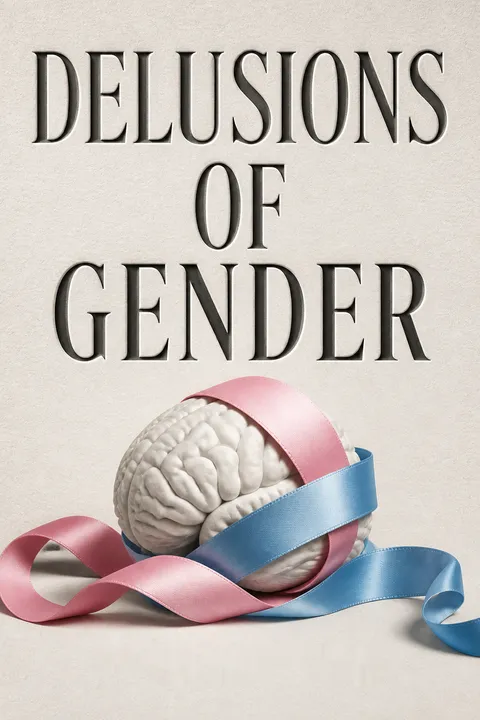
Delusions of Gender by Cordelia Fine challenges the notion of innate neurological differences between men and women. Fine argues that gender differences are largely socially constructed and influenced by cultural stereotypes. She critically examines scientific studies claiming biological gender differences, exposing flaws in methodology and interpretation. The book discusses how societal expectations and stereotypes shape behavior and performance. While some readers found the book repetitive or biased, many praised its thorough research, accessibility, and thought-provoking content. Fine's work encourages readers to question assumptions about gender and consider the complex interplay between biology and society.
People Also Read




Glossary
Implicit Association Test
measures automatic associationsA timed task that asks people to sort names, images, or words into categories. Faster pairings are treated as evidence that the categories are more strongly associated in memory. The test measures automatic associations, not necessarily consciously held beliefs, and its results should not be treated as a definitive judgment about an individual’s character.
active self
self-concept active nowThe particular part of a person’s broad self-concept that is most influential in a given moment. Social context can make an identity, such as gender or occupation, more prominent, bringing associated traits and expectations to mind. The active self can shift across situations, affecting self-perception, motivation, and behavior.
empathic accuracy test
tests real-time mind-readingA research method for assessing how accurately one person identifies another person’s thoughts and feelings during an interaction. Participants review a recording, report their own mental states, and then try to infer the other person’s states at those moments. Unlike simple self-report scales, it compares guesses with what the other participant actually reported.
stereotype threat
pressure from a negative stereotypeThe risk of being judged through a negative stereotype about a group while performing a task. When the stereotype becomes relevant, concern about confirming it can increase anxiety, occupy working memory, and alter motivation or strategy. The concept describes a situational burden, not an inherent limitation of the stereotyped group.
organizational-activational hypothesis
early shaping, later activationA hypothesis about hormone effects that distinguishes between early developmental influences and later hormonal activation. In its application to sex differences, prenatal hormones are proposed to organize lasting neural patterns, while hormones around puberty are proposed to activate some patterns. The hypothesis is a framework for research, not evidence that hormones determine complex adult behavior.
neuroconstructivism
brain development through interactionA perspective on development in which genes, neural activity, behavior, and environment interact continuously. Experience can influence which genes are expressed and can alter neural structure and function. The approach rejects both unlimited malleability and a simple genetic blueprint, treating biology as a set of developing capacities and constraints.
reverse inference
inferring mind from brain activityA reasoning method that infers a psychological process from activity in a brain region. It can be unreliable because many regions participate in multiple tasks, and a region’s activation does not uniquely identify a thought or feeling. Brain imaging is more informative when paired with independent behavioral evidence and a clearly tested hypothesis.
neuro-realism
brain evidence feels more realThe tendency for a psychological claim to seem more objective or convincing when accompanied by neuroscientific evidence, such as a brain image. The added brain information can increase confidence without actually explaining the behavior or strengthening the underlying evidence. The term describes an effect of presentation, not a scientific finding about the brain.
gender deviance neutralization
restoring conventional gender rolesA process in which partners manage the discomfort of a household arrangement that departs from traditional expectations about men’s and women’s roles. For example, a higher-earning woman may take on more domestic labor, or a couple may redefine what counts as providing, so that the relationship appears more conventionally gendered.
glass cliff
precarious leadership appointmentsA pattern in which women are more likely than men to be appointed to leadership positions when an organization or project is already in difficulty. Because these roles carry unusually high risks of failure, the appointment can appear to offer advancement while placing the leader in a less secure position.
glass escalator
men’s hidden career advantageAn advantage experienced by some men in occupations where women are the majority. Assumptions that men are especially suited to authority or advancement can push them toward higher-status roles, even when they prefer other work within the profession. The advantage is not experienced identically by all men.
gender detectives
children seeking gender rulesA description of children’s active search for clues about what belongs with being a boy or a girl. Children notice clothing, language, activities, and other social signals, then use them to classify people and infer group rules. Their learning is not simply passive imitation; children test, apply, and sometimes enforce the categories they observe.
About the Author
Other books by Cordelia Fine


Download PDF
Download EPUB
.epub digital book format is ideal for reading ebooks on phones, tablets, and e-readers.








