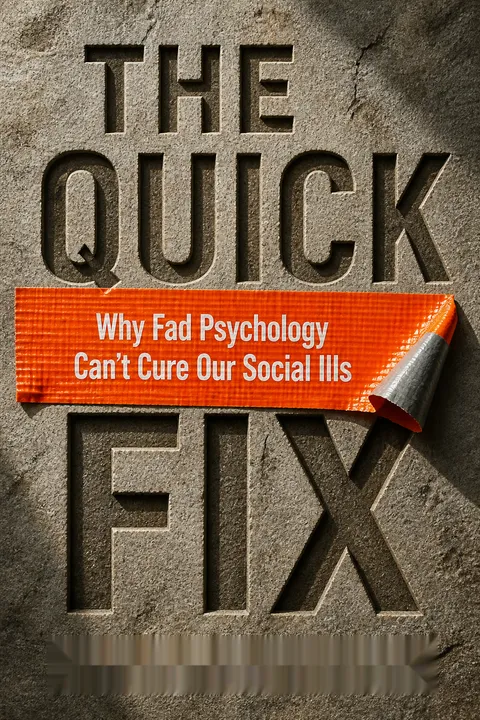


Key Takeaways
Demand evidence that a psychological fix changes the system, not just the story.
Beware the narrow lens. Singal calls a worldview centered on subtle psychological influences and individual-level repairs Primeworld. Its promise is seductive: change a person’s mindset, bias, or body language, and a problem as large as inequality may become easier to solve. But the approach often pushes institutions, history, and resource gaps out of focus. The book’s examples range from self-esteem lessons in schools to resilience training in the Army and bias tests in workplaces.
Keep the claim proportional. The criticism is not that psychology has nothing to offer. Some targeted interventions and behavioral nudges have evidence behind them. The danger comes when a plausible finding becomes a sweeping cure, or when improving individuals stands in for changing the conditions shaping their choices. Ask what the intervention actually changes, for whom, and compared with what alternative.
The useful distinction is between a psychological mechanism and a social explanation. A mechanism can clarify how a person responds to a situation without establishing that the mechanism is the main cause of a population-level outcome. That distinction is central to sound policy evaluation: a treatment can help some people while leaving the distribution of opportunity untouched. The book’s skepticism is strongest when it asks what has disappeared from view. Its caution also applies to structural accounts: naming a system does not, by itself, specify which institutional levers will work.
Treat self-esteem as support, not as a cure for social failure.
Correlation is not a program. In the 1980s and 1990s, California politician John Vasconcellos helped turn self-esteem into a proposed remedy for crime, school failure, and other social problems. The state funded a task force, and schools adopted activities meant to make children feel valued. Yet researchers’ review of the evidence found that self-esteem was often correlated with outcomes, not proven to cause them. Measures based on people’s own reports could also make the connection look stronger than objective measures did.
Direction matters. Better grades may help a student feel more capable, rather than self-esteem causing better grades. A later national study found a brief growth-mindset lesson modestly helped some students at risk of falling off track, while cognitive behavioral therapy can help people with specific mental-health needs. Those narrower findings do not justify treating self-esteem as a general-purpose fix.
The episode shows how a good intention can become a policy claim before the causal chain is established. Self-worth may matter deeply to people’s experience, even when a scale measuring it does not explain much variation in grades or conduct. That distinction protects both scientific accuracy and humane practice: rejecting a broad causal promise need not mean endorsing humiliation or indifference. A practical test for programs is whether they improve a defined outcome beyond the encouragement, tutoring, or support they already provide.
Never let a frightening label outrun the evidence about young offenders.
A forecast became a myth. In the 1990s, political scientist John DiIulio warned that a new class of remorseless young criminals, the superpredators, would drive a coming wave of violence. The prediction drew on real concerns: youth crime had risen, poverty and unstable environments can increase risk, and a larger share of young men can affect crime rates. But the feared surge never arrived. Youth violence declined, and researchers linked much of the earlier rise to factors such as guns and drug-market conflict.
Check the source number. DiIulio and others used a Philadelphia study to suggest that 6 percent of boys would become serious repeat criminals. The study recorded police contacts, not a confirmed population of violent offenders; many contacts did not lead to arrest or adjudication. The label helped legitimize harsher juvenile policies, while obscuring the role of poverty, policing, and chance.
Labels do political work. A category that suggests a person is beyond ordinary motives can make severe punishment feel like neutral risk management rather than a moral choice. The case also illustrates why forecasts deserve scrutiny at the level of their measurement: a proxy such as police contact can reflect both behavior and the intensity of surveillance. A careful account must hold individual harm and unequal context together. Neither makes the other disappear, and each matters to decisions about responsibility and punishment.
Change biased workplace rules before teaching women to perform confidence.
A dramatic claim faded. A 2010 study reported that briefly holding expansive poses changed participants’ hormones, feelings of power, and willingness to take a bet. Amy Cuddy’s widely viewed talk carried the claim into offices and popular culture. A larger attempted replication with 200 participants found no effects on hormones or risk-taking, and a co-author later rejected the original findings. Some evidence may support a modest effect on felt power, but not the sweeping transformation often advertised.
Redesign the setting. The book uses power posing to question why women are so often told to adapt to workplaces that reward assertiveness or overconfidence. It points instead to rules and procedures, such as unstructured interviews or grading based on professors’ unaided memories, that can invite bias. Body language does communicate social information, but that does not make a two-minute pose a remedy for institutional inequality.
This example separates interpersonal skill from institutional design. Learning how posture is interpreted can help someone navigate a particular interaction, but it does not show that the interaction’s rules are fair. The distinction matters because advice can quietly shift responsibility from organizations to people with less power. Institutional changes are not automatically effective or neutral either; they need evaluation. Still, a rule that makes decisions more consistent can address bias without requiring a reliable diagnosis of each decision-maker’s private attitudes.
Do not scale resilience training across populations by analogy alone.
The treatment changed targets. The Penn Resilience Program used cognitive behavioral ideas to teach young people to question rigid, pessimistic interpretations. Reviews found, at best, small reductions in depressive symptoms, with uncertain benefits when lay facilitators delivered the program universally. The Army then adapted this work into Comprehensive Soldier Fitness, a mandatory program for more than a million soldiers, promoted as a way to prevent PTSD and suicide. The original youth program had not been designed or shown to do that.
Measure the real outcome. The Army’s Global Assessment Tool did not use validated measures of PTSD, depression, or suicidality, making it ill-suited to establish whether the program prevented those conditions. Meanwhile, treatments such as cognitive processing therapy and prolonged exposure were designed for people already experiencing PTSD, though many veterans struggled to access care. A plausible theory is not proof that an intervention transfers to a new group or problem.
The critical question is not whether resilience is valuable, but whether a particular training produces the outcome it promises in the population receiving it. Moving from symptom management in children to prevention of combat-related trauma changes the mechanism, setting, and stakes. That should raise the evidence threshold, not lower it. The Army’s appeal to resilience also shows how institutions favor interventions that fit their existing identity. Fit can aid implementation, but it can also make an appealing program feel validated before it is tested.
Grit adds little when ability and safety nets explain more.
A catchy trait had limits. Psychologist Angela Duckworth defined grit through perseverance toward long-term goals and consistency of interest. Her scale predicted some outcomes, including which cadets completed West Point’s initial training, but the advantage was narrow: most cadets completed it, whether their grit scores were high or not. In a Chicago high-school study, grit added only about 0.5 percent to the explained variation in graduation, while test scores contributed more.
Separate value from novelty. A major review found grit closely overlaps with conscientiousness, a long-studied personality trait. Grit and conscientiousness each explain only a modest share of school performance, and reliable ways to raise either trait at scale remain unclear. Stories of determined students also risk survivor bias: they spotlight people who succeeded, not equally persistent people blocked by financial, logistical, or family barriers.
Persistence can be useful without being the master key to success. The value of a trait depends on the environment in which it operates: perseverance may help someone keep studying, but it cannot submit a financial-aid form for them or supply tuition. This is why stories of successful strivers need a comparison group of people who tried just as hard and faced worse constraints. Grit can describe effort, but using it to explain outcomes can accidentally turn unequal access into a judgment about character.
Do not diagnose individuals with a test that barely predicts behavior.
A score is not a verdict. The Implicit Association Test, or IAT, measures how quickly people sort words and images into paired categories. It became a popular way to identify unconscious bias, but the race IAT’s test-retest reliability is roughly 0.5, below the level psychologists commonly seek for individual assessment. A large review estimated that IAT scores explained about 1 percent of variation in observed behavior. The test cannot reliably tell whether a particular person will discriminate.
Keep the underlying issue in view. Weaknesses in the IAT do not prove implicit bias is unreal. They do mean the score is a poor diagnosis and that changing IAT results has not reliably changed behavior. Racial disparities can also reflect wealth gaps, explicit discrimination, and institutional decisions. Employers can reduce opportunities for bias through consistent selection procedures, without claiming to measure each manager’s unconscious attitudes.
The IAT illustrates a common measurement trap: a tool can produce a number with scientific-looking precision while the meaning of that number remains uncertain. Public use raises the stakes, because people may interpret a noisy score as a finding about their character. At the same time, measurement skepticism should not become an excuse to ignore discrimination that is visible in outcomes or documented in institutions. The stronger strategy is to ask which decision process produces unequal treatment, then test changes to that process directly.
Treat surprising lab findings as provisional until independent teams reproduce them.
The field had an incentive problem. Psychology’s replication crisis emerged as researchers found that many published findings did not recur in new studies. In a large project testing 100 studies, only about one-third to one-half replicated. Practices such as p-hacking, or trying multiple analyses until a result crosses the usual significance threshold, and selective publication can make weak effects look convincing. A famous social-priming claim that elderly-related words made people walk more slowly failed replication, along with several other striking results.
Improve the research process. Preregistration makes hypotheses and analysis plans public before results are known. Data sharing lets other researchers inspect the evidence. Registered Reports allow journals to review a study’s design before seeing its results, reducing the reward for a dramatic positive finding. These reforms do not guarantee truth, and replication attempts can differ in important ways, but they make it harder for a fragile result to masquerade as settled knowledge.
Replication is not a ritual of distrust. It is a way to distinguish a genuine effect from the noise that any experiment can produce, especially when the original claim is surprising and consequential. The deeper lesson concerns incentives: if publication rewards novelty and positive results, researchers are pushed toward stories that look stronger than the underlying evidence. Transparency and preregistration change what can be checked, while replication tests whether a result travels beyond the lab that first reported it.
Use nudges to remove friction, then reform rules causing the harm.
Small changes can matter. A nudge changes how choices are presented without banning options or substantially changing incentives. New York City redesigned a confusing court summons and sent text reminders to people accused of minor offenses. The share who failed to appear fell from 41 percent to 36 percent after the form redesign, and to 26 percent among recipients of the most effective reminder. Fewer missed dates meant fewer people at risk of arrest for failing to contest small fines.
Do not stop at the form. The city later changed the underlying rules, making many minor offenses civil matters and removing arrest warrants for failures to appear in those cases. That policy reform addressed the source of the harm more directly than a clearer notice could. Other nudges, such as automatic enrollment in retirement plans, have worked well, while efforts involving organ donation or student achievement have disappointed. Test each intervention, and know what it cannot fix.
Nudges are strongest when the obstacle is genuinely a friction point, such as a confusing form or an easily forgotten appointment. They are weaker as a substitute for changing incentives, rights, or access. The summons example shows how an inexpensive behavioral improvement can both reduce immediate harm and reveal a deeper policy failure. That is a productive role for applied behavioral science: not merely making an existing system run more smoothly, but helping decision-makers see where smooth operation is the wrong goal.
Follow the incentives behind a quick fix, especially who carries its failure.
Simple stories travel far. A claim that a brief exercise can raise confidence, reduce bias, or build resilience is easier to market than a plan requiring institutional change and long-term funding. The book calls this tendency bullet-point bias: presenting a compressed, provocative version of research that is easier to sell than its qualifications. Researchers gain attention, organizations gain a visible response, and media outlets gain an easy story. When the intervention fails, the burden can land on students, workers, or marginalized communities.
Ask who is accountable. Experiments discussed in the book suggest that presenting simple fixes for inequality can make audiences more likely to blame disadvantaged people for not overcoming their circumstances. That result is not proof that every intervention has this effect, but it gives reason to ask whether a program shifts responsibility away from institutions. A useful evaluation names the outcome, costs, limits, and alternatives before a claim becomes policy.
This is a political economy of knowledge as much as a problem of scientific method. The most marketable idea is often the one that lets powerful organizations act without changing how resources or authority are distributed. Yet low-cost interventions can still be worthwhile when their benefits are measured honestly and they do not crowd out more substantial remedies. The key questions are who defines success, who pays for failure, and whether the people targeted by the program had a say in the problem’s definition.
Analysis
The book’s central contribution is not simply a warning against bad psychology. It offers a model of how plausible research becomes public certainty: a complex problem invites a simple intervention, an institution adopts the intervention because it fits existing priorities, and media attention makes the claim appear more settled than it is. The cases differ, but the recurring failure is a mismatch between the evidence and the scope of the promise. A small experiment becomes a claim about real-world behavior; an intervention tested in one population is transferred to another; a weak predictor becomes a diagnosis; or a behavioral adjustment is sold as a remedy for structural inequality.
The argument is especially persuasive when it follows the full chain from measurement to policy. The IAT’s reliability and predictive limits matter because organizations used it to classify individuals. The Army example matters because the intervention’s target shifted from student depression to combat-related PTSD, while the outcome measures could not establish success. These are not abstract disputes about statistical etiquette. They show how evidentiary shortcuts can redirect money and responsibility.
The book also makes a necessary distinction between skepticism and denial. A weak measure does not disprove bias, and modest average effects do not mean an intervention is useless to every person. Conversely, a genuine psychological mechanism does not establish that it drives a major social disparity. This restraint is valuable, though the argument’s emphasis on structural causes should not be mistaken for proof that every structural reform works. Institutional changes also need careful evaluation, and psychological support can matter even when it cannot repair an entire system.
The most durable lesson is procedural: define the problem narrowly, identify the evidence actually supporting the intervention, test it with the intended population, and compare it with alternatives that alter the system itself. Behavioral science earns public trust not by promising a quick cure, but by being precise about what it can change and what it cannot.
Review Summary
The Quick Fix receives mostly positive reviews for its critical examination of popular psychology trends and their lack of scientific rigor. Readers appreciate Singal's thorough analysis of concepts like power posing, grit, and implicit bias, exposing their limitations and potential harm. The book is praised for its nuanced approach, skepticism, and emphasis on the need for structural solutions rather than quick fixes. Some reviewers find it repetitive or lacking depth in certain areas, but overall it's considered an important contribution to understanding the flaws in behavioral science and media coverage of psychological research.
People Also Read






Glossary
Primeworld
Individual-focused behavioral worldviewSingal’s term for an approach that gives subtle psychological influences, such as primes and biases, a central role in explaining behavior and social outcomes. Primeworld tends to favor interventions that alter individuals, while giving less attention to institutions, history, and structural conditions.
superpredator
Predicted remorseless young criminalA label introduced by political scientist John DiIulio for young offenders he predicted would act with extreme violence and little regard for victims or the future. The label became influential in 1990s crime debates, despite an unclear definition and a forecast of surging youth violence that did not occur.
Implicit Association Test
Reaction-time association measureA computer-based test that measures how quickly people sort concepts, such as positive or negative words, alongside images or categories, such as racial groups. Its creators argued that response-time differences reveal implicit attitudes. The book examines evidence that the test is too unreliable and weakly predictive to diagnose an individual’s likelihood of discriminatory behavior.
Grit
Perseverance toward long-term goalsAngela Duckworth’s construct for perseverance and sustained interest in long-term goals. Her scale uses self-report questions about persistence and changing interests. Research reviewed in the book finds some predictive value in particular settings, but substantial overlap with conscientiousness, modest links to academic performance, and little evidence that grit can be reliably increased at scale.
Penn Resilience Program
Youth cognitive-skills programA group-based program for young people that teaches cognitive behavioral skills, including identifying pessimistic interpretations and considering alternative explanations. It was designed to help prevent depression and anxiety. Reviews found small or uncertain effects, particularly for universal programs delivered by trained non-specialists.
Comprehensive Soldier Fitness
Army-wide resilience initiativeA U.S. Army program combining online learning, a required well-being assessment, and Master Resilience Training. It was promoted as a way to build resilience and prevent PTSD and suicide. The book argues that the program extended beyond the evidence for its source interventions and lacked appropriate measures to demonstrate those outcomes.
Questionable research practices
Methods that inflate findingsResearch choices that can increase the chance of false-positive results or make evidence appear stronger than it is. Examples discussed in the book include selective reporting of successful studies, trying multiple analyses without disclosing them, and changing a hypothesis after seeing the results.
p-hacking
Analysis until significance appearsA questionable research practice in which researchers make multiple choices about data, analyses, or comparisons until they obtain a statistically significant result. If those choices are not reported, readers may mistake a chance finding for a preplanned and reliable test of a hypothesis.
Registered Reports
Review before results are knownA publication process in which a journal evaluates a study’s research question and methods before the results are available. If the design meets the journal’s standards, the journal commits to publishing the study regardless of whether the results are positive, negative, or inconclusive. The process reduces incentives to produce dramatic findings.
Nudge
Low-cost choice adjustmentAn alteration to how choices are presented that predictably influences behavior without banning options or substantially changing economic incentives. Examples include clearer forms, reminders, and default enrollment. Nudges can reduce friction, but their effects vary and they cannot substitute for policy changes that address the source of a problem.
Choice architecture
Design of available choicesThe way options are organized and presented to people. Forms, defaults, reminders, and the placement of items can affect what people notice and do. Behavioral scientists use choice architecture to make desired actions easier while preserving alternatives, though any particular design needs testing in its real setting.
FAQ
What's The Quick Fix about?
- Exploration of Fad Psychology: The Quick Fix by Jesse Singal delves into the appeal of popular psychological ideas that claim to offer quick solutions to complex social issues.
- Critique of Oversimplification: The book critiques the tendency to embrace psychological theories without sufficient evidence, highlighting the oversimplification of human behavior.
- Case Studies and Examples: Singal uses case studies, such as the implicit association test (IAT) and the self-esteem movement, to show how flawed psychological concepts can influence public policy and societal beliefs.
Why should I read The Quick Fix?
- Critical Perspective on Psychology: The book encourages readers to question the validity of widely accepted psychological theories, making it essential for understanding human behavior.
- Awareness of Misleading Claims: Singal's exploration helps readers recognize the dangers of accepting psychological findings at face value, promoting informed decision-making.
- Engaging Writing: The accessible writing style makes complex psychological concepts understandable for both lay readers and professionals in the field.
What are the key takeaways of The Quick Fix?
- Skepticism is Crucial: Singal emphasizes the importance of skepticism when evaluating psychological claims, as many popular theories lack robust empirical support.
- Complexity of Human Behavior: The book highlights that human behavior is influenced by multiple factors, and simplistic solutions often fail to address underlying issues.
- Impact of Psychological Theories: Flawed psychological theories can shape public policy and societal attitudes, underscoring the responsibility of researchers to ensure accuracy.
What is the implicit association test (IAT) discussed in The Quick Fix?
- Definition of IAT: The IAT is a tool designed to measure implicit biases by assessing reaction times to word and image pairings, revealing unconscious prejudices.
- Critique of IAT's Validity: Singal argues that the IAT lacks reliability and validity in predicting real-world behavior, with flawed methodology leading to misleading results.
- Cultural Impact: Despite its shortcomings, the IAT has influenced diversity training and public discourse on racism, but reliance on it can lead to ineffective interventions.
How does The Quick Fix address the self-esteem movement?
- Historical Context: Singal provides an overview of the self-esteem movement, which gained traction in the 1980s and 1990s as a solution to social issues.
- Lack of Empirical Support: The book highlights the weak evidence supporting claims that boosting self-esteem leads to improved life outcomes.
- Consequences of Self-Esteem Programs: Singal discusses the negative consequences of self-esteem programs, suggesting they often distract from more effective solutions.
What are some examples of half-baked psychological ideas in The Quick Fix?
- Self-Esteem as a Solution: The self-esteem movement is critiqued as a half-baked idea that gained popularity without sufficient evidence.
- Power Posing: Singal discusses power posing, popularized by Amy Cuddy, as a psychological claim lacking robust empirical support.
- Grit in Education: The emphasis on grit as a predictor of success is critiqued for oversimplifying the complex factors influencing academic achievement.
What are the best quotes from The Quick Fix and what do they mean?
- “Many half-baked ideas are being enthusiastically spread, despite a lack of hard evidence.”: This quote warns readers to be skeptical of quick fixes in psychology.
- “Human behavior is influenced by a multitude of factors.”: It emphasizes the complexity of human behavior and the inadequacy of simplistic solutions.
- “We will never solve the pressing social issues of the day while relying on claims about human behavior that are half-true at best.”: This highlights the importance of accurate research in informing public policy.
How does Jesse Singal suggest we resist fad psychology in The Quick Fix?
- Promote Critical Thinking: Singal advocates for fostering a culture of critical thinking regarding psychological claims.
- Focus on Evidence-Based Practices: The book emphasizes the importance of relying on evidence-based practices in psychology and public policy.
- Encourage Open Dialogue: Open dialogue among psychologists, researchers, and the public is essential for improving psychological science.
What is the replication crisis mentioned in The Quick Fix?
- Definition of the Replication Crisis: The replication crisis refers to the awareness that many psychological studies fail to replicate, raising concerns about research reliability.
- Impact on the Field: Singal discusses how the crisis has cast doubt on numerous psychological theories, leading to calls for more rigorous methodologies.
- Consequences for Public Policy: The crisis has significant implications for public policy, as flawed research can lead to ineffective interventions.
How does The Quick Fix relate to current social issues?
- Addressing Inequality: Singal connects the critique of fad psychology to broader social issues like inequality and racism.
- Influence on Policy: The book discusses how popular psychological ideas can shape public policy, often without evidence support.
- Cultural Reflections: Singal’s exploration serves as a reflection of contemporary cultural attitudes toward mental health and self-improvement.
How does The Quick Fix critique the concept of implicit bias?
- Definition of Implicit Bias: Implicit bias refers to unconscious attitudes affecting understanding and decisions.
- Questionable Evidence: Singal argues that evidence supporting implicit bias's impact on behavior is weak.
- Need for Structural Change: Addressing implicit bias should not distract from systemic reforms tackling discrimination's root causes.
How does The Quick Fix suggest we move forward in psychology?
- Emphasize Evidence-Based Practices: Singal calls for a shift towards interventions grounded in solid empirical evidence.
- Focus on Systemic Issues: The book encourages addressing structural factors contributing to social problems.
- Encourage Humility in Research: Singal advocates for recognizing the complexity of human behavior and the limitations of current theories.
Download PDF
Download EPUB
.epub digital book format is ideal for reading ebooks on phones, tablets, and e-readers.








