Key Takeaways
1. Democracy is a Fragile Ecosystem, Not a Given
Democracy, too, is a delicate ecosystem – of checks and balances, rights and needs, power and accountability.
A delicate balance. Democracy is not an immutable state but a complex, living system requiring constant care and defense. Like a natural ecosystem, it relies on a healthy, functioning environment and a diverse community of interacting organisms, where each individual contributes to its broader health. This means that the ballot box alone is insufficient; true democracy demands the rule of law, separation of powers, free media, independent academia, and the protection of all rights.
The age of angst. We live in a frightening era of existential anxiety, where global challenges like climate change, poverty, and war make individuals feel small and insignificant. This vulnerability can lead people to clutch onto demagoguery and propaganda, which promise safety and stability, but ultimately accelerate societal division and distrust. The rapid pace of digital technology outstrips our cognitive, legal, and political systems, creating a dangerous gap that threatens democratic futures.
Interconnectedness is vital. To navigate these unmapped territories, we must reconnect with ourselves, each other, and nature. Just as ancient fungal networks enable trees to communicate and thrive, human interconnectedness through shared stories and mutual recognition is crucial for survival. Apathy and numbness, the moment we stop caring about what happens elsewhere, only exacerbate the crisis, reminding us that our lives and sufferings are deeply interlinked.
2. Beyond the Ballot Box: Institutions and Informed Participation are Key
The quality of information available, and the process of decision-making, were just as important as the act of voting itself.
More than just voting. While the right to vote is thrilling, it is not always a true exercise in democracy. Athenian debates, for instance, focused heavily on how people decided what to vote for, the reliability of information, and the means of persuasion, legitimate or otherwise. This historical perspective challenges modern interpretations that often reduce democracy to little more than casting a ballot, overlooking the critical processes that precede and inform that act.
Nurturing institutions. Democracy's institutions need to be nurtured and reformed to maintain voter trust, especially among younger generations. When components like the rule of law, free media, and minority rights are damaged, elections can devolve into majoritarianism, a swift fall towards authoritarianism. The decline in faith in democracy and trust in institutions, particularly among youth, signals a critical need for active participation beyond mere observation.
Avoiding complacency. The decades following the fall of the Berlin Wall saw an extraordinary ascent of democracy, but these gains have been challenged by popular grievances exploited by politicians. As Margaret Atwood warns, an election can be a sham, organized by those seeking to undermine freedom. Therefore, 2024, with its numerous elections, will be a test of democracy as much as a celebration, demanding vigilance and active engagement from citizens.
3. Revisiting History: The Idealized Past of Democracy Has Blind Spots
In order to find a reassuring, ancient, democratic ancestor for our own societies, we have to choose not to see quite a lot about ancient Athens, and about ourselves.
Selective admiration. Our idealized image of Athenian democracy, often linked to its flourishing art and culture, is a relatively recent phenomenon, widespread only for a couple of centuries. Before the 19th century, the Roman republic was often seen as a more judicious model. This selective admiration allows us to overlook uncomfortable truths about ancient Athens, such as its limited citizenship (excluding women and slaves) and the deep contestation of democracy even in its supposed glory days.
Exclusions and exploitation. Athenian democracy, while pioneering "people power," was built on significant exclusions.
- No women: Women could not vote or be part of the citizen body.
- Slavery: Thousands of slaves, considered chattel, were integral to the system, allowing free men time for political duties. The definition of Athenian freedom was intertwined with the exploitation of non-Athenians.
- Narrow citizenship: The more democratic Athens became, the more rigidly it defined citizenship, excluding migrants and asylum seekers.
This institutionalized exploitation represents a "black spot" that modern discussions often ignore, creating a vast moral paradox about freedom and humanity.
A cautionary tale. The story of democracy's origins, particularly Solon's reforms in Athens, serves as a cautionary tale. It highlights how democracy emerged as a realistic solution to civil strife caused by extreme wealth gaps and the exploitation of the poor by the rich. This historical context reminds us that democracy was designed to check power imbalances and ensure a more stable, productive, and humane society, rather than simply being a celebration of individual liberties without limits.
4. The Interplay of Freedom, Capitalism, and Inequality Creates New Pathologies
Liberalism cannot deliver freedom from fear because liberal societies in their encounter with capitalist economic structures produce pathologies of their own, pathologies that are different from the fear of despotism or intolerance that liberalism opposes, yet destructive in their own right.
Freedom's embarrassment. Freedom, a core concept for democracy, has become an embarrassment for the global left, often appropriated by the right to defend individual rights against shared social norms. However, the socialist tradition, from Marx onwards, also champions freedom, radicalizing it beyond the limitations of liberal theories that often restrict it to specific categories of people or states. A robust idea of freedom must address the failures of both socialist states to deliver on their promises and liberal capitalist institutions to expand freedom beyond privileged elites.
Liberal pathologies. While liberalism aims to limit state power and celebrate civil society, its encounter with capitalist economic structures generates its own distinctive power structures and fears.
- Psychological dispositions: Commercial society, while promoting prosperity, can encourage selfishness, greed, envy, and indifference to the vulnerable.
- State-market tension: The state is needed to guarantee private property and rights for commercial society, but its reliance on taxation can create divisive inequalities, often outsourced to global credit systems.
- Colonialism: Liberalism's historical stage theories, which celebrated commercial society as the pinnacle of progress, condemned alternative forms of life as "primitive," leading to colonialism and empire as a "crucial component" of its mission.
These anonymized, spontaneous power structures are difficult to fight, making the fear of liberal capitalism potentially more pernicious than the despotism it opposes.
Beyond political membership. The crisis of democracy reveals a tension between globalization's challenge to state sovereignty and the need for popular sovereignty. The right has successfully framed conflicts as a "liberal cosmopolitan versus communitarian cleavage," reducing problems of capitalism to issues of political membership. However, migration is a symptom, not a source, of crisis, and focusing solely on who belongs or policing group boundaries will not solve the underlying issues. A progressive alternative must rethink the link between democracy and capitalism, moving beyond abstract rights and culture to empower marginalized groups globally.
5. Authoritarianism Thrives on Division, Insecurity, and Exploited Grievances
Which is why both the extreme right and the extreme left try to create as much chaos as possible: it gives them a better shot at a dictatorship.
The path to dictatorship. When a government fails to deliver basic necessities, the result is either its overthrow or a brutal crackdown, often leading to chaos. Both extreme right and left ideologies exploit this chaos, saying "Burn it all down" or "Only I can fix it," to pave the way for dictatorship. They share a contempt for ordinary people, a belief in their own divine right to rule, and a readiness to purge enemies and rivals, demonstrating how easily a temperate zone can slide into totalitarianism.
Exploiting vulnerabilities. The rise of illiberal populism, particularly after the 2008 global economic crash, highlights how economic and psychological insecurities are fanned by weak regulation and widening social gaps. Political manipulators blame false culprits, like immigrants and minorities, offering unrealistic cures and creating an illusion of power for anxious supporters. This top-down manipulation, however, is just the upper layer of a more complex story rooted in material and psychological insecurities.
Adversaries at work. Adversaries are always ready to exploit divisions within democracies, waging "shadow wars" through energy, information, and cyberattacks. Russia, for example, is adept at fueling existing fires, using disinformation networks to spread lies and undermine trust in democratic institutions. This strategy aims to deter support for allies, spark domestic divisions, and influence democratic decision-making, including elections, by making democracies appear weak and dysfunctional.
6. The Indispensable Power of Collective Action and Community
What each person does not have, and what I missed the most about leaving my own democracy, was the ability to join with others in pursuing common desires.
Beyond individualism. While authoritarian regimes may foster an abundance of individualism through cut-throat competition, they suppress the fundamental human instinct to join with others in pursuing common desires. In contrast, democracy thrives on collective life, where social gatherings can evolve into political discussions and shared concerns lead to organized action. The freedom to be part of a collective, not just an individual, is a crucial, often overlooked, aspect of a full democratic life.
Suppression of collectives. Authoritarian governments actively work to erase collective life, breaking down collective actions into individual ones and scrutinizing any group with ambitions beyond immediate desires. This includes spiritual groups, feminist workshops, or labor activism, where collective organizing can turn a legal activity into a political threat. The punishment for collective organizing is often individual isolation, designed to prevent people from grieving, processing trauma, or starting afresh together.
Democracy's foundation. Democracy is only possible through collectives, as political change originates in consciousness-raising, identifying shared concerns, and organizing towards a common goal. If voters cast ballots without a sense of community or a collective story, democracy risks becoming a mere exercise in consumerism, a private browsing of an online marketplace. The organized expression of collective interests, built on trust, continuity, and structure, gives democracy its shape and meaning, requiring people to actively "join things."
7. Authenticity and Inclusivity: Democracy Must Align with Local Realities
When a political structure is installed from outside that does not align with the realities on the ground, it will inevitably lead to failure.
Imposed structures fail. The failure of democracy in Afghanistan was primarily a political, not a democratic, failure, stemming from structures that did not align with the country's diverse and complex society. Western policymakers advocated for a centralized, presidential elected autocracy, ignoring Afghanistan's historical divisions and cultural diversity. This imposed framework, concentrating power in a single individual, proved unsustainable and led to the exploitation of authority for personal gain, undermining democratic foundations.
Erosion of trust. The insistence on an externally designed, centralized power structure, coupled with widespread corruption and weak institutions, led to a lack of confidence among the Afghan people. Declining voter turnout in presidential elections reflected a perception that votes carried diminishing weight and that decisions were made by foreign figures or powerful elites, rather than by citizens. This disconnect fostered cynicism, highlighting that a lack of confidence is not a rejection of democracy itself, but a loss of faith in its functionality.
Lessons for all. Afghanistan's experience underscores a broader truth: any governance system must align with the society it governs to be sustainable. The absence of women and youth, who constitute the largest demographics, in any future political framework would doom it to collapse. For democracies globally, this means addressing the crisis of confidence by providing viable alternatives, ensuring transparent governance, and empowering citizens to shape their own future, rather than allowing institutions to be manipulated for partisan interests.
8. Democracy's Unfulfilled Promise: Women and Marginalized Groups Still Suffer
When democracy is threatened, women suffer disproportionately.
Underrepresentation persists. Despite democracy's promise, women remain significantly underrepresented in democratic institutions globally, often targeted for abuse when visible. The share of countries where the most powerful leader is a woman has never risen above 10%, and at the current rate, gender equality in top positions will not be reached for another 130 years. This highlights that democracy has yet to fulfill its potential for half of the global population.
Disproportionate impact. The poetic reflections on democracy's disappearance in African nations reveal a cycle of terror and fear where the strong arm of justice is fractured, and impunity trumps freedoms. In such fragile states, the wailing of the dispossessed, the disenfranchised, and the disappeared is a stark reminder of who bears the brunt when democracy vanishes. The fight to keep democracy alive is deeply personal for those who have known its absence and the immense loss of rights and freedoms that accompanies tyranny.
A changing society. In Afghanistan, the transition to religious autocracy under the Taliban resulted in an enormous loss of rights and freedoms, especially for women. However, Afghan society is changing, notably through the influence of social media on young people and the growing sense of political agency among Afghan women. This evolving dynamic will undoubtedly impact the viability of any future democratic structure, emphasizing that true democracy must be authentic, inclusive, and reflect the aspirations of all its people, particularly its largest demographics.
9. Vigilance and Bold Decisions are Essential for Democracy's Defense
Democracies should not be afraid of their own power. We need to understand that democracy and freedom are not a given.
Learning from history. Estonia's journey from Soviet occupation to a thriving democracy offers crucial lessons: bold decisions, not wishful thinking, build democracy. After regaining independence, Estonia prioritized rooting out corruption, building strong institutions, and joining NATO and the EU, driven by the motto "Never Alone Again." This foresight, despite initial skepticism, protected them from Russia's persistent imperialist ideology, demonstrating that strength deters aggressors and weakness encourages them.
No grey zones. The warning from Estonia's President Lennart Meri in 1998—that failing to dynamically integrate Europe would confirm "old ways are good enough" for Russia—proved prescient. Russia's invasions of Georgia (2008) and Ukraine (2014, 2022) underscore that it invades countries not in NATO, highlighting the danger of security "grey zones." Supporting Ukraine is not just about defending one democracy; it's a matter of global security, as Russia's vision of conquering and colonizing must be defeated for a safer world.
Protecting institutions. Democracies face internal threats mirroring early 20th-century challenges: rising nationalism, mainstreaming radical ideas, demonization of minorities, and loss of faith in institutions. This creates fertile ground for adversaries to exploit divisions. To protect democracies, a mindset shift is needed, recognizing that freedom is never free. This involves strengthening legislative bodies, ensuring they are functional and accountable, and openly informing the public about adversaries' methods to build resilience against hostile influence.
10. Rethinking Freedom: From Individual Rights to Global Interconnectedness
A world in which not everyone is free is a world that cannot be truly free for anyone.
Global freedom. The crisis of democracy necessitates a global perspective on freedom, recognizing that injustices in one part of the world affect everyone. The example of freedom of movement illustrates this: having a passport is insufficient if other states deny visas, revealing that impediments to freedom are often externalized. The idea that freedom can be realized in isolation, for only one group or state, is incoherent; we need to think of freedom as global freedom and democracy as global democracy.
Beyond liberal utopia. Classical liberals sought to limit state power and celebrated civil society, but their stage theories of history, culminating in the superiority of commercial society, inherently condemned alternative forms of life as "primitive." This narrative, while offering hope, produced its own distinctive fear: colonialism and empire, which is not collateral damage but a crucial component of the liberal mission. This highlights how liberalism, in its efforts to disperse power, generates its own anonymized power structures and fears, making it difficult to fight.
Moral responsibility. Progress requires challenging the terms in which freedom and democracy are mobilized, especially by the right, which often reduces conflicts to political membership. A progressive alternative must rethink the link between democracy and capitalism, moving beyond rights and culture to empower marginalized groups globally. This involves an awareness of our moral responsibility to others, a duty to engage with the past, and an acknowledgment of what we owe future generations to promote effective economic and political democracy at a global level.
Last updated:
Review Summary
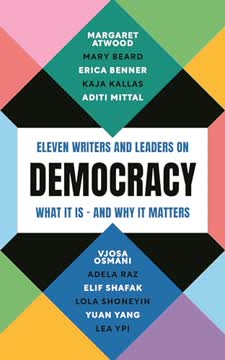
Democracy receives mixed reviews averaging 3.98/5 stars. Readers appreciate the diverse international perspectives from eleven female writers and leaders, particularly essays by Elif Shafak, Lea Ypi, Mary Beard, and Kaja Kallas. The book explores democracy's complexities, fragility, and challenges including inequality, corruption, and populism. Critics note uneven essay quality, lack of depth in some pieces, and absence of discussion on LGBTQIA+ rights. Some find it one-sided, favoring pro-democracy views without examining flaws thoroughly. Many praise its non-US-centric approach and timely relevance, though several reviewers desired more substantive analysis.