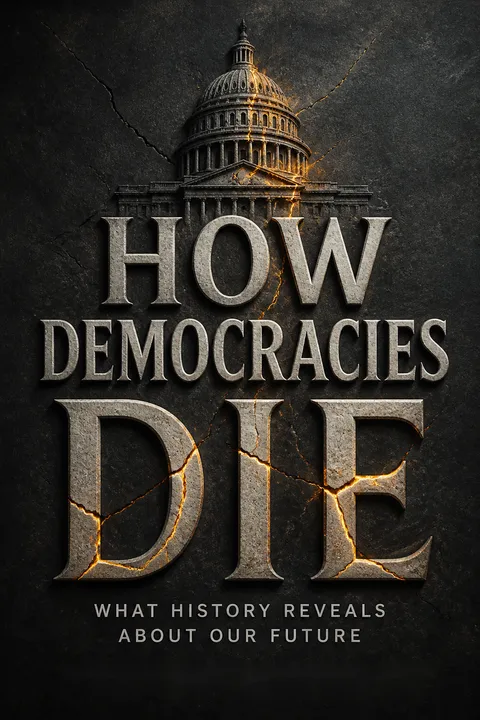


Key Takeaways
Watch the ballot box: elected leaders can dismantle democracy without a coup
The old picture misleads. Chile’s 1973 military coup made democracy’s death unmistakable: jets bombed the presidential palace, and the elected president died. But the authors describe a quieter route that has become more common since the Cold War. Leaders win elections, then weaken the institutions that could remove or restrain them.
Legality can disguise decay. Hugo Chávez first won office through elections, then gradually weakened courts, pressured media, and tilted competition toward his government. Elections and democratic language remained, even as their substance eroded. In a 2011 survey, 51 percent of Venezuelans still rated their country highly democratic. The warning is not that every controversial law signals dictatorship. It is that a pattern of legal-looking moves can hollow out democracy before citizens recognize the change.
The crucial distinction is between holding elections and preserving meaningful competition. A ballot can confer authority, but it cannot make every subsequent use of power democratic. This resembles the difference between a system’s visible interface and its underlying operation: the familiar rituals may persist even when the mechanisms that make them consequential have been disabled. The gradual pattern also complicates public judgment. Each isolated change can look defensible, so citizens need to assess cumulative effects on opposition, oversight, and future electoral fairness, rather than treating procedure alone as proof of democratic health.
Never legitimize an extremist because insiders believe they can control him
The bargain rarely stays bounded. In 1922, Italian elites accepted Mussolini as prime minister, believing his popularity and Fascist followers could help restore order. German conservatives made a similar wager when they installed Hitler as chancellor in 1933. Franz von Papen expected to push Hitler into a corner. Instead, each outsider used elite sponsorship to gain legitimacy and access to state power.
Venezuela repeats the pattern. Former president Rafael Caldera publicly sympathized with Hugo Chávez after Chávez’s failed 1992 coup, then released him from prison in 1994. Caldera thought Chávez’s appeal would fade. The endorsement and release helped make him a credible presidential contender. These are fateful alliances: establishment figures empower an anti-system politician to solve an immediate problem, then discover that the new ally has his own plans.
This is a problem of asymmetric commitment. Established politicians may view an alliance as temporary, while the outsider uses it to acquire credibility, networks, and institutional leverage that are difficult to take back. The risk is especially acute when insiders believe they can exploit an extremist’s voters without endorsing the extremist’s aims. Yet exclusion also carries costs: parties can become closed clubs that ignore genuine grievances. The practical challenge is to address those grievances without making antidemocratic conduct seem like an acceptable price of coalition-building.
Make parties screen candidates before celebrity turns popularity into power
Parties are democratic filters. The authors argue that voters alone did not keep American demagogues out of office. Father Coughlin drew enormous radio audiences, Huey Long built a national movement, and George Wallace won roughly 40 percent approval in 1968. Party leaders kept such figures from becoming major-party presidential nominees. Their old convention system was undemocratic, but its insiders could assess candidates through experience and personal knowledge, a kind of political peer review.
The filter weakened after 1968. Reforms made primaries binding, giving voters a direct role but reducing party leaders’ control. Later, campaign money and alternative media helped candidates bypass traditional networks. In 2016, Donald Trump entered the primaries with almost no endorsements from Republican officeholders, yet his celebrity and media attention helped him win. Parties must weigh voter choice alongside their responsibility to reject candidates who threaten democratic rules.
Candidate selection is an institutional design problem, not simply a contest between democracy and elitism. Open nominations broaden participation, while party screening can reduce the chance that a temporary surge of attention determines who controls the state. Neither mechanism is automatically legitimate: insiders can protect their own interests, and voters can be manipulated by information systems that reward spectacle. A sound filter therefore needs accountability and clear standards. The authors’ behavioral test offers a starting point, but parties must apply it consistently, including when a candidate’s policies are popular with their own base.
Track who controls referees, sidelines opponents, and rewrites the rules
Power grabs have a recognizable sequence. The authors compare democracy to a game whose rules matter only if officials enforce them fairly. Elected autocrats typically work to control courts, prosecutors, police, and regulatory agencies, turning neutral referees into shields for allies and weapons against critics. They also pressure, buy off, or legally harass opponents in the media, business, and politics.
Then they tilt the field. Peru’s Alberto Fujimori used intelligence adviser Vladimiro Montesinos to bribe legislators and media owners, and to compromise judges. Hungary’s Viktor Orbán changed electoral rules and district boundaries so that his party kept a two-thirds parliamentary majority in 2014 despite winning a smaller share of the vote than in 2010. Each change may appear lawful in isolation. Together, they make it harder for opponents to compete or for voters to replace the government.
The game metaphor helps turn an abstract threat into observable questions: Who investigates the powerful? Can critics organize and reach an audience? Can today’s losers realistically win tomorrow? These checks are more informative than asking whether a country still has courts or elections, since institutions can survive in name while losing independence in practice. The framework also calls for care: reorganizing an agency or changing an election rule is not inherently authoritarian. The relevant evidence is whether changes concentrate power, impair opposition, and reduce the possibility of peaceful turnover.
Treat emergencies as stress tests for rights, not blank checks for executives
Fear expands executive room. Wars and terrorist attacks can rally citizens around a leader and make lawmakers, judges, and the public less willing to challenge government action. After September 11, George W. Bush’s approval rating rose from 53 percent to 90 percent. In a 2002 survey, 55 percent of Americans said some civil liberties should be surrendered to fight terrorism, up from 29 percent in 1997.
Leaders can exploit or manufacture danger. Ferdinand Marcos invoked bombings and an alleged assassination attempt to impose martial law in the Philippines in 1972, then stayed in power for years. The authors note evidence that the supposed crisis was at least partly fabricated. Alberto Fujimori, by contrast, took office amid real economic collapse and insurgent violence, then used the emergency to justify dissolving Congress. Crises deserve scrutiny precisely when extraordinary powers seem most popular.
Emergencies create a predictable imbalance: threats feel immediate, while institutional damage appears abstract and reversible. That makes temporary restrictions politically easier to adopt than to remove. The examples suggest that crisis oversight should ask not only whether a threat exists, but whether each response is limited, reviewable, and tied to the threat. Still, restraint cannot mean paralysis. Governments must respond to genuine danger. The democratic test is whether extraordinary authority remains bounded and accountable, rather than becoming a durable advantage for the incumbent.
Accept rivals as legitimate, and resist using every legal power available
Written rules need unwritten support. The authors identify two norms that help constitutional checks work. Mutual toleration means accepting opponents who follow the rules as legitimate contenders for power. Institutional forbearance means restraining the use of legal powers when deploying them to the maximum would violate the system’s spirit.
The norms can prevent escalation. The Senate’s filibuster, for example, was available for decades but was used sparingly as a last resort. Presidents generally accepted limits on their power, and the Senate usually allowed presidents to fill Supreme Court vacancies. When rivals instead treat each other as existential threats, legal tools become weapons. In Chile before the 1973 coup, government and opposition repeatedly pushed constitutional powers to defeat one another. Their escalating contest helped destroy the democratic rules both sides claimed to defend.
These norms are a form of self-restraint that makes institutional competition sustainable. A rulebook cannot specify every future maneuver, so a political system depends on shared expectations about what not to do, even when the law permits it. But restraint has a moral limit: appeals to civility can also protect unjust arrangements or silence people excluded from power. The relevant distinction is between restraint that preserves fair competition and restraint demanded to shield the status quo from necessary democratic change.
When politics becomes identity warfare, losing starts to feel existential
Polarization is more than policy distance. The authors trace American party sorting to civil rights, racial realignment, immigration, and the growing alignment of party with religion and culture. As the parties became more socially distinct, opponents were increasingly seen not as people with different policies but as threats to a way of life. In 1960, only 4 percent of Democrats and 5 percent of Republicans said they would be displeased if their child married across party lines. By 2010, the figures were 33 percent and 49 percent.
The earlier peace had an unjust foundation. After Reconstruction, partisan accommodation partly depended on abandoning federal protection for Black voters and allowing one-party rule in the South. Racial exclusion lowered some political conflict, but at the cost of democracy itself. The challenge now is to sustain cooperation without returning to exclusion, in a country whose electorate is increasingly diverse.
Identity-based polarization changes what electoral defeat means. If a party’s supporters believe the other side rejects their nation, religion, or community, ordinary turnover can feel like dispossession. That helps explain why procedural restraint becomes harder to defend. The historical qualification is essential: lower conflict is not always evidence of healthier democracy. A calm political order can be achieved by excluding people from power. Any effort to reduce polarization should therefore ask both whether groups can cooperate and whether those groups have equal standing in the first place.
Defend democracy through institutions, not tactics that discredit its defenders
Opposition choices matter. In Venezuela, opponents tried to remove Chávez through a failed coup, a prolonged strike, and an election boycott. These tactics weakened their democratic credibility and helped the government portray them as enemies of the system. In Colombia, opponents of Álvaro Uribe focused instead on Congress and the courts. The Constitutional Court ultimately blocked his bid for another term, while the opposition retained stronger democratic standing.
Build coalitions across disagreement. The authors recommend using elections, courts, legislative oversight, and nonviolent protest, while joining with groups outside one’s usual political camp. Chile’s later democratic opposition offers an example: former rivals built trust through repeated meetings, then formed a coalition broad enough to defeat Pinochet in a 1988 plebiscite. The aim is not politeness for its own sake. It is to prevent opposition tactics from giving incumbents a pretext to weaken institutions.
A movement’s methods shape who trusts it and who is willing to join it. Constitutional action can make it harder for a government to frame its critics as enemies, while cross-partisan alliances demonstrate that the dispute concerns democratic rules, not merely one faction’s access to office. Nonviolent protest can also communicate discipline and widen public sympathy. These strategies are not guarantees of success, especially where institutions have already been captured. Their value is that they preserve a basis for democratic legitimacy rather than sacrificing it for a short-term win.
Make multiracial democracy materially inclusive, not merely procedurally open
Norms need an inclusive base. The authors argue that restoring old political arrangements is not enough, since earlier American stability rested partly on racial exclusion. They urge the Republican Party to rebuild its organization, marginalize extremists, and broaden its constituency beyond white Christians. Germany’s postwar Christian Democratic Union offers a model of a center-right party built across religious divides and clearly separated from authoritarian predecessors.
Shared benefits can bridge groups. The authors also argue that inequality and insecurity deepen resentment. Universal programs, such as health coverage, paid family leave, and stronger wage supports, could give people across racial and class lines a stake in common institutions. Such proposals are difficult to enact, and no policy can erase cultural conflict. But a democracy is more durable when participation is real and citizens see public institutions serving more than a narrow group.
The final challenge is institutional and distributive at once. Shared rules are easier to defend when people believe they belong to the political community and can benefit from its decisions. Universal programs may help create that common stake, while party reform can offer voters a credible alternative to exclusionary appeals. Neither is a shortcut: universal policies can still be designed poorly, and party coalitions can paper over deep inequality. The standard of success should be substantive inclusion, not just lower political temperature or smoother competition among established factions.
Analysis
The book’s sharpest contribution is to shift attention from dramatic coups to the less cinematic degradation of democratic competition. Its comparative cases make a strong case that formal institutions do not defend themselves. A constitution can remain in force while officials alter enforcement, access, and electoral rules until opposition becomes ineffective. The book also identifies political parties as pivotal institutions: they can prevent demagogues from becoming viable, or lend them the legitimacy and machinery they lack.
Its account of norms adds a valuable mechanism. Mutual toleration and forbearance are not pleas for good manners. They are practices that keep political conflict from becoming a contest for permanent victory. Yet norms are not neutral by definition. The account of post-Reconstruction America shows that apparent elite cooperation can rest on exclusion and coercion. That history complicates any simple call to restore a supposedly harmonious past. The task is to preserve restraint while widening who counts as a full participant.
The framework is most useful as a diagnostic, not a verdict. A politician’s attack on a judge, an executive order, or a disputed election law may be alarming, but any one event can have competing explanations. The stronger signal is a cumulative pattern: weakened oversight, targeted opponents, reduced electoral fairness, and claims that rivals are illegitimate. Applying that test consistently matters, especially when the suspected leader belongs to one’s own side.
The book’s prescriptions follow from its diagnosis: parties need credible gatekeeping, opposition should use constitutional channels, and coalitions must cross partisan boundaries. These are strategically demanding precisely because they ask people to accept short-term losses and bargain with ideological opponents. Their deeper premise is that democratic competition must remain reversible. A party should be able to lose office without losing its rights, and to win office without gaining the power to make future losses impossible. The authors’ most enduring question is therefore practical: what actions today preserve the possibility of fair contest tomorrow?
Review Summary
How Democracies Die examines the erosion of democratic norms and institutions, drawing on historical examples worldwide. Readers praise its scholarly approach and relevance to current politics, particularly in the US. The book's framework for identifying authoritarian behavior and its analysis of political polarization are highlighted as strengths. While some criticize its focus on American politics and perceived bias, most find it insightful and well-researched. Many reviewers emphasize its importance for understanding threats to democracy and potential solutions.
People Also Read





Glossary
Fateful alliance
Elite pact with extremistsA bargain in which established politicians ally with or elevate an anti-system outsider, believing they can use the outsider’s popularity while retaining control. The alliance can instead legitimize the outsider, weaken mainstream parties, and provide access to office. The authors use Mussolini, Hitler, and Hugo Chávez to show how short-term political calculation can open a path to authoritarian power.
Gatekeepers
Parties filtering candidatesPolitical parties and their leaders, understood as institutions responsible for screening candidates who seek mainstream power. Gatekeeping includes refusing to nominate or endorse antidemocratic figures, separating from extremist factions, and sometimes joining ideological opponents to defeat a serious threat. The concept emphasizes that voters’ choices are shaped by who is allowed to become a credible candidate.
litmus test
Behavioral warning signsA way to assess whether a politician displays authoritarian tendencies by examining conduct rather than relying only on labels or ideology. The authors’ test looks for rejection of democratic rules, denial of opponents’ legitimacy, tolerance or encouragement of violence, and willingness to restrict critics’ civil liberties. One warning sign merits concern, while patterns provide stronger evidence.
mutual toleration
Recognizing rivals as legitimateThe norm that political opponents who follow constitutional rules have an equal right to compete for power and govern. It does not require agreement or affection. It requires resisting the claim that rivals are traitors, subversives, or existential enemies merely because they hold different political views. Without this norm, losing an election can seem too dangerous to accept.
institutional forbearance
Restraint in legal powersThe practice of refraining from using legal or constitutional powers to their maximum extent when doing so would violate the system’s spirit or undermine future competition. Examples include using obstruction or impeachment only with restraint, and presidents not exploiting every ambiguity in executive authority. It helps institutions remain usable by both current winners and future opponents.
constitutional hardball
Aggressive legal power playThe use of formal legal powers in ways that may comply with the letter of the law but violate established expectations and push institutions toward partisan combat. Examples include using impeachment on dubious grounds, blocking appointments solely to disable a rival, or exploiting procedural authority to secure lasting advantage. Repeated hardball can weaken norms and provoke escalating retaliation.
invisible primary
Pre-primary elite competitionThe informal contest that takes place before voters cast primary ballots. Candidates seek endorsements, funding, organizational support, media attention, and backing from party activists and elected officials. These networks historically helped establish which candidates were viable. The authors argue that celebrity, wealth, and alternative media made it easier for some candidates to bypass this stage.
competitive authoritarianism
Elections without fair competitionA political system that retains elections and other democratic institutions in name, but incumbents systematically weaken the conditions that make competition fair. Governments may pressure media, politicize courts, constrain opponents, or change rules while maintaining a democratic appearance. The concept captures the gap between the continued presence of elections and the erosion of their capacity to permit genuine turnover.
FAQ
What's How Democracies Die about?
- Democratic decline: The book explores how democracies can erode not just through violent coups but also through elected leaders who undermine democratic institutions from within.
- Historical context: Authors Steven Levitsky and Daniel Ziblatt draw parallels between contemporary American politics and historical examples from countries like Venezuela, Germany, and Italy.
- Focus on norms: Emphasizes the importance of unwritten democratic norms, such as mutual toleration and institutional forbearance, in maintaining a healthy political environment.
Why should I read How Democracies Die?
- Timely relevance: Given the current political climate in the U.S. and globally, the book provides critical insights into the vulnerabilities of democratic systems.
- Lessons from history: Offers valuable lessons from past democratic failures, helping readers understand the warning signs of potential authoritarianism.
- Practical advice: Analyzes problems and suggests strategies for citizens and political leaders to defend democracy against rising threats.
What are the key takeaways of How Democracies Die?
- Democracy is fragile: Democracies can die slowly and imperceptibly, often without a clear moment of crisis, making vigilance essential.
- Importance of political norms: Strong democratic norms, such as mutual toleration and forbearance, are crucial for the health of a democracy.
- Role of political parties: Political parties serve as gatekeepers, and their failure to isolate extremist candidates can lead to the rise of authoritarian figures.
What are the best quotes from How Democracies Die and what do they mean?
- “Democracy’s assassins use the very institutions of democracy.”: Elected leaders can dismantle democracy while still operating within its legal frameworks, making it difficult for citizens to recognize the threat.
- “The promise of history…is that we can find the rhymes before it is too late.”: Emphasizes learning from historical examples to prevent repeating past mistakes in the face of rising authoritarianism.
- “The electoral road to breakdown is dangerously deceptive.”: Democratic erosion can occur through legal means, making it less visible and urgent to the public.
How do democracies typically die, according to How Democracies Die?
- Elected leaders subverting democracy: Many democracies die not through military coups but through elected officials who gradually dismantle democratic institutions.
- Legal and constitutional means: Actions taken by these leaders often appear legal, such as changing electoral laws or packing courts, confusing citizens about the state of democracy.
- Historical examples: Case studies from various countries illustrate how leaders like Hugo Chávez and Adolf Hitler used democratic processes to gain power and then erode it.
What is the significance of mutual toleration in How Democracies Die?
- Acceptance of political rivals: Mutual toleration refers to the understanding that political opponents are legitimate rivals, essential for a functioning democracy.
- Prevention of extreme polarization: Reduces the likelihood of viewing opponents as existential threats, which can lead to authoritarian measures.
- Historical context: Erosion of mutual toleration in various countries has led to democratic breakdowns, emphasizing its importance in maintaining democratic stability.
What does institutional forbearance mean in the context of How Democracies Die?
- Restraint in political actions: Involves politicians exercising self-control and avoiding actions that, while legal, could undermine democratic norms and institutions.
- Importance for checks and balances: Crucial for the functioning of checks and balances, preventing one branch of government from overreaching its authority.
- Examples of forbearance: Historical examples include the Senate’s traditional deference to presidential appointments, helping maintain democratic integrity.
How do political parties act as gatekeepers in How Democracies Die?
- Filtering candidates: Responsible for vetting candidates and keeping extremist figures out of the mainstream, essential for protecting democracy.
- Consequences of failure: When parties fail to act as gatekeepers, it can lead to the rise of authoritarian leaders, as seen in the 2016 U.S. presidential election.
- Historical lessons: Discusses historical instances where parties successfully kept extremists out of power, highlighting the importance of strong party structures.
What strategies do the authors suggest for defending democracy in How Democracies Die?
- Recognizing warning signs: Emphasizes the need for citizens to be aware of early warning signs of authoritarianism, such as attacks on the media and political opponents.
- Building coalitions: Advocates for political parties to unite against extremist candidates, even if it means forming alliances with ideological rivals.
- Engaging in civic action: Encourages citizens to actively participate in the political process, advocating for democratic norms and holding leaders accountable.
How does How Democracies Die relate to current events?
- Reflection of contemporary politics: Draws parallels between historical democratic breakdowns and current political trends in the U.S. and other democracies.
- Understanding polarization: Provides insights into how extreme polarization can threaten democracy, resonating with current political divisions.
- Call to action: Urges readers to recognize the fragility of democracy and take proactive steps to defend it, reflecting the urgency of the current political climate.
What are the implications of How Democracies Die for future democratic governance?
- Need for vigilance: Citizens must remain vigilant and engaged to protect democracy from gradual erosion.
- Importance of political culture: A healthy political culture, characterized by mutual toleration and forbearance, is essential for sustaining democracy.
- Lessons for leaders: Political leaders are encouraged to prioritize democratic norms and resist the temptation to exploit their powers for partisan gain.
How does How Democracies Die address the role of media?
- Media as a democratic pillar: A free and independent press is vital for democracy, serving as a check on power and informing the public.
- Attacks on the media: Discusses how political leaders have targeted the media, labeling it as "fake news" to undermine its credibility.
- Consequences of media suppression: Warns that attacks on the media can lead to a less informed public and a weakened democracy, as citizens lose trust in information sources.
About the Author


Download PDF
Download EPUB
.epub digital book format is ideal for reading ebooks on phones, tablets, and e-readers.








