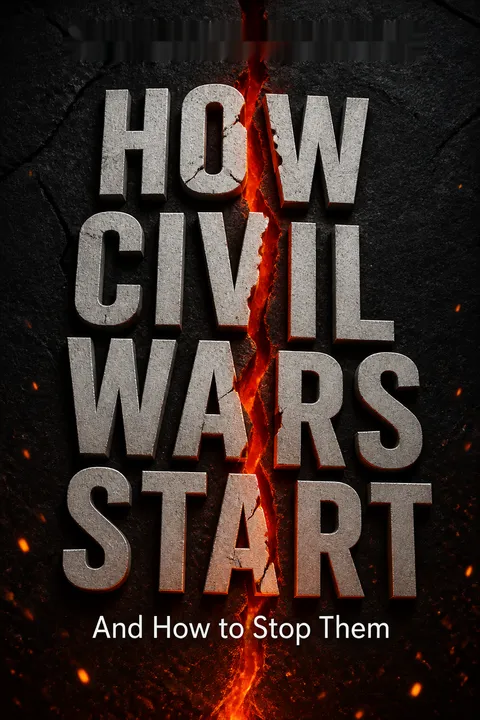


Key Takeaways
Treat civil war as a process, not a sudden breakdown
Violence has a prehistory. The book opens with Adam Fox, a Michigan militia member whose group plotted to kidnap Governor Gretchen Whitmer and provoke a wider revolt. The plot was disrupted, but Walter sees its ingredients as familiar from conflicts abroad: small armed groups, political grievance, recruitment, and leaders who frame violence as necessary. Modern civil wars rarely begin with uniformed armies meeting on a battlefield. They can develop through scattered attacks, intimidation, and militias targeting civilians and public institutions.
Watch the pattern forming. In Sarajevo, residents kept going to work and weddings even as militias organized nearby. The warning is that daily life can look normal while political trust and restraint are already eroding.
What's striking is the gap between how people imagine war and how it often begins: not with a declaration, but with preparations that are easy to dismiss one by one. This resembles the way public-health surveillance tracks clusters and trends before a crisis becomes obvious. The analogy has limits, because political actors interpret events strategically, while infections do not. Still, the practical lesson is valuable: evaluate patterns of organization, rhetoric, and tolerated violence, rather than asking whether the country already looks like a battlefield.
Treat the fragile middle between dictatorship and democracy as a danger zone
The middle is unstable. Walter calls a regime between full autocracy and full democracy an anocracy. On the Polity scale used in the book, scores range from -10, most autocratic, to +10, most democratic; the anocracy zone runs from -5 to +5. The Political Instability Task Force found that partial democracies were about twice as likely as autocracies, and three times as likely as full democracies, to face instability or civil war.
Speed can magnify risk. After the 2003 invasion of Iraq, the United States removed Baath Party members from government and disbanded the military before stable institutions were in place. Hundreds of thousands lost jobs and influence. Insurgencies formed as former power holders feared permanent exclusion. Walter argues that rapid political shifts are especially risky in the first two years, while slower transitions, such as Mexico's decades-long opening, can give institutions time to develop.
The useful distinction is between democracy as a destination and democratization as a process. Elections alone cannot make a state legitimate if courts, security forces, and public administration cannot enforce rules fairly. This is a classic institutional-capacity problem: political competition expands faster than the machinery needed to manage its consequences. Yet the finding should not be read as an argument for dictatorship. The book also describes countries that pass through the middle peacefully. The warning is against abrupt institutional dismantling, not against political rights.
Track identity-based political exclusion, not diversity by itself
Difference is not destiny. Research discussed in the book finds that a country's ethnic diversity alone does not reliably predict civil war. A sharper warning sign is factionalism: political parties organized around ethnic, religious, or racial identity that seek power for one group at others' expense. In Yugoslavia, Josip Tito suppressed overt ethnic politics; after his death, Slobodan Milošević and other leaders mobilized national identity and grievance. Rival communities increasingly came to see control of the state as a struggle for survival.
Look for stacked identities. Walter calls a group a superfaction when identity overlaps with religion, class, and geography. Serbs and Croats in the former Yugoslavia became more sharply separated across these lines. The book cites research finding much greater conflict risk when a society's factions are this tightly aligned.
This distinction helps avoid a common analytical mistake: treating cultural variety as a built-in source of violence. Political institutions determine whether differences cross-cut one another or pile into opposing camps. When religion, territory, economic opportunity, and party loyalty all point in the same direction, compromise can feel like surrender. The concept also suggests a diagnostic question for democracies: do political coalitions remain open to shifting interests, or do identity and party become nearly inseparable? The latter narrows the space for negotiation, even without widespread personal hatred.
Watch for once-dominant groups who believe their rightful status is slipping
Status loss can mobilize. Walter uses downgrading to describe a group's perceived or actual decline in political power and social standing. Datu Udtog Matalam, a respected Muslim leader in the Philippines, lost influence as Catholic settlers moved into Mindanao and the government favored them in land ownership and opportunity. His separatist manifesto helped intensify fear on both sides, contributing to a conflict that outlasted him.
The claim of entitlement matters. Groups that believe a region or country is rightfully theirs may respond fiercely to losing control. Walter calls such groups sons of the soil, a term for communities that see themselves as native heirs to a territory. A study cited in the book found these groups rebelled at about 60 percent, compared with 28 percent for groups outside the category. This describes a risk pattern, not a moral right to exclude newcomers.
The emphasis on status adds something that income statistics can miss. A group can be materially comfortable and still experience political change as humiliation or loss of ownership. Behavioral research on loss aversion helps explain why people may fight harder to recover a perceived loss than to secure a comparable gain. But status narratives are also politically constructed: leaders can portray equality as dispossession. That makes it essential to distinguish genuine exclusion from claims that equal rights for others are themselves an injury.
Do not mistake peaceful protest for proof that a system can still reform
Hope keeps people peaceful. Catholics in Northern Ireland protested discrimination for years. When British troops treated them as enemies rather than protecting their rights, many concluded that peaceful reform would not work; the Provisional IRA gained support. In Syria, protesters initially sought political freedoms and an end to arbitrary detention. The government's deadly crackdown and refusal to offer reforms helped turn demonstrations into armed resistance.
Some political moments expose the future. Elections can reassure losers that they may compete again, or convince them that power is permanently closed to them. The book cites peaceful protest success rates of about 65 percent in the 1990s and 34 percent since 2010. Those figures do not mean protest causes war. The danger is a failed attempt at change, especially when a government answers dissent with violence and a faction sees no credible route back into power.
Hope here is more than a feeling. It is a judgment that the political system remains responsive, which gives citizens a reason to accept temporary defeat. This connects to the logic of nonviolent movements: broad coalitions can make repression costly and reform more attractive to leaders. But that route depends on institutions that can hear demands and protect demonstrators. The lesson is not that every protest deserves immediate concessions. It is that indiscriminate force can destroy the very legitimacy that makes peaceful dissent manageable.
Treat engagement-driven social media as an accelerant for factional conflict
Outrage travels well. In Myanmar, internet access grew rapidly after political restrictions eased. Buddhist ultranationalists used Facebook to spread anti-Rohingya hate and false claims; military-linked accounts amplified the content. Walter describes the platform's engagement-based business model as an accelerant because algorithms can reward material that provokes fear and anger. The result was a faster, wider circulation of messages that marked a minority as dangerous and foreign.
The consequences were real. The book reports that about 700,000 Rohingya were forced to flee Myanmar by early 2018. Walter is careful to distinguish this one-sided ethnic cleansing from a civil war, since the Rohingya could not organize an armed fight back. More broadly, social platforms help political entrepreneurs reach recruits, coordinate groups, raise money, and cast rivals as existential threats.
The Myanmar case makes visible a difficult design problem: a platform can distribute speech broadly while its ranking system selectively rewards content that captures attention. The technology does not create prejudice from nothing, but it can make grievance easier to repeat, coordinate, and monetize. This is a governance problem as much as a media-literacy problem, because individual users cannot inspect or control the recommendation system shaping their feeds. At the same time, moderation must be transparent and accountable, or measures against hate can become tools for suppressing dissent.
Expect decentralized terror and intimidation, not a replay of 1861
Modern insurgents avoid open battle. A powerful government can defeat militias in a conventional war, so modern insurgent groups may instead use guerrilla tactics, assassinations, sabotage, and attacks on public infrastructure. They can communicate through encrypted networks and organize as small, loosely connected groups. The aim is often to frighten civilians, weaken trust in government, and pressure leaders or voters into accepting the militants' demands.
Walter's U.S. warning was specific to its moment. Assessing the United States after the January 6, 2021, attack, she described an erosion of democratic safeguards, identity-based factionalism, and growing militia activity. She reported a Polity score of +5, at the edge of the anocracy range, and a factionalism rating in the danger zone. These indicators frame a risk assessment, not a prediction that civil war is inevitable or imminent.
The shift from battlefield to intimidation changes what preparedness means. A state may be militarily dominant yet politically vulnerable if citizens doubt that elections, courts, or law enforcement are impartial. This is why a few coordinated attacks can have effects far beyond their casualty count: they can alter behavior, participation, and perceptions of safety. The book's American diagnosis is also historically situated and politically charged. Its strongest use is as a checklist of institutional vulnerabilities, not as a settled forecast or a license to treat ordinary dissent as insurgency.
Repair democratic institutions and everyday trust before violence becomes routine
Make peaceful politics credible. Walter identifies rule of law, voice and accountability, and effective public services as central protections against renewed conflict. That means protecting fair elections, limiting executive power, expanding participation, and ensuring that citizens can obtain basic services. She also argues for civic education and for confronting domestic extremist networks rather than dismissing them as isolated troublemakers.
South Africa shows that leaders can change course. Under apartheid, the country had many conditions associated with civil war. President F. W. de Klerk lifted the ban on liberation groups and released Nelson Mandela, while Mandela pursued negotiations rather than revenge. Economic pressure and leadership choices helped open a peaceful transition. Walter's conclusion is practical: improve governance, address broad-based grievances, and enforce the law against violence without granting extremists their exclusionary aims.
The prevention strategy is strongest when its parts reinforce one another. Fair procedures make public services more legitimate; legitimate institutions make it easier to reject militia protection and conspiracy narratives. This is a positive feedback loop, just as corruption and selective enforcement can create a destructive one. South Africa also cautions against reducing peace to personal virtue: external pressure, political calculation, organized opposition, and negotiation all mattered. Reform cannot eliminate every extremist. It can, however, reduce the number of people who see violence as their only practical route to safety or influence.
Analysis
Walter's central contribution is to replace the cinematic image of civil war with a cumulative political model. The pivotal signs are not simply poverty, cultural diversity, or angry rhetoric. They are combinations: weakened institutions, political factions organized around identity, groups losing status, and a shrinking belief that the system can deliver protection or fair competition. The case studies make this model tangible. Iraq shows how dismantling institutions can turn former insiders into insurgents. Yugoslavia shows how leaders can harden identities that once coexisted. Northern Ireland and Syria show how state violence can destroy the expectation of peaceful change.
The model is most useful as a way to ask disciplined questions, not to announce a date for conflict. A regime score or factionalism rating describes broad patterns, while actual outcomes depend on choices by leaders, security forces, opposition movements, and outside actors. Walter emphasizes this distinction, but her application to the United States is necessarily more contestable than the historical cases: political categories and risk measures do not settle every dispute about how institutions are functioning. Her warning is strongest when read conditionally. If election legitimacy, equal protection, and institutional restraint continue to erode, risk rises; the measures are not proof that war must follow.
The book also links structural conditions to communication. Identity entrepreneurs supply the story, while social platforms can distribute it at scale and reward escalation. This is a persuasive account of acceleration, though not a complete theory of media effects. Platforms amplify political incentives that already exist; they do not explain why some audiences accept a narrative while others reject it. The distinction matters for solutions. Better moderation alone cannot repair exclusion, and economic relief alone cannot restore confidence in elections. Prevention requires institutions that are both capable and trusted, paired with public norms that make political defeat tolerable. The book's deepest practical insight is that peace depends on keeping a credible, nonviolent path to power open for rivals.
Review Summary
How Civil Wars Start by Barbara F. Walter explores the conditions that lead to civil wars, drawing on historical examples and data analysis. Reviewers found the book insightful and alarming, praising Walter's examination of factors like anocracies, factionalism, and social media's role in conflicts. Many readers appreciated the author's application of these concepts to the current U.S. political climate. However, some criticized the book's perceived political bias, particularly in later chapters. Overall, readers found the book thought-provoking and relevant, despite disagreements on specific points.
People Also Read




Glossary
Anocracy
hybrid political regimeA political system that combines democratic and autocratic features. Citizens may vote and organize, while leaders retain broad powers and checks on government remain weak. Walter identifies this middle zone as unusually vulnerable to conflict, especially when political change is rapid or institutions cannot manage competition fairly.
Factionalism
identity-based political exclusionA political arrangement in which parties organize around ethnic, religious, or racial identity and seek to govern for their own group at the expense of others. It differs from ordinary disagreement over policy because group membership becomes politically fixed and compromise can appear to threaten a community's security.
Superfaction
overlapping group divisionsA faction whose members share several reinforcing identities, such as ethnicity, religion, class, and geographic location. These overlapping divisions can make political boundaries harder to cross and intensify competition. Walter argues that such concentrated, aligned groups can be especially volatile when they compete for control or protection.
Downgrading
declining group statusA group's loss of political influence, social standing, or cultural privilege, whether measured institutionally or experienced as a loss. Groups that once held power may react sharply when they believe their position is slipping and that they are entitled to retain it. The perception can be politically mobilized even when the claimed entitlement is not justified.
Sons of the soil
territorially rooted groupsAn ethnic or local community that considers itself native to a particular territory and its rightful heir. Members may view later arrivals as outsiders who threaten their control of land, language, jobs, or political representation. The term describes a recurring conflict pattern, not a legal or moral endorsement of exclusive ownership.
Ethnic entrepreneurs
leaders who mobilize identityPolitical or social actors who use ethnic, religious, or racial identity to build support, often by portraying an out-group as a threat. They may use media, historical narratives, symbols, and discriminatory policies to intensify grievance and secure power. Their actions can turn latent social differences into organized political factions.
Security dilemma
self-reinforcing mutual fearA cycle in which one group takes measures it considers defensive, such as forming armed groups or acquiring weapons, but rivals interpret those measures as evidence of hostile intent. The rivals respond in kind, increasing insecurity on both sides. Leaders can exploit this cycle by presenting fear as proof that violence is necessary.
Accelerationism
hastening societal collapseAn extremist belief that existing society is irredeemable and that violence should hasten its collapse so a radically different order can be built. In the book, some far-right groups use this logic to provoke conflict, expecting government overreaction and social disorder to recruit new supporters.
Leaderless resistance
decentralized militant actionA strategy in which small, independent cells or individuals act without a central command structure. Shared ideology and communication networks provide loose coordination, while decentralization makes infiltration and disruption more difficult. Online platforms can help such groups communicate, recruit, and circulate tactics.
Conflict trap
recurring civil warThe tendency for countries that have experienced civil war to face renewed conflict when the underlying grievances and institutional weaknesses remain unresolved. Former fighters and narratives can persist or reappear in new forms. Walter argues that strengthening governance, including accountability and rule of law, helps reduce the chance of another conflict.
FAQ
What's How Civil Wars Start: And How to Stop Them about?
- Focus on civil wars: The book examines the conditions and factors that lead to civil wars, using historical examples and data analysis to identify patterns in conflicts worldwide.
- Modern implications: Barbara F. Walter argues that the warning signs of civil war are visible in contemporary America, stressing the need to recognize these signs to prevent future violence.
- Predictive framework: Walter introduces a framework for predicting civil wars, focusing on political structures, social divisions, and identity politics, with a particular emphasis on "anocracy."
Why should I read How Civil Wars Start: And How to Stop Them?
- Timely relevance: The book provides critical insights into the factors leading to civil unrest, essential for understanding current political climates in the U.S. and globally.
- Expert analysis: Walter's extensive research and experience as a civil war scholar offer a well-researched perspective combining theory with real-world examples.
- Preventive strategies: It discusses potential strategies for preventing civil wars, making it a valuable resource for policymakers, activists, and concerned citizens.
What are the key takeaways of How Civil Wars Start: And How to Stop Them?
- Anocracy as a risk factor: Countries with political systems that are neither fully democratic nor autocratic are more prone to civil war.
- Role of identity politics: Ethnic and religious identities can become politicized, leading to factionalism and violence when groups feel threatened.
- Importance of hope: The loss of hope among citizens can trigger civil conflict, as people may resort to violence if they believe peaceful reform is impossible.
What are the best quotes from How Civil Wars Start: And How to Stop Them and what do they mean?
- “We have trusted, for too long perhaps, that peace will always prevail.” This highlights the complacency that can lead to civil unrest, emphasizing the need for vigilance.
- “A movement turns to violence when all hope is lost.” It underscores the desperation that can drive groups to extremism, stressing the importance of addressing societal issues.
- “Hope shrinks in the face of blatant government brutality.” This emphasizes the role of hope in maintaining social order and the consequences of losing faith in government.
What is the concept of anocracy in How Civil Wars Start: And How to Stop Them?
- Definition of anocracy: Anocracy is a political system with both democratic and autocratic features, often leading to instability and a higher risk of civil war.
- Historical examples: The book uses examples like Iraq post-Saddam to illustrate how rapid political transitions can lead to conflict.
- Predictive value: Walter discusses how the polity index score can predict civil war likelihood, with anocracies being at the highest risk.
How does How Civil Wars Start: And How to Stop Them relate to current events in the U.S.?
- Warning signs in America: Walter identifies political polarization, extremist groups, and erosion of democratic norms as warning signs of civil conflict in the U.S.
- Impact of social media: The book discusses how social media can amplify divisions and spread misinformation, contributing to societal unrest.
- Call to action: Walter urges readers to recognize these signs and take action to prevent civil war, emphasizing civic engagement.
What role do factions play in civil wars according to How Civil Wars Start: And How to Stop Them?
- Definition of factions: Factions are groups coalescing around shared identities, often leading to power competition and civil war.
- Historical context: The book provides examples like the Yugoslav Wars to illustrate how factions can escalate into violence.
- Consequences of factionalism: Entrenched factions can lead to social cohesion breakdown and increased likelihood of armed conflict.
How does How Civil Wars Start: And How to Stop Them explain the psychological aspects of civil conflict?
- Downgrading and status loss: Groups feeling their status slipping may resort to violence to reclaim their position.
- Emotional triggers: Emotions like fear and anger can fuel conflict, especially when groups perceive identity threats.
- Hope and despair: Hope is crucial in preventing civil war; losing hope in peaceful reform can lead to violence.
What preventive measures does How Civil Wars Start: And How to Stop Them suggest?
- Strengthening democratic institutions: Reinforcing democratic norms and institutions can reduce civil war risk.
- Addressing grievances: Open dialogue and negotiation can help address marginalized groups' grievances and prevent conflict.
- Civic engagement: Active citizen involvement in political systems can foster transparency and accountability.
How does social media influence civil wars according to How Civil Wars Start: And How to Stop Them?
- Amplification of divisions: Social media can exacerbate divisions, spreading extremist narratives and inciting anger.
- Recruitment tool for extremists: It serves as a recruitment tool, allowing extremist groups to organize and mobilize quickly.
- Misinformation and disinformation: The spread of false narratives can increase tensions and undermine trust in institutions.
What historical examples does How Civil Wars Start: And How to Stop Them use to illustrate its points?
- Yugoslav Wars: Used as an example of how factionalism and identity politics can lead to civil war.
- Iraq post-Saddam: Highlights how rapid political change can create instability and sectarian violence.
- Philippines and Mindanao: Illustrates the psychological aspects of downgrading and perceived loss of power.
What is the pre-insurgency phase as defined in How Civil Wars Start: And How to Stop Them?
- Initial grievances identified: Groups articulate grievances and build a collective identity, creating narratives to rally support.
- Recruitment and organization: Groups recruit members and prepare for potential conflict, laying groundwork for future violence.
- Stockpiling resources: As tensions rise, groups may stockpile weapons, indicating a shift towards armed conflict.
Download PDF
Download EPUB
.epub digital book format is ideal for reading ebooks on phones, tablets, and e-readers.








