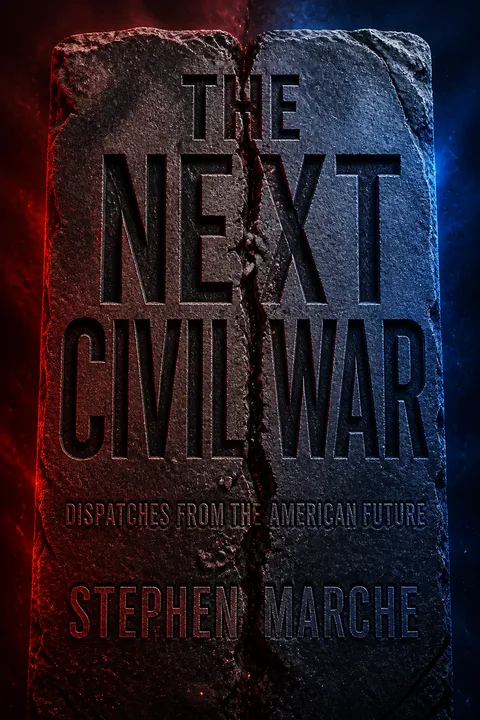


Key Takeaways
Read civil war as a cascading systems failure, not a sudden battle.
The fracture comes first. Marche argues that a second American civil war would be less like two armies meeting in a field and more like a breakdown of shared authority, trust, and national identity. He points to economic inequality, political paralysis, environmental strain, and declining faith in institutions as forces that amplify one another. Donald Trump, in this account, is a symptom of these pressures, not their sole source; changing presidents would not automatically remove them.
The warning is not a timetable. The book cites a 35 percent expert estimate of civil war within 10 to 15 years, and a 2019 poll in which Americans rated their country 67.23 out of 100 toward the edge of civil war. Under one research definition, civil strife begins at 25 deaths in a year, while civil war requires 1,000 combatant deaths. Marche uses these figures to describe danger already present, not to prove a future war is inevitable.
What's useful here is the shift from searching for one villain to tracing reinforcing failures. Systems thinking helps explain why shocks can have outsized effects: weak trust makes coordination harder, and failed coordination further weakens trust. Yet a cascading model can make collapse sound more inevitable than it is. Feedback loops can intensify breakdown, but institutions and social movements can also interrupt them. The distinction between civil strife and civil war is especially valuable because it separates serious warning signs from a claim that the country has already crossed into war.
Treat viral outrage as infrastructure that can turn local disputes into national tests.
A bridge becomes a symbol. In Marche's imagined first dispatch, federal inspectors close a rural bridge they consider unsafe. A sheriff reopens it in defiance of federal authority, drawing militias, counterprotesters, and national media. The bridge matters less than the story each side attaches to it: public safety for some, federal tyranny for others. The scenario draws on real resistance by sheriffs, including Richard Mack, who described threatening to arrest federal officials over a bridge repair dispute.
The feed escalates the stakes. Marche describes an information system in which outrage attracts attention, attention rewards spectacle, and spectacle recasts a practical dispute as a battle over national identity. He calls hard-right activists who oppose federal authority while claiming to defend the country “anti-government patriots.” Their movements can be ideologically inconsistent yet connected by a shared narrative of illegitimate government.
The bridge scenario captures a key feature of modern political conflict: the symbolic meaning of an event can travel farther than its material consequences. Media systems do not merely report a dispute; the incentives of attention can magnify its most polarizing interpretations. This resembles a coordination problem, where people act not only on what happened but on what they believe others are seeing and preparing to do. The account is strongest as a warning about escalation, not as proof that online attention alone causes violence. Local institutions and trusted intermediaries still shape how a crisis is understood.
Watch grievance turn violent when isolation, opportunity, and urgency converge.
Violence can be leaderless. “Stochastic terrorism” is the book's term for political violence emerging from a broad atmosphere of hostility without a central organizer issuing a precise plan. The imagined assassin is an isolated young man whose private frustrations find validation in online conspiracy communities. The politics give personal failure a grand explanation and make violence appear meaningful.
The transition has warning patterns. Sociologist Ramón Spaaij describes three clusters: a sudden opening to act, a decline in the perceived cost of action alongside rising costs of inaction, and a final intensification of pressure. These are not a reliable checklist for predicting any one person. They describe how personal crisis, violent rhetoric, and available opportunity can intersect. The Secret Service can secure a president against many immediate threats, but it cannot by itself remove a society-wide climate of political hatred.
This account connects political violence to social psychology without reducing it to either ideology or individual pathology. A grievance can become more compelling when a person finds belonging in a group that supplies both an enemy and a heroic role. That insight matters for prevention: threat assessment alone cannot substitute for social connection, credible institutions, and ways to resolve grievances without violence. The framework also needs restraint. Many isolated people consume extreme material and never act, so these patterns can guide attention but cannot establish guilt or predict a particular attack with certainty.
Prepare for climate shocks where inequality makes every recovery less fair.
Three pressures compound. Marche identifies economic inequality, drought, and vulnerable property as the United States' principal “threat multipliers,” forces that intensify other dangers. Inequality can leave households with little cushion after a shock and weaken public willingness to accept recovery costs. Drought can raise food prices and disrupt supply chains. Floods and storms can damage infrastructure, homes, and tax bases, leaving cities less able to recover.
The imagined New York disaster makes the chain personal. In one dispatch, a fictional storm overwhelms flood protections, strands a radio producer, and forces families to evacuate. The story is a scenario, not a forecast. Its foundation includes real vulnerabilities: Hurricane Sandy caused extensive damage, and the book cites a model estimating 13 million future US climate migrants from sea-level rise alone. The point is that displacement and recovery depend on social resources, not weather alone.
The threat-multiplier idea is powerful because it links climate risk to housing, food, public finance, and trust rather than treating weather as a separate environmental issue. Disaster research likewise emphasizes that exposure and recovery are uneven: the same hazard can be manageable for one household and ruinous for another. The book's narrative turns an abstract model into a human experience, though its dramatic New York scenario can blur the line between plausible pathway and likely outcome. The practical implication is not certainty about one storm, but the value of reducing vulnerability before emergencies arrive.
A military victory can deepen the legitimacy crisis it was meant to end.
Winning firefights is not winning consent. Marche's bridge scenario gives federal forces overwhelming tactical superiority, yet each action risks confirming the rebels' claim that the government is an occupying enemy. Legal constraints, divided loyalties among local authorities, and a constant media spectacle complicate any response. The military may defeat an armed group while failing to restore public confidence.
Counterinsurgency is a political problem. The book discusses the military doctrine called SCHBT, a sequence for shaping conditions, clearing and holding territory, building institutions, and transitioning control. It also describes ISIR, a framework for identifying, separating, influencing, and encouraging renunciation by insurgents. Retired General Daniel Bolger argues that force cannot persuade a population to accept rule it regards as illegitimate. Colonel Peter Mansoor sees a narrower possibility: security can sometimes create room for political progress.
This distinction between tactical success and political legitimacy is central to understanding insurgency. Coercion can suppress visible resistance while strengthening the grievances that sustain it, especially when civilians experience the state as arbitrary or humiliating. The book wisely includes disagreement: force may sometimes reduce immediate violence enough for political negotiation to proceed. But that possibility depends on the political project being credible to the people affected. The lesson is not that governments should never use force, but that force cannot substitute for representation, accountability, or a legitimate route back to ordinary civic life.
Secession becomes plausible when political camps harden into territorial identities.
Difference alone does not divide a country. Scholars of secession whom Marche interviews emphasize that independence movements usually need more than policy disagreement. They need a shared identity connected to a territory. The book describes increasingly distinct urban and rural political cultures and the “big sort,” the movement of like-minded people into different places. It also cites a 2014 poll in which one in four Americans supported the idea of their state peacefully leaving the Union.
A peaceful split would still be difficult. A breakup would raise questions about national debt, citizenship, military assets, borders, and international recognition. Texas and California separatists have attracted support, but political rhetoric is not the same as a workable independence plan. Marche presents separation as a possible alternative to violence, not an easy solution. The country would have to negotiate its way through questions that the Constitution does not provide a simple process to resolve.
The territorial dimension is a useful corrective to the idea that intense polarization automatically produces secession. People may disagree fiercely while remaining economically, socially, and personally entangled across regional lines. Federalism can sometimes accommodate that variation without dissolving the state, but it depends on rules that both sides regard as fair. Secession also carries its own risks: borders create new minorities, and a region that leaves may discover that internal differences have not disappeared. The book's scenario is most persuasive as a measure of how far trust has fallen, rather than a prediction that separation is imminent.
Confront national symbols honestly, because historical myths can bind and divide.
A monument carries competing memories. Marche examines Silent Sam, a Confederate statue at the University of North Carolina. For activist Maya Little, its prominent location honored white supremacy. For Confederate heritage advocate Jake Sullivan, removing it dishonored ancestors. The statue's dispute reflects a deeper history: Americans have often reconciled politically by preserving selective memories and excluding Black experience. The book traces this pattern from slavery's place in the Constitution through the compromises that followed the Civil War.
Symbols are not neutral decorations. They tell people whose sacrifices count and who belongs in public life. When a legislature blocks relocation of the statue, even a proposed compromise satisfies neither side. Marche argues that the conflict is not merely about interpreting the past; it is also about present dignity and future belonging. Honest history cannot erase grief, but it can expose the omissions that make inherited national stories feel false to some citizens.
The case shows why disputes over monuments are often disputes over political membership in disguise. Collective memory shapes which groups see public institutions as theirs, and whose injuries are treated as settled history. A museum can create room for context, but moving an object does not itself resolve the underlying conflict over recognition. The book's attention to both participants' meanings is valuable, while its emphasis on irreconcilability risks making compromise appear impossible by definition. Better public memory does not require equal moral standing for every claim; it requires evidence, context, and a willingness to face historical harm without turning remembrance into inherited guilt.
Fix representation before every election becomes a contest over regime legitimacy.
Rules shape who feels represented. Marche points to an electoral system in which a presidential candidate can win the popular vote and lose the presidency, and a Senate whose state-based structure gives small-population states disproportionate influence. He cites a projection that by 2040, 30 percent of the population could control 68 percent of the Senate. Such arrangements may be lawful, yet growing gaps between votes and power can make government seem unresponsive.
The cycle feeds itself. When citizens doubt that votes can change policy, they are more likely to see institutions as partisan prizes. Political actors then have stronger incentives to harden the rules, distrust opponents, and treat losses as illegitimate. Marche argues that replacing one president or party cannot repair a structural crisis. His proposed direction is institutional reform, including a modern electoral system and renewed legitimacy for courts and government.
Legitimacy is partly procedural: citizens may accept outcomes they dislike when they believe the process is fair and offers a real chance to compete. That makes representational rules more than technical details. Still, changing electoral structures is not a neutral engineering exercise. Every design favors some values, such as geographic representation, proportionality, or stable governing coalitions. Reform therefore requires transparent reasoning and broad consent, not simply a new arrangement that benefits the current majority. The book's strongest point is that a system can remain formally constitutional while losing practical authority among the people it governs.
Make hope a program of institutional reinvention, not a prediction of recovery.
The book ends with agency. Marche does not present his imagined dispatches as unavoidable outcomes. He argues that Americans could modernize elections, strengthen courts, reform policing, confront domestic extremism, reduce inequality, and prepare cities and agriculture for climate change. These are different problems, but each requires public institutions capable of acting and citizens willing to recognize their legitimacy.
Nostalgia is not a repair plan. The author rejects the hope that the country will drift back to normal without deliberate change. He calls for recovering the founders' willingness to redesign government for living people, rather than treating the Constitution as untouchable scripture. That argument does not guarantee success. It does identify the alternative to fatalism: acknowledge that inherited structures can fail, then build political arrangements suited to current realities.
The conclusion usefully separates hope from optimism. Optimism predicts a favorable outcome; hope can persist while admitting that outcomes depend on choices and institutions. That distinction supports action without pretending that good intentions are enough. Yet reform itself needs a constituency, and a society divided over basic facts may struggle to agree on what should change. The book's appeal to reinvention is therefore a beginning, not a blueprint. Its most durable contribution is to make institutional maintenance visible: democracy is not preserved by reverence alone, but by rules that remain usable, credible, and open to revision.
Analysis
The book works as scenario-driven political nonfiction. Its fictional dispatches are not predictions in the strict sense. They are narrative stress tests: each takes documented vulnerabilities, such as armed political movements, weak infrastructure, or contested electoral legitimacy, and follows how those conditions might interact after a triggering event. This structure gives abstract systems human faces, from a sheriff turning a bridge closure into a sovereignty dispute to a family displaced by a storm. It also creates a risk: vivid stories can feel more probable than the evidence warrants. The book is most persuasive when it distinguishes known trends from imagined triggers, and least secure when a plausible pathway begins to resemble an inevitable destination.
Its underlying argument is that political breakdown is not reducible to a single leader or party. The deeper danger is the loss of shared legitimacy: citizens no longer agree on who may govern, what counts as evidence, or which national stories include them. Information networks intensify the problem by rewarding spectacle, while inequality and climate stress make the costs of paralysis more immediate. The result is a feedback model in which institutional failure deepens social distrust, and distrust makes collective responses harder.
The book's strongest analytical move is to treat violence as a struggle over meaning as well as force. A government may win an engagement and lose authority; an individual attacker may become a symbol for people who never meet him. Its most debatable move is the expansive framing of the American Republic as nearing its end. That language is an effective alarm, but the United States contains competing institutions and identities that can also restrain escalation. The evidence supports serious vulnerability, not a settled forecast of civil war or secession.
The final call for reinvention follows from the diagnosis. If inherited rules no longer produce representation or trusted outcomes, appeals to nostalgia cannot restore confidence. But redesign requires agreement about fair procedures, and that is precisely what polarization erodes. The book leaves readers with a demanding proposition: democratic survival depends less on celebrating national unity than on building institutions capable of handling persistent disagreement without turning every loss into an existential defeat.
Review Summary
The Next Civil War receives mixed reviews, with ratings ranging from 1 to 5 stars. Some praise its well-researched scenarios and thought-provoking analysis of America's potential collapse, while others criticize it as alarmist, biased, or lacking nuance. Supporters find the book's exploration of political polarization, inequality, and structural issues compelling. Critics argue it oversimplifies complex issues and fails to offer solutions. The book's speculative nature and the author's outsider perspective as a Canadian are both lauded and criticized, depending on the reviewer's stance.
People Also Read


Glossary
anti-government patriot
Anti-state, pro-country activistMarche's label for a diverse collection of hard-right groups and individuals who oppose federal authority while presenting themselves as defenders of the United States. The term describes a shared political sensibility, not one organization or fixed ideology. Members may combine opposition to federal power with militia activity, white nationalism, conspiracy beliefs, or other views, but the label does not imply that every person shares all of them.
stochastic terrorism
Violence emerging from ambient rhetoricPolitical violence that arises without a central organizer directing a specific attack. A widespread atmosphere of hostility, repeated violent rhetoric, and cultural narratives can encourage some individuals to act, even when no speaker gives them an explicit plan. The term emphasizes that broad conditions may raise risk while leaving the timing, perpetrator, and exact event difficult to predict.
threat multiplier
Force that intensifies other risksA condition that worsens existing political or social vulnerabilities rather than causing conflict by itself. Marche applies the term to economic inequality, drought, and vulnerable property. For example, a storm can become more disruptive when infrastructure is fragile and residents lack resources to recover. The concept connects environmental and economic pressures to the capacity of institutions and communities to withstand shocks.
interposition
Local resistance to federal authorityThe doctrine, rejected by the Supreme Court in Cooper v. Aaron, that a state or local official may stand between federal authority and residents to resist what the official considers an abuse of power. In the book, some sheriffs use the idea to claim a special duty to obstruct federal action. Its continuing appeal illustrates how constitutional language can be used to challenge the legitimacy of government.
the big sort
Political clustering by placeJournalist Bill Bishop's term for the tendency of Americans to move into communities populated by people with similar lifestyles and political outlooks. The choices are often made for reasons beyond party affiliation, such as work or preferred ways of life, but they can still concentrate political groups geographically. Marche argues that this clustering reinforces polarization by reducing everyday contact across political differences.
SCHBT
Counterinsurgency sequenceA military planning sequence described in the book as Shape, Clear, Hold, Build, and Transition. It aims to prepare an area, remove insurgent control, maintain security, establish institutions, and transfer responsibility. Marche presents it as doctrine developed for counterinsurgency, while stressing that tactical control cannot by itself produce legitimacy or resolve the political grievances that sustain resistance.
ISIR
Radicalization response frameworkA counterinsurgency framework described as Identify, Separate, Influence, and Renunciation. It proposes identifying radicalized people, separating them from insurgent networks, influencing them, and encouraging them to reject the movement. Marche questions how such a process can succeed when state actions also restrict rights or harm families, since coercive methods may strengthen the very grievances the framework seeks to reduce.
FAQ
1. What is "The Next Civil War: Dispatches from the American Future" by Stephen Marche about?
- Explores Imminent American Collapse: The book examines the possibility and nature of a second American civil war, arguing that the United States is on the brink of collapse due to deep political, social, and economic divisions.
- Dispatches as Scenarios: Marche presents a series of "dispatches"—detailed, plausible scenarios—depicting how civil conflict could unfold, including armed uprisings, political assassinations, environmental disasters, and eventual secession.
- Analysis of Underlying Forces: The narrative investigates the root causes of instability, such as hyper-partisanship, loss of institutional legitimacy, economic inequality, and climate change.
- Blends Fact and Imagination: While grounded in interviews, data, and historical precedent, the book uses speculative fiction techniques to make abstract threats tangible and immediate.
2. Why should I read "The Next Civil War" by Stephen Marche?
- Timely and Urgent: The book addresses current and escalating threats to American democracy, making it highly relevant for anyone concerned about the country's future.
- Comprehensive Perspective: Marche combines political analysis, historical context, expert interviews, and vivid storytelling to provide a multifaceted understanding of America's fragility.
- Challenges Complacency: It confronts the reader with uncomfortable truths about the state of the nation, urging a reckoning with issues often ignored or minimized in mainstream discourse.
- Global Implications: The book argues that the fate of the United States will have profound consequences for democracy and stability worldwide.
3. What are the key takeaways from "The Next Civil War" by Stephen Marche?
- Civil War Is Plausible: Multiple experts and polls suggest a significant risk of civil conflict in the near future, with America already experiencing levels of civil strife by some definitions.
- Complex, Cascading Causes: No single factor will cause collapse; instead, a turbulent interaction of political, economic, environmental, and informational crises is eroding national unity.
- Spectacle and Information Warfare: Modern conflict will be shaped as much by media narratives, memes, and viral outrage as by physical violence.
- Institutional Paralysis: The U.S. political system is increasingly unable to address collective crises, making it vulnerable to shocks and unable to reform itself.
- Secession and Disunion: The book posits that peaceful separation into multiple countries may be a more likely and less catastrophic outcome than outright civil war.
4. How does Stephen Marche define and envision a "second American civil war"?
- Not Like the First: Marche argues the next civil war would not resemble the 1860s conflict with organized armies, but rather a chaotic, decentralized struggle—neighbor against neighbor, driven by beliefs, race, and ideology.
- Threshold Already Crossed: By some technical definitions (e.g., number of deaths from domestic extremism), the U.S. is already in a state of civil strife.
- Multiple Inciting Incidents: The book presents various plausible triggers, such as a standoff over a rural bridge, a presidential assassination, or a catastrophic environmental event.
- War of Meaning: The conflict would be as much about control of narratives and legitimacy as about territory or government.
5. What are the main causes of instability and potential civil war in "The Next Civil War"?
- Hyper-Partisanship: Deepening political polarization has turned party affiliation into tribal identity, eroding the possibility of compromise or shared national purpose.
- Loss of Institutional Legitimacy: Trust in government, the judiciary, media, and other institutions is at historic lows, undermining the social contract.
- Economic Inequality: Extreme and growing inequality has historically led to unrest, and the U.S. now matches or exceeds levels seen before revolutions elsewhere.
- Climate Change and Environmental Crisis: Increasingly severe disasters (droughts, hurricanes) threaten food security, property, and urban stability, acting as "threat multipliers."
- Information Pollution: Social media and partisan media ecosystems amplify outrage, spread disinformation, and make consensus or factual agreement nearly impossible.
6. How does "The Next Civil War" describe the role of right-wing militias and anti-government movements?
- Mainstreaming of Extremism: Once fringe beliefs about secession and armed resistance have become mainstream within the American right, with significant support from elected officials and law enforcement.
- Preparation for Conflict: Militias and "preppers" are actively training, arming, and organizing for the possibility of government collapse or civil war.
- Ideological Incoherence: The hard right is a loose coalition of groups (militias, sovereign citizens, white nationalists) united more by anti-government sentiment than by a coherent ideology.
- Infiltration of Institutions: There is documented infiltration of law enforcement and the military by hard-right and white supremacist elements, complicating any government response to insurrection.
7. What scenarios or "dispatches" does Stephen Marche use to illustrate possible futures for America?
- The Battle of the Bridge: A rural sheriff defies federal authority over a bridge closure, sparking a standoff that escalates into armed conflict and military intervention.
- Portrait of an Assassination: A "lone wolf" assassin, radicalized by online hate and personal grievance, kills the president, triggering national trauma and further polarization.
- The Fall of New York: A catastrophic hurricane overwhelms New York City, exposing the fragility of urban infrastructure and creating millions of climate refugees.
- Outbreak of Widespread Violence: A major terrorist attack (e.g., a dirty bomb at the Capitol) leads to martial law, mass detentions, and a cycle of repression and insurgency.
- The End of the Republic: The U.S. peacefully or violently breaks apart into multiple countries, as political and cultural divisions become insurmountable.
8. How does "The Next Civil War" address the impact of climate change and environmental crises on American stability?
- Threat Multiplier: Climate change is presented as a force that exacerbates existing social, economic, and political tensions, making crises more likely and more severe.
- Urban Vulnerability: Major cities, especially on the coasts, are at risk from rising sea levels and extreme weather, with infrastructure ill-prepared for nonlinear, catastrophic events.
- Food Insecurity: Droughts and heat waves threaten American agriculture, potentially leading to food shortages, price spikes, and social unrest.
- Climate Refugees: The book predicts internal migration on a massive scale, as millions are displaced by environmental disasters, straining resources and fueling further division.
9. What does Stephen Marche say about the role of information, media, and spectacle in modern American conflict?
- Outrage as Currency: Social media algorithms and partisan media thrive on outrage, making moral anger the primary driver of virality and political engagement.
- Dehumanization and Meme Warfare: The internet enables rapid dehumanization of opponents and the spread of extremist ideas, often under the guise of satire or irony.
- Narrative as Battlefield: Control over the story—who is the hero, who is the traitor—becomes as important as control over territory or institutions.
- Spectacle Over Substance: Political and violent events are shaped and amplified by their media representation, often escalating conflict rather than resolving it.
10. How does "The Next Civil War" explore the possibility and process of American secession or peaceful disunion?
- Secession as Best-Case Scenario: Marche suggests that, given current trends, a negotiated separation into multiple countries may be preferable to prolonged violence.
- Legal and Practical Barriers: The U.S. Constitution does not allow for secession, but overwhelming popular will could force a political solution, as has happened elsewhere.
- Emerging Identities: The book argues that political, cultural, and even psychological differences are hardening into distinct regional identities, laying the groundwork for separation.
- Potential New Countries: Scenarios include independent Texas, California, a Northern union, and a Southern Confederacy, each with its own economic and social profile.
11. What solutions or hopes does Stephen Marche offer for averting collapse in "The Next Civil War"?
- Need for Revolutionary Spirit: Marche argues that only a fundamental reinvention of American politics—akin to a new Constitutional Convention—can address the scale of the crisis.
- Rejecting Complacency: He warns against the hope that things will simply "work out," insisting that active, collective effort is required to reform institutions and restore legitimacy.
- American Hope and Openness: Despite the darkness, the book acknowledges the enduring spirit of hope, reinvention, and frankness that has historically defined America.
- No Easy Fixes: The author is clear that technical or incremental reforms are insufficient; only bold, systemic change can prevent further decline.
12. What are the best quotes from "The Next Civil War" by Stephen Marche, and what do they mean?
- "The United States is coming to an end. The question is how." — This opening line sets the tone, emphasizing inevitability and focusing attention on the form, not the fact, of collapse.
- "If destruction be our lot, we must ourselves be its author and finisher." (Abraham Lincoln) — Quoted in the epigraph, this underscores the idea that America's greatest threats are internal, not external.
- "The unimaginable does not mean the unpredictable." — Marche argues that while the specifics of collapse are uncertain, the general direction is clear and visible to those willing to look.
- "Civil wars are total wars laced with atrocities, fought not between professional soldiers but between populations." — This highlights the horror and all-consuming nature of modern
Download PDF
Download EPUB
.epub digital book format is ideal for reading ebooks on phones, tablets, and e-readers.








