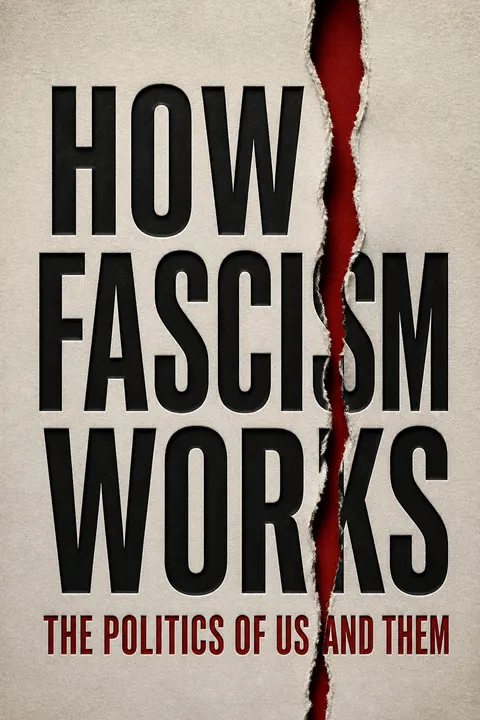


Key Takeaways
Spot fascism in the tactics that divide neighbors into virtuous us and dangerous them
A politics of division. Stanley uses fascist politics to describe ultranationalist tactics that define the nation through ethnic, religious, or cultural belonging and portray an authoritarian leader as its true voice. The tactics matter even when they do not produce a fully fascist state. Their recurring move is to divide people into a worthy in-group and a threatening out-group, making exclusion and cruelty easier to accept.
A family history of warning. Stanley’s father escaped Nazi Germany as a child in 1939. The same year, celebrated aviator Charles Lindbergh promoted an exclusionary vision of America. The contrast shows how a country can carry democratic ideals and fascist sympathies at once. The book follows the political techniques that turn division into policy, rather than treating fascism only as a historical regime.
The book’s most useful move is to shift attention from political labels to political behavior. A leader need not openly endorse a past dictatorship for exclusionary tactics to do harm. At the same time, a single inflammatory statement cannot establish that an entire movement is fascist. The stronger test is cumulative: whether a politics repeatedly sorts citizens by identity, weakens constraints on leaders, and makes targeted groups seem less deserving of protection. That standard preserves the warning without making the term meaningless.
Test golden-age nostalgia against the history it edits out
Nostalgia as a blueprint. The mythic past is an idealized national history, presented as pure, unified, and glorious, then used to justify political changes in the present. Its gender roles are often patriarchal: the strong father leads and protects, while women are assigned domestic and reproductive duties. The point is not historical accuracy. The imagined past makes social hierarchy feel ancient and natural.
Memory has political uses. Stanley connects this strategy to Confederate memorials that celebrate a heroic South while minimizing slavery, and to Hungary’s constitutional praise of Christian heritage and traditional family structures. Research he cites also finds that people remember their own group’s wrongdoing less accurately than wrongdoing attributed to outsiders. Mythmaking can therefore exploit an existing bias, turning selective memory into a defense of national innocence.
Collective memory is not simply a warehouse of facts. It helps groups decide who belongs, what obligations they have, and which losses deserve repair. That makes honest history politically consequential, not merely academic. The argument is strongest when it distinguishes pride in a community from a story that requires purity and domination. A nation can honor achievements without pretending they cancel its crimes. The practical question for any heritage claim is what evidence it leaves out, and whose experience disappears when the story is told.
Ask what cherished ideal a political slogan is being used to hollow out
Virtuous language, harmful ends. Propaganda can make an objectionable political goal sound like a defense of accepted ideals. Stanley points to Richard Nixon’s law-and-order campaign, which his chief of staff’s notes connect to an intent to target Black Americans while avoiding explicit racial language. The slogan sounded like public safety; it helped conceal a discriminatory agenda.
Watch the inversion. Frederick Douglass exposed a similar contradiction in a country that celebrated liberty while enslaving people. Stanley also describes governments attacking judges in the name of fighting corruption, then replacing independent judges with party loyalists. Fascist propaganda does not always reject democracy’s values openly. It can use freedom, fairness, or anticorruption as cover for weakening the institutions that make those values real.
Political language should be evaluated by more than its stated intention. A useful test compares a slogan’s promised principle with the policy and institutional changes carried out under its banner. Does a call for safety protect everyone, or define a suspect population in advance? Does an anticorruption drive increase accountability, or remove independent oversight? This approach avoids dismissing ideals as mere rhetoric. It asks whether the institutions needed to honor those ideals are being strengthened or quietly dismantled.
Defend the shared facts democracy needs before debating policy
Make truth seem optional. Stanley argues that attacks on universities, expertise, and the press erode the common ground needed for public debate. Conspiracy theories help by insinuating that opponents are secretly corrupt, even when audiences do not accept every detail as fact. The fabricated Protocols of the Elders of Zion, for example, cast Jews as controlling institutions and media. In the 2010 Smolensk plane crash, Polish politicians associated with PiS promoted competing conspiracies that undermined trust in government and journalism.
Noise can be a strategy. When every report is dismissed as biased and every rumor treated as equally plausible, citizens lose reliable ways to assess claims. Stanley challenges the idea that simply airing all views will let truth prevail: debate needs shared assumptions and standards of evidence. Without them, political news can become spectacle, with loyalty to a leader replacing trust in verifiable information.
Disagreement is productive only when participants can identify what would count as evidence against their own position. That condition is easily overlooked in defenses of unrestricted debate. Open discussion can test claims, but it can also amplify insinuations designed to make testing impossible. The key distinction is not between comfortable and uncomfortable speech. It is between argument that risks being corrected by evidence and messaging that treats every correction as proof of a cover-up. Democratic media needs openness and verification, not endless repetition of every allegation.
Separate genuine demands for equality from powerful groups’ claims of victimhood
Hierarchy needs a story. Stanley draws on Social Dominance Theory, which studies beliefs that justify group-based differences in power. Fascist politics presents these differences as natural, then casts the loss of privilege as persecution. In a 2014 study, white participants who were reminded of a coming majority-minority United States became more supportive of several right-wing policies, including immigration restrictions. The perceived threat came from the prospect of sharing status.
Context distinguishes the claims. Stanley contrasts domination-driven nationalism with movements formed under oppression. He describes Black Lives Matter as a demand that Black lives receive equal regard, not a claim that other lives matter less. The feeling of loss among people accustomed to social advantages can be real, but it does not establish that they face discrimination comparable to groups denied rights and power.
A fair analysis takes people’s sense of loss seriously without treating that feeling as proof of injustice. This distinction matters because equal treatment often feels like reduced status to those accustomed to receiving more. It also prevents a false equivalence between movements seeking inclusion and movements defending dominance. The question is not simply whether a group invokes identity or pride. It is whether the political demand expands equal standing or preserves a hierarchy by restricting another group’s rights.
Judge actions fairly; reject labels that turn whole populations into criminals
A label can convict before evidence. In 1989, Donald Trump called for the execution of five Black teenagers accused in the Central Park jogger case. They were later exonerated. Stanley uses the episode to show how law-and-order rhetoric can abandon due process while presenting the accused as threats by nature. Linguistic intergroup bias describes a related habit: people often describe an outsider’s bad act as evidence of character, while describing an insider’s similar act as a specific mistake.
The consequences accumulate. The US prison population grew from about half a million in 1980 to more than 2.3 million in 2013, with Black Americans disproportionately incarcerated. Research Stanley cites finds that racial cues can also increase support for punitive policies. These patterns do not prove that every law-enforcement concern is fabricated. They show why crime claims require scrutiny of evidence, fairness, and unequal effects.
Words such as criminal compress an event, a legal judgment, and a claim about character into one label. That compression can make punishment seem obvious while obscuring differences among offenses, circumstances, and evidence. Yet careful language alone cannot correct unequal enforcement or sentencing. The value of the linguistic analysis is that it reveals one point where bias enters public judgment, not a complete explanation of incarceration. A serious account must examine both the stories told about crime and the institutions that act on them.
Treat sexual panic as a political tool, not proof of danger
Fear recruits protectors. Fascist politics often depicts outsiders as sexual threats to women, children, or the nation’s racial purity. Stanley traces this tactic through claims that Black men endangered white women, propaganda about African soldiers in the postwar Rhineland, and later anti-immigrant rumors. Such stories can convert anxiety about social change into demands for a powerful male protector.
Gender becomes a political boundary. The book also examines the 2016 North Carolina bathroom bill, which restricted transgender people’s access to bathrooms by birth sex and was defended as protection for women. The debate cast transgender girls as likely predators without substantiating that generalization. Stanley argues that attacks on sexual minorities and women’s autonomy can defend patriarchal authority indirectly, by presenting equality and freedom as risks to public safety.
Safety concerns deserve evidence, especially when the proposed response limits a minority’s ordinary participation in public life. The recurring political maneuver is to move from a vivid possibility to a blanket suspicion of a whole group. That jump is not unique to fascist movements, but it becomes especially consequential when paired with unequal power and leaders promising protection through exclusion. A careful response separates credible, specific risks from claims that treat identity itself as evidence of danger.
Notice when rural pride is recruited to vilify cities and pluralism
Place becomes identity. Fascist politics often presents the countryside as self-reliant and morally pure, while casting cities as decadent, dependent, and crowded with outsiders. Nazi ideology idealized farmers as guardians of the nation and treated cosmopolitan cities as corrupting. In a 2017 US survey, 42 percent of rural respondents agreed that immigrants burdened the country by taking jobs, housing, and health care, compared with 16 percent of urban respondents.
Real grievances can be misdirected. Stanley describes Minnesota campaigns that blamed urban residents for living off rural taxpayers, even though metropolitan areas generated tax revenue that flowed across the state. Rural communities can have legitimate needs, including jobs and infrastructure. The tactic is to explain those needs through resentment of cities and minorities rather than through an accurate account of economic relationships.
Geography is a powerful political shorthand because it bundles work, culture, education, and identity into a map. That shorthand can make distant urban institutions easy to blame for local hardship. But rejecting the scapegoat should not mean dismissing rural frustration as irrational. The distinction is between taking unequal investment seriously and treating pluralism itself as the cause. Good analysis follows where resources move and who controls decisions, rather than assuming either city or countryside is a single political character.
Protect institutions that let workers share power across group lines
Worth is tied to work. Stanley describes a fascist ideal in which people earn social value through hard work and competition; those who need assistance are cast as lazy or parasitic. In the United States, research he cites found that white Americans’ views of Black people as lazy predicted opposition to welfare more strongly than economic self-interest. This framing turns public support into a moral test and obscures who actually receives assistance.
Solidarity disrupts the divide. Labor unions can bring workers of different races and backgrounds together to bargain collectively. Stanley links attacks on unions to efforts to weaken that shared power and preserve economic hierarchy. He also explains how exclusionary policies can manufacture the conditions used to justify stereotypes: incarceration records sharply reduce job callbacks, particularly for Black applicants. Treating resulting unemployment as proof of laziness completes the cycle.
The connection between economic institutions and political identity is central here. When people bargain together, their shared interests can compete with racial or religious divisions; when isolated, they have fewer ways to influence employers or policy. This does not make every union or welfare program effective, nor does it eliminate conflicts over resources. It does mean that judging an institution only by its imperfections misses what it enables people to do collectively. The key question is whether reforms improve shared capacity or remove it.
Challenge what becomes normal before cruelty becomes invisible
Normality can move. Stanley’s grandmother, Ilse Stanley, worked to rescue Jews from Sachsenhausen while many in Berlin struggled to grasp the danger. In her memoir, she recalls that people could still live at home and worship, so many treated the situation as survivable. The example shows how gradual changes can make escalating persecution seem ordinary until the costs are unmistakable.
Notice the connected tactics. Mythic history, propaganda, attacks on expertise, hierarchy, victimhood, law-and-order rhetoric, sexual anxiety, rural idealization, and contempt for welfare reinforce one another. Their shared purpose is to narrow empathy and make exclusion feel deserved. The intended audience is not only the people targeted; it is also the population recruited to accept the division. Resisting that recruitment means checking claims, protecting equal rights, and refusing to treat outsiders as less human.
Normalization is more than becoming accustomed to shocking events. It can also change the standard by which people judge whether an event is shocking at all. That makes attention to gradual shifts important, but it also calls for precision: not every hard policy or political conflict is evidence of fascism. The strongest warning comes from a pattern in which public language dehumanizes targets, institutions lose independence, and harms once considered unacceptable become routine. Naming that pattern early is useful only when paired with evidence and a defense of equal dignity.
Analysis
The book’s strongest contribution is its account of fascist politics as a mutually reinforcing process rather than a costume recognizable only in dictatorships. Mythic history supplies a story of lost purity. Propaganda recasts exclusion as virtue. Attacks on expertise weaken common standards of truth. Hierarchy and victimhood then make unequal treatment feel deserved, while criminalization, sexual panic, and work-based moral judgments direct fear toward particular groups. This sequence explains why a slogan or policy can matter beyond its immediate effects: it can help prepare the public to accept the next step.
The method also has a vulnerability. Because the identified tactics are broad, some occur in ordinary politics, where law enforcement, national history, free speech, or social welfare are legitimately debated. Treating any single instance as conclusive would collapse a warning framework into a partisan label. The book’s more persuasive argument is about interaction and direction: Are institutions made less independent? Are rights applied unevenly? Are targeted people described as inherently dangerous or undeserving? Does criticism of a leader become evidence of conspiracy?
That distinction suggests a practical reading of the book. Use its concepts as diagnostic questions, not as a verdict delivered in advance. Examine both rhetoric and material consequences, and test whether claims survive scrutiny by independent sources. Also distinguish equality-driven movements from movements that use the language of injury to protect dominance. The framework is most valuable when it can identify danger without denying complexity, and when it helps preserve democratic commitments rather than merely naming their opponents. Its final moral demand is concrete: maintain institutions and relationships that let people encounter one another as fellow citizens, not as categories assigned a fixed human worth.
Review Summary
How Fascism Works examines the tactics used by fascist movements to gain power. Many reviewers found it insightful and timely, praising its analysis of current political trends. Some criticized it as overly biased against conservative views. The book covers topics like propaganda, anti-intellectualism, and appeals to a mythic past. Readers appreciated its accessibility and relevance to modern politics, though some wanted more historical context or solutions. Overall, it was seen as an important, if sometimes flawed, exploration of fascist strategies in contemporary democracies.
People Also Read








Glossary
Fascist politics
Us-versus-them authoritarian tacticsStanley uses this term for ultranationalist political strategies that divide people by racial, ethnic, religious, or cultural identity and present an authoritarian leader as the nation’s voice. The term describes tactics used to gain and exercise power, not only the structure of a fully fascist state.
Mythic past
Invented national golden ageA selective or fictional account of national history that portrays an earlier society as pure, unified, patriarchal, and glorious. In Stanley’s account, the story creates nostalgia and makes present-day hierarchy appear traditional or natural, often by minimizing historical wrongdoing and the experiences of excluded groups.
Legitimation myths
Beliefs that justify hierarchyIn Social Dominance Theory, these are beliefs that make unequal group power appear proper, deserved, or inevitable. Stanley applies the idea to claims that social rankings reflect nature or merit. Such beliefs can disguise the political choices and historical conditions that maintain a hierarchy.
Social Dominance Theory
Study of group hierarchiesA social-psychological framework, associated in the book with Jim Sidanius and Felicia Pratto, that examines how societies organize groups into unequal hierarchies and how beliefs can sustain those arrangements. Stanley uses it to explain why political movements can present hierarchy as natural rather than constructed.
Linguistic intergroup bias
Group-based descriptions of behaviorA tendency to describe an outsider’s bad action in broad character terms, while describing an insider’s similar action more specifically. For example, one person may be called a criminal for an act that another is said to have committed. Stanley explains how this language signals group boundaries and shapes judgments.
Manipulative expertise
Expertise used to misleadA term Stanley draws from philosopher Alasdair MacIntyre for the use of apparent technical knowledge to steer public judgment beyond what evidence warrants. In the book’s discussion of crime and race, confident predictions and statistical claims can lend authority to stereotypes, even when the available evidence does not support them.
FAQ
What's "How Fascism Works: The Politics of Us and Them" about?
- Exploration of Fascism: The book delves into the mechanics of fascist politics, focusing on how it creates divisions between "us" and "them" to gain and maintain power.
- Historical and Contemporary Analysis: It examines both historical examples and contemporary instances of fascist tactics in various countries, including the United States.
- Fascist Tactics: The author, Jason F. Stanley, outlines specific strategies used in fascist politics, such as propaganda, mythic past, and hierarchy.
- Impact on Society: The book discusses the societal impact of these tactics, including the erosion of democratic norms and the dehumanization of certain groups.
Why should I read "How Fascism Works: The Politics of Us and Them"?
- Understanding Modern Politics: It provides insights into the rise of far-right nationalism and its implications for democracy worldwide.
- Educational Value: The book is a valuable resource for those interested in political science, history, and sociology, offering a detailed analysis of fascist strategies.
- Awareness and Prevention: By understanding these tactics, readers can better recognize and counteract them in their own societies.
- Engaging and Accessible: Jason F. Stanley presents complex ideas in an accessible manner, making it suitable for both academic and general audiences.
What are the key takeaways of "How Fascism Works: The Politics of Us and Them"?
- Fascist Tactics: The book identifies key strategies of fascist politics, including the mythic past, propaganda, anti-intellectualism, and hierarchy.
- Division and Dehumanization: Fascist politics thrives on creating divisions and dehumanizing certain groups, leading to societal polarization.
- Historical Parallels: The book draws parallels between past and present instances of fascism, highlighting the recurring nature of these tactics.
- Call to Action: It emphasizes the importance of recognizing and resisting fascist tactics to protect democratic values and institutions.
How does Jason F. Stanley define fascism in "How Fascism Works"?
- Ultranationalism: Stanley defines fascism as a form of ultranationalism, often centered around ethnic, religious, or cultural identity.
- Authoritarian Leadership: Fascism is characterized by the presence of an authoritarian leader who claims to represent the nation.
- Manipulative Tactics: The book outlines how fascist politics uses tactics like propaganda and myth-making to manipulate public perception.
- Dangerous Consequences: Stanley warns that while fascist politics may not always lead to a fascist state, it poses significant dangers to democracy.
What is the significance of the "mythic past" in fascist politics according to "How Fascism Works"?
- Nostalgia and Identity: The mythic past is used to evoke nostalgia and create a sense of national identity based on a glorified history.
- Manipulation of History: Fascist politics often involves rewriting history to support its ideology, emphasizing a pure and heroic past.
- Tool for Division: By idealizing a mythic past, fascists create a division between those who belong to this past and those who threaten it.
- Emotional Appeal: The mythic past serves as an emotional tool to rally support and justify exclusionary policies.
How does "How Fascism Works" address the role of propaganda in fascist politics?
- Concealing True Intentions: Propaganda is used to mask problematic goals with widely accepted ideals, such as stability or freedom.
- Manipulating Public Perception: It twists language and ideals to unite people behind objectionable ends, often through fear and misinformation.
- Historical Examples: The book provides historical examples, such as Nazi Germany, to illustrate the effectiveness of propaganda in fascist regimes.
- Contemporary Relevance: Stanley highlights how similar tactics are used in modern politics to undermine democratic institutions and norms.
What does "How Fascism Works" say about the relationship between fascism and anti-intellectualism?
- Undermining Education: Fascist politics seeks to devalue education and expertise, attacking universities and intellectuals as sources of dissent.
- Promoting a Single Viewpoint: In fascist ideology, education is used to promote the dominant culture and its mythic past, suppressing alternative perspectives.
- Simplifying Language: Fascist politics often involves degrading language to eliminate complex public discourse and replace it with slogans.
- Historical and Modern Examples: The book discusses both historical and contemporary instances of anti-intellectualism in fascist movements.
How does "How Fascism Works" explain the concept of "unreality" in fascist politics?
- Destabilizing Truth: Fascist politics replaces reasoned debate with fear and anger, creating a state of unreality where truth is subjective.
- Conspiracy Theories: The book highlights the role of conspiracy theories in undermining trust in media and institutions, fostering paranoia.
- Replacing Reality with Power: Regular lying and manipulation of information allow fascist leaders to replace truth with their own narratives.
- Impact on Society: This erosion of a shared reality leads to division and mistrust, making democratic deliberation difficult.
What role does hierarchy play in fascist politics according to "How Fascism Works"?
- Natural Law Justification: Fascist ideology often claims that natural hierarchies of power and dominance justify inequality.
- Exploiting Social Tendencies: The book discusses how fascist politics exploits human tendencies to organize hierarchically, legitimizing myths of superiority.
- Division by Worth: Hierarchies are used to divide society into "deserving" and "undeserving" groups, often along racial or ethnic lines.
- Threat to Democracy: By promoting hierarchy, fascist politics undermines the liberal democratic principle of equality under the law.
How does "How Fascism Works" address the theme of victimhood in fascist politics?
- Manipulating Resentment: Fascist politics exploits feelings of victimhood among dominant groups, portraying them as oppressed by equality-driven policies.
- Historical Context: The book provides historical examples of how perceived victimhood has been used to justify oppressive nationalist movements.
- Contrasting Nationalisms: It distinguishes between nationalism driven by genuine oppression and that used for domination and hierarchy.
- Emotional Appeal: Victimhood is used to create a sense of identity and unity against perceived threats, often leading to exclusionary policies.
What are some of the best quotes from "How Fascism Works" and what do they mean?
- "The most telling symptom of fascist politics is division." This quote highlights the central role of creating an "us" versus "them" mentality in fascist politics.
- "Fascist politics includes many distinct strategies." It underscores the multifaceted nature of fascist tactics, which work together to achieve power.
- "Fascist politics can dehumanize minority groups even when an explicitly fascist state does not arise." This quote warns of the dangers of fascist tactics even in democratic societies.
- "The pull of fascist politics is powerful." It acknowledges the seductive nature of fascist politics, which offers simple solutions to complex problems.
How does "How Fascism Works" relate to current global political trends?
- Rise of Nationalism: The book connects its analysis to the rise of far-right nationalism in countries like the United States, Hungary, and Poland.
- Erosion of Democratic Norms: It discusses how contemporary political movements use fascist tactics to undermine democratic institutions and norms.
- Global Relevance: The themes and strategies outlined in the book are applicable to various political contexts worldwide, making it a timely read.
- Call to Action: Stanley emphasizes the importance of recognizing and resisting these tactics to protect democratic values globally.
Download PDF
Download EPUB
.epub digital book format is ideal for reading ebooks on phones, tablets, and e-readers.








