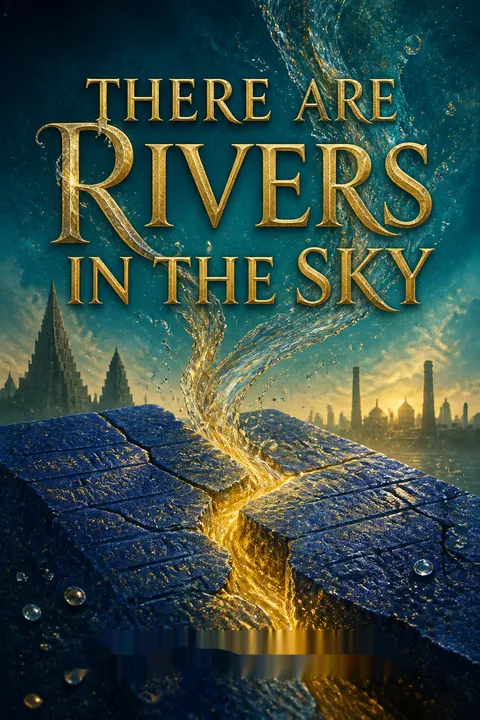


Plot Summary
Ashurbanipal’s Forbidden Tablet
In ancient Nineveh, a raindrop settles in the hair of King Ashurbanipal as he studies a blue lapis tablet bearing a version of the Epic of Gilgamesh. Its final dedication praises Nisaba, the old goddess of storytelling, rather than Nabu, the male god favored by the king.
Ashurbanipal hides the tablet instead of destroying it. Then soldiers drag in his former tutor and chief counselor, accused of spying for the king’s rebellious brother. The battered counselor condemns Ashurbanipal’s use of poisoned wells and starvation against conquered people.
When the king refuses to kill him himself, he orders the soldiers to burn him alive. The drop remains in the king’s hair, carrying away a memory of the violence that the palace’s grand library cannot contain.
A King Born in Sludge
In 1840, Arabella Smyth gives birth beside the polluted Thames while working as a tosher, scavenging the riverbank. Poor, frightened, and without her absent carpenter husband, she begs the other scavengers to leave the baby to the river.
They give him the grand name King Arthur, then place him against his sleeping mother as snow falls. A snowflake melts on his tongue, and he remembers the sensation for life. Arthur’s extraordinary memory soon lets him retain faces, sounds, dates, and details after a single encounter.
At twelve, a new teacher disbelieves his explanation for lateness, then beats him when he corrects an arithmetic error. The headmaster assaults him during the punishment. Arthur recalls the man’s past cruelty, denounces him, and leaves the school for good.
The Printer’s Apprentice
Arthur’s violent, unreliable father takes him to Bradbury & Evans, where the publishers test his memory and hire him as an errand boy. Arthur learns printing and engraving, but the real change comes when mentor William Bradbury gives him books and candles, opening a world beyond the slums.
His father still beats him and takes his wages. In 1854, Arthur buys water from a Broad Street pump and brings it home; his twin brother drinks it, contracts cholera, and dies.
Arthur later realizes that the contaminated water, not the city’s foul air, killed the child, and that he carried it into the house. Soon after, he finds Bradbury dead by suicide. Grief and guilt settle over Arthur, but the printing house and its books remain the first place where his mind feels valued.
The Tablets Begin to Speak
After seeing the lamassus from Nineveh at the British Museum, Arthur studies cuneiform tablets during every spare minute. He recognizes a writing system where others see meaningless marks, and Dr Samuel Birch hires him to sort the museum’s vast, damaged collection.
Arthur’s knowledge grows through fragments, damp-paper impressions, and long hours under poor light. He identifies a tablet as part of the Epic of Gilgamesh and works toward its account of a devastating Flood. In 1871, he presents his translation, showing that the Mesopotamian story predates the biblical version of Noah’s Ark.
The discovery ignites public debate about science, religion, and the age of the earth. Arthur becomes famous, but fame does not satisfy him: he wants to travel to Nineveh and search for the poem’s missing lines.
Narin’s Interrupted Baptism
In 2014, nine-year-old Narin attends a Yazidi baptism beside the Tigris in Hasankeyf. Her grandmother Besma has brought sacred water from Lalish because Narin is losing her hearing and may soon be unable to hear the family’s songs and stories.
A bulldozer repeatedly interrupts the rite, forcing the group to move as the government’s Ilisu Dam project tears into their ancestral land. Besma postpones the baptism, hoping to take Narin to Lalish with her father, Khaled, a traveling qanun musician.
As they walk the riverbank, Besma teaches Narin plants by touch and explains why their people preserve history through oral tradition. Narin’s future is already narrowing: her hearing is fading, Hasankeyf is slated for inundation, and the dwindling Yazidi community faces displacement and prejudice.
A Houseboat for One
In London in 2018, hydrologist Zaleekhah Clarke moves out of her marriage and into a small houseboat on the Thames. Her husband Brian has told her she lacks the capacity for happiness, and she has begun imagining a quiet suicide by water.
At the tattoo parlour owned by Nen, an Assyriology student turned cuneiform tattoo artist, Zaleekhah finds an unexpected ease: Nen pronounces her name correctly, repairs the boat’s leaking sink, and offers a place among her mudlarking friends.
The boat’s name, She Who Saw the Deep, draws Zaleekhah toward the ancient poem she has encountered in her uncle’s collection. She does not yet tell Nen how close she is to giving up, but their first conversations make the houseboat feel less like a waiting room for death.
The River Leads to Leila
Arthur reaches Constantinople in 1872, but must wait for the sultan’s excavation permit. During a neighborhood fire, he rescues a qanun from a brothel and learns that his mother has died in an asylum.
Once his firman arrives, he travels to Nineveh and accepts the hospitality of a Yazidi village despite warnings that its people are dangerous. The sheikh’s adopted daughter, Leila, is a faqra, a seer who can read signs others miss. On Red Wednesday, Arthur witnesses her terrifying vision of a massacre and hears her warn the villagers to flee toward the mountains, away from water.
At the excavation, he finds the missing section of the Flood Tablet. He also recognizes that he loves Leila, who responds with a brief, tender gesture. His sponsors summon him back to England before he can stay.
The Wells Are Poisoned
After Narin and Besma travel to Iraq, their Yazidi village in Zêrav comes under attack. Unknown assailants poison the wells and burn the groves, then Kurdish forces guarding the area withdraw. Khaled, returning from a wedding, is captured with other men and boys; militants shoot them into an empty cistern.
Wounded, he crawls out and calls Besma, warning her to take Narin to Mount Sinjar. Their convoy survives an ambush, but on the mountain thousands face heat, thirst, and dwindling supplies.
Besma shares their last water with children, then sets out to find a spring with a forked branch. Narin follows her. At the same time, the militants patrol the mountain’s base, and the two are captured. The family’s planned pilgrimage becomes a flight for survival.
The Girl Who Reads
ISIS separates Narin from Besma and her father, then holds her with other Yazidi women and girls in Mosul. Salma, a fellow captive whom Besma once helped, protects Narin and claims the child belongs to a line of seers, deterring the commander from taking her immediately.
Narin is forced to work in his household, where she sees women abused and hears that she may be sold to a man in Turkey. When she recognizes cuneiform on a tablet the commander has taken from a museum, he discovers she can read a few signs because Besma taught her.
He gives her a lapis tablet and demands a translation, treating her knowledge as a source of money. Narin tries to use her leverage to protect Salma and the other captives. The commander retaliates, and Narin retreats into silence.
Arthur Returns to Ruins
After returning to London, Arthur marries Mabel, has children, and continues his museum work, but his first journey has left him bound to Leila and the Tigris. In 1876 he returns to Nineveh.
The Yazidi village has been emptied by a massacre ordered by the Pasha of Mosul and a religious judge; survivors were driven toward the river, where destroyed boats and a missing bridge left them trapped. Arthur cannot excavate. Grief and guilt stop him from working, until a traveler reports seeing a Yazidi woman carrying a qanun.
Believing Leila may have survived by following her own warning, Arthur rides toward Castrum Kefa. Ill with dysentery and nearly out of money, he collapses in a shepherd’s hut. A thief takes his belongings, including the blue tablet, and Arthur dies before Leila can reach him.
A Past Beneath the Water
Zaleekhah and Nen grow closer through shared work, coffee, and conversations about Mesopotamian stories. Zaleekhah reveals that her parents died in a flash flood in Turkey when she was seven. She survived because she had left their tent to use the bathroom, then watched the torrent take them; afterward, she stopped speaking for a year.
Her uncle Malek raised her, but his insistence that immigrants cannot afford failure has made gratitude feel like a debt. When Zaleekhah tells Nen she has been depressed for years and planned to die, Nen listens without reducing her grief to a diagnosis.
Zaleekhah also learns that Helen’s daughter Lily needs a kidney transplant. The child’s illness does not magically cure her depression, but it sharpens her desire to remain present, help her family, and reconsider what she can still choose.
The Price of a Kidney
At Malek’s home, Zaleekhah finds a photograph of a thirteen-year-old Yazidi girl marked as a near-perfect kidney match for Lily. Malek admits that he and his wife have arranged an operation in Istanbul using a girl held in captivity, insisting that the child would otherwise remain enslaved and that the family would provide for her afterward.
Zaleekhah recognizes the logic as a cover for organ trafficking, not rescue. She refuses to cooperate and confronts Malek with the moral cost of treating a captive child as a resource.
He appeals to the family’s history and to the care he gave Zaleekhah after her parents died, but she no longer accepts gratitude as permission to obey. Their relationship fractures. Zaleekhah tells Helen what was planned, and they begin seeking a legitimate donor for Lily.
The Last Drop Falls
Zaleekhah and Nen trace the captive girl through trafficking intermediaries and pay to free Narin, the Yazidi child whose photograph Malek had obtained. They bring her to Hasankeyf in 2018, as the dam’s floodgates open and the ancient settlement faces submersion.
Narin visits the graves of her mother and great-great-grandmother Leila; Besma lies in an unmarked mass grave, and Narin does not know whether Khaled survived. When Zaleekhah reaches out, Narin sees the three-mark water tattoo on her wrist, the same pattern Besma wore on her forehead, and allows the smallest beginning of trust.
Before leaving, she acknowledges Arthur’s grave, still marked with his Thames-to-Tigris journey. A drop completes its long passage through rivers, bodies, and time, then falls over a newborn in London.
Analysis
The novel’s three protagonists are linked less by coincidence than by competing forms of memory. Arthur trusts the written fragment: cuneiform survives fire, and careful reading can restore a voice to the dead. Narin inherits a different archive, carried in Besma’s stories, gestures, recipes, and plant knowledge. Zaleekhah approaches memory through scientific evidence, measuring rivers whose histories have been hidden beneath streets or dammed out of sight. Each method has limits. A tablet can be stolen from the people whose past it records; oral tradition can preserve a community yet remain invisible to institutions; data can establish environmental damage without healing the grief attached to it.
Water makes those limits physical. It gives cities fertility, spreads cholera, separates families, carries bodies, and is redirected by rulers and governments who treat its movement as something they can own. The novel refuses to make water either benevolent or malicious. Its changes are indifferent, while human beings decide whether to share it, poison it, or turn it into a weapon. The same ethical question recurs in different forms: what does preservation mean when the object, land, or person being saved is treated as property?
Arthur’s collecting complicates his good intentions. He wants to rescue a poem from oblivion, yet the ancient objects he studies have been removed from their homeland and displayed for distant audiences. Zaleekhah confronts a related contradiction when her uncle frames the purchase of a captive girl’s kidney as a rescue. Both situations expose the danger of benevolence that ignores consent. The novel’s answer is not that memory or preservation is futile, but that they require attention to living people, not only to what can be catalogued.
By ending with Narin’s fragile recognition of Besma’s mark on Zaleekhah’s wrist, the story offers connection without pretending that trauma is repaired. Hasankeyf is still being drowned; Narin’s losses remain; Lily still needs legitimate care. Yet a remembered sign becomes a first point of trust. The ending’s returning drop suggests continuity, not consolation: the past persists, and what people do with its memory remains a choice.
Review Summary
People Also Read






Characters
Arthur Smyth
The memory-bearing scholarBorn into poverty beside the Thames, Arthur has an almost perfect memory and a hunger for learning that no formal schooling can satisfy. His childhood teaches him to observe precisely and to hide what he feels, while the books and printing craft he discovers give that attention a purpose. He is drawn to damaged texts because he recognizes something of himself in what others discard. His fascination with Mesopotamia combines scholarly curiosity with a longing for a place beyond the limits of his upbringing. Arthur is thoughtful, compassionate, and often painfully awkward with people; he can decipher ancient marks more readily than the expectations of those around him.
Narin
The young storykeeperNarin is a curious Yazidi child raised by her grandmother Besma and loved by her traveling musician father, Khaled. She notices birds, plants, and the small shifts in adults’ expressions, and she wants explanations rather than comforting half-answers. Her approaching deafness makes her eager to preserve the voices and stories around her. Besma’s teachings give her a sense of ancestry and a language for fear, but Narin also forms her own judgments about cruelty and faith. She is tender without being passive, and her attention to signs, sounds, and written marks links her intimate family world to the much older history of Mesopotamia.
Zaleekhah Clarke
The hydrologist adriftZaleekhah is a London hydrologist whose work studies water systems, pollution, and the rivers cities have buried. Orphaned as a child and raised by her wealthy uncle, she carries both the grief of her parents’ loss and the pressure to justify the opportunities she received. She is observant and intellectually rigorous, yet conflict-averse and inclined to mistake endurance for obligation. Her marriage and career cannot shield her from depression, and her scientific interest in water is inseparable from personal trauma. Zaleekhah’s movement toward self-determination begins when she allows other people to see her uncertainty rather than presenting the competent, grateful version of herself.
Ashurbanipal
The learned Assyrian kingAshurbanipal is a powerful Assyrian ruler who values literature, languages, and the collection of knowledge as highly as military success. His library reflects genuine intellectual ambition, but his learning does not make him humane. He believes that controlling stories and religious authority helps secure political control. The conflict around the blue tablet exposes his unease with voices that evade royal permission, even when he cannot bring himself to destroy their work.
Besma
The riverwise grandmotherBesma is Narin’s grandmother, a healer, water-diviner, and keeper of Yazidi oral tradition. She expresses affection through practical care: food, plant knowledge, protective rituals, and stories that give a child ways to understand grief and injustice. Besma is deeply attached to her land and its pistachio trees, yet her devotion is not simple nostalgia; she recognizes that memory and survival sometimes demand movement. Her faith in the living world coexists with clear-eyed awareness of persecution. She wants Narin to inherit resilience without inheriting hatred.
Leila
The seer and storytellerLeila is a young Yazidi woman from a family of healers and diviners. As a faqra, she can perceive patterns and warnings that others overlook, a gift that carries emotional weight rather than easy authority. She is also a musician and storyteller, and her quiet presence draws Arthur toward the lived culture surrounding the ancient ruins he studies. Leila’s knowledge is rooted in oral memory, place, and community, offering a counterpoint to the written archives that have made her homeland famous abroad.
Nen
The cuneiform tattooistNen, short for Brennen, owns the Forgotten Goddess tattoo parlour and has studied Assyriology without completing her degree. She combines artistic skill, historical curiosity, sobriety, and an unforced acceptance of her own uneven path. Nen treats tattoos as a way for people to inscribe personal stories, and she is especially drawn to the Epic of Gilgamesh and the forgotten goddess Nisaba. Direct and warm, she notices when Zaleekhah is withdrawing but does not force disclosure. Her steadiness comes from having faced her own mental-health struggles rather than imagining herself untouched by them.
Malek
The protective benefactorMalek is Zaleekhah’s uncle and guardian after her parents’ deaths. A self-made businessman who rose to wealth and public influence, he is generous with his family but also invested in controlling risk and maintaining appearances. His own childhood displacement and unresolved family wounds help explain his insistence that loved ones must succeed and remain protected. He expresses care through money, advice, and intervention, often assuming that practical provision gives him the right to decide what is best. His affection is genuine, but it is entangled with pride, fear, and a strong expectation of loyalty.
Khaled
The traveling musicianKhaled is Narin’s father, a popular qanun player whose work takes him across the region. Since his wife’s death, he has raised Narin with Besma’s help and remained reluctant to build a new family. He values music as something people need alongside food and water, and his hope in cultural life contrasts with the fear that drives relatives to emigrate. Khaled’s love for Narin is clear, though travel and danger repeatedly keep him from being present.
William Bradbury
The apprentice’s patronWilliam Bradbury is a publisher who recognizes Arthur’s intelligence and gives him opportunities his class would otherwise deny him. He offers books, candles, instruction, and a measure of personal kindness, treating curiosity as something worth cultivating. Bradbury is not merely a benefactor: his own private suffering complicates Arthur’s belief that material security protects people from despair. His support helps transform Arthur’s gift for remembering into a vocation.
Arabella
Arthur’s troubled motherArabella is Arthur’s impoverished mother, a tosher who works while pregnant and struggles to care for her children in a violent, unstable household. Her despair after giving birth reflects hunger, abuse, and the absence of reliable support, not a lack of feeling for her son. Arthur remembers her tenderness alongside the pain of her illness, and that intimate memory shapes his longing to protect the people he loves.
Mabel
Arthur’s practical partnerMabel comes from a comfortable family and is drawn to Arthur’s intelligence and unusual career. She values security, social standing, and the prospect of family life, while his commitment to ancient poetry and travel pulls him elsewhere. Their different expectations of marriage are not simply a clash between a shallow person and a sensitive one; they reveal how each understands care, duty, and the future.
Brian
Zaleekhah’s estranged husbandBrian is Zaleekhah’s husband and a fellow scientist who once shared her commitment to studying and conserving water. Their professional partnership initially provides a deep point of connection, but their expectations around happiness, parenthood, and her research diverge. Brian is capable of tenderness and self-awareness, yet his response to Zaleekhah’s history with her mentor exposes the jealousy and resentment that have accumulated in their marriage.
Helen
Zaleekhah’s cousin and sisterHelen is Malek’s daughter and grew up with Zaleekhah as a sister. Their closeness changes as adulthood gives them different routines and responsibilities, but their affection remains strong. Helen is stylish and socially confident, while also carrying the anxieties of a mother whose child is seriously ill. Her vulnerability helps Zaleekhah see that other people’s polished lives conceal their own fears.
Salma
The captive’s protectorSalma is a Yazidi woman from another village who becomes a fellow captive alongside Narin. She remembers Besma’s kindness and repays it by comforting and protecting Narin when the child is isolated. Salma understands how quickly violence can strip people of safety, so she uses the small leverage available to her to shield someone younger.
Dr Samuel Birch
The museum’s patient scholarDr Samuel Birch is the British Museum’s Keeper of Oriental Antiquities. He notices Arthur’s repeated visits to the Assyrian collection and gives the self-taught boy a chance to work with the tablets. Birch’s openness to Arthur’s unusual expertise contrasts with the class barriers and institutional suspicion surrounding the young scholar.
The ISIS commander
The captor and traffickerThe unnamed commander holds Yazidi women and girls in a family home in Mosul while directing militants and profiting from looted antiquities. He treats captives as property and Narin’s ability to read cuneiform as a commercial asset. His ordinary domestic setting makes his violence more disturbing, not less: the household continues its routines while abuse and trafficking take place upstairs.
Aunt Malek
The society-minded auntAunt Malek is Helen’s mother and the other adult who helped raise Zaleekhah. She moves comfortably through a world of wealth, family rituals, and social expectations, often preferring to smooth over conflict rather than expose it. Her affection for Zaleekhah is real, but her instinct to preserve appearances can make care indistinguishable from avoidance.
Lily
Helen’s ailing daughterLily is Helen’s young daughter and a much-loved member of the Malek family. Her serious kidney illness forces the adults around her to confront fear, urgency, and the limits of money and influence.
Plot Devices
The traveling drop
Connects lives through waterA recurring drop of water passes through changing forms and places across centuries. It begins in the storm over Nineveh, touches Arthur at his birth and later travels through the Thames and Tigris, linking characters who never meet directly. Its physical journey gives the novel a continuous thread through the non-linear timelines, while its accumulated associations make water a witness to human choices. The device turns the water cycle into a narrative structure, not just a metaphor: each transformation moves the story between different lives, histories, and kinds of loss.
The blue tablet
Carries the contested poemThe lapis tablet preserves a version of the Epic of Gilgamesh and a forbidden dedication to Nisaba, the displaced goddess of writing. Its path through royal concealment, archaeological excavation, private collecting, and wartime looting links the ancient and modern plotlines. The tablet also raises the question of who may claim a story: the ruler who stores it, the scribe who writes it, the scholar who deciphers it, or the people whose history it records. Its movements bring Arthur’s work and Narin’s inherited knowledge into contact.
Cuneiform fragments
Make damaged memory readableThe wedge-shaped marks on clay tablets begin as an obscure script that Arthur studies through patient observation and scholarship. Because tablets survive fire and burial, their fragments preserve ordinary records as well as poetry, even when the people who made them have been forgotten. Narin’s grandmother passes down a few signs orally, allowing the child to recognize and interpret parts of a tablet in captivity. Cuneiform therefore joins formal learning to inherited memory, and turns literacy into both a means of recovery and a source of danger.
The lamassu
Guards the story’s thresholdsThe human-headed, bull-bodied, bird-winged lamassus stand at the entrance to Ashurbanipal’s library and later appear in museums, private collections, and personal keepsakes. Their displacement from Mesopotamia makes them guardians without a home, echoing the uprooted characters and communities throughout the novel. A scorched hoof also preserves a trace of violence that official displays cannot explain. The sculptures connect Arthur’s first fascination with Nineveh to Nen’s historical interests and Zaleekhah’s family object, giving the ancient past a visible presence in modern London.
Oral family stories
Preserve what archives omitBesma teaches Narin Yazidi creation stories, plant knowledge, rituals, and histories of persecution that are carried through speech rather than official records. These narratives help Narin understand her community and give her practical knowledge in moments of danger. They also contrast with museums and libraries, which preserve objects while often separating them from the people who made or inherited them. The family stories are not presented as neutral documentation: they are living acts of care, shaped by memory, repetition, and the need to survive displacement.
About the Author



Download PDF
Download EPUB
.epub digital book format is ideal for reading ebooks on phones, tablets, and e-readers.








