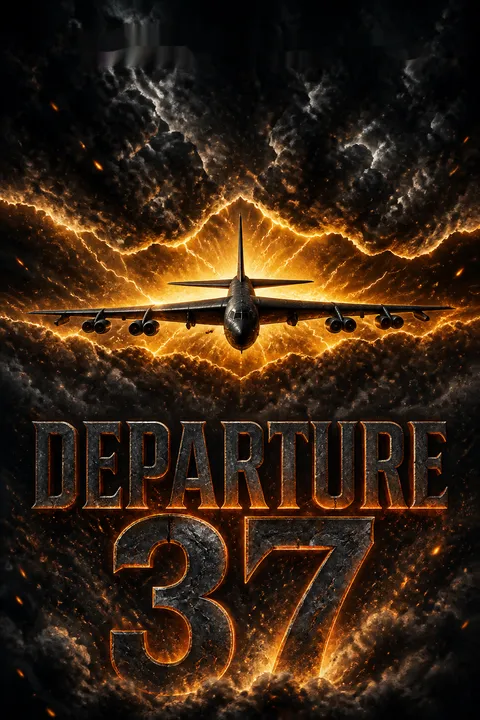


Plot Summary
Mothers Ground the Sky
Just after midnight, Delta captain Brian Grayson answers his mother Melinda’s call from a Minneapolis hotel. She warns him not to fly, certain his plane will kill everyone aboard. Though Brian loves flying and has no explanation for her certainty, he promises to call out.
In Virginia, DARPA archivist Layla Chen receives a call that seems to come from her dead mother, complete with private family memories. Layla knows the voice is an artificial replica because she helped build Seeker Script, a system designed to imitate pilots’ mothers and keep them from boarding planes.
The calls spread to hundreds of pilots, grounding flights nationwide. A satellite signal from a missing nuclear bomber triggered the emergency system, but Layla cannot explain why that lost aircraft may be returning.
The opening makes fear useful before it makes it trustworthy. Brian faces a choice between professional duty and the intimate authority of a mother’s alarm; Layla knows the same intimacy has been manufactured, yet still feels its force. Seeker Script exposes a political paradox: a government can avert danger by deceiving the people it claims to protect, but the deception also creates suspicion and panic. The pilots’ compliance is not proof that the warning is true. It shows how family attachment can move people where official authority might fail.
The Wreck Speaks
At Ash Point, seventeen-year-old Charlie Goodwin films local pilot Abe Zimmer beside the abandoned runway, turning his stories of a 1962 B-52 crash into online entertainment.
Charlie has recently moved from Brooklyn with her grieving father, Greg, and resents the isolated Maine life built around her late mother Dana’s unrealized brewery dream. A silver balloon descends toward the wreck site. Charlie finds it caught in a tree, then hears a woman’s voice coming from the shattered cockpit, warning her not to fly.
The voice sounds like Dana, murdered in Brooklyn, and Charlie runs. Back at the taproom, a news report connects the pilots’ strange calls to the national ground stop. Charlie faints when she recognizes the warning as part of the same impossible event.
Charlie’s instinct is to turn Ash Point into a joke she can edit, narrate, and control. The voice breaks that distance by invading the site where she remembers her mother. Her first response is flight, but her embarrassment at fainting and her anger at the apparent prank quickly become acts of self-defense. The scene also complicates what counts as evidence: Charlie has a recording-free experience that others may dismiss, while the pilots’ calls are visible on television. Her grief makes her vulnerable to a fake voice, but it also makes her an unusually precise witness to its personal details.
Graphite Opens a Door
In 1961, physicist Martin Hazelton works at Crane, Indiana, trying to shield aircraft electronics from the electromagnetic pulse of a nuclear blast. A scrap of graphite dust on adhesive tape inspires him to coat a model B-52.
It survives an electric field, suggesting graphite can both conduct and insulate under the right conditions. Marty then combines graphite with a deliberately created, electrically charged cloud. His next model enters the cloud and disappears without smoke or debris.
The discovery attracts Admiral Ralph Cutting and a classified military team, who see a new weapon in the vanishing aircraft. Marty sees an unanswered scientific problem. His private grief and his efforts to protect his brother Hank, an Air Force pilot, are already entangled with the research, though he has not admitted how deeply.
Marty’s breakthrough is an accident made possible by disciplined attention. He notices an unpromising residue because he is willing to treat ordinary matter as a question rather than waste. The military’s response changes the meaning of that curiosity: a method devised to protect aircraft can also remove them from the world. Marty and Cutting therefore look at the same result and see different obligations. His scientific restraint is sincere, but it is not neutral. By keeping control of the method, he hopes to limit its use, while the secrecy surrounding him gives others room to imagine a weapon without limits.
The Watch Remembers
Marty’s models begin returning, and he discovers that their arrival follows the time shown on his father’s old Ball watch. The watch was exposed to a thermonuclear blast while his brother Hank flew a B-52, and its hands once spun during a test.
Marty cannot explain the connection, but he relies on the timepiece rather than dismantling it. Marilyn Metzger, a Navy official whose fiancé vanished with Flight 19, investigates Marty and presses him about his past.
A classified medical file reveals that Marty suffered a breakdown after a nuclear test and began imagining Hank as a living pilot. Hank actually died as a child in a truck fire. Marty accepts the truth of his loss, while Marilyn confirms that his vanishing aircraft are real and asks to join the coming human test.
The watch gives Marty a mechanism he can observe but not understand, while Hank gives him a relationship he can preserve only by distorting memory. Marilyn refuses to let scientific competence excuse emotional evasion: she makes Marty confront both the dead brother he has invented and the living grief he has avoided. Her own search for her missing fiancé motivates her, but it also risks turning the experiment into a route back to the past. Their intimacy does not solve either loss. Instead, it briefly lets each acknowledge that hope can be a method of survival and a source of danger.
Abe Drives Into Silence
After Charlie’s encounter, she, Abe, and Abe’s grandson Lawrence discover that phones, internet, and vehicles have stopped working, though the taproom’s old-fashioned lights and beer lines still function. They pull down the balloon and find a radiosonde marked with a 1962 date.
Inside are Marty’s watch and a handwritten instruction about finding a storm, using Nightshade, turning the watch backward, and applying voltage. Charlie’s ATV and her father’s Subaru are dead.
When the ancient airfield’s battle siren sounds, Abe takes his old truck toward town to check the road, leaving Lawrence and Charlie with a revolver. They spot a military roadblock and Abe’s abandoned truck. Then a B-52 bearing the same loon emblem as the wreck descends and lands on Ash Point’s freshly maintained runway.
The powerless vehicles isolate the trio, but they also distinguish the old mechanical world from the new one dependent on chips and networks. Abe’s truck remains usable because it predates that infrastructure; his decision to drive alone turns practical experience into a risky form of protection. The watch and note make the strange event tangible, yet their instructions offer no immediate safety. Charlie’s impulse to investigate is now paired with a growing reluctance to be alone. When the B-52 arrives, the old runway ceases to be local legend and becomes an active part of a military operation.
The Bombers Were Never Tests
As the Cuban Missile Crisis escalates, Cutting pushes Project Kingsolver toward a full-scale trial at Ash Point. Marty joins a B-52 piloted by Earl Dupree to seed a storm with Nightshade, while Captain Hightower’s Loring crew, including Marilyn, flies a second bomber into the cloud.
Marty spots generators on that aircraft and realizes the plan is not merely to test the effect. The Loring plane carries a nuclear bomb and may be sent forward as a weapon. When it vanishes, Marty learns the bomb is armed and that the team’s radio-based return system is a fiction.
He connects wires to his father’s watch, turns its hands backward, and sends the watch in a weather balloon into the storm with instructions. His damaged plane goes down; official records declare him dead.
Marty’s concealment of the watch began as an attempt to prevent the military from controlling what he could not explain. It has instead allowed others to build a mission around false assumptions. Seeing the armed bomber makes his private secrecy morally consequential: the weapon may disappear without a reliable way back. His improvised warning is not a solution so much as an attempt to give the crew a chance. The storm, watch, and balloon join scientific method to desperate hope. The official account of Marty’s death preserves the government’s secrecy, but it cannot settle what he experienced at the end.
Ash Point Returns Fire
The men emerging from the landed bomber believe they have been caught in a psychological test. Charlie recognizes the captain’s name, Hightower, from Ash Point’s crash history and tells the crew that the year is 2025. Lawrence identifies the other airmen as Bellamy and Granville.
Before they can absorb the explanation, soldiers approach across the runway. An unfamiliar F-16 makes a low pass, and the crew reads the modern fighter as a threat rather than reassurance. Hightower orders everyone back aboard.
Bellamy and Granville seize Charlie and Lawrence, blindfold them, and force them into the plane. Hightower takes off with the teens and the live nuclear bomb, following his 1962 orders to strike Cuba if the situation on the ground shows that the mission has failed.
The crew’s violence grows from a collision between military discipline and an environment they cannot interpret. The soldiers intend to secure the aircraft, but the fighter flyby confirms the airmen’s fear of capture. Charlie and Lawrence become leverage before they can become interpreters. Hightower’s decision to take off is rational within the information he has: he sees armed strangers, an unfamiliar aircraft, and a mission that still demands action. The danger lies not in simple madness but in an outdated chain of command continuing to function after its world has disappeared.
New York, Then Blood
With Lawrence restrained below and Charlie in the cockpit, Hightower aims toward Cuba because his orders make a failed mission grounds for nuclear retaliation. Charlie persuades him to look at New York, whose changed skyline proves that the plane has crossed into another era.
DARPA interrupts with a convincing imitation of President Kennedy and urges Hightower to land. Charlie recognizes the deception and shuts off her phone rather than let a dead president command the crew through a false promise.
As the B-52 passes the city, Granville rejects the evidence, threatens to drop the bomb, and wrests a pistol from Bellamy. A shot kills Bellamy. Granville then shoots himself. Hightower steadies the bomber and turns it away from New York, while Charlie remains trapped aboard with the nuclear threat still unresolved.
The skyline succeeds where official explanation fails because it offers visible evidence that cannot be reduced to a voice recording. The counterfeit Kennedy tries to restore authority by borrowing the prestige of a dead president, but Charlie recognizes that reassurance without truth is another form of coercion. Her refusal forces Hightower to confront the deception directly, even though it risks prolonging the crisis. Granville’s violence is the consequence of an identity built around obedience: when his mission and reality become incompatible, he treats force as the final proof of duty. Hightower’s turn away from the city is a fragile choice for judgment over orders.
A Choice Above Ash Point
Lawrence escapes his restraints and reaches the cockpit, where Marilyn Metzger has joined Hightower. The watch and Marty’s note finally give them a way to understand the return flight and a possible second leap through time.
Charlie argues that landing will let the government hide the crew, while parachuting out in view of the rescue fleet will make the teenagers harder to erase. Lawrence, an experienced skydiver who has practiced with Abe’s museum ejection seat, backs her plan.
Charlie and Lawrence eject together and are rescued from the water, badly injured but alive. Hightower and Marilyn remain aboard, using the watch and Nightshade as they fly into a storm. The B-52 disappears from radar and does not return. The government never offers the public the true account.
Charlie’s final act turns the skills she once used to mock Ash Point into tools for survival. Her filming instincts have taught her that many witnesses can make an event harder to suppress, while Lawrence’s training gives the plan practical weight. Their escape is not a clean victory: it saves the living teenagers but leaves Hightower and Marilyn to choose an unknown destination. The story preserves that uncertainty rather than claiming the technology is mastered. The government’s silence also remains active, shaping what the public can know even after the crisis has passed.
Epilogue
Charlie spends six days in the hospital with a broken ankle and cracked ribs while officials question her and Lawrence. She accepts a nondisclosure agreement after learning that both Lawrence and Abe survived. The public receives a cover story about a historic B-52 and an unexplained attack on airline systems.
DARPA archivist Layla Chen visits Charlie with college funding, a promise of a museum at Ash Point, and an invitation to consider working for the agency. Charlie explains that the voice in the wreck had no known connection to DARPA’s system. Layla cannot account for it. Charlie leaves with Layla’s card, an unlit cigarette, and the unresolved possibility that her mother truly warned her.
The ending offers Charlie material security without giving her the explanation she wants. Tuition and a museum can repair some consequences of the day, but they are also instruments for keeping her story contained. Layla’s visit makes the boundary between conspiracy and sincere uncertainty unusually thin: even the official entrusted with DARPA’s secrets cannot identify the source of the voice. Charlie’s choice to keep the card and the cigarette, without deciding what either means, leaves her future open. The final mystery honors her mother’s continuing psychological presence without confirming a supernatural answer.
Analysis
Departure 37 makes the cost of secrecy concrete by giving it faces and voices. Brian risks the judgment of passengers; Charlie risks being disbelieved about the voice that most unsettles her; Marty risks the lives of a crew because he withholds the watch’s role. In each case, information arrives through intimacy or improvisation rather than a reliable institution. A mother’s voice can be fabricated, a military briefing can be false, and a device that appears to obey physics can still exceed anyone’s account of it.
The novel’s central tension is not science against superstition. It is the human desire to make danger legible before acting. Marty needs a mechanism, Cutting needs a strategic advantage, and Layla needs a crisis contained. Their partial explanations become hazardous when treated as complete ones. Charlie, who once converted local history into entertainment, gradually learns to treat people and evidence as more than content. Lawrence’s loyalty and Abe’s memory matter because they supply forms of knowledge the state has ignored.
The story also resists a clean moral distinction between deception and truth. Seeker Script saves lives by misleading pilots, while the fake Kennedy nearly secures a landing but compromises Hightower’s trust. Charlie’s insistence on telling him that Kennedy is dead is tactically dangerous and ethically necessary. The same question shadows the time experiment: does a technology become safer when its operators can explain it, or when they accept the limits of what they know? The ending offers no final answer. The aircraft vanishes again, the voice in the wreck remains unaccounted for, and the government turns an extraordinary event into a manageable public story. What survives is not certainty, but the obligation to keep asking who pays for the next experiment.
Review Summary
Departure 37 blends science fiction, historical fiction, and thriller elements, drawing comparisons to The Twilight Zone. Set in dual timelines of 1962 and 2025, it explores government secrets, time travel, and mysterious plane disappearances. While marketed as horror, most reviewers found it more of a techno-thriller. The novel received praise for its complex plot, atmospheric tension, and well-developed characters, particularly Abe. Some readers found the technical details overwhelming, but overall, the book was well-received for its originality and thought-provoking narrative.
People Also Read



Characters
Charlie Goodwin
The Ash Point filmmakerCharlie is a sharp, funny seventeen-year-old from Brooklyn who makes videos about Ash Point’s abandoned base and its local legends. She uses sarcasm and editing to keep distance from a place she did not choose and from the grief she shares with her father, Greg. Her mother’s practical advice remains a measure against which Charlie tests her own perceptions. She is observant, but often mistakes emotional exposure for weakness and control for safety. Her filmmaking gives her an instinct for framing and evidence, while her growing attachment to Lawrence and Abe challenges her habit of treating the town’s people as material for an audience.
Martin Hazelton
The haunted physicistMarty is a gifted physicist whose work moves from atmospheric research into the secret military effort to shield aircraft from nuclear electromagnetic pulses. He trusts experiments more readily than emotional explanations, yet memory, guilt, and attachment shape his choices as powerfully as mathematics. His younger brother Hank is central to his private understanding of courage and failure. Marty is neither a detached scientist nor a simple conscientious hero: he believes he can contain dangerous knowledge by withholding part of it, even as the demands of national security narrow his ability to choose how it is used.
Layla Chen
DARPA's keeper of mistakesLayla is DARPA’s chief archivist and a specialist in monitoring projects that may outlive their official cancellation. Her technical fluency is matched by an ability to read institutional motives, though she knows that expertise does not guarantee control. She has personal experience with grief and with the allure of technological solutions, which helps her understand why an artificial voice can still wound its listener. Layla believes secrecy can prevent catastrophe, but she is not blind to the costs of deception. Her measured manner makes her a useful intermediary between an unruly crisis and officials who want immediate, absolute answers.
Marilyn Metzger
The seeker of lost airmenMarilyn works within the Navy’s classified world and pursues the truth about Flight 19, which took her fiancé from her. Intelligent, persistent, and socially agile, she can use charm as readily as confrontation, but her investigation is rooted in a grief that official explanations cannot soothe. Marilyn believes that a person’s feelings matter even when military planners treat lives as numbers in a risk calculation. Her connection with Marty grows from their shared fascination with the unknown and their different relationships to loss. She wants access to the experiment not only as an official observer, but as someone who cannot stop asking what happened to the missing.
Lawrence Zimmer
The steady hometown allyLawrence is Abe’s grandson, Charlie’s classmate, and a dutiful student-athlete whose earnestness initially irritates her. He is observant, capable, and more emotionally perceptive than his polished, rule-following manner suggests. His father’s long absences at sea have left him accustomed to responsibility, especially for his grandfather. Lawrence’s interest in aviation and his experience with skydiving give him practical knowledge when events turn dangerous. He does not demand that Charlie stop being sharp or independent, but he challenges her when her videos reduce the people around her to jokes.
Abe Zimmer
Ash Point's witnessAbe is a former Navy pilot who has spent decades telling stories about the B-52 crash at Ash Point and the survivor he insists the military concealed. His beer, cigar, and appetite for conspiracy make it easy for others to dismiss him, but his memory and aviation knowledge are often exact. Abe is generous with Charlie and protective of Lawrence, though his fear tends to emerge as preparation for disaster. The museum he hopes to build is both a memorial to the lost aircrew and an attempt to make the community take its own history seriously.
Captain Hightower
The stranded bomber pilotHightower commands the B-52 crew sent into the secret 1962 mission. He is disciplined, attentive, and shaped by a military culture in which orders are meant to survive confusion. Unlike the more volatile members of his crew, he asks questions and revises his understanding when evidence becomes impossible to ignore. His decisions affect Charlie and Lawrence as directly as the bomb aboard his aircraft. He is also connected to Charlie’s family history, giving the confrontation between past and present an intimate dimension beyond the military crisis.
Brian Grayson
The pilot who answersBrian is a Delta captain with thousands of hours in the cockpit and a deep love of flying. He is divorced and close to his family, but he has never had reason to distrust his practical, unsuperstitious mother. When she warns him about a specific flight, he must weigh years of professional judgment against the possibility that ignoring her could endanger hundreds of passengers.
Melinda Grayson
Brian's resolute motherMelinda is Brian’s seventy-eight-year-old mother, a practical woman who has never tried to keep him from flying. Her unusual certainty about his danger makes her warning difficult for him to dismiss and difficult for her to explain.
Sara Chen
Layla's remembered motherSara is Layla’s mother, remembered through family habits, private jokes, and the Mandarin endearment she used with her daughter. Those intimate details make her voice especially powerful when it is recreated by technology.
Greg Goodwin
Charlie's grieving fatherGreg moves Charlie from Brooklyn to Maine after his wife’s death and tries to build the brewery she once dreamed of opening. His plans are inseparable from grief and a belief that a safer place might protect his daughter from further loss. He loves Charlie, but his absorption in the brewery and his own pain leave her feeling stranded.
Dana Goodwin
Charlie's practical compassDana is Charlie’s mother, a skilled brewer whose dream gives the Maine project its purpose. She is remembered as loving and direct, encouraging Charlie to separate sharp observation from the ability to change a situation. Her advice continues to shape how Charlie thinks about perception, responsibility, and the people she might overlook.
Hank Hazelton
Marty's daring younger brotherHank is Marty’s younger brother and a military pilot whose courage contrasts with Marty’s reflective temperament. Their childhood bond left Marty with a lasting sense of responsibility and a store of imagined conversations. Hank’s experiences in the nuclear age help connect Marty’s research to the human beings asked to fly through its consequences.
Admiral Ralph Cutting
The mission's military sponsorCutting oversees the Office of Naval Research effort behind Project Kingsolver. He is disciplined and strategically minded, convinced that an extraordinary weapon may change the balance of power during a nuclear crisis. He respects Marty’s talent while pushing him toward a scale and purpose Marty does not fully share.
Iris Stoka
The systems visionaryIris is an ARPA computer specialist whose ideas extend beyond the immediate experiments. She imagines aircraft that could vanish repeatedly and systems that reduce the need for human operators. Her intelligence makes her a valuable collaborator and a source of unease for Marty, who worries about what happens when technology is designed to act without people.
Captain Dupree
Marty's storm pilotDupree is an experienced B-52 pilot assigned to the Ash Point aircraft. He is controlled under pressure and focused on bringing his crew through the storm, even when the classified mission exceeds what he has been told.
Bellamy
The bomber's gunnerBellamy is one of Hightower’s aircrew, trained to perform his assigned role within a tightly controlled mission. He is wary of the unfamiliar future and relies on the captain’s authority as events grow more volatile.
Granville
The shaken airmanGranville is a member of the Loring crew whose fear surfaces as anger when the mission’s assumptions collapse. He has volunteered for dangerous service, but his confidence depends on a clear enemy and a world that follows familiar rules.
Betsy Kreuzer
Layla's archival partnerBetsy is a former CIA analyst working alongside Layla in DARPA’s classified archives. She brings an analyst’s caution to the search through Project Kingsolver’s records and helps Layla sort the evidence from the assumptions.
Plot Devices
Seeker Script
Impersonates a trusted voiceSeeker Script is DARPA software that builds convincing character replicas from publicly available recordings and uses them to deliver tailored calls. In this crisis, it imitates pilots’ mothers and persuades hundreds of pilots not to fly, helping ground commercial air traffic. Layla understands how the system can reproduce recognizable voices and private details. The voice Charlie hears in the B-52 wreck remains unexplained, so the technology provides a plausible comparison but not a confirmed answer.
Nashua Nightshade
Makes a charged cloud a passageMarty’s experimental process combines graphite with an electrically active, artificially seeded cloud. Aircraft entering the charged cloud can disappear without ordinary physical destruction. The process is difficult to scale and even harder to control. It becomes the core of Project Kingsolver, first as a laboratory breakthrough and later as a potential military capability. The same cloud can carry a plane beyond its expected time of return, making the experiment more dangerous than a simple form of stealth.
The Ball watch
Sets the aircraft's return timeMarty’s father’s old wristwatch behaves differently after exposure to a nuclear test. Marty discovers that vanished models return in relation to the time shown on the watch, and electrical contact can make its hands turn backward. The watch links the cloud experiment to the story’s passage through time. A later message attached to it gives the Ash Point characters a possible survival method, though they do not know whether the instructions will work or what destination they will produce.
The radiosonde balloon
Carries a warning across decadesA weather balloon and its small instrument box arrive at Ash Point bearing a 1962 manufacturing date. The box contains the Ball watch and Marty’s handwritten instructions. Its arrival turns an otherwise invisible scientific history into a physical clue Charlie, Lawrence, Abe, and Hightower can examine. The balloon also connects the turbulent storm surrounding Project Kingsolver to the present-day crisis, allowing a message to travel where ordinary communication cannot.
Download PDF
Download EPUB
.epub digital book format is ideal for reading ebooks on phones, tablets, and e-readers.








