

Key Takeaways
Redesign the systems we mistake for nature
The made world. From a window in San Diego, Norman sees houses, roads, planted gardens, and a reshaped bay. Even the labels weed and pest reflect human preferences, not nature’s categories. More broadly, laws, markets, work schedules, and social hierarchies are also human-made arrangements. They may feel inevitable because people grow up inside them, but they were built through choices and can be changed.
Design shapes designers. Objects and institutions do more than meet needs: they steer behavior and define what seems normal. A calendar organizes days; a workplace organizes family life. Norman’s central claim is that design helped produce today’s ecological and social harms, but a broader, more responsible design practice can help repair them.
The striking move is to treat design as more than objects: it includes the rules and institutions that quietly organize ordinary life. That broadens responsibility beyond professional designers, while also making change imaginable. Yet calling nearly everything designed can blur the difference between deliberate choices and outcomes no one controlled. The useful implication is not that every harm has a designer to blame, but that systems can be examined for who they serve, what behavior they reward, and whose costs they hide.
Trace today’s rules backward before treating them as inevitable
The past remains active. Path dependence means a society’s current conditions are shaped by the route it took to reach them. A rule or institution can persist not because it is best, but because later choices were built on earlier ones. Norman contrasts this with a thrown ball: its motion depends on its present forces, while human beliefs and institutions carry history with them.
History has living consequences. The cotton trade linked British industry, colonial control of India, enslaved labor in the American South, and racial hierarchy. The example shows how commerce, power, and prejudice became entangled over time. Factory schedules offer another inheritance: people now treat clock-governed work as normal, though industrial production helped establish that pattern. Understanding history means examining how past arrangements shape current options, not merely memorizing dates.
Path dependence is a useful antidote to the claim that existing institutions simply reflect human nature. Historical explanation can reveal where alternatives were closed off and who benefited from that closure. It also guards against simplistic fixes: changing a rule may not undo the networks, habits, and advantages that grew around it. History, however, is contested evidence, not a single neutral record. Norman’s call to consider multiple viewpoints matters because a reform built on an incomplete account can reproduce the exclusions it aims to correct.
Measure lives, not just transactions, and tell the story behind numbers
Numbers are not the outcome. GDP totals the monetary value of goods and services, but it does not distinguish useful activity from pollution or cleanup costs. It also misses health, education, fairness, and happiness. Norman argues for presenting important dimensions separately rather than compressing them into one national score. Psychological measures can assess subjective experiences rigorously, while dashboards can show which ecological or social conditions need attention without hiding them inside a composite number.
Context makes evidence meaningful. Climate averages can sound trivial when described as a small temperature change, while the resulting fires, floods, and crop disruptions are concrete. A hospital visit offers a second example: clinicians discussed a patient’s readings in the hallway without entering her room. Statistics can establish patterns, but stories show how those patterns affect people. Used together, measurement and narrative offer both scale and human context.
This is not an argument against quantification. It is an argument against mistaking a convenient proxy for the thing society values. The distinction resembles a basic problem in public administration: once a target becomes a performance measure, institutions can optimize the score while neglecting the mission. Dashboards help by preserving multiple dimensions, and stories make their stakes legible. Still, subjective measures can be shaped by survey design and expectations. The strongest approach combines transparent methods, disaggregated data, and narratives that can be challenged rather than treated as universal.
Design products to circulate, not disappear into landfill
Linear production leaves a trail. The take-make-waste model extracts materials, manufactures goods, and discards them at the end of use. Harm arises at every stage, from mining and energy use to products that are difficult to repair. Fashion, feature upgrades, breakdown, and incompatible standards can all push people to replace things that still work.
Keep value in motion. Circular design aims to reduce pollution, keep products and materials useful, and help natural systems regenerate. That means choosing materials carefully and designing for repair, upgrading, reuse, and disassembly. Recycling helps, but it is not a complete solution: some materials degrade, local rules vary, and mixed materials can be hard to separate. Norman also describes a shift from selling rarely used cars to providing transportation as a service. That model can create ongoing business value without requiring each customer to own a new vehicle.
The key insight is that waste is often decided at the design stage, long before a consumer sorts a bin. That shifts the burden from individual virtue toward product architecture and business incentives. A service model can align company revenue with maintaining useful goods, though it is not automatically sustainable: shared services still require materials, energy, and fair access. Circularity is strongest when it reduces extraction and extends useful life, rather than simply giving a wasteful product a more attractive recycling story.
Build slack into systems before efficiency makes them brittle
Efficiency can hide fragility. A resilient system can keep functioning through disruption or recover after failure. Redundancy, such as multiple control systems on an aircraft, can help, though it costs more. By contrast, tightly coupled systems can be fast and efficient but vulnerable to a single breakdown.
The supply chain lesson. Toyota’s just-in-time approach kept inventories small and relied on close coordination with suppliers. It worked efficiently until pandemic illness, natural disasters, transport delays, and war disrupted supplies. Automobile production then faced shortages, including computer chips. Norman contrasts this with loosely connected systems that retain more local autonomy and can route around failures. Neither structure is always best: the design choice depends on the consequences of interruption. Efficiency should be assessed alongside recovery capacity, not treated as the only measure of performance.
The supply-chain example exposes a familiar organizational temptation: visible inventory looks wasteful, while invisible dependence looks efficient. Resilience makes the hidden tradeoff explicit. It also suggests that spare capacity has value even when it appears unused, much like insurance. But redundancy cannot be added everywhere without cost, and loose coupling can make coordination harder. The practical question is which functions are critical, how quickly failure spreads, and who bears the cost when a lean system breaks. Resilience is a deliberate allocation choice, not a free benefit.
Design with communities, while accounting for every living system
Widen the design brief. Human-centered design often focuses on the people who will use a product. Humanity-centered design expands that concern to communities, future consequences, other living things, and the physical environment. It retains attention to people’s needs but asks how production, use, and disposal affect the wider system.
Share authorship. Norman’s approach is to design with and, as much as possible, by the community rather than imposing a finished solution. Foreign aid illustrates the risk of the opposite method: outside experts can propose technically sound projects that local residents cannot maintain or did not help shape. Designers should act as facilitators and mentors, while communities contribute knowledge of local needs and conditions. This does not eliminate disagreement within a community, but it makes participation part of the work rather than an afterthought.
This approach treats participation as a source of knowledge and a question of power. Residents often understand daily constraints that distant specialists cannot observe, while technical experts can contribute skills communities may not have access to. Neither perspective is sufficient alone. Participation is also not a guarantee of fairness: local groups contain competing interests, and the loudest voices may not represent everyone. Good facilitation therefore asks who is missing, who controls resources, and how people can contest decisions after a project begins.
Solve complex public problems through small, testable modules
Start with workable pieces. Wicked problems are complex public issues that lack a single complete solution. A village sanitation system, for instance, connects water quality, pumps, pipes, sewerage, household needs, construction disruption, and local politics. A large master plan can become costly and outdated before it is finished.
Learn by implementation. Incremental modular design divides a larger project into small units that each deliver a useful result. Teams specify what goes into and comes out of each module, then test whether it works before connecting it to the whole. This lets a project adapt to local conditions and changing requirements. The method resembles software development, but community projects may need months, not days, for each stage. Funding systems often prefer one dramatic project, so modular work also requires showing progress clearly and building support for continued effort.
Small experiments can reduce the cost of being wrong and create evidence from actual use, rather than relying entirely on forecasts. Common interfaces can let successful pieces connect without forcing every community into identical arrangements. The risk is fragmentation: many local successes may fail to address infrastructure or power that operates across regions. Small-scale work needs shared goals, coordination, and a route for scaling what proves useful. Modularity is not a reason to avoid ambitious change; it is a way to make ambition revisable.
Make machines handle drudgery, not make people imitate machines
Technology sets the terms. Frederick Taylor’s efficiency methods tried to increase output by reducing workers’ movement, thought, and discretion. Norman argues that workplaces still often treat human attention as a machine component, asking people to monitor automated systems for long stretches and intervene only when something unusual happens. That task is especially difficult because people become less alert when nothing seems to require attention.
Augment human judgment. Artificial intelligence can recognize patterns well, but it can inherit biases in its training data and struggle with unfamiliar situations. Norman’s preferred direction is to use machines for tasks they do reliably, while preserving human responsibility for interpretation and values. Calculators, for example, free engineers from repetitive arithmetic so they can spend more time checking assumptions and judging results. When a system fails, the label human error can obscure design choices that made the failure likely.
The distinction between automation and augmentation is important because performance depends on the whole human-machine team, not the machine alone. A system that removes routine work can expand human capacity; one that leaves people responsible for rare emergencies can create an impossible monitoring role. AI’s opacity and biased data make this especially consequential in high-stakes decisions. Yet human judgment is not automatically fair or reliable. The goal is not to romanticize people, but to assign tasks according to actual strengths and make responsibility visible.
Rebuild work and education around human lives, not old clocks
Industrial schedules are inherited choices. Factory production helped make fixed hours and a sharp division between work and home seem normal. Norman points to pandemic-era remote work as evidence that some jobs can be organized more flexibly, though manufacturing, care, food service, and other hands-on work still require people in particular places. He argues that work should offer autonomy and a sense of contribution, not merely a timed job.
Make learning lifelong. Instead of concentrating education in youth and forcing everyone through equal-length courses, he proposes shorter learning modules taken when people need or want them. Learners would demonstrate mastery of specific material rather than receive a single grade that blurs what they know. Such arrangements could better fit changing occupations and interests, though they require reliable standards and access to quality instruction.
The chapter connects sustainability to daily arrangements, not only to energy technology. Flexible schedules can improve autonomy for some workers, while workers whose presence is essential may be left with less choice. Any life-centered redesign must address that asymmetry rather than treating remote work as a universal template. Modular education similarly promises flexibility but depends on time, money, and trustworthy credentials. These proposals are most persuasive when paired with institutions that distribute flexibility and learning opportunities beyond already privileged groups.
Pair public pressure with policy, and protect people through transition
Prevention is hard to see. People often respond when disaster is visible but struggle to support actions whose success means nothing happens. During the pandemic, some saw costly precautions followed by no immediate catastrophe and concluded the precautions were pointless. Climate risks create the same challenge: effects are delayed, while costs of action can arrive now.
Build coalitions and fair rules. Norman argues that warnings alone are insufficient. Citizens, community groups, companies, governments, and international organizations need to coordinate. Policy can ensure that all companies face similar requirements, while public pressure can make inaction politically costly. The transition must also account for workers and businesses harmed by changing energy and production systems. New occupations should use existing skills where possible. Seat-belt requirements show that even a clear safety measure can take decades to become standard, so action needs persistence as well as urgency.
The challenge is partly motivational and partly distributive. A delayed collective benefit competes with immediate costs concentrated on particular workers, regions, or industries. Asking those groups to accept sacrifice without credible support weakens the coalition needed for reform. Public communication can make risk more understandable, but it cannot substitute for compensation, alternative livelihoods, and enforceable rules. The strongest version of Norman’s argument joins bottom-up legitimacy with top-down capacity: local initiatives reveal what works, while policy can prevent responsible actors from being undercut by competitors.
Analysis
Norman’s deepest contribution is to make design a political verb. Design is not merely the styling of products or the usability of interfaces. It is the organization of incentives, routines, measures, supply chains, and public authority. This reframing connects environmental damage to ordinary institutional decisions without reducing the crisis to individual consumer choice. The book’s three tests, meaning, sustainability, and humanity, challenge systems that count output while externalizing ecological and social costs.
Its strongest analytical thread is the mismatch between the tools used to understand problems and the problems themselves. Linear causality, single metrics, and tightly controlled experiments work well in bounded settings, but societies are historically contingent, adaptive, and full of delayed feedback. Norman argues for plural evidence: quantitative measures, qualitative accounts, and stories that preserve context. That is more than a communication technique. It is a method for preventing abstraction from making affected people disappear.
The book also avoids a simple anti-technology position. It treats technology as powerful but politically situated, asking who benefits, who maintains it, and whether people remain in control. Its proposal for designers as facilitators is valuable precisely because technical expertise alone cannot settle competing priorities. However, facilitation cannot be neutral when land, money, and authority are unequal. Community participation needs mechanisms for representation and accountability, while modular experiments need coordination to prevent local improvements from remaining isolated.
A further tension concerns metrics. Replacing GDP with a single happiness score would repeat the same error in a more appealing vocabulary. Norman’s preference for multiple visible indicators is wiser, though decision makers still must make tradeoffs among them. Here, institutional economics and Goodhart’s law offer a useful caution: when a measure becomes a target, organizations can optimize the indicator rather than the underlying good. The book’s answer is not to abandon measurement, but to make measures plural, legible, revisable, and answerable to the people whose lives they represent. Design becomes a way to negotiate those choices in public.
Review Summary
Design for a Better World receives mixed reviews, with an average rating of 3.58/5. Readers appreciate Norman's influential status and the book's broad concepts on sustainability and human-centered design. However, many criticize its execution, finding it repetitive, verbose, and lacking actionable insights. Some praise its wide-ranging topics, while others feel it's outdated and fails to provide concrete solutions. The book's formatting and readability are also criticized. Overall, opinions vary greatly, with some finding it insightful and others disappointed.
People Also Read








Glossary
Humanity-centered design
Design for people and ecosystemsAn approach that extends human-centered design beyond the immediate user to communities, all living things, the physical environment, and long-term consequences. It asks designers to address root causes, consider interconnected systems, test and refine solutions, and work with communities rather than impose solutions on them.
Circular design
Design that prevents wasteA design approach that reduces pollution and waste by keeping products and materials useful for as long as possible. It favors repair, upgrading, reuse, and recovery of components, while choosing materials that can return safely to natural systems where appropriate. It challenges the linear pattern of extraction, manufacture, and disposal.
Path dependence
History shapes present choicesThe influence of past events and decisions on current beliefs, institutions, and available options. In social systems, present conditions cannot be understood only by examining their current state, because historical practices may have shaped who holds power, which routines feel normal, and which alternatives remain difficult to pursue.
Societal affordances
Social rules enable or constrain actionsNorms, customs, laws, and institutional arrangements that suggest, permit, or discourage particular behaviors. Unlike physical affordances, which make actions physically possible or impossible, societal affordances can be violated. They nevertheless shape everyday activity, often without people noticing the constraints they impose.
DesignX
Design for complex social systemsNorman and collaborators’ approach to applying design to large sociotechnical problems involving many stakeholders, disciplines, technologies, and political constraints. It emphasizes that design methods must extend beyond products to system-level challenges, while recognizing that implementation and coordination are often harder than identifying a promising solution.
Incremental modular design
Build large projects in tested partsAn approach for complex projects that divides an agreed larger goal into small modules, each designed to deliver a useful result and tested against clear requirements. Modules can be revised or replaced without redesigning the entire project, allowing learning, local variation, and adaptation as conditions change.
Take-Make-Waste
Linear extraction and disposalA production pattern in which materials are taken from the earth, transformed into products, and discarded after use. Waste and environmental harm occur throughout extraction, processing, manufacturing, transport, use, and disposal. The circular economy offers an alternative by designing products and materials for continued use.
Satisficing
Choose an option good enoughHerbert Simon’s term for choosing an option that sufficiently meets a need instead of spending unlimited time trying to identify an ideal solution. It reflects bounded rationality: people have limited information, time, and mental capacity, so practical decisions often seek an acceptable result rather than a theoretical optimum.
Wicked problems
Complex problems without final solutionsSocial and environmental challenges that are difficult to define fully, involve interacting causes and stakeholders, and lack a single solution that satisfies everyone. Interventions can change the problem itself, so progress depends on learning, negotiation, and repeated adjustment rather than expecting one definitive fix.
FAQ
What's Design for a Better World about?
- Design's Influence: The book explores how design shapes our artificial world and its implications for sustainability and humanity. It highlights that almost everything we see is designed, influencing behavior and the environment.
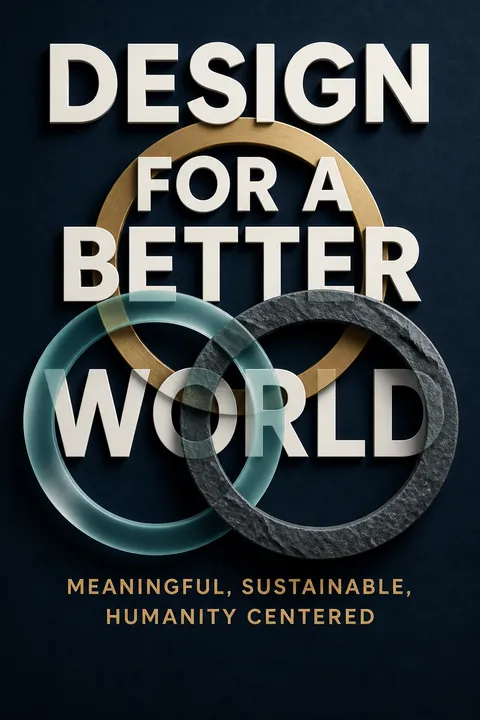
- Core Themes: Donald A. Norman organizes the book around three main themes: meaningful design, sustainable practices, and humanity-centered approaches, addressing critical issues affecting our lives and the planet.
- Call for Change: Norman advocates for a transformation in design philosophy to prioritize human well-being and ecological health, suggesting that rethinking design can address pressing global challenges.
Why should I read Design for a Better World?
- Unique Perspective: The book offers a fresh perspective on the role of design in shaping societal values and environmental outcomes, encouraging critical thinking about daily interactions with products and systems.
- Actionable Insights: Norman provides practical strategies for creating designs that are functional and beneficial to society and the environment, making it a valuable resource for designers and policymakers.
- Engaging Writing: The accessible and engaging narrative, supported by real-world examples, makes complex topics understandable and relatable.
What are the key takeaways of Design for a Better World?
- Artificial World: The book emphasizes that our world is largely artificial and designed, shaping behaviors and societal structures, empowering individuals to question and change systems.
- Meaningful Design: Norman stresses the need for designs that communicate effectively and resonate with people's values, using understandable language and relatable examples.
- Sustainability Focus: Advocating for sustainable practices and a circular economy, the book highlights designing for longevity and minimal waste to benefit the environment and society.
What is the difference between human-centered design and humanity-centered design in Design for a Better World?
- Individual vs. Ecosystem Focus: Human-centered design focuses on individual users, while humanity-centered design includes the entire ecosystem, acknowledging interconnectedness.
- Broader Issues: Humanity-centered design addresses systemic issues like equity and environmental impact, considering long-term societal and planetary effects.
- Guiding Principles: Norman outlines five principles for humanity-centered design, including solving core issues and involving communities, aiming for designs that benefit all humanity.
How does Design for a Better World address climate change?
- Root Causes: Norman argues climate change is a symptom of deeper systemic issues, emphasizing the need to address unsustainable design practices and economic models.
- Collective Action: The book advocates for collective efforts to change behaviors and practices contributing to climate change, involving individuals, businesses, and governments.
- Design's Role: Design is seen as crucial in mitigating climate change by creating sustainable and environmentally friendly products and systems.
What is the circular economy, and how is it discussed in Design for a Better World?
- Circular Economy Defined: It is an economic model emphasizing reuse, repair, and regeneration of materials to minimize waste, contrasting with the traditional linear economy.
- Design Principles: Norman outlines principles like minimizing waste, keeping products in use, and regenerating natural systems, guiding sustainable product design.
- Implementation Challenges: The book discusses difficulties in transitioning to a circular economy, including business resistance and the need for new training and education.
What is the concept of humanity-centered design in Design for a Better World?
- Expanded Focus: Humanity-centered design considers broader implications on all people and the environment, seeking equitable, sustainable, and culturally relevant solutions.
- Community Involvement: Emphasizes involving communities in the design process, leading to more meaningful and effective outcomes.
- Systemic Issues: Aims to tackle systemic issues like inequality and environmental degradation, prioritizing the well-being of all individuals.
How does Design for a Better World propose to democratize design?
- Community Empowerment: Advocates for empowering communities to actively participate in the design process, ensuring their voices are heard and needs met.
- Collaborative Methods: Highlights participatory and co-design methods involving stakeholders in decision-making, leading to more relevant solutions.
- Inclusive Process: Emphasizes breaking down barriers between experts and laypeople, promoting innovative solutions reflecting diverse perspectives.
What are the main challenges in implementing sustainable design practices according to Design for a Better World?
- Resistance to Change: Companies often hesitate to adopt sustainable practices due to fears of increased costs and potential sales loss, rooted in profit-focused models.
- System Complexity: Modern supply chains and production processes' interconnected nature complicates implementing changes without disruption.
- Education Need: There's a pressing need for designers to be educated on sustainability and circular design principles, requiring a shift in design education.
What is the significance of the "incremental modular design" approach in Design for a Better World?
- Approach Defined: Involves breaking down large projects into smaller, manageable modules for incremental development and implementation.
- Benefits: Allows flexibility and adaptability, encouraging experimentation and learning from failures, leading to continuous improvement.
- Application: Useful in addressing complex "wicked problems," enabling iterative testing and refinement for effective solutions.
What role does human behavior play in the challenges discussed in Design for a Better World?
- Behavior Complexity: Human behavior is complex and influenced by numerous factors, making it difficult to predict responses to design changes.
- Change Resistance: People often resist changing behaviors, even when recognizing the need, hindering sustainable practice adoption.
- Education Importance: Emphasizes education and awareness to help individuals understand the impact of their choices, fostering solutions resonating with values.
What are the best quotes from Design for a Better World and what do they mean?
- “Almost everything artificial has been designed.”: Highlights that our environment is shaped by design, influencing behaviors and structures, empowering change.
- “We live in a world designed by people.”: Emphasizes designers' responsibility to create products and systems positively impacting society and the environment.
- “Design must change from being unintentionally destructive to being intentionally constructive.”: Advocates redefining design practices to focus on sustainability and humanity-centered approaches.
About the Author
Other books by Donald A. Norman
Download PDF
Download EPUB
.epub digital book format is ideal for reading ebooks on phones, tablets, and e-readers.








