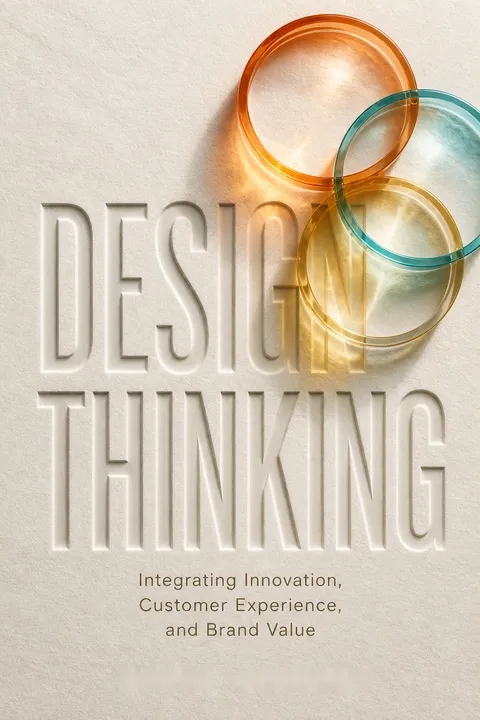


Key Takeaways
Use design thinking to join human needs, experimentation, and business reality
A bridge between worlds. Design thinking applies designers’ ways of observing, imagining, making, and testing to problems in products, services, and organizations. It is not a replacement for professional design craft. It is a way to bring users, designers, and business teams into the same problem-solving process, with commercial realities considered alongside creative possibilities.
A prototype changed the field. In the introduction, Thomas Lockwood recalls pairing a 3M engineer’s new microfiber with outdoor gear, then testing prototypes with athletes in freezing conditions. The material, developed for industrial scrubbers, helped keep users warm when wet and later became Thinsulate. Engineers, designers, users, and a business-minded CFO contributed to the work. The lesson is not that creativity beats analysis, but that innovation often comes from combining kinds of knowledge that organizations keep apart.
The strength of this approach is its refusal to treat creativity and analysis as rival temperaments. It resembles applied science: observe a phenomenon, form a possibility, build a testable version, and revise in light of evidence. The Thinsulate story makes that cycle concrete, while showing how an unexpected connection between industries can open a new path. Still, a process cannot guarantee a breakthrough. Teams need technical expertise, resources, and authority to act on what testing reveals. Design thinking is best understood as a disciplined way to improve the odds of useful discovery, not as a magic label for innovation.
Study people in context to uncover needs they cannot readily describe
Look beyond stated preferences. Asking customers what they want often produces requests for familiar products, not clues to a different solution. Field observation, interviews, and ethnographic research help teams understand what people are trying to do, what frustrates them, and what they may not think to mention. The goal is to understand behavior in its surroundings, rather than merely sort people into demographic categories.
Nike widened the frame. The company looked beyond the running shoe to runners’ motivations: personal improvement, achievement, and connection with other runners. Nike+ paired a shoe sensor with an iPod and an online community, turning a product into a way to track progress and share it. The book reports that Nike’s U.S. running-shoe share rose from 48 percent before launch to 61 percent by late 2008, alongside sales of more than 1.3 million Nike+ kits.
Contextual research is valuable because people’s accounts of their behavior are often incomplete, not because customers are poor judges of their own lives. Observation can reveal workarounds and unmet needs that surveys miss, while interviews help explain what those behaviors mean. The Nike+ case also shows how an insight can lead to a broader relationship, not simply a new feature. A useful caution is that empathy is not permission to project a team’s assumptions onto users. Researchers need to test interpretations with participants and remain alert to whose needs are being overlooked.
Make rough ideas tangible before certainty makes them expensive
Build to learn, not impress. A prototype is an early, simplified representation of an idea that makes it possible to test assumptions and get specific feedback. It might be a sketch, a rough physical model, a storyboard, or a role-play of a service. Its job is to expose questions while the idea is still easy to change, not to look like a finished product.
Cheap tests can beat polished guesses. In one business-design example, teams explored experience concepts with about $18 in prototype materials, rather than spending $200,000 on elaborate mock-ups of incremental product ideas. The book also describes Pixar’s practice of failing early as a way to learn faster. In services, acting out a customer’s journey can reveal gaps that a written proposal conceals. Repeated testing helps teams improve promising ideas and abandon weak ones before major investment.
Prototyping turns disagreement into something observable. Instead of debating whether a concept sounds appealing, a team can watch people try it, note where expectations break down, and decide what to change. This is closely related to experimental learning: each prototype should answer a question, however modestly. Roughness also signals that feedback is welcome. But failure is useful only when teams record what it teaches and have permission to respond. Repeatedly producing prototypes without changing decisions is activity dressed as learning. The valuable cycle is make, observe, interpret, and revise.
Redesign the organization, not just the product it makes
Culture can cancel good ideas. A company may celebrate design in its offices while its incentives reward short-term wins, risk avoidance, competition between departments, and rigid procedures. Those habits make it difficult to find time for collaboration, test uncertain ideas, or speak honestly about problems. The book argues that embedding design therefore requires changes to organizational systems, not merely a new design department or workshop.
Change the conditions of work. Design-friendly organizations give teams authority, make room for reflection, reward learning, encourage shared purpose, and allow experimentation. Leaders need to support the effort publicly and model the desired behavior. One practical method is an intent workshop, where stakeholders agree on the problem and describe a preferred future before trying to solve it. The book also recommends identifying obstructive systems and redesigning them, rather than blaming individuals for working inside them.
This is a systems view of organizational change: behavior is shaped not only by personal attitudes but also by calendars, budgets, approval paths, and reward structures. That perspective helps explain why design initiatives often stall after enthusiastic launches. It also shifts the designer’s task from improving an artifact to examining the conditions that produce it. There is a power question here, however. Cultural change cannot be delegated to designers if executives retain the incentives and decision rights that preserve the old culture. Leaders must be willing to alter the machinery that their own success may depend on.
Move between user insight, imagined concepts, and viable business models
Three connected activities. Heather Fraser’s Three Gears of Business Design is an iterative framework for joining deep user understanding, visualized concepts, and strategic business design. First, learn about people’s needs in the wider context of their lives. Next, make possible solutions tangible and explore them with users. Then determine what capabilities, partnerships, investments, and operating changes would make a strong concept workable. Teams can cycle among these activities rather than treating them as a one-way sequence.
Design the whole value system. A food business, for example, may find more opportunity by studying healthy eating than by focusing only on its frozen dinners. The wider view can generate ideas, but the business still has to assess how to deliver them. The framework encourages teams to link a concept to the activities that support it, mapping what the organization can reuse, what it must change, and how those choices create value for users and the enterprise.
The framework addresses a familiar gap between inspiring ideas and executable strategy. User research without business design can produce desirable concepts that no organization can deliver; financial analysis without user understanding can efficiently optimize the wrong offer. Iteration allows each perspective to correct the others. This also connects to systems thinking, where value emerges from relationships among activities rather than from a single component. The balance is delicate: early financial scrutiny can suppress possibility, but postponing feasibility entirely can waste effort. The useful discipline is to ask business questions in ways that improve a concept, not merely disqualify it.
Let every customer touchpoint prove the brand promise
A brand is delivered in use. A brand strategy may state what a company promises, but customers judge it through products, packaging, websites, stores, service encounters, and employee behavior. Design can make the promise recognizable and emotionally engaging, but the whole organization has to fulfill it. A persuasive identity cannot compensate indefinitely for a disappointing experience.
Small design choices can unlock meaning. During a Coca-Cola redesign, the team revived a flowing ribbon motif and introduced yellow alongside the familiar red. The changes drew on the brand’s visual history and gave its packaging fresh energy. The story illustrates how design can activate existing brand associations rather than inventing an unrelated identity. Other chapters make the internal point: employees need to understand and enact the brand, because a customer experiences the company through the people and systems they encounter.
This account treats branding as an operational promise, not just a communications exercise. The distinction matters because customers encounter organizations through multiple channels, and inconsistencies can weaken the meaning a company hopes to create. The ribbon and color worked as cues because they were connected to recognizable brand history; novelty alone would not necessarily have done the same. Emotional design can deepen attachment, but it also raises an ethical responsibility. A brand should not use sensory appeal to disguise poor delivery. Trust grows when the experience behind the symbol can support the feelings the symbol invites.
Design the service journey as one system, not isolated encounters
Services unfold over time. Unlike a product, which is often encountered as an object, a service consists of a changing sequence of interactions among people, spaces, processes, and technology. Service design examines that journey as a whole and uses tools such as storyboards, role-play, and journey maps to make it visible. A polished website, for instance, cannot rescue an experience whose call center, delivery, or follow-up fails.
OpenRoad redesigned the dealership experience. The Vancouver auto group shifted from treating the dealership mainly as a place to sell cars toward a more customer-centered environment. It added information kiosks, a comfortable lounge, and a less pressured buying experience, and brought service customers back into the showroom rather than leaving them in the repair area. The book reports a 28 percent retail sales increase in the first year. The change joined physical layout, staff behavior, and service processes.
The journey perspective helps organizations find failures that departmental metrics can hide. Each unit may meet its own target while the customer experiences a confusing handoff or an avoidable delay. Mapping the full sequence makes dependencies visible and creates a shared object for teams to improve. This resembles operations research, but adds attention to emotion, context, and perception. The reported sales gain is suggestive rather than proof that every design element caused the result. Good evaluation should connect experience changes to outcomes while considering other factors, such as market conditions and concurrent business decisions.
Protect bold service ideas long enough to test their real value
Radical service innovation needs shelter. The book describes a five-stage route from market insight to new value propositions, alternative service models, revised delivery systems, and iterative pilots. The central discipline is to avoid judging an early idea solely by whether it fits current operations. Early concepts should be explored for customer appeal, technical possibility, and business value, with prototypes used to improve them rather than simply approve or kill them.
A bank tested a different relationship. At 1st Source Bank, research found that customers valued personal relationships and tellers felt limited by the traditional counter. The team prototyped side-by-side banking, where employees and customers could interact without a teller wall. A partial pilot used adapted existing equipment before a full rollout. The book reports that converted branches performed more than 30 percent better than comparable older branches on new accounts, deposit growth, and loan sales.
The staged approach recognizes that radical ideas are especially vulnerable to evaluation systems designed for incremental change. A low-fidelity pilot can reduce uncertainty without requiring a company to commit to a full rollout. It also brings front-line employees into innovation, where their operational knowledge can reveal both possibilities and constraints. The bank example demonstrates that changing service design may require changing social roles, not just furniture. Yet pilot results must be interpreted carefully: a successful trial may depend on unusually motivated staff or favorable locations. Replication is part of the evidence, not an administrative afterthought.
Measure design through customer, operational, financial, and social outcomes
Value has several dimensions. Brigitte Borja de Mozota presents four ways design can contribute: differentiating a company in the market, improving internal processes, helping it adapt or find new opportunities, and producing business or broader social value. The Balanced Score Card offers a practical way to connect design measures to customer outcomes, processes, organizational learning, and finances. This makes design easier to discuss with executives without reducing it to appearance or cost.
Measure what changed. In one Steelcase workplace example, colocating teams and using flexible furniture helped reduce the time needed to move staff from twelve weeks to twelve hours. The authors also report a 72 percent reduction in move-related costs. For public and service work, the book describes measures such as social and environmental outcomes and a service usability score based on users’ experiences. Metrics should match the project’s purpose, not merely what is easiest to count.
Measurement gives design a seat in resource decisions, especially when outcomes connect to existing organizational goals. A balanced set of indicators can reveal trade-offs: a change may improve satisfaction while increasing delivery costs, or create near-term expense for longer-term capability. This is stronger than claiming design has value because it looks good. Still, metrics are not neutral. If teams are judged only on short-term revenue, social benefits and learning may disappear from view. A scorecard should function as a conversation about value and causation, not as a decorative dashboard that implies every meaningful outcome can be reduced to one number.
Look for tomorrow's opportunity in today's widening customer-value gap
Expectations move while products stand still. The Product Opportunity Gap describes the space between what existing offerings provide and what people will value as their circumstances change. The book recommends scanning political, environmental, social, technological, and economic factors, known as PESTE, to anticipate emerging needs. A company can then decide which user values, such as convenience, identity, comfort, or sustainability, its next offer should address.
A familiar staple found a new format. CJ Corporation saw that more single-person households and wider microwave use could create demand for convenient, single-serving rice that still tasted good. Its Het-Bahn product addressed that mismatch and later expanded into other foods. The broader lesson is to look beyond current market share toward future opportunity. The book also connects this form of foresight to inclusive and environmentally responsible design, which can reveal needs neglected by products aimed only at established customers.
Trend scanning is most useful when it becomes a question about behavior: what might people need to do differently if their circumstances change? The Het-Bahn example links a demographic shift and a technology to an everyday unmet need, rather than treating trends as a list of fashionable predictions. This kind of foresight is necessarily uncertain. Political, social, and technological forces do not translate neatly into consumer demand, so teams should treat forecasts as hypotheses and test them with users. Including environmental and accessibility concerns also broadens opportunity beyond affluent mainstream markets.
After convenience becomes ordinary, compete through experiences people care about
Satisfaction accumulates across encounters. Customers compare what they expected with what they experienced at each brand touchpoint. Over time, these encounters shape the brand’s meaning and influence whether customers stay, leave, or recommend it. The book contrasts a hyped PlayStation 3 launch that left many customers underwhelmed with Nintendo’s Wii, whose physical, approachable controls brought new kinds of players into gaming. The difference was not simply technical performance, but the experience people found engaging.
Design for significance, not just ease. Convenience remains important, but once competitors offer it widely, it may no longer distinguish them. The chapters point to experiences that connect with identity, community, learning, or a sense of contribution. A meaningful experience need not be grand or expensive. It must matter to the people using it and be supported by consistent delivery. Overpromising raises expectations, making weak experiences particularly damaging for established brands.
The shift from ease to significance helps explain why customers may prefer an experience that is playful, communal, or identity-rich over a technically superior but emotionally flat alternative. It also connects design to behavioral science: people remember and interpret experiences, not feature lists in isolation. Meaning, however, cannot be manufactured by branding alone. Claims about purpose or community become fragile when the actual service contradicts them. The practical challenge is to discover what matters to a specific audience, then make that value perceptible in use. Convenience is a foundation; it is rarely a complete reason to care.
Analysis
This anthology’s central argument is that design becomes strategically powerful when it moves upstream. Rather than receiving a nearly finished brief and adding visual polish, design methods can help determine which problem deserves attention, what future experience is worth creating, and how an organization must change to deliver it. The book’s examples repeatedly connect three scales: the person using an offering, the sequence of interactions around it, and the business or social system that sustains it.
Its most useful tension is between openness and accountability. Observation, imagination, and rough prototyping keep teams from mistaking current assumptions for fixed limits. Strategy, operational planning, and measurement prevent attractive concepts from remaining theater. The strongest cases do not choose one side. They use evidence to broaden the design space, then use pilots and business analysis to refine what can work. This is a practical answer to the false choice between creativity and rigor.
The anthology also makes clear that design outcomes depend on power and organizational conditions. A team cannot normalize experimentation if leaders punish early failure, nor can a brand promise care if employees lack time or discretion to show it. Consequently, design leadership includes redesigning incentives, processes, and decision rights. That is more demanding than teaching a workshop, but more likely to produce durable change.
Some claims require care. The cases show plausible links between design interventions and commercial gains, but examples alone cannot isolate causation. Similarly, emotional branding and meaningful experiences can enrich people’s lives, yet can also be used to stimulate consumption without addressing wider costs. The book’s attention to social and environmental value offers a corrective, though implementation requires measures that account for those effects.
Because the volume brings together many contributors, it offers a landscape rather than a single, universally agreed method. That is a limitation when readers want one recipe, but a strength when the subject itself crosses research, craft, management, and service delivery. Its lasting lesson is a discipline of integration: understand people deeply, make possibilities tangible, align the organization around delivery, and judge success by value that reaches beyond appearance.
Review Summary
Design Thinking receives mixed reviews, with an average rating of 3.85/5. Readers appreciate its case studies and insights on creating meaningful user experiences through empathy and research. Some find it valuable for understanding design's role in business strategy and innovation. However, critics note it can be dry and textbook-like, with outdated examples and a lack of cohesion due to multiple authors. The book is praised for its coverage of brand, service design, and customer experience, but some feel it doesn't focus enough on design thinking itself.
People Also Read

Glossary
Design thinking
Human-centered innovation methodA way of applying designers’ methods and sensibilities to problem solving. In this book, it combines observation of users, multidisciplinary collaboration, visualization, rapid prototyping, and business analysis. It can be used to develop products, services, experiences, and organizational change, but it does not replace the professional craft of design.
Wicked problems
Problems without simple solutionsComplex challenges that shift as people try to address them and have no single, final solution that is simply right or wrong. The book applies the term to persistent social and business issues, such as sustainability, healthcare, and balancing short-term demands with long-term goals. Such problems call for reframing, experimentation, and attention to connected systems.
Three Gears of Business Design
Iterative business-design frameworkHeather Fraser’s framework for connecting deep understanding of users, visualization and prototyping of concepts, and strategic design of the business model. The three activities are not a fixed linear sequence. Teams move among them to develop solutions that meet human needs and can be delivered through an organization’s capabilities, partnerships, investments, and operating activities.
PESTE factors
Five forces shaping trendsA trend-scanning framework covering political, environmental, social, technological, and economic factors. The book uses these forces to help teams anticipate shifts in lifestyles and customer values. They are inputs for identifying possible future needs, not guarantees about what customers will want; emerging opportunities still need to be interpreted and tested.
Product Opportunity Gap
Mismatch between offers and needsThe gap between the service level of products currently available and the higher or different level customers may expect as their circumstances and values change. The concept encourages companies to compare today’s offering with possible emerging needs, then develop products or services that address the difference.
Value Opportunity Analysis
Map of customer-value attributesA method associated in the book with Jonathan Cagan and Craig Vogel for identifying consumer value opportunities across seven areas: emotion, aesthetics, identity, ergonomics, impact, core technology, and quality. It helps teams translate changing customer values into attributes that can guide product development and design.
Four Powers of Design
Design’s four routes to valueBrigitte Borja de Mozota’s account of how design can create value by differentiating an offer in the market, improving internal processes, helping a company transform or find opportunities, and contributing to business and wider societal results. The framework connects design activities to customers, organizational processes, learning, and financial performance.
Balanced Score Card
Multi-perspective performance frameworkA management tool used in the book to connect design contributions with four kinds of organizational performance: customer value, internal processes, learning and development, and financial results. Applying it to design helps teams select measures relevant to a project and relate them to business objectives, rather than treating design as an unmeasured aesthetic contribution.
Brand Driven Innovation
Innovation guided by brand meaningA framework for using a brand’s meaning and desired relationship with stakeholders to guide innovation and design. The approach links research into how people and employees experience a brand with future innovation directions, design choices, and the coordination of customer touchpoints. Its aim is to help an organization fulfill its brand promise through what it makes and does.
Service usability (SU)
Assessment of service experienceA method described by live|work for evaluating the quality of a service across its touchpoints and over time. It examines whether users understand the service’s value, feel good about the experience, can use it easily, and can access it. User interviews and observation produce an overall score and practical recommendations for improvement.
FAQ
What's Design Thinking: Integrating Innovation, Customer Experience, and Brand Value about?
- Focus on Design Thinking: The book delves into design thinking as a human-centered innovation process that integrates design into business strategy.
- Expert Contributions: Edited by Thomas Lockwood, it includes insights from 34 authors, offering a broad perspective on design thinking.
- Structured Content: It is divided into four sections: Design Thinking Methods, Value in Branding, Influence of Service Design, and Creating Meaningful Customer Experiences.
Why should I read Design Thinking: Integrating Innovation, Customer Experience, and Brand Value?
- Modern Business Relevance: It addresses the growing importance of design thinking in today's business landscape.
- Practical Insights: Offers methods and case studies for implementing design thinking to solve complex problems.
- Diverse Perspectives: Contributions from various thought leaders provide a multifaceted understanding of design thinking.
What are the key takeaways of Design Thinking: Integrating Innovation, Customer Experience, and Brand Value?
- Human-Centered Approach: Emphasizes understanding user needs to create innovative solutions.
- Collaboration and Iteration: Encourages teamwork and rapid prototyping for learning from failures and successes.
- Business Strategy Integration: Highlights embedding design thinking into business processes for effectiveness and satisfaction.
What are the best quotes from Design Thinking: Integrating Innovation, Customer Experience, and Brand Value and what do they mean?
- Human-Centered Innovation: "Design thinking is essentially a human-centered innovation process."
- Creativity as Economic Engine: "Creativity in its various forms has become the number-one engine of economic growth."
- Integrative Process: "The objective is to involve consumers, designers, and businesspeople in an integrative process."
What is the definition of design thinking as presented in Design Thinking: Integrating Innovation, Customer Experience, and Brand Value?
- Human-Centered Innovation Process: A methodology focusing on observation, collaboration, and rapid prototyping.
- Business Analysis Integration: Ensures creative ideas align with strategic business objectives.
- Empathy and Understanding: Requires deep empathy for users to uncover unarticulated needs.
How does Design Thinking: Integrating Innovation, Customer Experience, and Brand Value describe the evolution of design thinking?
- Historical Context: Traces design thinking from traditional practices to broader business applications.
- Business Practice Integration: Recognized as essential for addressing complex challenges and driving transformation.
- New Models Emergence: Discusses integrated design management models combining design thinking with business processes.
What methods are recommended for implementing design thinking in organizations according to Design Thinking: Integrating Innovation, Customer Experience, and Brand Value?
- Empathy and User Research: Conduct user research to understand customer needs deeply.
- Rapid Prototyping: Create quick prototypes to test ideas and gather feedback.
- Cross-Functional Collaboration: Foster creativity by encouraging diverse team collaboration.
What role does service design play in design thinking according to Design Thinking: Integrating Innovation, Customer Experience, and Brand Value?
- Enhancing Customer Experience: Focuses on creating seamless interactions between customers and services.
- Measuring Design Value: Evaluates service design's impact on satisfaction and performance.
- Integration with Product Design: Combines service and product design for holistic solutions.
How can organizations become more design-minded according to Design Thinking: Integrating Innovation, Customer Experience, and Brand Value?
- Cultural Shift: Foster a culture that values design and innovation.
- Leadership Support: Leadership should champion design initiatives and integrate them into strategy.
- Continuous Learning: Commit to ongoing learning and adaptation using design thinking.
What are the four powers of design as outlined in Design Thinking: Integrating Innovation, Customer Experience, and Brand Value?
- Design as Differentiator: Creates competitive advantage through brand equity and loyalty.
- Design as Integrator: Improves processes and fosters collaboration within organizations.
- Design as Transformer: Drives innovation and creates new business opportunities.
- Design as Good Business: Highlights financial benefits like increased sales and ROI.
How does Design Thinking: Integrating Innovation, Customer Experience, and Brand Value integrate design thinking with business strategy?
- Strategic Alignment: Ensures design thinking aligns with business objectives for effectiveness.
- Organizational Embedding: Embeds design thinking into processes to enhance customer satisfaction.
- Holistic Approach: Combines creative and analytical thinking for comprehensive solutions.
What are the main sections and themes in Design Thinking: Integrating Innovation, Customer Experience, and Brand Value?
- Design Thinking Methods: Explores various methodologies for implementing design thinking.
- Value in Branding: Discusses how design thinking enhances brand value.
- Influence of Service Design: Examines the role of service design in customer experience.
- Creating Meaningful Experiences: Focuses on designing experiences that resonate with customers.
About the Author
Download PDF
Download EPUB
.epub digital book format is ideal for reading ebooks on phones, tablets, and e-readers.








