Key Takeaways
1. We Don't See Reality; Our Brain Evolved for Survival, Not Accuracy.
The answer is that we don’t see reality.
Fundamental truth. Contrary to popular belief and millennia of philosophical inquiry, neuroscience reveals that our brains do not perceive objective reality. Our sensory processes, far from granting direct access, actually separate us from it. This isn't a flaw; it's a paradox of evolution.
Survival mechanism. Our brains didn't evolve to show us the world as it truly is, but to help us survive within it. This means our perceptions are tailored for utility, not accuracy. The viral "The Dress" phenomenon, where people saw different colors, vividly demonstrated this subjective nature of perception, unsettling many who believed in an objective visual truth.
Beyond sight. This principle extends beyond vision to all our senses. The "Rubber-Hand Illusion" shows how our brain can adopt a fake hand as our own, and "phantom words" can be heard in nonsense sounds. These aren't "tricks" but evidence that our brain constantly interprets and constructs a useful reality, even if it deviates from objective physical facts.
2. All Sensory Information is Inherently Meaningless; Your Brain Creates Its Meaning.
All information in and of itself is meaningless.
Raw data. The energy and molecules our senses receive—photons, vibrations, chemicals—are just electro/chemical energy. They are raw, undifferentiated data without inherent meaning or instructions. Our brain doesn't access the "stuff itself," only the changes in energy states.
Meaning-making machine. Our brain is a prodigiously skilled machine that creates meaning from this meaningless information. A certain light means a surface color, a smell means food, a smile means an emotion. This interpretive process is constant and rapid, making it feel as if meaning is built into reality, but it's always a construction.
Four barriers. We lack direct access to reality due to four fundamental reasons:
- Limited senses: We only perceive a tiny fraction of the electromagnetic spectrum (e.g., reindeer see UV light, stomatopods have 16 visual pigments).
- Constant flux: The world is always changing, so even if we perceived reality, it would instantly be outdated.
- Ambiguous stimuli: A smile can mean joy, sarcasm, or pain; light quality is determined by sun, reflectors, and transmitters, making its source ambiguous.
- No instruction manual: Information doesn't tell us how to act; our brain must create a response.
3. Your Brain is a Product of Its Ecology: Active Engagement Shapes Your Perception.
Engaging with the world gives our brain a historical record of experiential feedback that sculpts the neural architecture of the brain.
Embodied history. Our brain's architecture is a physical manifestation of our past experiences—individual, cultural, and evolutionary. This history, built through a continuous "response cycle" of trial and error, determines how we perceive and behave. Active engagement is not just beneficial; it's neurologically necessary for shaping our neural networks.
Adaptation timelines. This shaping occurs across three critical timelines:
- Evolution: Long-term adaptation (e.g., deep-sea fish having fewer light receptors).
- Development: Medium-term growth and pruning (e.g., kittens needing active movement to develop spatial perception, Marian Diamond's enriched rat environments).
- Learning: Short-term, minute-to-minute adjustments (e.g., mastering a new skill, adapting to the feelSpace belt).
Minds match ecology. Our brains constantly adapt to their environment. An "enriched" environment fosters neural complexity, while an "impoverished" one can reduce cognitive abilities, as seen in Romanian orphans. This means changing your environment can literally change your brain, and vice versa, creating a dynamic feedback loop.
4. Context is Everything, and All "Illusions" Are Just Useful Perceptions.
The change in “reality” took place inside of the mind rather than out—the same leap of thought that had tripped up Goethe with his colored shadows.
Relational processing. The brain doesn't deal in absolutes; it deals in relationships. Meaning is made through context and the differences (contrast) it provides. Michel Chevreul's discovery at the Gobelins Factory showed that a color's appearance changes based on adjacent colors, not its inherent physical properties.
Contrast is vital. Our vision relies on constant, tiny eye movements (saccades) to detect differences. Without contrast in space or time, our vision literally fades to blindness, as demonstrated by the "freezing eye" experiment. This highlights that the brain is only interested in change, difference, and contrast to interpret information.
Usefulness over accuracy. Our brain's goal is not accurate perception, but useful perception. When an action hero jumps across buildings, their brain doesn't calculate physics; it usefully perceives the space to ensure survival. Similarly, our perception of color, sound, or even pain is a useful interpretation, not an accurate reflection of objective reality. Therefore, "illusions" are simply instances where our brain's useful interpretations deviate from objective measurement, revealing that either everything is an illusion, or nothing is.
5. Humans Are Beautifully Delusional: Your Imagination Physically Changes Your Brain.
We are beautifully delusional because internal context is as determinative as our external one.
Power of imagination. Unlike a frog, which merely responds to stimuli, humans can imagine. This "delusional" capacity allows us to mentally explore scenarios, create stories, and even envision ourselves as princes. What's remarkable is that these imagined experiences are not just abstract thoughts; they physically change our neurons and, consequently, our perceptual behaviors.
Neural overlap. Research by Stephen Kosslyn using fMRIs shows that imagining things visually activates the same brain regions as actually seeing them. This "motor imagery" is used by elite athletes to improve performance and in psychotherapy to treat phobias. For the brain, "realness" encompasses both physically experienced and imagined events.
Self-reinforcing perceptions. Our imagined perceptions become part of our "past" history, influencing future seeing. By consciously choosing our delusions—imagining complex, challenging possibilities—we can sculpt our brain's internal probability distributions. This can lead to "lucky" outcomes, as positive thinking reinforces neural pathways that favor beneficial interpretations, while negative rumination can strengthen destructive meanings.
6. Your Assumptions Define Your "Space of Possibility" and Limit What You Can Perceive.
Your assumptions (i.e., the connectivity between brain cells that is your history) determine the boundaries and everything that falls within—and hence the structure and dimensionality of your space of possibility.
Physiological biases. Assumptions are not just abstract ideas; they are deeply physiological, electrical patterns in our brain's neural network. These "attractor states" make certain thoughts and behaviors highly probable, while others remain effectively invisible or impossible to conceive. This is the "neuroscience of bias."
Limited routes. Our brain's vast network of 86 billion neurons and 100 trillion connections has an almost infinite potential for patterns. However, our assumptions, shaped by millennia of evolution and personal experience, constrain these possibilities. Like a railway system, our brain's "trains" follow established routes, making some perceptions easy and others inaccessible.
Blindness to assumptions. We are often blind to our own assumptions because they are so deeply ingrained and useful for daily functioning (e.g., assuming a chair will hold us). This "bias-blindness" is a major obstacle to creativity. The "Dunker's candle problem" illustrates this: the solution is obvious once the assumption about the matchbox (as a container) is challenged.
7. Free Will Lives in "Re-Meaning" Your Past to Change Your Future Perceptions.
Free will lives, not in going to A, but in choosing to go to not-A.
Beyond present control. Benjamin Libet's experiments showed that our brain makes decisions milliseconds before we are consciously aware of them, suggesting limited free will over immediate responses. However, this doesn't mean we lack agency entirely.
Changing the narrative. We can influence our "future now" by "re-meaning" past events. This process changes the statistical history upon which future perceptions are predicated. Whether through therapy, self-reflection, or reading, altering the meaning of our past narrative changes our "future past," thereby altering future reflexive behaviors.
The power of "Why?". Asking "Why?" is the engine of this re-meaning. It challenges deeply held assumptions, creating new "spaces of possibility." Just as Jean-François Champollion deciphered hieroglyphs by questioning the assumption that they were purely symbolic, asking "Why?" about established truths can unlock revolutionary insights and shift our perceptual landscape.
8. Uncover Invisible Assumptions by Actively Seeking Contrasting Experiences.
Diversity of experience is a transformative force for the brain because new people and environments not only reveal our assumptions to ourselves, they also expand our space of possibility with new assumptions.
Bias-blindness. Our assumptions are often invisible to us, making it hard to know what to question. We tend to perceive ourselves as stable and unchanging, even though our "personalities" shift with context. This "average" view of self prevents us from recognizing our unique biases.
Emotions as indicators. Our emotions serve as proxies for revealing unfulfilled assumptions. Negative emotions arise when reality doesn't match our expectations. By asking "What assumption wasn't fulfilled?" during conflict or discomfort, we can uncover the unseen forces guiding our behavior and gain the potential for choice.
Travel and diversity. Actively seeking contrasting situations and ecologies is a powerful way to reveal assumptions. Living or working abroad, as Adam Galinsky's research shows, can significantly boost creative intelligence by exposing us to different cultural assumptions. Even local "travel" or engaging with diverse groups can expand our "space of possibility" and foster new assumptions.
9. Embrace Uncertainty and "Stop" Your Reflexive Responses to Unlock Creativity.
To not “know” was to die.
Evolutionary fear. Our brains evolved in a world of extreme uncertainty, where predicting danger meant survival. This ingrained fear of the unknown makes us actively resist uncertainty, often leading to anger or clinging to familiar (even painful) certainties. This drive for certainty drastically narrows our "space of possibility."
The power of "not-A". To deviate, we must consciously choose "not-A"—to stop our immediate, reflexive response. This is the essence of free will: not controlling the present, but choosing to suspend the automatic. Meditation, for example, is a mechanism for going to "not-A," fostering empathy and neural growth by emptying the mind of ceaseless meanings.
Celebrate doubt. Overcoming the brain's innate aversion to uncertainty requires courage. By actively ignoring initial worries or discomfort, we dim the influence of old assumptions. This "stopping" allows new, better thoughts to emerge, igniting a new history for our perception. It's about looking away from the obvious, challenging our attention to settle on the less probable, and thereby expanding our potential responses.
10. Engineer Your Own Ecology of Innovation: A Dynamic Balance of Play and Intention.
Innovation is this dialectic that is present throughout nature and is echoed in a number of other dualistic tensions that run through this book: reality versus perception, past usefulness versus future usefulness, certainty versus uncertainty, free will versus determinism, and seeing one thing but knowing another is actually the physical truth.
Five principles. To truly innovate, we must engineer an "ecology of innovation" defined by:
- Celebrating uncertainty: Embracing the unknown as an opportunity.
- Openness to possibility: Encouraging diverse experiences.
- Cooperation: Finding value in group diversity (novice + expert).
- Intrinsic motivation: Letting the process be its own reward (play).
- Intentional action: Acting with awareness and purpose (science).
Play + Intention = Science. Play, as observed in bonobos, celebrates uncertainty and is intrinsically motivated, making it a powerful tool for learning and exploration. When combined with intention, play becomes science—a systematic way to question assumptions and generate new understanding.
Creativity and efficiency. Innovation is a dynamic balance between creativity (saying yes to new ideas, complexification) and efficiency (saying no, consolidation). The brain itself embodies this, balancing excitation and inhibition. Successful systems, like Apple's "wedge innovation," spiral between these phases, starting sharp and then widening, constantly adapting and redefining normality. "Failure" in this context is simply learning, not a setback.
Last updated:
Review Summary
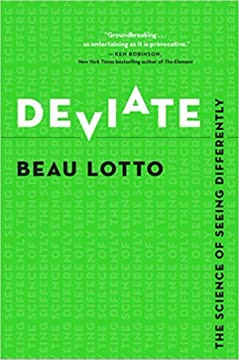
Deviate by Beau Lotto receives mixed reviews, averaging 3.73 out of 5 stars. Many readers appreciate the neuroscience concepts about perception and how our brains create reality through assumptions, finding the visual experiments and unconventional formatting engaging. However, critics note the book lacks practical applications, becomes repetitive, and feels more theoretical than actionable. Some praise its thought-provoking insights on uncertainty, creativity, and adaptation, while others find it overly abstract or unnecessarily complex. The book's central thesis—that we can change future perceptions by altering our past assumptions—resonates with some readers but frustrates those seeking concrete guidance.