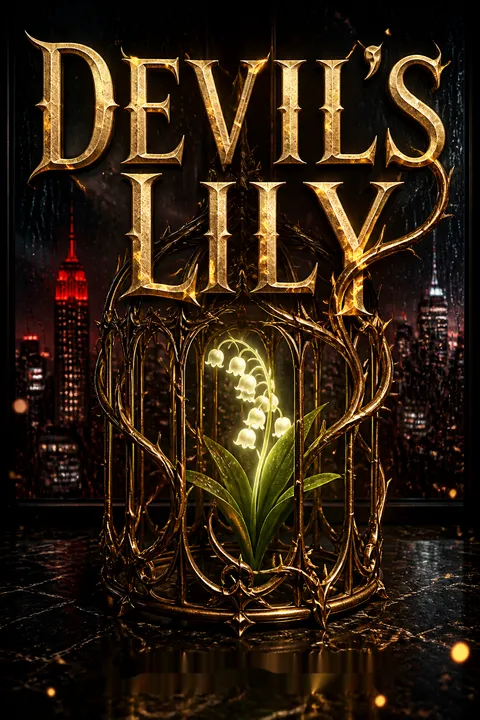


Plot Summary
Birthday Through the Gates
At twenty-one, Elira Përmeti has spent five years confined to her family’s Queens compound, a punishment her father Afrim imposed after her mother died in an attack. On her birthday, Afrim finally permits an outing with bodyguards, and Elira seizes the chance to drive herself through Flushing.
Hungry, she stops at Mughetto, a restaurant marked with lily-of-the-valley flowers, unaware it is a front for the Italian crime boss Maximo Leonotti. His armed men recognize her guards, but Elira sees only a handsome stranger watching her. Maximo has his men cook her a birthday meal and send gifts. When she refuses his advances and runs, he slips a burner phone into her jacket. Back home, Elira finds it and keeps the discovery secret.
Elira’s birthday is not simply a coming-of-age outing. It is her first chance to act without her father’s permission defining the limits of her world. Her delight in driving and wandering makes the city feel newly available, but her inexperience also leaves her unable to read the danger surrounding Mughetto. Maximo’s gifts exploit the very freedom she is trying to claim: attention feels like a door opening, while the hidden phone turns that attention into surveillance. The scene establishes the novel’s central ambiguity early. Elira is drawn toward agency, yet the men around her repeatedly translate desire into control.
A Name Bought With Fire
Maximo traces the burner phone and discovers that the red-haired woman is Afrim’s daughter, an enemy heiress almost nobody has seen. While his crime-family brothers debate Albanian expansion and a diverted weapons shipment, Maximo messages Elira with an offer to help her leave the compound.
She agrees to identify herself only after he promises his name in return; once she sends hers, he refuses to honor the bargain. An hour later, fire alarms erupt across the estate.
Believing the distraction is her chance, Elira slips out through the unattended gate, orders a taxi, and heads to Flushing Meadows Corona Park rather than Mughetto. Maximo’s plan has worked, but not as intended: she is free of her guards for the moment and has no intention of going to him.
The exchange exposes how differently the two characters understand consent and leverage. Elira treats a name as a mutual confidence, a small reciprocal risk between strangers; Maximo treats it as intelligence that gives him power over an adversary. Her escape is genuinely her own decision, but its conditions have been engineered by him. That distinction matters because Elira’s wish for freedom is real even when Maximo manipulates the route she takes. The fire alarms also transform her father’s security system into an opening. Protection, once imposed without her voice, becomes a vulnerability she can exploit.
The Unisphere Date
Elira wanders the park until she reaches the Unisphere, where Maximo appears and insists on joining her day. He holds her hand, clears the Fantasy Forest rides of other visitors, and leads her to the Queens Museum’s miniature panorama of New York. The city model’s slow sunset gives them a private view, and Elira initiates her first kiss.
Maximo reciprocates, then drugs her and carries her to his private jet. When she wakes, she learns he has identified her and taken her to Las Vegas. The day she imagined as an adventure has become an abduction. Maximo offers her no honest explanation for the sedative or the flight, and Elira understands that her attraction has left her dangerously exposed.
The date is constructed from real wonder and coercive privilege at once. Maximo gives Elira experiences she has long been denied, but he can do so by ordering a public attraction emptied and controlling every practical detail. Her first kiss is freely chosen; the drugging that follows is not. That sharp shift prevents the romance from being read as a simple reward for her curiosity. Elira’s openness is both a strength and a vulnerability, while Maximo’s ability to make a fantasy appear effortless masks the force that sustains it. The miniature city also quietly anticipates the larger power struggle: he shows her a world he can arrange, then removes her from it.
Vegas Makes Them Family
On the jet, Maximo tells Elira that his name is Maximo Leonotti, a leader of the Nightshades and Afrim’s rival. He presents a marriage agreement, but she rejects it until he shows her video of a sniper aiming at her father and brother. With their lives threatened, Elira signs the prenup. At a Las Vegas courthouse, she becomes Maximo’s wife, then turns her face away when he is expected to kiss her.
Back in New York, he withholds her purse and phone so she cannot contact home, explaining that the marriage is meant to unsettle Afrim and contain his criminal ambitions. Elira has saved her family from an immediate threat, but Maximo has made her safety depend on a union she did not freely choose.
The marriage makes legal form serve as an instrument of coercion. The prenup’s polished language and courthouse ceremony cannot turn Elira’s constrained choice into meaningful consent; the sniper videos make the family’s lives the price of refusal. Maximo’s power operates through both spectacle and bureaucracy, binding her more securely with documents than with guards alone. Elira’s refusal of the wedding kiss preserves one boundary, however small, and signals that compliance is not surrender of her inner judgment. The scene also establishes the marriage’s double function: it is personal possession for Maximo and political pressure against Afrim.
A Home With Armed Guards
Maximo brings Elira to his penthouse, introduces her as his wife, and orders his guards to treat her with the respect they show him. She finds an extravagant wardrobe but an empty kitchen, so she uses the boss’s authority to order baking supplies and begins feeding the men.
When Maximo returns and finds her playing a video game with them, jealousy overwhelms him; he punishes her with a spanking that leads to their first intercourse. Afterwards, Elira panics because he has come inside her and she is not using contraception.
She tries to reach a pharmacy, but Maximo catches her at the secured elevator. He calls his doctor, who inserts a contraceptive implant in her arm. Their home now contains moments of warmth, but Elira’s choices remain fenced by Maximo’s control.
Domestic intimacy grows here inside a structure that is still profoundly unequal. Elira’s baking creates a social life among Maximo’s guards, giving her influence through care rather than rank; the empty kitchen becomes a space she can remake. Maximo’s jealousy then converts that welcome into a pretext for sexual punishment, and Elira’s physical response does not erase the coercive context. Her attempt to obtain emergency contraception is an assertion of bodily autonomy, while Maximo’s intervention replaces her urgent decision with his. The implant addresses pregnancy risk, but the scene makes clear that practical protection is not the same as permission or trust.
Singapore Bound
As Elira settles into the penthouse, Maximo learns that a shipment of weapons expected at his New York port has been rerouted to Singapore. The ship’s officers have cut communications, and the Nightshades cannot tell who authorized the change.
Maximo’s brothers, Rafael Moretti, Michael Hart, and Romero Lombardi, suspect a powerful rival rather than a simple boundary dispute. Maximo eventually locates the former port manager, Heath Davis, who approved the rerouting and then vanished. Davis refuses to explain, even under interrogation, suggesting someone has threatened him.
The missing cargo threatens several criminal families at once, making Maximo’s private conflict with Afrim only one part of a wider conspiracy. While Elira tries to build a routine, Maximo begins pursuing an adversary who can act beyond his usual reach.
The shipment plot widens the novel’s scale beyond a marriage used to settle a territorial score. Maximo’s established confidence depends on information moving through systems he controls, from port officials to encrypted communications. The rerouting breaks that assumption: somebody can redirect a major operation and make the people involved disappear from contact. Heath’s silence implies coercion behind the sabotage, foreshadowing the later discovery that several threats are being coordinated through intermediaries. The business crisis also changes Maximo’s attention. His private fixation on Elira does not remove his responsibility to a criminal organization; instead, the two obligations begin competing for the same time and judgment.
Afrim Meets His Son-in-Law
Afrim summons Maximo to a waterfront coffee shop in Old Howard Beach, pretending he only suspects that Maximo’s men took his missing daughter. Maximo confirms it, announces that Elira is his wife, and refuses to return her. Afrim’s guards draw their weapons, but concealed shooters drop them before the meeting can become a firefight.
Maximo warns Afrim to stop searching and threatens the territory he has seized. Back at the penthouse, Elira has turned baking into a refuge and has begun winning the guards’ affection, though she still fears Maximo will break their bargain. When she negotiates a call to her father, she reassures Afrim that she is safe and describes Maximo as family. Her words surprise her as much as him.
The waterfront meeting makes the marriage’s political cost visible: Afrim’s grief and Maximo’s territorial pride turn Elira into the point where two family systems collide. Maximo’s confession is not an act of reconciliation; he uses it to establish dominance, including through the hidden shooters who disarm Afrim’s men. Yet Elira’s phone call complicates the roles imposed on her. She does not deny the coercion that began the marriage, but she recognizes a new attachment and chooses to reassure her father. That choice is emotionally significant precisely because it is not a clean absolution. She is trying to hold together love for her family and growing dependence on Maximo.
A Queen Faces the Nightshades
Before a dinner with the Nightshades, Maximo lets Elira call Afrim, and she tells her father that she is safe, although the call leaves her shaken. A stylist dresses her in a dark green gown chosen by Maximo, and he escorts her to Rafael’s heavily guarded home.
There she meets Michael, whose irreverence unsettles the room, and Romero, whose charm makes her laugh. Rafael, the group’s leader, studies her coolly before accepting her presence. Elira notices a second, smaller throne and flower designs that resemble Maximo’s tattoo, but she gets no explanation.
During dinner, Rafael privately warns Maximo that Afrim is gathering Albanian support and may provoke a wider uprising. The marriage has drawn Elira into the Nightshades’ politics, not just Maximo’s home.
The dinner stages belonging as an audition conducted by men who are accustomed to deciding who counts. Elira answers their scrutiny with poise, but the elaborate clothing also shows Maximo preparing her as a political figure, someone meant to be seen and respected. Her attention to the empty throne and repeated floral symbols records a quieter form of intelligence: she notices what the men decline to explain. Rafael’s warning reframes the marriage as a potential spark for interfamily conflict. Elira is no longer merely protected or imprisoned; she is becoming a participant in a political arrangement whose consequences reach beyond her own relationship.
The Port's Burning Distraction
After Rafael warns of Albanian unrest, three of Maximo’s warehouses are attacked. He reaches the first fire and learns that men have been killed, then sees surveillance footage of armed traffickers moving frightened girls from a cargo ship into a van at his port.
The warehouse explosions had drawn his guards away from the docks. Maximo orders the van followed and returns to Heath Davis, who reveals that an unnamed woman used the dark web to arrange the shipment rerouting. He also recalls a separate payment for ignoring a later cargo vessel.
Under pressure, Davis confirms that the person behind that order spoke with an Albanian accent and threatened his six-year-old daughter. Maximo realizes the attacks are coordinated, but he is already too late to stop the girls’ first transfer.
The fires are more than an escalation of gang violence: they exploit Maximo’s own habits of command by forcing him to redeploy people toward the most visible emergency. The port footage turns an abstract shipment mystery into a human crisis, and the trafficked girls expose the moral gulf between financial loss and bodily harm. Heath’s fear for his daughter explains his silence without making him innocent. The unidentified woman and Albanian accent complicate Maximo’s assumption that Afrim is the sole threat. This section’s central pressure is epistemic: Maximo has immense force, but he cannot protect people or make sound choices when an enemy controls what he knows and when he learns it.
Gunfire Reaches the Penthouse
With Maximo away investigating the fires, Afrim and Elira’s brother Roan lead an armed assault on the penthouse to retrieve her. Marco guides Elira into a hidden panic room, but she finds the camera monitors and recognizes Roan among the attackers.
She runs into the corridor to stop the shooting. When she fires a pistol into the ceiling to get his attention, Roan’s shot hits her arm. Maximo arrives to find his wife bleeding in Roan’s arms and nearly attacks him before tending to her wound.
Once she can speak, Elira insists that she chose to stay and orders both families to stop sending men against each other. Afrim and Roan deny responsibility for the fires and trafficking, making it clear that someone has used their rescue attempt as cover.
Elira’s intervention is reckless, but it follows a painful logic: she cannot watch the family that raised her kill the family she has begun to choose. The bullet makes that impossible balancing act physical. Roan’s shot is accidental, yet the injury exposes how easily protective love can reproduce the violence it claims to prevent. Maximo’s first response is possessive rage, but Elira redirects him toward negotiation and insists on speaking for herself. Her account of staying with Maximo does not erase how the marriage began; it marks a change in the present. The attack also reveals the strategic danger of assuming every hostile act has the same author.
Flowers Over Old Scars
As Elira recovers, Maximo stays home, feeds her, and tries to keep her in bed, while she refuses to become another prisoner. He finally takes her to his private gun range, where she proves Roan taught her to shoot and shatters a distant target with an assault rifle.
On the drive, Elira trades a promise of kisses for the story behind Maximo’s flower tattoo. He explains that Rafael, Michael, and Romero were teenagers when Rafael’s father tortured them after they protected Emilia Rossi, a classmate he had marked for violence.
Rafael killed his father to save the others, and the four boys later chose flower tattoos to cover their scars and honor their survival. Their story gives Elira a new view of Maximo’s guarded tenderness, while the range lets her reclaim a skill she once had to hide.
The flower tattoo turns the men’s bodies into an archive of chosen kinship. Its beauty does not erase the injury beneath it; it gives the group a way to place meaning over damage without pretending the damage never happened. Maximo’s disclosure is therefore a form of intimacy different from sexual possession: he entrusts Elira with a history he usually shields. Meanwhile, the gun range expands her agency rather than merely satisfying a romantic gesture. Her competence unsettles Maximo’s assumptions and answers the opening image of a sheltered woman behind gates. Elira can be vulnerable without being helpless, and the story increasingly depends on her capacity to act.
The Girls Board at Gunpoint
A week after the penthouse assault, Maximo and his men locate the trafficked girls in an abandoned Queens housing complex. He reassures twelve-year-old Sachiko, who helps him communicate with the other Japanese children, and moves them toward a safe house before their captors return.
He arranges for their eventual journey home with Yuto Hayashi, a Japanese crime boss. At the airstrip, armed attackers open fire as the girls prepare to board. Maximo shields Sachiko and is wounded, but gets her onto the plane.
A woman leading the attack reveals herself as Emilia Rossi, the old friend the Nightshades have long believed lost. She uses smoke grenades to escape. Afrim later tells Maximo that his own second-in-command, Gjon, organized the trafficking. While Maximo is away, Emily exploits a fire alarm and kidnaps Elira.
The rescue distinguishes Maximo’s criminal identity from the immediate choice he makes: he may be ruthless in business, but he risks himself to protect children and refuses to treat them as cargo. Sachiko’s trust is earned through restraint and clear practical care, not intimidation. Emily’s attack then fractures the Nightshades’ shared past, because the woman they remember as family now sees them as a threat. Gjon’s role confirms that Afrim’s own organization has been infiltrated. The parallel events show how secrecy damages every alliance: Maximo can rescue the girls, yet Emily mistakes the operation for trafficking, while Elira is left exposed in the confusion.
Budapest Is Not Freedom
Emily drives Elira toward a small airstrip, claiming she is saving her from Maximo and intends to send her to Budapest with a new identity. Elira rejects the rescue: she wants to return to Maximo, and she realizes she loves him.
When Emily leaves the car to help prepare the plane, Elira finds a screwdriver and hotwires the unfamiliar vehicle using the lessons Roan secretly taught her. She speeds through the industrial roads and spots Maximo’s convoy approaching.
After blocking its path, she climbs out to find him, but her stolen car explodes behind her and throws her to the ground. Maximo reaches her alive and carries her away while his men and the Nightshades fight off Emily’s attackers. Elira’s escape is her own achievement, not a rescue granted by either rival.
Emily repeats Maximo’s original violation under the language of protection. Her intentions may differ, but deciding Elira’s destination, name, and appearance without consent reproduces the same structure of captivity. Elira’s escape therefore resolves more than a chase: she refuses both men’s claim to know what is best for her. The hotwiring scene pays off Roan’s earlier lessons and joins the story’s two strands of protection and autonomy. Maximo’s arrival saves her from the explosion, but he does not create her escape. The distinction allows the romantic resolution to rest on a protagonist who has acted decisively for herself.
A Lily Covers the Scar
After the blast, Maximo carries Elira home, where a doctor treats burns across her back and scrapes on her face. Elira asks for a lily-of-the-valley tattoo over the scar on her arm, and Maximo inks it himself, turning his own emblem of survival into a mark she chooses for her body.
Two weeks later, the bonus epilogue follows Emily in an alley as Rafael corners her after tracking her through the city. They argue over her attacks and her mistaken belief that Maximo was trafficking the girls.
Their confrontation becomes a kiss, but Emily pulls away and runs, still unable to reconcile her desire for Rafael with her anger over their shared past. Elira and Maximo have found a chosen intimacy; the Nightshades’ unresolved history remains volatile.
The tattoo completes the flower motif by changing who controls its meaning. Maximo’s tattoo was made to cover scars left by another man’s violence; Elira chooses her own design and places it over a wound caused by her brother during a rescue gone wrong. The act cannot undo either injury, but it lets her decide how the mark will be carried. The bonus epilogue deliberately withholds comparable closure for Emily and Rafael. Their kiss proves that attachment survives betrayal, not that the past has been repaired. The book resolves Elira and Maximo’s emotional movement while leaving the wider ensemble poised between loyalty, revenge, and unfinished grief.
Epilogue
A week after the explosion, Maximo tattoos a lily of the valley over Elira’s gunshot scar, at her request. The flower links her chosen mark to the tattoo that represents his bond with the Nightshades, but this time the image covers an injury she survived on her own terms.
In the bonus epilogue, two weeks later, Rafael tracks Emily to an alley. She admits through their confrontation that she believed she was rescuing Elira and the trafficked girls, then kisses Rafael before fleeing again, divided between desire and anger. Elira and Maximo end in chosen intimacy; Emily and Rafael remain caught in an older wound.
The tattoo offers an image of recovery that does not depend on erasing history. Elira does not hide her scar or simply adopt Maximo’s identity; she chooses a flower whose significance now belongs partly to her. The bonus epilogue refuses to make the same promise for Emily and Rafael. Their physical reunion gives no guarantee of trust, forgiveness, or safety. By placing the couple’s intimacy beside the unresolved danger of the older pair, the ending distinguishes a relationship that has begun to negotiate choice from one still organized by betrayal and withheld truth. Closure is real, but it is local rather than universal.
Analysis
Devil’s Lily builds its dark romance around a conflict between protection and possession. Elira begins inside a compound where her father’s love has become surveillance; Maximo offers her experiences and attention she has been denied, then uses threats, abduction, and legal coercion to make her his wife. The book does not make those beginnings disappear when attraction deepens. Instead, it repeatedly places Elira’s bodily responses beside her anger, fear, and attempts to set limits, forcing the reader to distinguish desire from consent rather than treating them as interchangeable.
Elira’s growth is measured through concrete acts of agency. She drives beyond the gates, keeps the burner phone, chooses to call Afrim, refuses to remain hidden during the firefight, asks for the history behind Maximo’s scars, and ultimately escapes Emily by hotwiring a car. Her change is not a simple rejection of dependence. She develops attachments while insisting that attachment cannot mean surrendering her judgment. Maximo’s shift is similarly behavioral: he begins by assuming he can take what he wants, then increasingly waits for Elira’s choices, shares the history of his chosen family, and lets her claim symbols and spaces as her own.
The family and business plots widen the romance into a study of inherited violence. Afrim’s confinement of Elira, Roan’s rescue attempt, Maximo’s revenge against Afrim, and Gjon’s betrayal show how loyalty can protect people while also making them instruments of conflict. The Nightshades’ flower tattoos give this history a visual language: beauty covers scar tissue but does not undo it. Elira’s chosen tattoo alters that meaning, transforming inherited symbols into an act of self-authorship.
The trafficking plot and the missing shipment add a second kind of danger: an enemy can manipulate events by controlling what each faction believes. Emily attacks Maximo because she mistakes rescue for trafficking; Afrim’s men become cover for crimes they did not commit. The novel resolves Elira and Maximo’s emotional arc, but Emily and Rafael’s confrontation leaves the wider cycle of secrecy, grief, and retaliation open.
Review Summary
Devil's Lily receives mixed reviews, with ratings ranging from 1 to 5 stars. Many praise its gripping storyline, steamy romance, and well-developed characters. Critics cite concerns about non-consensual elements and rushed relationship development. Fans appreciate the mafia setting, alpha male protagonist, and feisty heroine. Some readers find the book addictive and eagerly anticipate the series continuation, while others express disappointment with character depth and plot execution. The book's controversial themes and forced marriage trope elicit strong reactions from readers.
People Also Read



Characters
Elira Përmeti
The sheltered heiressElira is Afrim’s daughter and Roan’s younger sister, raised behind the security of a Queens compound after losing her mother as a child. Her exuberance, humor, and appetite for new experiences disguise how little freedom she has been allowed. Baking gives her a private refuge, while the practical skills Roan taught her make her more capable than her father assumes. Elira is unusually transparent about what she feels, which makes her vulnerable to manipulation but also gives her a rare ability to form quick, candid bonds. Her central struggle is not simply choosing between two powerful men. She wants to be treated as a person with authority over her own movements, body, and loyalties.
Maximo Leonotti
The possessive crime bossMaximo leads the Italian criminal organization controlling much of Queens and commands the loyalty of the Nightshades, his brothers by choice. He reads danger quickly, uses wealth and force without hesitation, and treats control as a form of security. His attraction to Elira begins within that controlling worldview, leading him to manipulate and threaten her rather than ask for trust. Beneath his practiced hardness, the scars hidden under his flower tattoo record an earlier dependence on chosen family. Elira’s openness unsettles the emotional discipline that has served him in business. He is both dangerous and capable of care, a contradiction the story makes consequential rather than harmless.
Afrim Përmeti
The overprotective fatherAfrim is the Albanian crime boss of Queens and Elira’s father. After his wife’s death, he turns protection into confinement, keeping Elira inside the compound and surrounding her with guards. His love is sincere, but fear has narrowed it into rules that leave his daughter little room to mature. He is also a political leader whose choices affect the balance between Albanian and Italian power. His habit of withholding information from Elira deepens the distance he means to prevent.
Roan Përmeti
The protective older brotherRoan is Elira’s older brother and one of her few trusted teachers. He gives her clandestine lessons in driving, fighting, and handling weapons, quietly preparing her for a world their father tries to keep from her. His protectiveness resembles Afrim’s, but his practical instruction also acknowledges Elira’s capacity. Roan’s fierce loyalty can become impulsive, especially when family is threatened.
Rafael Moretti
The Nightshades' leaderRafael is the most powerful of the Nightshades and the man whose authority the others accept despite each being a crime boss in his own right. Controlled, watchful, and difficult to read, he prefers strategy to impulsive retaliation. His bond with Maximo, Michael, and Romero was forged in adolescence through shared violence and loyalty. His history with Emilia remains a guarded subject, hinting at a private wound beneath his public command.
Michael Hart
The tattooed technologistMichael is a technology executive and one of the Nightshades, known for his unconventional appearance, sharp technical ability, and irreverent manner. He develops systems that serve both legitimate businesses and the group’s criminal operations. His jokes conceal a serious loyalty to his brothers and a persistent concern for Emilia, whose absence still troubles him. He is often the first to look for a technical route through a problem.
Romero Lombardi
The charming legal fixerRomero is a criminal defense lawyer and Nightshade, using his command of the legal system to protect the group’s interests. He is socially graceful, flirtatious, and quick with humor, qualities that soften tense rooms without making him less calculating. His loyalty to Rafael and the others comes from their shared past, not merely business. He treats Elira warmly, though Maximo’s possessiveness makes even friendly attention contentious.
Emilia Rossi, called Emily
The estranged friendEmilia, usually called Emily, is a brilliant young woman who once became close to the Nightshades during their school years. Her connection to Rafael is especially charged, and her history with the group includes a traumatic episode that changed all of their lives. Skilled, secretive, and fiercely committed to her own sense of justice, she acts on convictions that others may not share. Her absence has left the Nightshades with unanswered questions and an unfinished emotional history.
Dante
Maximo's trusted secondDante is Maximo’s second-in-command and a steady presence during negotiations, investigations, and security crises. He understands Maximo’s temper well enough to challenge it with a look or a brief warning. His loyalty is practical and deeply rooted, and he often turns Maximo’s orders into coordinated action.
Marco
Elira's assigned guardMarco is assigned to protect Elira in Maximo’s penthouse. Initially a formal guard, he gradually responds to her warmth, pastries, and willingness to treat the men as people. He remains loyal to Maximo, but he takes his responsibility for Elira seriously and tries to keep her safe without denying her personality.
Dren
Elira's former bodyguardDren is Elira’s longtime bodyguard at her father’s compound. He knows her escape tricks and usually follows her despite protesting. His sternness is balanced by familiarity and affection, making him one of the few people who can guard her without treating her as a stranger.
Ethan Lancaster
The Nightshades' doctorEthan is a hospital physician who also treats Maximo and his men when criminal life leaves them injured. His dry humor and clinical composure help him work around the group’s possessiveness and impatience. He treats Elira professionally, even when Maximo tries to interfere with her medical care.
Gjon
Afrim's second-in-commandGjon is Afrim’s senior lieutenant and a familiar presence in the Përmeti organization. He handles sensitive business discussions and occupies a position of trust, which makes his actions especially consequential when the criminal families face pressure.
Heath Davis
The frightened port managerHeath is a former logistics manager tied to Maximo’s shipping operation. He knows how the weapons shipment was rerouted but initially refuses to speak, afraid for his young daughter. His fear makes him a vulnerable link in a conspiracy larger than his own role.
Sachiko
The brave young translatorSachiko is a twelve-year-old Japanese girl among the children held by traffickers. Her limited English and clear judgment make her the first person able to build a bridge between the frightened group and Maximo’s rescuers. She is a child forced into adult danger, but she still finds ways to help others.
Yuto Hayashi
The Japanese crime bossYuto leads a Japanese criminal organization and has reason to care about the trafficked children being held in Queens. He is not an ally of Maximo by default, but their shared interest in getting the girls home creates a cautious channel of cooperation.
Plot Devices
The burner phone
A false escape routeMaximo slips a burner phone into Elira’s jacket at Mughetto, then uses its location to discover that she lives in Afrim’s compound. He contacts her through the device and offers help escaping, but asks for her name before sharing his own. The phone makes their first private connection possible while giving Maximo a means to trace and manipulate her. Elira keeps it secret from her guards, so the device also marks her first deliberate step into a relationship outside her family’s control. Its double function captures the story’s recurring confusion between intimacy and surveillance.
The marriage contract
A threat made legalMaximo’s prenup and rapid Las Vegas ceremony turn his leverage over Elira’s family into a legal bond. The contract includes a clause requiring consummation, which he uses to press the marriage further after she signs under threat. Its formal language gives the arrangement a veneer of mutual agreement, but the sniper videos make the imbalance unmistakable. Later, Elira’s wedding ring becomes a public sign of her changing allegiance, even as the original coercion remains part of their history. The contract is both a plot mechanism and a measure of how the characters understand power.
The flower tattoos
Scars turned into kinshipThe Nightshades’ flower tattoos cover scars left by Rafael’s father and commemorate the four men’s survival and chosen loyalty. Maximo’s lily of the valley is especially important: its drooping flowers suggest pain and resilience, and its design later connects to the restaurant and artwork Elira notices. When Elira chooses a matching flower to cover her gunshot scar, she turns a symbol that began as the men’s private history into a mark she has chosen for herself. The motif links bodily injury, memory, and the possibility of shaping how a wound is carried.
The hidden panic room
Protection with a blind spotMaximo’s penthouse contains a concealed safe room behind his tie display, with an armory and a separate surveillance room hidden within it. Marco uses the space to protect Elira during the attack on the apartment. Once inside, she discovers the camera feeds and recognizes Roan among the attackers, prompting her to leave safety and intervene. The room therefore does more than shelter her: its surveillance gives her information, while the information makes hiding impossible. Its secret design embodies the novel’s recurring paradox that protection can preserve life while also withholding choice.
The diverted shipment
A conspiracy's moving trailThe rerouted weapons shipment to Singapore begins as a financial and political threat to Maximo and the Nightshades. Its trail leads through a silenced ship crew, a vanished port manager, and threats against Heath Davis’s daughter. The investigation eventually intersects with a second operation involving trafficked Japanese girls, while warehouse bombings draw Maximo’s guards away from the port. The shipment is not merely a criminal subplot: it shows how an unseen adversary can use information, timing, and proxies to redirect powerful organizations against one another.
Nightshades Series

Download PDF
Download EPUB
.epub digital book format is ideal for reading ebooks on phones, tablets, and e-readers.








