

Key Takeaways
Change the culture beneath the initiative, or the old organization will absorb it.
Programs meet habits. The authors argue that quality, restructuring, and process redesign often fail when they leave the organization’s underlying values and routines untouched. They cite studies in which as many as three-quarters of major change initiatives failed or caused serious problems. New procedures can be swallowed by old expectations: people return to familiar ways of deciding, cooperating, and defining success.
NUMMI made the contrast visible. General Motors’ Fremont plant had severe absenteeism, thousands of grievances, and poor quality. After it reopened as a GM-Toyota joint venture, absenteeism fell from 20 percent to 2 percent, annual grievances fell from 5,000 to two, and productivity doubled the GM average. Equipment and many workers remained; management practices and the meaning of the work changed. Employees began to feel responsible for the cars they built.
What's striking is the distinction between changing a workflow and changing the social expectations that govern it. This resembles systems thinking: changing one component rarely changes the behavior of a system if incentives, norms, and feedback still reward the old pattern. The NUMMI story gives that abstract point a human face. Still, culture should not become a catch-all explanation for every failed initiative. Technology, market conditions, resources, and execution also matter. The useful test is whether the new process is supported by daily decisions and rewards, not whether leaders have announced a new set of values.
Map competing values before declaring one culture universally superior.
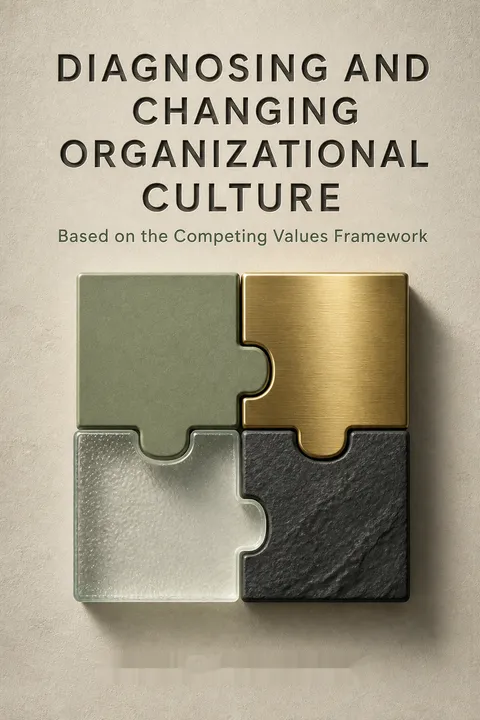
A map, not a ranking. The Competing Values Framework organizes organizational priorities along two tensions: flexibility versus stability, and internal cohesion versus external focus. Their intersection suggests four recurring culture patterns. Clan cultures emphasize belonging and development; adhocracy cultures prize experimentation; market cultures focus on competition and results; hierarchy cultures rely on coordination and dependable procedures. These are useful categories for discussion, not exhaustive descriptions of every organization.
Each pattern solves a different problem. A fast-changing design team may need room to experiment, while a high-volume operation may depend on reliable controls. The framework also connects culture to leadership, effectiveness criteria, and management practices. For example, supportive team building fits clan priorities, while rigorous process monitoring fits hierarchy priorities. The point is not to choose a winner in the abstract, but to ask which values suit the work and environment.
The framework's strength is its refusal to treat management as a single ideal style. It resembles the idea of organizational ambidexterity, the capacity to explore new possibilities while reliably exploiting what already works. The four patterns make trade-offs easier to name, especially when departments assume their own priorities are simply common sense. The caution is that a neat two-axis map can make messy organizations look more unified than they are. It works best as a shared vocabulary for inquiry, with room for local differences and values the model does not capture.
Measure today against the culture your next five years require.
Make assumptions discussable. The Organizational Culture Assessment Instrument, or OCAI, is a short questionnaire for comparing an organization’s present culture with its preferred future. It asks members to divide 100 points among four descriptions across six dimensions: dominant characteristics, leadership, employee management, organizational glue, strategic emphasis, and success criteria. Respondents complete it once for the present and again for the culture they want in five years.
The picture matters. Averaging each culture type’s scores and plotting them creates a profile that makes preferences and gaps easier to see. A large difference between current and preferred scores can suggest where change is needed. The OCAI is intended for a clearly defined unit, such as a team or business division, rather than an enormous corporation treated as culturally uniform. Its results are a starting point for discussion, not an automatic change prescription.
The OCAI's practical value lies partly in its ability to turn an invisible subject into something a group can compare and debate. That is a useful measurement principle: a rough shared instrument can improve conversation even when it cannot capture every nuance. The five-year preference question also forces people to consider future demands rather than merely defend familiar practices. But preferences are not forecasts, and a score is not proof that a proposed culture will improve performance. The strongest use combines the profile with concrete evidence about customers, work, and the environment.
Align leadership, rewards, and routines, but keep useful tensions alive.
Congruence creates coherence. Cultural congruence means that an organization’s key elements reinforce similar priorities. Leadership behavior, strategy, rewards, employee practices, and definitions of success should not send contradictory signals. If executives praise teamwork but reward only individual competition, employees learn which message has consequences. The book presents congruent cultures as more typical of high-performing organizations, while noting that mismatch can sometimes expose a need for change.
Coherence is not sameness. The framework also shows why organizations may need apparently opposing capacities. They may need innovation and control, or employee support and demanding targets. In the authors’ research on higher education institutions, effectiveness could be associated with combinations of flexibility and stability, and support and achievement. A culture profile should therefore reveal both misalignment and valuable tensions, rather than invite leaders to maximize one quadrant and suppress the rest.
This insight connects culture to incentive design: employees reasonably attend to what the organization measures and rewards, not only what it says. Alignment can reduce the friction of contradictory instructions and make strategy credible. Yet perfect consistency is not always desirable. A firm that eliminates dissent to create consensus may become coherent but brittle; one that prizes experimentation everywhere may lose reliability. The more useful aim is selective alignment: make signals consistent around core priorities while preserving legitimate debate and different working norms where the tasks require them.
Expect growth to turn startup freedom into rules, then market pressure.
Growth changes the cultural problem. The authors describe a common life-cycle tendency: young organizations often begin with entrepreneurial freedom, build close-knit relationships as they grow, then add formal controls to coordinate expanding work, and finally face stronger pressure to compete and deliver results. These are tendencies, not a fixed timetable; mature organizations may contain several patterns in different units.
Apple illustrates the trade-offs. The company began with an entrepreneurial, loosely structured culture. Its Macintosh group fostered a strong team identity, then growth and competition increased demands for procedures and control. Bringing in John Sculley to manage that shift helped expose a clash with founder Steve Jobs’s preferred style, and Jobs left the company. The case shows why a culture that worked at one scale may become a constraint at another, and why transition can feel like abandoning what made the organization distinctive.
The life-cycle account is a helpful antidote to the idea that an organization can preserve its founding culture unchanged while growing indefinitely. Scale creates coordination costs, while competition can intensify demands for measurable results. The account also echoes organizational ecology, which studies how structures and routines become harder to change as organizations age. Its limitation is the temptation to treat the sequence as inevitable. Some organizations retain flexibility through autonomous teams or distributed decision-making. The practical question is which new demands genuinely require different practices, rather than assuming growth itself dictates one cultural destination.
Build consensus on what culture change means before launching programs.
Start with shared diagnosis. The book’s change process begins by having a representative group assess the current culture, discuss why members scored it as they did, and then agree on a preferred future. It warns against simply averaging responses: differences can reveal real conflicts or distinct experiences. The group then spells out what increasing or decreasing emphasis in each area means, and what it does not mean.
Turn agreement into action. Members identify stories that express the desired values, decide what behaviors to start, stop, or continue, and choose a small number of practical priorities with owners and deadlines. In one example, a team clarified that more employee involvement did not mean lower standards, and less bureaucracy did not mean eliminating accountability. That work made the proposed changes more concrete and reduced the risk that people would interpret the same slogan in incompatible ways.
The emphasis on consensus is not just a meeting technique. It surfaces the different mental models that otherwise derail implementation after leaders believe they have communicated clearly. The distinction between what change does and does not mean is especially valuable because people often hear a new priority as permission to discard an old responsibility. Still, consensus can become a veto mechanism if every affected group must agree on every detail. A disciplined process can distinguish shared direction from decisions that require clear ownership and timely authority.
Make the new culture visible in processes, stories, and everyday choices.
Values need operating machinery. The book urges leaders to carry cultural priorities into structures, symbols, systems, staffing, strategy, leadership behavior, and management skills. It also recommends small visible wins, regular communication, measurement, follow-up, and accountability. A new culture is more credible when hiring, evaluation, resource decisions, and core work processes reflect it, rather than leaving it as a poster or speech.
Quality needs a whole system. The authors argue that total quality management can stall when organizations adopt isolated tools. Measurement and process control matter, but so do customer insight, employee involvement, and continuous improvement. Their broader point is that durable change requires mutually reinforcing practices. At Xerox, managers taught the change principles, applied them, explained them to others, and monitored progress, exposing employees to the message repeatedly and making implementation part of the work.
This is a strong account of institutionalization: routines and systems teach people what an organization truly values through repeated experience. Stories add emotional memory, while measurement makes progress inspectable. Together, they bridge symbolic change and operational change. The danger is turning every value into a metric, which can invite gaming or narrow attention to what is easiest to count. Measures should therefore be paired with observation and feedback, and leaders should check whether incentives are producing the behavior intended rather than merely improving the number.
Change managers' observable behavior, not merely their stated leadership style.
Culture change becomes personal. The Management Skills Assessment Instrument, or MSAI, assesses behaviors associated with twelve areas, including teamwork, coaching, innovation, customer service, coordination, and control. Managers rate themselves, while subordinates, peers, and superiors provide additional ratings. This 360-degree feedback can reveal gaps between a manager’s self-image and colleagues’ experience, then support a focused development plan.
Choose skills that fit the destination. If an organization wants more collaboration, managers may need to improve listening, team facilitation, and development of others. If it needs stronger controls, monitoring and coordination may matter more. The authors advise selecting a few improvement priorities, setting actions and time frames, and asking colleagues to support follow-through. The premise is simple: new cultural language will not take root if managers continue behaving in ways that reinforce the old expectations.
The MSAI brings culture change down from the level of slogans to behaviors people can observe and discuss. Multi-source feedback can reveal blind spots, while a short development agenda makes improvement more actionable than a general resolution to lead better. It also fits social learning: people infer norms by watching influential colleagues. Such feedback can threaten status and identity, however, and ratings can reflect politics or uneven access to a manager. Confidentiality, careful interpretation, and a developmental rather than punitive purpose are essential.
Use culture scores to open inquiry, not to erase subcultures.
A profile simplifies reality. The authors present the Competing Values Framework as a practical map, not a complete catalogue of organizational life. Departments, occupations, and levels can hold distinct subcultures, even when they share some organization-wide assumptions. A company-wide average may hide those differences, so the appropriate unit of analysis is the unit whose culture is meant to change.
Numbers need context. The OCAI has reported reliability coefficients from .67 to .83 across studies, and research cited in the book supports its validity for examining organizational culture. Even a reliable instrument cannot decide which culture is best for a particular organization. The authors recommend combining quantitative profiles with stories, events, and symbols. When individual ratings diverge, discuss the reasons rather than averaging away evidence that members experience the organization differently.
This is the necessary methodological humility in a model built to make a complex phenomenon manageable. A common vocabulary can enable comparison, but the act of aggregation can also silence minority experiences, especially across occupational or status boundaries. Organizational culture research is strongest when measurement is triangulated with observation, interviews, and work outcomes. The framework’s categories should therefore be treated as hypotheses about shared priorities. If the people closest to the work describe a different reality, that discrepancy is not noise to remove; it is evidence to investigate.
Analysis
The book’s central contribution is less a four-part taxonomy than a practical sequence for turning an abstract, politically charged subject into a manageable organizational conversation. The Competing Values Framework gives people a vocabulary for naming trade-offs. The OCAI makes those trade-offs visible, and the change process asks members to interpret the scores together before leaders prescribe remedies. That sequence matters because culture change is partly a problem of coordination: people must understand not only the desired direction, but also what it permits, what it protects, and what behavior will count as evidence of progress.
The model is persuasive when treated as a diagnostic map. Its two axes capture durable tensions between integration and external responsiveness, and between flexibility and control. Those tensions resemble the exploration and exploitation problem in organizational learning: organizations must generate new capabilities while reliably using existing ones. The book’s insistence that effective organizations may need contradictory skills is therefore more sophisticated than a simple call to become innovative or people-centered.
The main analytical risk is reification. A culture profile can make a contested, uneven set of practices appear like one stable organizational trait. Results depend on whose unit is rated, who participates, and whether stated preferences reflect genuine environmental demands or a recent frustration. The book acknowledges subcultures and measurement limits, but implementation can still privilege senior managers’ interpretation. The strongest use of the method treats disagreements as data, checks proposed changes against customer and operational outcomes, and avoids assuming that a preferred score is inherently superior.
Its lasting practical lesson is disciplined alignment without cultural uniformity. An organization should make leadership behavior, incentives, routines, and systems support its strategic needs, while allowing different units to express shared commitments in different ways. Culture is neither a substitute for strategy nor a decorative layer around it. It is the social infrastructure that determines whether strategy can be enacted repeatedly, learned from, and adapted when circumstances change.
Review Summary
Diagnosing and Changing Organizational Culture receives mixed reviews, with an average rating of 3.9/5. Readers appreciate its analytical approach and practical tools for assessing and changing organizational culture. Many find the Competing Values Framework and OCAI useful for diagnostics and planning. However, some criticize the book for being dry, repetitive, and overly mechanical in its approach to culture. Despite these criticisms, many readers find value in its frameworks and applications, particularly for leaders and consultants working on organizational change.
People Also Read






Glossary
Competing Values Framework
Map of organizational prioritiesA model for interpreting organizational culture through two tensions: flexibility versus stability, and internal cohesion versus external focus. Their intersection produces four recurring culture patterns: clan, adhocracy, market, and hierarchy. The framework helps organizations compare priorities and discuss trade-offs; it is a diagnostic aid, not a claim that every culture fits neatly into one category.
Organizational Culture Assessment Instrument (OCAI)
Survey of current and preferred cultureA questionnaire that assesses organizational culture across six dimensions, including leadership, employee management, strategy, and definitions of success. Respondents allocate points among four culture descriptions for the organization as it is now and as they would prefer it to be. Scores can be averaged and plotted to identify dominant patterns and areas for discussion.
Clan culture
Culture centered on cohesionOne culture type in the Competing Values Framework. It emphasizes teamwork, participation, trust, employee development, and a strong sense of belonging. Leaders commonly act as mentors or facilitators, and success is associated with morale and commitment. The term describes a dominant organizational orientation, not a literal family structure or a guarantee of harmony.
Adhocracy culture
Culture centered on innovationOne culture type in the Competing Values Framework. It emphasizes flexibility, experimentation, creativity, entrepreneurship, and readiness to pursue emerging opportunities. Authority and teams may shift as tasks change. This orientation can help organizations facing uncertainty, but it does not by itself ensure reliable execution, customer value, or financial success.
Market culture
Culture centered on resultsOne culture type in the Competing Values Framework. It focuses on external positioning, competition, productivity, measurable goals, and market performance. Leaders are expected to drive results, and success is often defined through achievement and competitive standing. The term refers to an organizational orientation, not simply to the marketing department or a consumer marketplace.
Hierarchy culture
Culture centered on reliabilityOne culture type in the Competing Values Framework. It emphasizes formal roles, rules, coordination, predictability, and efficient processes. Leaders commonly organize and monitor work, while success is associated with dependable delivery and smooth operations. This orientation can support consistency and control, but excessive reliance on it may constrain adaptability.
Cultural congruence
Alignment among cultural elementsThe extent to which different parts of an organization express compatible priorities. Leadership, strategy, employee practices, rewards, and definitions of success are congruent when they reinforce rather than contradict one another. Congruence can reduce confusion and support execution, though different organizational units may appropriately require distinct practices.
Cultural strength
Dominance of a culture patternThe degree to which one culture type is prominent in an organization’s profile. A strong culture can create shared focus and coordinated effort, especially when the environment rewards unity. Strength alone does not indicate that a culture is suitable: a strongly held set of priorities can also become a liability when circumstances change.
Management Skills Assessment Instrument (MSAI)
Assessment of managerial behaviorsA behavior-focused instrument for assessing managerial competencies associated with the Competing Values Framework. It covers twelve areas, including managing teams, innovation, customer service, and coordination. Managers can compare self-ratings with feedback from subordinates, peers, and superiors, then use discrepancies to identify specific development priorities that may support culture change.
Within-Person Deviation Score
Relative score within one raterA statistical method used in analyses of the MSAI. Each item score is adjusted by subtracting the individual respondent’s average across the questionnaire. This reduces the influence of a person’s general tendency to rate a manager high or low, allowing researchers to examine relative patterns among behaviors and test whether those patterns fit the framework.
FAQ
What's "Diagnosing And Changing Organizational Culture" about?
- Overview: The book, authored by Kim S. Cameron, is centered around understanding and transforming organizational culture using the Competing Values Framework.
- Framework Focus: It provides a structured approach to diagnosing and changing organizational culture by leveraging the Competing Values Framework, which categorizes cultures into four types: Clan, Adhocracy, Market, and Hierarchy.
- Practical Application: The book offers practical tools and assessments to help organizations identify their current cultural state and implement effective change strategies.
- Goal: The ultimate aim is to enhance organizational performance by aligning culture with strategic objectives.
Why should I read "Diagnosing And Changing Organizational Culture"?
- Comprehensive Guide: It serves as a comprehensive guide for leaders and change agents looking to understand and influence organizational culture.
- Practical Tools: The book provides practical tools and frameworks that can be directly applied to real-world organizational challenges.
- Improved Performance: By aligning culture with strategy, the book aims to improve overall organizational performance and adaptability.
- Expert Insights: Authored by Kim S. Cameron, a recognized expert in organizational culture, it offers valuable insights and proven methodologies.
What are the key takeaways of "Diagnosing And Changing Organizational Culture"?
- Competing Values Framework: Understanding the four types of organizational cultures and how they compete and complement each other.
- Cultural Diagnosis: The importance of accurately diagnosing the current cultural state before implementing change.
- Change Strategies: Effective strategies for aligning culture with organizational goals to drive performance.
- Continuous Improvement: Emphasizing the need for ongoing assessment and adaptation of culture to meet evolving business needs.
What is the Competing Values Framework in "Diagnosing And Changing Organizational Culture"?
- Four Culture Types: The framework categorizes organizational cultures into Clan, Adhocracy, Market, and Hierarchy.
- Competing Values: It highlights how these cultural types have competing values that can either hinder or enhance organizational effectiveness.
- Assessment Tool: The framework serves as a tool for assessing the current cultural state and identifying areas for improvement.
- Strategic Alignment: It helps organizations align their culture with strategic objectives to improve performance.
How does "Diagnosing And Changing Organizational Culture" suggest diagnosing organizational culture?
- Cultural Assessment Tools: The book provides tools like the Organizational Culture Assessment Instrument (OCAI) to diagnose culture.
- Data Collection: Emphasizes collecting data through surveys, interviews, and observations to understand the current cultural state.
- Gap Analysis: Identifying gaps between the current culture and desired cultural state to inform change strategies.
- Feedback Mechanisms: Encourages the use of feedback loops to continuously assess and refine cultural initiatives.
What strategies does "Diagnosing And Changing Organizational Culture" recommend for changing culture?
- Vision and Leadership: Establishing a clear vision for change and strong leadership to guide the process.
- Engagement and Communication: Actively engaging employees and maintaining open communication throughout the change process.
- Incremental Changes: Implementing small, manageable changes that align with the overall cultural transformation goals.
- Reinforcement and Support: Providing ongoing support and reinforcement to ensure the sustainability of cultural changes.
What role does leadership play in "Diagnosing And Changing Organizational Culture"?
- Visionary Leadership: Leaders are responsible for setting a clear vision for cultural change and aligning it with organizational goals.
- Role Modeling: Leaders must model the desired cultural behaviors to inspire and influence employees.
- Support and Resources: Providing the necessary support and resources to facilitate cultural change initiatives.
- Continuous Engagement: Maintaining continuous engagement with employees to ensure alignment and commitment to the cultural transformation.
How does "Diagnosing And Changing Organizational Culture" address resistance to change?
- Understanding Resistance: Recognizes resistance as a natural response to change and emphasizes understanding its root causes.
- Involvement and Participation: Encourages involving employees in the change process to reduce resistance and increase buy-in.
- Communication and Transparency: Maintaining open communication and transparency to address concerns and build trust.
- Support Systems: Implementing support systems to help employees adapt to and embrace cultural changes.
What are the best quotes from "Diagnosing And Changing Organizational Culture" and what do they mean?
- "Try as you may, change cannot be controlled." This quote emphasizes the unpredictable nature of change and the importance of flexibility.
- "People have a way of fighting through the pain of change when they want the outcome badly enough." Highlights the motivational power of a compelling vision and desired outcomes.
- "Lean Change Management moves the slider for managing change from using plan-driven approaches to feedback-driven approaches." Suggests a shift towards adaptive, feedback-oriented change management strategies.
- "Disruptive innovation is good. Disruption for the sake of disruption is not." Warns against unnecessary disruption and advocates for purposeful, strategic innovation.
How does "Diagnosing And Changing Organizational Culture" integrate Lean Startup principles?
- Feedback Loops: Emphasizes the use of feedback loops to continuously assess and adapt cultural change initiatives.
- Minimum Viable Changes: Introduces the concept of Minimum Viable Changes (MVCs) to test and validate cultural changes incrementally.
- Hypothesis-Driven Experiments: Encourages the use of hypothesis-driven experiments to explore and validate cultural change strategies.
- Iterative Approach: Advocates for an iterative approach to cultural change, allowing for adjustments based on real-time feedback and results.
What is the role of assessments in "Diagnosing And Changing Organizational Culture"?
- Cultural Diagnosis: Assessments are used to diagnose the current cultural state and identify areas for improvement.
- Data-Driven Insights: Provides data-driven insights that inform cultural change strategies and initiatives.
- Progress Measurement: Helps measure progress and effectiveness of cultural change efforts over time.
- Continuous Feedback: Facilitates continuous feedback and adaptation of cultural change initiatives to ensure alignment with organizational goals.
How can "Diagnosing And Changing Organizational Culture" help organizations improve performance?
- Strategic Alignment: Aligns culture with strategic objectives to enhance organizational performance and adaptability.
- Employee Engagement: Increases employee engagement and commitment through involvement in the change process.
- Innovation and Agility: Fosters a culture of innovation and agility, enabling organizations to respond effectively to market changes.
- Sustainable Change: Ensures sustainable cultural change by embedding new behaviors and practices into the organizational fabric.
About the Author
Other books by Kim S. Cameron
Download PDF
Download EPUB
.epub digital book format is ideal for reading ebooks on phones, tablets, and e-readers.








