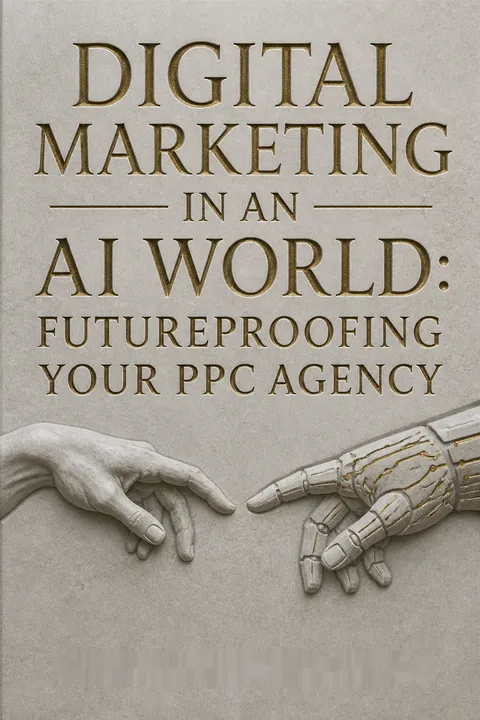


Key Takeaways
Pair machine prediction with human judgment to beat machine-only averages.
Automation is powerful, not universal. In pay-per-click advertising, machine learning excels at finding patterns in enormous volumes of historical data and using them to predict which bid or ad may perform best. Google’s automated tools can handle specific tasks such as bidding, targeting, and combining ad components. They are not a general-purpose marketing mind that understands every client, product, or market event. A well-managed automated campaign can produce respectable average results, but the book argues that stronger performance comes from combining machine speed with human knowledge of the business.
The work moves upstream. As routine calculations become automated, the marketer’s value shifts toward choosing the right goals, supplying relevant information, spotting opportunities, and deciding when the system needs intervention. Automation changes the job more than it abolishes it.
The argument is strongest when treated as a division of labor, not a promise that people always outperform software. Machines can cheaply search patterns at a scale that humans cannot match; people can supply context, priorities, and accountability that an optimization score does not contain. The partnership works only when each side’s limits are explicit. A marketer who cannot explain what a system is optimizing, or what costs its success might impose, is not really supervising it. As tools improve, human value may shift again, so adaptability matters more than claiming any human skill is permanently untouchable.
Feed automation the business facts Google cannot infer from auction data.
Context changes the bid. A ski resort may see ticket sales rise after fresh snowfall, yet an automated bidding system cannot use snowfall if it has not been given that information. Even snowfall needs context: wet snow may attract fewer skiers than powder. Similar blind spots arise when a company runs a brief promotion or changes its priorities. Historical data can help a model make predictions, but it cannot reliably account for a relevant factor that is absent from its inputs.
Start with the business. Ask what actually drives sales, profit, or customer value, then check whether the system can see those signals. A human manager may know that a sale starts this weekend and adjust a target before the model has enough evidence to react. That is not rejecting automation. It is giving it better direction.
This is a practical version of the data problem: a model can only optimize what its inputs and objective make legible. The important question is not whether the system uses a large amount of data, but whether it has the data that matters for this decision. There is a further caution: adding every imaginable signal can create noise or encourage overfitting. The useful discipline is to identify a plausible business driver, test whether it predicts an outcome, and keep it only if it improves decisions. Human context generates hypotheses; measurement checks them.
Give machines varied creative, but let humans decide what is worth saying.
A test needs an idea. Automated systems can combine headlines, descriptions, audiences, and placements, then learn which combinations attract responses. But they do not know a client’s distinctive promise unless a person provides it. Ads work best when they answer the searcher’s need and explain why this business is a useful choice. Generic templates can make every advertiser sound alike, leaving both audiences and the learning system with little meaningful variation.
Human creativity finds new angles. The book describes a Facebook ad intended as a still image that accidentally moved slightly. The animated version performed better, revealing a useful creative possibility through an unexpected result. A marketer can deliberately test such ideas, understand why they fit a particular audience, and supply varied material for the system to evaluate. Automation can distribute and compare the options; it does not replace the strategic act of creating them.
The distinction between generating options and defining what deserves attention is important beyond advertising. Search systems can optimize a response rate, but a higher click rate does not necessarily mean a clearer promise, a better customer experience, or more durable brand trust. This is a form of the proxy problem: the measurable response stands in for a harder goal. Human creative judgment can broaden the experiment space, while careful measurement can reveal which ideas work. Neither novelty nor data alone guarantees good marketing; the useful loop is purposeful variation followed by evaluation against business outcomes.
Hand repetitive calculations to machines when PPC combinations explode.
Scale overwhelms manual work. A bid can depend on location, device, time, age, gender, and past visits to a site. Combining just a few of these dimensions creates tens of thousands of possible bid situations for one keyword. A human can manage broad strategy, but cannot reliably calculate a suitable bid for every auction in real time. Automated bidding can process those combinations and adjust bids according to goals such as cost per acquisition or return on ad spend.
The same advantage applies to attribution. A customer may encounter a business through searches, video, display ads, social networks, and several devices before buying. Assigning all credit to the final click ignores the earlier steps. Machine learning can analyze these complicated paths and estimate how interactions contribute to a conversion. People should focus on whether the model’s goal and data fit the business, not imitate calculations a computer can perform faster.
This is the clearest case for automation: high-volume, repetitive decisions with many interacting variables. It also explains why a simple comparison between human and machine performance can mislead. The system is not merely a faster analyst; it can evaluate combinations that would be impractical to inspect manually. Still, precision in calculating a bid does not settle whether the campaign should pursue that customer, channel, or outcome. Attribution models are estimates, not direct observations of causal influence. Their results should inform budget choices without being mistaken for a perfect map of why a sale happened.
Build your career around the doctor, pilot, or teacher role.
Three human roles endure. The book groups durable PPC work into three personas. The doctor understands a client’s circumstances, diagnoses problems, and explains trade-offs with empathy. The pilot monitors automated campaigns, handles anomalies, and responds to changing conditions. The teacher helps train or refine systems by selecting useful data, goals, and rules. One person may perform all three roles, but the framework helps professionals identify where their strengths create value.
Diagnosis needs context. A campaign may lose conversions after a website redesign. A data tool can identify the decline, but an account manager may know that corporate approval rules now make landing-page changes impossible. That knowledge changes the practical recommendation. Rather than suggesting an unavailable fix, the manager can pursue a feasible alternative, explain the reasoning, and preserve trust.
The three roles combine technical oversight with relational work, a useful corrective to the idea that expertise is only the ability to operate a platform. The doctor role highlights trust and explanation; the pilot role makes responsibility continuous rather than limited to setup; the teacher role treats systems as things people shape. Together, they describe judgment at several points in a decision process. The framework is a map, not a staffing formula. Small teams may need one person in several roles, while larger agencies can specialize. The test is whether all three functions are covered, not whether every title appears on an org chart.
Train campaigns against meaningful business outcomes, not convenient proxy conversions.
A model needs a useful target. Supervised learning trains a system on labeled historical examples, such as clicks, purchases, and customer locations, to predict future outcomes. If a law firm has only a small monthly budget and cannot generate enough signed clients for automated bidding, it may have more frequent signals from people downloading a relevant white paper. The marketer can track those downloads as micro-conversions, meaning smaller actions that precede a final sale, and use them to provide more learning data.
More data is not automatically better. A micro-conversion is useful only if it is meaningfully connected to valuable customers. Reinforcement learning takes another route: people define the rules and desired reward, then the system tests strategies through repeated simulations. In either case, the human must choose an objective that reflects business value rather than merely what is easiest to count.
This takeaway joins measurement design to the broader problem of proxy goals. A system trained to maximize a frequent preliminary action may become excellent at that action while failing to produce profitable customers. The bridge between micro-conversion and sale therefore deserves validation, not assumption. The book’s distinction between learning from labeled history and learning through a reward-based process is useful because both depend on human choices: what counts as evidence, and what counts as success. A practical safeguard is to track intermediate signals alongside final outcomes, so the proxy remains connected to the purpose it is meant to represent.
Monitor automated campaigns for meaningful anomalies, not every noisy fluctuation.
Speed can magnify mistakes. An automated bid system may react to a temporary drop in conversions by lowering bids. If the real cause was a website outage, the system may keep bids low even after the site is restored, reducing traffic and prolonging the damage. The account manager must notice what changed, correct the problem, and ensure the system is not learning from misleading data.
Set alerts with scale in mind. A 50 percent traffic decline at 2 a.m. might represent only five lost clicks, while the same percentage drop during a busy period could cost hundreds. Monitoring should distinguish consequential changes from ordinary noise. The book compares this oversight to a commercial pilot: automation handles much of the routine operation, but a trained person stays ready to intervene when conditions depart from expectations.
Good monitoring is a decision system of its own. Alerts that fire constantly create fatigue, while thresholds that are too loose conceal real failures. The relevant threshold depends on volume, timing, and the cost of delay, not on percentage change alone. This makes the pilot role less like watching every dashboard number and more like designing a sensible attention policy. The same principle applies to automated decisions in finance, healthcare, and logistics: humans are most useful when escalation rules are clear before a crisis, rather than improvised after the system has already amplified a problem.
Sell your agency's unique integration, not access to Google's free AI.
A tool is not a distinction. If every advertiser can use Google’s Smart Bidding, selling the fact that an agency uses it does not explain why that agency is better. The value lies in selecting the right tools, adding information the platform lacks, and fitting the system to a client’s goals. The book calls one path to this kind of innovation recombinant innovation: combining existing tools and ideas in a useful new way.
Make the combination concrete. A sunscreen advertiser might combine weather data with bidding systems so campaigns respond to high ultraviolet conditions. An agency could show how it connected those signals, tested their effect, and used the result. That is more persuasive than a generic claim about artificial intelligence. The agency’s differentiator is the quality of its questions, integration, and execution, not a fashionable technology label.
This is a durable positioning lesson because access to a tool tends to spread faster than the expertise required to use it well. Differentiation can come from combining data, systems, and industry knowledge in a way that is difficult to copy quickly. Yet a clever integration is not automatically valuable. Agencies need to show that it improves outcomes after accounting for implementation costs, data limitations, and the possibility that a simpler process would work just as well. The most credible pitch is a demonstrated capability with a measurable business effect, rather than technical novelty presented as an end in itself.
Keep PPC fundamentals and repeatable team processes ahead of tool changes.
Automation does not erase fundamentals. A marketer who understands target cost per acquisition can anticipate that a short sale may improve conversion rates and adjust bidding goals before the automated system learns from the new conditions. Similarly, a 2017 Akamai study cited in the book found that conversion rates fell 7 percent when a landing page loaded 100 milliseconds more slowly. Faster bidding cannot compensate for a page that frustrates customers.
Build a process that can adapt. The book’s photography analogy contrasts film, where each exposure was costly, with phone cameras that can take many shots and use software to select among them. Professional work still requires knowing which moments matter. Agencies need repeatable methods, quality checks, and staff who keep learning, rather than relying on random testing or outdated habits. Tools may change; sound measurement, clear goals, and sound execution remain necessary.
The deeper point is that automation raises the return on foundational knowledge. A person who understands the underlying mechanics can recognize when a platform’s recommendation is inappropriate, while someone who relies on the interface alone may be unable to diagnose a failure. Process also makes quality less dependent on finding a few exceptional performers. The tension is that procedures can harden into bureaucracy, especially in a fast-changing field. Good processes therefore need both consistency and revision: they standardize what should be reliable, while creating a channel for staff to report when the assumptions no longer match reality.
Analysis
The book’s central move is to replace a job-loss question with a task-allocation question. PPC work contains both calculable operations and judgments that require context: automated systems can price many auction situations, while people decide which objective deserves optimization, whether a signal is meaningful, and what the client can realistically implement. The Doctor, Pilot, and Teacher roles turn that distinction into a career and agency framework. Their value is not simply that humans are more creative or empathetic. It is that people remain accountable for defining the problem, interpreting the output, and responding when conditions change.
A major strength is the attention to the gap between platform averages and individual business realities. A model trained on broad historical patterns may miss snowfall, a short promotion, a changed approval process, or a site outage. These examples show why data volume alone does not guarantee relevance. The book also recognizes that objective selection is a human responsibility: optimizing clicks, leads, or even conversions can conflict with profit, customer value, or brand reputation.
The argument has limits. Human judgment is not automatically accurate, and intuition can preserve bias or mistake a memorable anecdote for a reliable pattern. Conversely, algorithmic systems may capture signals that experienced practitioners overlook. The useful standard is not human superiority but disciplined comparison: test tools against business outcomes, expose assumptions, and retain meaningful oversight. The book’s 2019 descriptions of Google products are necessarily time-bound, but its management questions remain pertinent as platforms change: what is being optimized, which context is missing, and who is responsible when the result is wrong?
For agency leaders, the strongest strategic implication is that cheap automation makes undifferentiated labor harder to sell. A defensible service combines technical fluency with industry understanding, communication, and processes that keep learning. The agency is valuable not because it stands between a client and a platform, but because it helps the client use that platform well, including knowing when not to trust its default assumptions.
Review Summary
Digital Marketing in an AI World receives mixed reviews, with an average rating of 4 out of 5. Positive reviews praise its insights on the future of PPC and adapting to AI. Some find it easy to read and valuable for agency owners. However, critics argue it's too basic for experienced marketers and lacks depth. The book discusses the shift in PPC skills, the role of agencies, and how to identify areas where human expertise remains valuable. Some readers appreciate its accessibility, while others find it outdated or unimpressive for a 2019 publication.
People Also Read










Glossary
Quality Score
Ad relevance predictionGoogle Ads’ estimate of how likely an ad is to be relevant and receive a click in a particular situation. The book describes it as drawing on factors such as the keyword, ad, landing page, and user behavior. It influences ad ranking and the cost an advertiser pays, helping relevance matter alongside the bid.
Smart Bidding
Automated auction biddingGoogle Ads’ automated approach to setting bids in individual auctions based on predictions about conversion likelihood or value and an advertiser’s chosen target. It can process signals and combinations too numerous for manual bid setting. Its performance depends on suitable goals and data, and it may miss business factors not represented in its model.
micro-conversions
Early customer actionsSmaller actions that occur before a final sale or other major business outcome. Examples in the book include a prospective customer downloading a white paper, visiting a landing page, or requesting information. When final conversions are too scarce to guide a model, micro-conversions can provide additional learning signals, provided they are meaningfully connected to eventual business value.
Doctor, Pilot, Teacher
Three PPC human rolesThe book’s framework for describing human work alongside PPC automation. The Doctor understands client circumstances, diagnoses problems, and explains recommendations. The Pilot monitors systems, responds to unusual conditions, and manages risk. The Teacher selects useful goals and data and helps train or refine machine learning systems. A professional may perform more than one role.
recombinant innovation
New combinations of existing ideasAn approach to innovation that creates value by joining existing tools, data, or concepts in a distinctive way rather than inventing every component from scratch. In PPC, an agency might combine external business information with advertising automation to account for factors that a platform’s standard model does not include.
supervised learning
Learning from labeled examplesA machine learning approach in which a system is trained on historical examples with known labels or outcomes. In PPC, these may include clicks, conversions, customer locations, or sales values. The model learns patterns connecting inputs to outcomes, then uses those patterns to make predictions about new situations.
reinforcement learning
Learning through rewardsA machine learning approach in which people specify rules and a desired reward, then the system tries actions and learns from their results. The book illustrates it with a computer learning to keep a ball in play and break bricks. Simulations can allow repeated training without relying entirely on costly real-world examples.
FAQ
1. What is "Digital Marketing in an AI World" by Frederick Vallaeys about?
- Focus on AI and PPC: The book explores how artificial intelligence (AI) and machine learning are transforming pay-per-click (PPC) advertising, especially within Google Ads.
- Futureproofing Agencies: It provides strategies for PPC professionals and agencies to adapt, thrive, and remain relevant as automation increases in digital marketing.
- Human vs. Machine Roles: Vallaeys discusses the evolving roles of humans versus machines, emphasizing collaboration for optimal results.
- Practical Guidance: The book offers actionable advice on positioning yourself and your agency, developing new skills, and reframing your value proposition in an AI-driven landscape.
2. Why should I read "Digital Marketing in an AI World" by Frederick Vallaeys?
- Industry Insider Perspective: Written by a former Google AdWords Evangelist, the book offers unique insights from someone who helped shape the PPC industry.
- Actionable Strategies: It provides concrete steps for PPC professionals and agency owners to adapt to rapid technological changes.
- Clarifies AI Hype: The book demystifies AI and machine learning, separating fact from fiction and addressing common fears about job loss.
- Futureproofing Your Career: Readers learn how to develop irreplaceable skills and position themselves for long-term success in digital marketing.
3. What are the key takeaways from "Digital Marketing in an AI World" by Frederick Vallaeys?
- Humans + Machines = Best Results: The most effective PPC outcomes come from combining human creativity and intuition with machine efficiency and data analysis.
- Evolving Roles: PPC professionals must shift from repetitive tasks to higher-value roles: Doctor (diagnostician), Pilot (overseer/strategist), and Teacher (system trainer).
- Value Proposition Shift: Agencies must redefine their value beyond basic campaign management, focusing on unique insights, customization, and strategic guidance.
- Continuous Learning Required: Staying current with technology, reskilling, and process improvement are essential for ongoing relevance and success.
4. How does Frederick Vallaeys define the impact of AI and machine learning on PPC advertising?
- Automation of Repetitive Tasks: AI excels at automating data-heavy, repetitive, and mathematical aspects of PPC, such as bidding and reporting.
- Human Creativity Still Needed: Machines struggle with creative messaging, nuanced strategy, and understanding unique business contexts—areas where humans excel.
- Collaboration is Key: The best results occur when humans and machines work together, leveraging each other's strengths.
- Not a Total Replacement: While AI reduces the need for manual work, it does not make PPC professionals obsolete; instead, it changes the nature of their work.
5. What are the three key human roles in PPC agencies according to "Digital Marketing in an AI World"?
- Doctor: Acts as a diagnostician, identifying problems, providing personalized solutions, and communicating with clients empathetically.
- Pilot: Oversees and monitors campaigns, intervening when anomalies or opportunities arise, and ensuring systems stay on course.
- Teacher: Trains and refines machine learning systems, providing the right data, context, and feedback to improve automated outcomes.
- Role Adaptation: PPC professionals should focus on these roles to remain indispensable as automation increases.
6. What does Frederick Vallaeys say humans do better than machines in PPC marketing?
- Intuitive Problem Solving: Humans can identify and act on factors machines may overlook, such as sudden weather changes or cultural trends.
- Creative Messaging: Crafting compelling ad copy and unique value propositions remains a human strength.
- Strategic Goal Setting: Humans are better at understanding business objectives, setting nuanced goals, and translating them into actionable PPC strategies.
- Client Communication: Building trust, explaining complex concepts, and managing client relationships require human empathy and communication skills.
7. What does "Digital Marketing in an AI World" identify as tasks machines do better than humans in PPC?
- Bid Management: Machines can process vast amounts of data and adjust bids in real time across thousands of variables, far beyond human capacity.
- Attribution Modeling: AI can analyze complex customer journeys and assign value to multiple touchpoints more accurately than manual methods.
- Pattern Recognition: Machine learning excels at finding correlations and trends in big data that would be invisible or too time-consuming for humans.
- Scalability and Speed: Automated systems can handle large-scale, complex campaigns efficiently and with fewer errors.
8. How does Frederick Vallaeys recommend PPC agencies redefine their value proposition in an AI-driven world?
- Go Beyond Automation: Agencies should not just rely on standard automation tools like Google Smart Bidding, which are available to everyone.
- Leverage Unique Insights: Use proprietary data, industry expertise, and creative strategies to deliver results machines alone cannot achieve.
- Customization and Integration: Combine multiple tools, data sources, and custom automations to address specific client needs.
- Communicate Value Clearly: Be able to explain and demonstrate how your agency’s approach delivers superior outcomes compared to automated, one-size-fits-all solutions.
9. What practical advice does "Digital Marketing in an AI World" give for futureproofing your PPC agency workforce?
- Emphasize Process Over Rockstars: Build strong, repeatable processes so average team members can deliver excellent results, not just top performers.
- Hire for Adaptability: Seek employees who are eager to learn, adapt, and reskill as technology evolves.
- Develop New Skillsets: Encourage proficiency in analytics tools (e.g., R, Tableau, BQML), automation platforms, and creative problem-solving.
- Foster Knowledge Sharing: Invest in training, documentation, and knowledge management to keep the team current and effective.
10. What are the "fundamentals" that matter more than ever in PPC, according to Frederick Vallaeys?
- Understanding Core Concepts: Mastery of PPC basics—such as bidding logic, conversion tracking, and campaign structure—remains essential.
- Creative Targeting: Ability to segment audiences and craft tailored messaging for micro-segments is increasingly important.
- Strategic Thinking: Knowing when and how to intervene in automated systems, set goals, and measure success is critical.
- Continuous Learning: Staying updated on platform changes and new features ensures ongoing effectiveness and competitiveness.
11. How does "Digital Marketing in an AI World" suggest agencies approach automation and task prioritization?
- Automate Repetitive, Time-Consuming Tasks: Focus on automating high-frequency, labor-intensive activities like ad testing and reporting first.
- Retain Human Input for Creativity: Keep creative tasks, such as ad copywriting and strategic planning, in human hands.
- Use Pseudocode for Process Mapping: Break down tasks into step-by-step instructions to identify what can be automated.
- Balance Efficiency and Value: Make trade-offs between automation and manual work based on impact, cost, and client needs.
12. What are the best quotes from "Digital Marketing in an AI World" by Frederick Vallaeys, and what do they mean?
- "Humans plus machines can outperform machines acting alone." – Emphasizes that collaboration, not replacement, is the path to superior PPC results.
- "Your old value proposition is toast." – Warns agencies that relying on outdated services or skills is no longer viable in the AI era.
- "Seek to be an indispensable complement to something that’s getting cheap and plentiful." (Hal Varian, quoted) – Advises professionals to add value where automation commoditizes basic tasks.
- "The rate of change in our world today is the SLOWEST it’s ever going to be again." – Highlights the accelerating pace of technological change and the need for continuous adaptation.
- "Let go of your fear of future shock. Enjoy and benefit from the new age of machine learning in PPC marketing." – Encourages readers to embrace change and see AI as an opportunity, not a threat.
Download PDF
Download EPUB
.epub digital book format is ideal for reading ebooks on phones, tablets, and e-readers.








