

Key Takeaways
Accept finitude before it turns every loss into a war.
Control has limits. Before his accident, Stephen Strange treats death and failure as problems medicine should eventually defeat. When his hands cannot be repaired, he clings to the life he has lost instead of imagining another. The book connects this struggle to Nietzsche’s amor fati, the effort to affirm life as it is, including suffering and mortality, rather than demand that reality be rewritten to suit us.
Finitude gives choices weight. Strange’s final confrontation with Dormammu makes him endure a repeating moment of death to protect Earth. The Ancient One, facing her own death, recognizes that limited time makes life precious. The point is not to welcome suffering, but to stop treating every limit as an insult.
What's striking is the distinction between accepting a limit and approving of it. A physician can still treat illness vigorously while recognizing that cure is not always possible; care is not measured only by whether death is postponed. The same distinction helps outside medicine: grief need not be solved to be lived through. The argument can be overstated if it turns suffering into a necessary route to wisdom. Strange's transformation is a story about what he makes of pain, not proof that pain automatically improves anyone.
Your title cannot give life meaning; your choices can.
Identity is not a job title. Strange defines himself almost entirely through being a celebrated neurosurgeon. Once the accident ends that career, he initially sees no life worth living. The existentialist idea called authenticity describes taking responsibility for choices instead of hiding behind a fixed role or borrowed values. Strange's new purpose does not come from discovering that he was destined to be a sorcerer. It emerges as he chooses to use his abilities to protect others.
Responsibility changes the story. Early Strange rejects difficult patients when they threaten his record and dismisses Christine's suggestion that life might hold other meanings. At Kamar-Taj, he learns that his skill alone does not define him. The book reads his decision to face Dormammu as a commitment that gives his brief, uncertain life direction.
This distinction between a role and a person has practical force in professions where status can become identity. A surgeon, executive, or artist can mistake excellence at a task for a complete account of the self. Yet roles also give people real obligations and communities, so authenticity need not mean discarding them. Strange's case is more precise: he must stop using his role as an excuse to serve only his own reputation. Chosen purpose is not whatever feels meaningful; it is tested by what a person is willing to do for others.
When reality breaks your model, widen the keyhole before declaring it impossible.
Knowledge has blind spots. Strange trusts observation and scientific explanation, but treats them as proof that nothing exists beyond the material world. The Ancient One challenges that certainty by showing him experiences his old framework cannot explain. The keyhole image captures a general lesson: a limited view can feel complete precisely because it hides what lies outside it. Socrates adds the discipline of admitting that something may be missing even when its details remain unknown.
Perspective is also cultural. The book notes that the film challenges some stereotypes through its female teacher and more capable Asian characters, yet its casting of a white Ancient One remains a contested choice. Good intentions do not erase inherited bias. Widening a perspective means examining not only what a person knows, but also whose experience their account leaves out.
Intellectual humility is not credulity. An anomaly can justify reopening a question without making every proposed explanation equally sound. The same discipline applies to social bias: acknowledging that a viewpoint is situated does not make all interpretations interchangeable. The film's own casting debate usefully complicates its lesson. A work can criticize a stereotype while carrying parts of it forward. That tension is valuable because self-criticism becomes meaningful when it examines the limits of the critic, not just the mistakes of someone else.
Judge knowledge by how responsibly it was earned and used.
Accuracy is not enough. Virtue epistemology studies the intellectual character behind belief: not only whether someone reaches a true conclusion, but whether they do so with care, openness, and responsibility. The book distinguishes reliable abilities, such as Strange’s exceptional memory, from responsible habits, such as impartiality and intellectual courage. A brilliant mind can still serve a selfish interest or a destructive cause.
The students diverge. Pangborn uses mystical knowledge to restore his own mobility. Kaecilius pursues immortality while dismissing the people he harms. Mordo relies so rigidly on authority and rules that he struggles to consider exceptions. Strange begins with talent but little openness; his education requires him to question his assumptions and take responsibility for what he learns. Knowledge in Kamar-Taj is not inherently forbidden, but some uses are dangerous.
This framework matters wherever expertise carries power. Reliable measurement, technical skill, and memory can improve decisions, but they cannot determine whose interests count or what risks are acceptable. Those are questions of judgment and responsibility. Still, intellectual virtue is difficult to assess from a single choice: a person can be open-minded in one dispute and reckless in another. The book's examples suggest that character is demonstrated through repeated habits, not a dramatic moment of insight. Expertise becomes trustworthy when competence and accountability develop together.
Scientific revolutions need working alternatives, not just failures.
Anomalies rarely topple a worldview. Thomas Kuhn's account of scientific change distinguishes normal science, which solves familiar puzzles within an accepted framework, from paradigm shifts, which change the framework itself. Scientists do not usually abandon a theory at the first failure. Strange, too, keeps searching for a medical fix until he encounters evidence and practices that make sorcery a credible alternative in his world.
Conversion takes practice. Strange cannot understand sorcery merely by hearing its claims or memorizing spells. He must learn how to work within its methods, much as a novice scientist learns to perform the practices of a field. The book uses this to explain why revolutionary ideas can seem unintelligible to people trained in another framework. It does not establish that real-world magic is science; the story supplies evidence that our world does not.
Kuhn's account helps explain why evidence alone does not always settle disputes: people learn what counts as a relevant problem and a good explanation inside shared practices. This is a useful corrective to the image of science as automatic fact-checking. It should not be stretched into the claim that all worldviews are equally reliable. The book itself stresses that sorcery works in the fictional setting because it produces teachable methods and results. A promising alternative needs more than novelty; it must explain failures, support new inquiry, and withstand scrutiny.
Separate what physics predicts from what reality is.
Prediction is not interpretation. Quantum mechanics generates highly successful predictions, yet philosophers and physicists disagree about what its mathematics says reality is. The measurement problem asks why quantum descriptions allow superpositions, such as a cat treated as both alive and dead, while ordinary observation presents a single outcome. The many-worlds interpretation answers that each possible result continues in a different branch, but it remains one interpretation, not a settled demonstration of parallel worlds.
The astral body raises another puzzle. Strange's separation from his physical body dramatizes mind-body dualism, the view that mind and body are distinct substances. But the story also shows his astral form affecting books, people, and machines. That raises the hard question of how a nonphysical mind could cause physical events. The image makes a philosophical problem vivid; it does not solve it.
The distinction between a model's predictive success and its account of underlying reality is a central habit of careful thinking. It prevents popular science from turning mathematically sophisticated possibilities into established facts. The same caution applies to the film's astral scenes: they invite a dualist reading, but their apparent interactions create a further explanatory burden. Fiction can clarify the shape of a problem without settling it. That is a strength, not a weakness, provided the spectacle is not mistaken for evidence.
Break a rule only after examining alternatives and owning the consequences.
Good ends do not erase costs. The Problem of Dirty Hands describes a conflict in which someone pursues a valuable outcome by violating a moral rule. The Ancient One draws power from the Dark Dimension to prolong her life and protect Earth, despite teaching that such power is forbidden. Strange also bends rules when he uses the Eye of Agamotto to trap Dormammu in a time loop. Mordo sees only the violation; the others weigh it against catastrophe.
Necessity needs scrutiny. The Ancient One believes she has no adequate substitute, but the claim that there is no other option deserves examination. The book also emphasizes responsibility for consequences: her secrecy helps produce Mordo's disillusionment. A decision made for the greater good can still carry moral residue, including harms caused by the decision-maker's deception or failure to prepare successors.
The strongest version of the argument does not say that consequences always outrank principles. It says that principles can conflict with one another, and that refusing to choose is itself consequential. But invoking an emergency can become a convenient way to evade scrutiny. The decisive questions are whether the danger is real, whether less harmful alternatives exist, and who bears the cost. Accountability matters even when the choice was defensible. A person who claims an exception should explain it publicly where possible and accept responsibility for foreseeable damage.
Make service a partnership, not a license for self-erasure.
Wong is more than staff. He protects Strange's body while the Sorcerer Supreme travels in astral form, manages the Sanctum, and handles practical dangers his master overlooks. The book asks whether a servant's devotion necessarily means a loss of self-respect. Its answer is that Wong serves a shared mission, not a person he considers inherently superior. His knowledge of ordinary life also makes Strange dependent on him, reversing the simple picture of master and subordinate.
Work can build agency. Drawing on Hegel's account of master and servant, the chapter suggests that labor gives Wong practical knowledge of himself and his world. Still, Strange's extreme self-sacrifice leaves little room for ordinary friendship, rest, or love. The Sorcerer Supreme's burden is real, but treating every human attachment as a distraction risks turning service into isolation.
The chapter usefully separates the dignity of a person from the prestige of a role. Service can express chosen commitment, skill, and solidarity rather than submission. The key test is whether the worker retains meaningful agency and whether the relationship recognizes mutual dependence. That distinction matters in workplaces and caregiving, where praise for devotion can conceal exploitation. Wong's partnership is an ideal reading, but the inherited servant role still deserves scrutiny: a noble purpose does not automatically make unequal labor fair.
Do not confuse defeating evil with permission to use any force.
Tolstoy challenges the hero's method. He argued for nonresistance to evil, warning that violence used against wrongdoing can reproduce the very coercion it opposes. That position seems difficult to square with Strange's battles against mystical threats. The book narrows the conflict: Tolstoy's strict opposition focused on violence between human beings, while Dormammu is presented as a sentient cosmic power intent on consuming worlds. Whether such a being deserves the same moral treatment becomes a real question, not an automatic answer.
Restraint matters in both fields. Medicine and martial arts share an ethic of minimizing harm. The martial ideal described in the book favors stopping an aggressor with the least lasting damage possible. Strange's oath as a doctor also complicates his use of force, though the oath does not neatly govern his new role as sorcerer. The story asks what protecting life requires when every available choice carries risk.
This comparison reveals that moral categories depend partly on agency. A storm is harmful but not blameworthy; a deliberate attacker can be. Yet labeling an enemy evil can also make violence feel self-justifying. Tolstoy's challenge is valuable even where nonviolence seems impractical: it forces the defender to ask whether force is necessary, proportionate, and directed at stopping harm rather than punishing a target. The distinction between hurting and harming is especially useful here. Victory is not the only measure of ethical defense.
Saving everyone can become a reason to neglect the people beside you.
Heroism can become an extreme. Aristotle's virtue ethics locates good character between excess and deficiency, with practical judgment needed to find the right response in context. Strange moves from selfish ambition as a surgeon to near-total self-denial as Sorcerer Supreme. His mission protects countless lives, but it also leaves him lonely and reluctant to sustain ordinary relationships.
Partiality exposes the cost. In the comic story discussed in the book, Strange uses the last remnant of a universal cure to save Wong rather than give it to scientists who might reproduce it for millions. The choice shows the depth of their friendship, but it is ethically troubling because one beloved life is favored over many strangers. Strange is neither a perfect utilitarian nor an untouched saint. His decisions reveal the human judgment that grand principles cannot replace.
The tension is not simply between selfishness and altruism. People have special obligations to friends, patients, and dependents, but those obligations can collide with duties to strangers. The cure dilemma makes the conflict concrete: intimacy gives Wong moral importance, yet scale makes the wider population impossible to ignore. A balanced ethic needs both partial care and impartial standards, without pretending that a formula resolves every tragic choice. Strange's imperfect judgment is narratively useful because it prevents heroism from becoming a synonym for moral infallibility.
Analysis
This collection uses Doctor Strange less as a single philosophical case than as a portable laboratory. The film's transformation from surgeon to sorcerer gives contributors a shared narrative, while the comics supply harder cases about Wong, medical duty, violence, and corrupted power. Across those stories, the central movement is from mastery to judgment. Strange begins by trusting skill, status, and physical explanation to make him sovereign over his life. His injury exposes the limits of that confidence, but the book does not simply replace science with mysticism. Its strongest chapters ask how knowledge is justified, how frameworks change, and what remains uncertain even when a model predicts well.
The anthology's disagreements are part of its value. Nietzschean acceptance of mortality, existentialist self-creation, Aristotelian virtue, Kantian duty, and consequentialist attention to outcomes do not collapse into one tidy doctrine. The same act can appear courageous, reckless, compassionate, or unfair depending on the moral lens. Strange's bargain with Dormammu dramatizes sacrifice, while his choice to save Wong with a scarce cure reveals partiality that readers may resist. That tension keeps the stories ethically alive.
The book also benefits from treating representation and dependence as philosophical matters. The Ancient One's casting complicates the film's lesson about widening perspective; Wong's role complicates the assumption that service equals submission. These questions show that philosophy concerns not only cosmic dimensions but also who is heard, who performs invisible work, and whose interests count.
A useful caution is that superhero fiction makes metaphysical possibilities visible without making them evidence about our world. The multiverse, astral projection, and magic are thought experiments here, while quantum theory and scientific change are real philosophical topics that require careful distinctions. Read in that spirit, the book's lasting proposition is not that every boundary should be crossed. It is that intellectual humility, moral courage, and responsibility matter most when familiar rules no longer settle what to do.
Review Summary
Readers generally enjoyed Doctor Strange and Philosophy, praising its exploration of philosophical themes through the lens of the Marvel character. Many appreciated essays on ethics, scientific topics, and gender representation. However, some criticized the book's gender bias in authorship and certain essays' interpretations of servitude and spirituality. Reviewers found the book's insights interesting but noted repetition between chapters. Overall, the collection offers an engaging blend of philosophy and pop culture for fans of both subjects.
Glossary
Baconian project
science as human masteryA modern ambition associated with Francis Bacon and René Descartes: use scientific knowledge and technology to reduce suffering, extend human power, and gain control over nature. In the book, Strange's faith that medicine should overcome bodily limits embodies this project. Its danger is that every limit can come to look like a failure that must be defeated.
amor fati
affirmation of one's fateNietzsche's idea of loving or affirming life as it is, rather than resenting its unavoidable conditions. It includes suffering, change, and mortality, not merely the pleasant parts of existence. The book uses it to contrast Strange's early effort to reverse his accident with a later willingness to accept pain and act meaningfully despite it.
bad faith
denying one's freedomIn Sartre's existentialism, bad faith is the evasion of personal freedom and responsibility by treating an adopted role or value as fixed and unquestionable. Strange's early identity as a celebrated surgeon limits his ability to imagine a life beyond his career. The term does not mean ordinary dishonesty alone; it describes self-deception about one's choices.
virtue epistemology
intellectual character in knowingAn approach to knowledge that evaluates the knower's intellectual traits as well as the truth or justification of beliefs. The book distinguishes reliable abilities, such as memory and perception, from responsible habits, such as impartiality and intellectual courage. It asks not only whether someone knows, but whether knowledge was pursued and handled responsibly.
paradigm
shared scientific frameworkIn Thomas Kuhn's philosophy of science, a paradigm is the shared set of theories, methods, standards, and exemplary problems that guides a scientific community's ordinary work. Anomalies may accumulate without immediately dislodging it. A paradigm shift changes what researchers regard as real, important, and solvable, and requires learning new practices as well as new ideas.
Problem of Dirty Hands
good ends, wrongful meansA moral conflict in which a person believes a valuable outcome can be achieved only by violating an important moral rule. The Ancient One's use of forbidden magic to protect Earth is the book's central example. The problem asks whether the good result justifies the violation, what alternatives existed, and who remains accountable for the consequences.
duration
lived experience of timeHenri Bergson's term for time as it is experienced from within, as a continuous process of change and becoming, rather than as a sequence measured by clocks. The book contrasts this lived time with time treated as units to count or manipulate. Strange's growth depends on experiencing the present as formative, not merely as a resource to control.
measurement problem
quantum outcomes and observationA foundational puzzle in quantum mechanics: the theory permits superpositions of possible outcomes, but measurements yield a definite result. Interpretations disagree about what measurement does and what the mathematics says about reality. The book presents many-worlds as one proposed interpretation, not as an experimentally settled fact about parallel universes.
Socratic Hero
hero through examined humilityA model of heroism developed in the book from Socrates' example. It joins intellectual humility, continual self-examination, a search for wisdom, courageous commitment to right action, and concern for improving society. Strange approaches this ideal when he admits the limits of his knowledge and uses his abilities to protect others rather than preserve his own status.
natural law
objective order of natureA philosophical idea that nature contains an order or principles that can guide human conduct. The book contrasts views that treat natural law as divinely grounded and unchanging with Strange's willingness to violate rules in an emergency. The central ethical question is whether breaking a rule can protect the larger order the rule was meant to serve.
FAQ
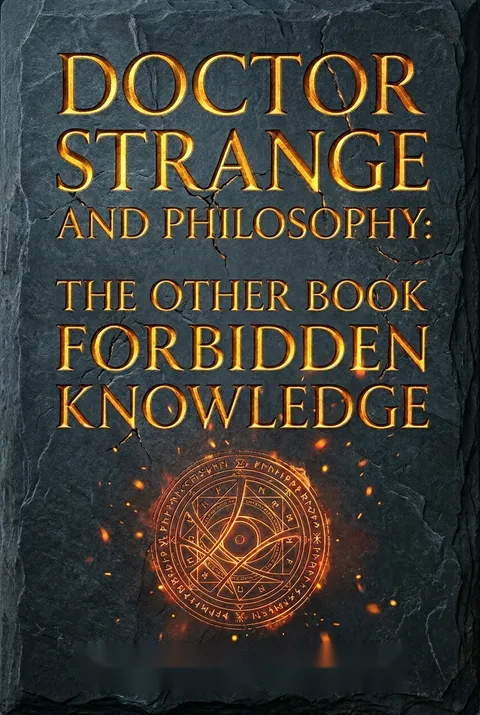
What is Doctor Strange and Philosophy: The Other Book of Forbidden Knowledge by Mark D. White about?
- Philosophy through pop culture: The book explores philosophical themes using the character Doctor Strange from Marvel comics and the 2016 film, making complex ideas accessible through a familiar pop culture lens.
- Wide philosophical scope: It covers existentialism, epistemology, metaphysics, ethics, and the philosophy of science, examining how these concepts are embodied in Doctor Strange’s journey.
- Multi-author perspectives: Edited by Mark D. White, the volume features essays from various philosophers, each analyzing different aspects of Doctor Strange’s character, story arcs, and universe.
- Connection to broader issues: The book links Doctor Strange’s narrative to universal questions about reality, knowledge, morality, and the meaning of life.
Why should I read Doctor Strange and Philosophy: The Other Book of Forbidden Knowledge by Mark D. White?
- Engaging introduction to philosophy: The book uses Doctor Strange’s world to make philosophical concepts more relatable and enjoyable, especially for fans of comics and film.
- Deeper character understanding: Readers gain insight into Doctor Strange’s transformation, existential crises, and moral dilemmas, enriching their appreciation of the character.
- Broader cultural relevance: The essays connect philosophical ideas to real-world ethical and cultural questions, making the book relevant beyond the superhero genre.
- Accessible and thought-provoking: The writing is designed to be accessible to non-philosophers while still offering depth for those familiar with philosophical discourse.
What are the key takeaways from Doctor Strange and Philosophy: The Other Book of Forbidden Knowledge by Mark D. White?
- Transformation through crisis: Doctor Strange’s journey from arrogance to humility is a philosophical exploration of personal growth, meaning, and authenticity.
- Limits and power of knowledge: The book examines the ethical and epistemological challenges of forbidden knowledge, the nature of reality, and the boundaries of science and magic.
- Moral complexity of heroism: It highlights the ethical dilemmas faced by Doctor Strange, such as the “problem of dirty hands” and the tension between rules and the greater good.
- Integration of science, magic, and philosophy: The narrative demonstrates how scientific and mystical worldviews can be reconciled, reflecting on paradigm shifts and the nature of reality.
What are the best quotes from Doctor Strange and Philosophy: The Other Book of Forbidden Knowledge by Mark D. White and what do they mean?
- “No knowledge in Kamar-Taj is forbidden, only certain practices.” This quote highlights the distinction between knowledge itself and the ethical use of that knowledge, a central theme in the book.
- “We are just a tiny momentary speck within an indifferent universe.” Reflects Doctor Strange’s initial nihilism and existential crisis, which he overcomes through philosophical growth.
- “The keyhole can be widened in unimaginable ways.” Suggests the expansion of human understanding and the breaking of traditional boundaries in both philosophy and magic.
- “The bill comes due.” Emphasizes the moral consequences of choices, especially when breaking rules for the greater good.
How does Doctor Strange and Philosophy by Mark D. White use Doctor Strange’s story to explore existentialist philosophy?
- Existential crisis and angst: Doctor Strange’s accident and loss of his career mirror Heidegger’s concept of angst and the need to live authentically in the face of mortality.
- From nihilism to meaning: The book traces Strange’s journey from nihilism to finding meaning through choices and commitments, drawing on Sartre’s existentialism.
- Nietzschean transformation: Strange’s struggle with ego and suffering is compared to Nietzsche’s Übermensch, culminating in his acceptance of life’s challenges and eternal recurrence.
- Authenticity and self-actualization: The narrative shows how Strange’s philosophical growth leads to a more authentic and meaningful existence.
What are the main philosophical themes discussed in Doctor Strange and Philosophy: The Other Book of Forbidden Knowledge by Mark D. White?
- Existentialism and meaning: The book delves into questions of life’s purpose, authenticity, and the confrontation with death.
- Epistemology and knowledge: It explores how Doctor Strange’s understanding of knowledge evolves, including empiricism, rationalism, and virtue epistemology.
- Metaphysics and mind-body dualism: The essays examine astral projection, the nature of consciousness, and the debate between physicalism and dualism.
- Ethics and moral responsibility: The book addresses moral dilemmas, the problem of dirty hands, and the tension between breaking rules and serving the greater good.
How does Doctor Strange and Philosophy by Mark D. White relate Doctor Strange’s journey to the philosophy of science and paradigm shifts?
- Kuhn’s paradigm shifts: The book uses Thomas Kuhn’s theory to explain Strange’s transition from neurosurgeon to sorcerer, highlighting the radical change in worldview required.
- Resistance to new paradigms: Strange’s initial rejection of magic mirrors the scientific community’s reluctance to abandon established paradigms despite anomalies.
- Learning new ways of knowing: The narrative emphasizes the importance of practical knowledge and exemplars in adopting new paradigms, paralleling Strange’s mystical training.
- Role of outsiders: Strange’s outsider status enables him to bridge scientific and mystical paradigms, driving revolutionary change.
What does Doctor Strange and Philosophy by Mark D. White say about knowledge, forbidden knowledge, and virtue epistemology?
- Nature of forbidden knowledge: The book discusses the ethical dilemmas of knowledge that can be used for good or harm, using the Book of Cagliostro as an example.
- Virtue epistemology: It applies Aristotle-inspired virtue epistemology to analyze how characters acquire and use knowledge, focusing on intellectual virtues like courage and responsibility.
- Limits of empiricism and rationalism: Doctor Strange’s journey challenges the sufficiency of sensory experience and rational thought, exploring skepticism and innate ideas.
- Ethical use of knowledge: The narrative emphasizes that knowledge itself is not forbidden, but its application must be guided by virtue and responsibility.
How does Doctor Strange and Philosophy by Mark D. White address the integration of magic, science, and metaphysics in the Marvel Cinematic Universe?
- Magic as advanced science: The book suggests that magic can be understood as a form of advanced science or metaphysics, with Doctor Strange manipulating energies and dimensions.
- Multiverse and quantum mechanics: It draws parallels between magic and scientific concepts like the multiverse and quantum measurement, referencing the many-worlds interpretation.
- Philosophical puzzles: The essays discuss philosophical issues such as the measurement problem, superposition, and the role of consciousness in shaping reality.
- Reconciliation of worldviews: Doctor Strange’s journey exemplifies the blending of scientific materialism and mystical understanding, reflecting the historical closeness of philosophy and science.
What ethical and moral dilemmas does Doctor Strange face in Doctor Strange and Philosophy: The Other Book of Forbidden Knowledge by Mark D. White?
- Problem of dirty hands: The book explores whether breaking moral rules (e.g., using dark magic) can be justified for the greater good, as seen with the Ancient One and Strange.
- Virtue ethics and the golden mean: Strange struggles to balance extremes, often operating at the edges rather than the virtuous mean.
- Partiality and sacrifice: The narrative examines Strange’s tendency to favor close friends over others and his willingness to endure suffering for the greater good.
- Responsibility and heroism: Doctor Strange’s acceptance of the burden of protecting humanity highlights the ethical complexity of heroism.
How does Doctor Strange and Philosophy by Mark D. White use Doctor Strange’s relationship with Wong to explore philosophical ideas about servitude and partnership?
- Beyond master-servant: The book portrays Wong as a partner essential to Strange’s success, not merely a servant.
- Self-respect and mission: Wong maintains self-respect by valuing his role and mission, avoiding the moral pitfalls of servility.
- Hegelian dialectic: Their relationship is analyzed through the lens of Hegel’s master-servant dialectic, showing mutual dependence and growth.
- Symbiotic partnership: Strange depends on Wong’s worldly skills, making their relationship one of mutual support rather than hierarchy.
What metaphysical and philosophical issues about mind, body, and the multiverse are discussed in Doctor Strange and Philosophy: The Other Book of Forbidden Knowledge by Mark D. White?
- Mind-body dualism: Doctor Strange’s astral projection challenges physicalism and illustrates the debate between materialism and Cartesian dualism.
- Interactionism puzzles: The book explores how an immaterial mind can affect a material body, using Strange’s experiences as a case study.
- Multiverse and identity: Manipulation of time and dimensions raises questions about identity, paradoxes, and the nature of reality.
- Expanding philosophical horizons: The multiverse concept encourages readers to reconsider fixed axioms and the limits of human knowledge.

Download PDF
Download EPUB
.epub digital book format is ideal for reading ebooks on phones, tablets, and e-readers.








