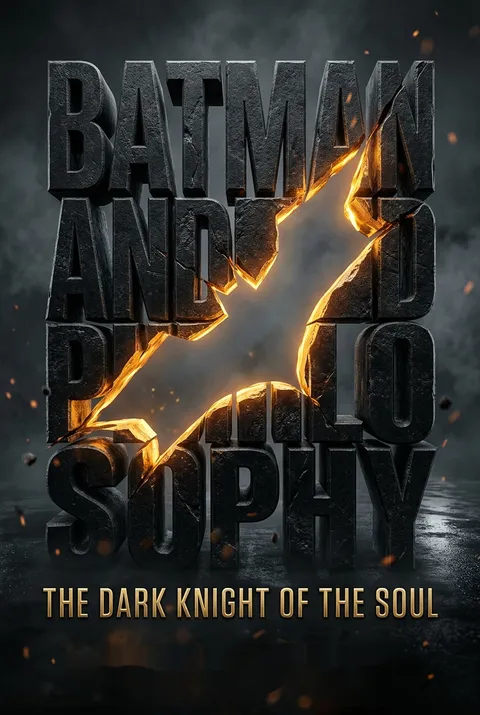


Key Takeaways
Do not let a clean outcome erase the moral cost of killing.
Two ethical lenses. Utilitarianism judges an act by its consequences, so killing one person to save many can seem right. Deontology asks whether the act itself is permissible, whatever follows. The familiar trolley dilemma sharpens the clash: diverting a runaway trolley saves five people but kills one. A transplant surgeon who kills a healthy person to save five patients seems far less defensible, even though the numbers match. Batman's choice about the Joker is harder still: the Joker has caused immense harm, but future victims are not yet known, and Batman would be the one to kill him.
Responsibility has limits. Batman can argue that the Joker is responsible for his crimes, not Batman. But a threat that is imminent and unavoidable differs from a prediction that someone will kill again. Acting on that prediction resembles prepunishment, which denies the possibility that a person may change.
The thought experiments expose why moral arithmetic feels persuasive but incomplete. In public policy, expected benefits matter, yet rights and procedures prevent officials from treating individuals as disposable whenever a forecast favors it. Batman's refusal to kill can therefore function as a limit on his own power, not merely a private rule. The difficult question is whether that limit remains defensible when containment repeatedly fails. The book leaves the dilemma alive rather than pretending that either consequences or principles settle every case.
Separate causing harm from deserving blame when judging the Joker.
Two kinds of responsibility. Causal responsibility means an action helped produce an outcome. Moral responsibility means the person deserves praise or blame for it. Batman might accidentally start a chain of events that harms someone without reasonably foreseeing the result; he could be causally involved without being blameworthy. The Joker is plainly a cause of his victims' deaths, but that alone does not settle whether he can be morally blamed.
Control is the question. The chapter uses the idea of second-order desires: a person's capacity to reflect on immediate impulses and decide which ones should guide action. If the Joker's insanity destroys that capacity, his choices may not be free in the relevant sense. His earlier decision to become the Red Hood does not automatically make him responsible for becoming a homicidal maniac, an outcome he could not reasonably anticipate.
This distinction helps keep accountability from collapsing into either vengeance or excuse-making. Modern legal and clinical reasoning also asks about a person's capacity to understand and control conduct, rather than treating harmful outcomes as proof of full culpability. Still, the Joker is a fictional extreme, not a diagnostic case. His portrayal cannot establish how real mental illness works, and the story's moral force depends on not confusing an explanation of impaired agency with a claim that victims' suffering matters less.
Treat a young partner as a person to educate, not a tool.
Robin is not a resource. Batman takes in young wards and trains them to fight dangerous criminals. A utilitarian defense says this may protect Gotham overall, but a duty-based view puts children's safety first. Virtue ethics asks a different question: what kind of person does the training help the child become? It treats moral character as something formed through practice, example, and correction, not simply through memorizing rules.
Jason shows the risk. Jason Todd had courage, but also rashness and a taste for harsh violence. Batman taught combat and bravery more successfully than restraint and moderation. Jason's death at the Joker's hands makes the failure painfully concrete. The lesson is not that danger can never teach courage; it is that a mentor must assess a student's character and provide the kinds of guidance the student actually needs.
The chapter's strongest point is that expertise does not equal teaching ability. A mentor may be excellent at a craft while poor at noticing what a learner cannot yet manage. This applies well beyond superheroes: apprentices need graduated responsibility, feedback, and protection from risks they are not equipped to judge. The analogy has limits, since Robin's consent and maturity vary across stories. A child who volunteers for danger still depends on adults to evaluate whether that choice is truly informed.
Aim hatred at wrongdoing, but count what it costs your life.
A virtue can have a shadow. Aristotle's virtue ethics treats good character as a practiced balance between extremes. The essay offers another way to assess Batman: his thoughts and actions may be virtuous when he wants good for Gotham and opposes deliberate cruelty. On this view, anger at a violent criminal need not be vicious; it can express a morally appropriate rejection of harm.
But justice is not flourishing. Batman's hatred helps sustain his relentless fight, yet his life is lonely and narrowed by it. He avoids stable relationships, and his work leaves little room for pleasure or ordinary connection. The essay separates being morally useful to others from living well oneself. Batman may improve Gotham while still paying a serious personal price.
Moral anger can be informative: it signals that a boundary has been crossed and can energize resistance to abuse. The danger comes when anger stops tracking wrongdoing and becomes an identity that needs enemies to feel purposeful. Batman's isolation makes that tension visible. A careful distinction between condemning an act and reducing a person to that act preserves moral clarity without making contempt the only available response.
Restore public order without confusing force with legitimate justice.
Gotham tests the social contract. In No Man's Land, an earthquake devastates the city, federal authorities isolate it, and residents struggle amid scarcity and gang rule. The story echoes Thomas Hobbes's state of nature, a condition in which people lack a reliable authority to protect them and fear becomes a reason to seek order. The comparison with post-Katrina New Orleans is suggestive, though the book notes that media accounts exaggerated some reports of violence.
Methods shape the order restored. Commissioner Gordon tries to rebuild trust while preserving limits. Officer William Petit increasingly treats lethal force as the answer and becomes consumed by violence. Humanitarians such as Dr. Leslie Thompkins resist that logic by caring for even dangerous patients. Batman helps restore order, but works alongside Gordon and the police rather than claiming final authority for himself.
Disaster stories reveal that institutions are not abstractions: food, rescue, medical care, and trustworthy communication are what make order real. Hobbes clarifies why people accept authority for security, while the contrasting characters ask what security costs when force has no restraint. The Gotham and New Orleans comparison must be handled carefully. A fictional city built for supervillains cannot stand as evidence that disaster naturally produces lawlessness; the chapter's own account of sensational reporting warns against that shortcut.
A childhood vow can give life direction without settling every duty.
A promise creates a self. Bruce's parents are murdered when he is a child, and he vows to fight the evil that took them. The promise is more than a plan for revenge: it gives shape to a shattered life and links his work to his parents' concern for Gotham. It also binds him to the past, giving him a reason to continue even when success is uncertain.
Commitment has an opportunity cost. Peter Singer's argument about aid says people should prevent severe suffering when they can do so without sacrificing something of comparable moral importance. Applied to Bruce's inherited fortune, that raises an uncomfortable question: would money given to people lacking food or medical care do more good than a life spent fighting crime in Gotham? A promise can matter deeply without automatically outweighing every other obligation.
The tension is between fidelity and impartial concern. Commitments make trust and long-term projects possible, but they can also privilege familiar people and places over strangers with greater needs. Bruce's vow is compelling partly because it is personal; Singer's challenge is powerful because moral need does not become smaller with distance. The practical issue is not whether either motive is false, but how a person allocates finite time and resources when several genuine duties compete.
Build identity through choices, while recognizing the rules shaping them.
The mask is made, not discovered. Drawing on Nietzsche and Foucault, the book presents identity as shaped through action, social expectations, and relationships of power, rather than as a fixed inner essence waiting to emerge. In Year One, Bruce trains, fails, and searches for a way to make criminals fear him before deciding that the bat can become his symbol. He constructs the role through repeated choices.
Batman has no simple checklist. Stories show other people wearing the cowl, and older versions of the character even use guns or kill. Wittgenstein's idea of family resemblance helps explain why a character can remain recognizable without one feature shared by every version. Batman is understood through overlapping traits and stories, not a single necessary condition.
This account avoids the trap of treating identity as either destiny or pure invention. People shape themselves, but they do so within histories, institutions, and available roles. A costume can help organize action and public meaning, yet it cannot make every chosen identity equally viable or harmless. The shifting Batman canon makes the point unusually clear: cultural icons are maintained through interpretation, and disagreement about what counts as the real character is part of how the icon persists.
Borrow a hero's virtues, then learn to choose for yourself.
Examples teach through practice. Aristotle argues that people develop virtues by repeatedly performing the kinds of actions a just, brave, or temperate person would perform. Batman can therefore serve as a moral exemplar: a fictional figure whose courage, justice, and generosity offer patterns to imitate. Emulation does not require copying his impossible feats; ordinary acts can express the same qualities.
The goal is independence. Kant warns that following an admired person without judgment leaves a person dependent on authority. Dick Grayson's path from Robin to Nightwing offers a reconciliation: he learns skills and character from Batman, then leaves the sidekick role and makes independent decisions. The mentor succeeds not by producing a permanent copy, but by helping a student become capable of self-direction.
Stories can make virtues concrete by showing them under pressure, which abstract definitions often fail to do. But fictional heroes are edited ideals: readers see selected actions and sometimes even private motives, while real people remain opaque and inconsistent. The most useful form of admiration is therefore selective. A model can supply a starting vocabulary for courage or justice, but judgment must remain with the person acting, especially when a hero's methods are morally contested.
Choose your life's project without pretending circumstances chose it for you.
Mortality makes choices visible. Heidegger's term Angst describes an unsettling confrontation with one's own death and the limits of one's future. In that experience, familiar projects appear as choices rather than fixed necessities. The chapter reads Bruce's near-fatal injury in Year One this way: he sees the resources available to him, recognizes that no mission has yet organized them, and then adopts the bat as a project for his life.
Freedom is neither total nor absent. Bruce does not choose the murder of his parents or the wealth and skills he inherits. But those facts do not dictate that he become Batman. His action is a decision made from within circumstances, not a mechanical result of them. The philosophical point is that responsibility begins with acknowledging both constraint and choice.
This account avoids two familiar distortions: the fantasy that anyone can become anything, and the fatalism that a person's past determines every move. A chosen project can organize effort and make sacrifice intelligible, but it can also become difficult to question once it supplies a person's whole identity. The useful test is whether commitment remains a choice that can be examined, rather than a script treated as inevitable simply because it has been repeated.
Shared trauma cannot tell you exactly what another person experiences.
Similar histories are not identical lives. Thomas Nagel's question about what it is like to be a bat illustrates the gap between describing an organism and knowing its subjective experience. The book applies this to Batman and the Joker. Both are transformed by violence and try to make sense of a disordered world, but neither can inhabit the other's point of view.
Circumstances shape freedom. Simone de Beauvoir's idea of situated freedom holds that choices are real but made within conditions a person did not choose. A decision opens some futures and closes others, including futures for people nearby. Batman and the Joker therefore share neither a single interpretation of their past nor a single moral response to it. Their resemblance cannot make one man's outlook a transparent guide to the other.
This is a useful corrective to the idea that empathy means imagining another person perfectly. Shared experience can support understanding, but it does not erase differences in memory, body, social position, or interpretation. The distinction matters in conflict: recognizing another person's limits does not require endorsing their conclusions. Batman and the Joker's intimacy is compelling precisely because mutual recognition coexists with profound disagreement about what their common losses mean.
Build friendship through equality, trust, and disagreement, not sameness.
Two heroes define friendship differently. Superman's friendships resemble Aristotle's ideal of people who value each other's character and help each other become better. Batman's bond with Superman has a Nietzschean edge: Superman represents a possibility Batman admires, while Batman offers a demanding counterweight to Superman's optimism. Their differences give each something to learn.
Trust is tested by power. Superman gives Batman a piece of kryptonite, trusting him with a means to stop him if necessary. Batman, meanwhile, secretly prepares ways to neutralize allies, revealing how suspicion can undermine intimacy. The book also argues that Batman's lack of superpowers makes his risks especially visible, so raw power alone is a poor measure of heroism. Their friendship depends on respect across unequal abilities, not on pretending those inequalities do not matter.
A strong friendship can include correction rather than constant affirmation. The two characters' contrasting temperaments make that corrective function unusually legible: optimism can miss danger, while suspicion can turn every relationship into a contingency plan. Their bond is most persuasive when each remains more than a lesson for the other. The comparison also complicates claims that friendship requires equal power; mutual respect may matter more than equal capacities, though concealed surveillance understandably strains that respect.
Balance the crusade with ordinary care and human connection.
Alfred's justice is immediate. Batman pursues a distant ideal of social justice, but Alfred expresses justice through everyday loyalty: caring for Bruce, tending his injuries, and offering practical help and affection. Kierkegaard's contrast between the knight of infinite resignation and the knight of faith illuminates the difference. Batman commits himself to a demanding ideal; Alfred trusts and serves a particular person, even when the effort seems absurd.
The Way includes opposites. Taoist thought describes yin and yang as interdependent forces. The book's fictional teacher, Bat-Tzu, argues that Batman's hard, relentless side needs the softer qualities he suppresses. The principle of wei-wu-wei, often rendered as action through non-forcing, appears in Alfred's quiet effectiveness: noticing what is missing, helping without taking center stage, and patiently keeping Batman grounded.
The contrast does not make public justice and private care enemies. Large institutions can protect people at scale, while ordinary acts preserve trust and dignity in the present. Alfred also exposes the risk of celebrating self-sacrifice without asking who bears its cost. His loyalty is moving, but a life organized entirely around another person's mission could become self-erasure. Balance means valuing care without demanding that caretakers disappear into it.
Analysis
This collection is not a single argument so much as a set of philosophical investigations sharing one unusually productive character. Its central achievement is to make Batman's contradictions do intellectual work. He protects a legal order while violating its rules, pursues justice through a life that may damage his own flourishing, and claims a fixed mission while embodying a character repeatedly rewritten by different authors. The essays resist treating these tensions as continuity errors to be cleaned up. They use them to test ethical theories against difficult cases.
The most revealing conflict is between Batman as an ideal and Batman as a person. As an exemplar, he can model courage and discipline. As a guardian, he may expose children to unacceptable danger. As a vigilante, he may restore security while threatening the state's claim to legitimate force. As a friend, he offers loyalty but also surveillance and contingency plans. The same trait can be virtue in one setting and failure in another. That makes the book less a guide to copying Batman than a lesson in evaluating actions within roles, power relations, and consequences.
The anthology also moves between philosophical traditions that do not fully agree. Consequentialism emphasizes preventable suffering; deontology protects constraints on action; virtue ethics asks what character is being formed. Existentialism stresses chosen projects under finite conditions, while Taoism cautions against one-sided striving. Their disagreement is a strength, but it means the reader should not expect one final verdict on the Dark Knight. The essays offer different lenses, sometimes with competing judgments.
The book's most durable insight is that moral seriousness requires more than a noble mission. It also requires attention to who is being used, who has authority, what alternatives exist, and what a commitment costs. Gotham's greatest detective may solve crimes, but the philosophical questions remain open because solving a problem is not the same as settling what justice demands.
Review Summary
Batman and Philosophy receives mixed reviews. Many readers appreciate the philosophical insights applied to Batman's world, finding it thought-provoking and enjoyable. However, some criticize the book for being repetitive, focusing too much on a few comic storylines, and not delving deep enough into either philosophy or Batman lore. The essays vary in quality and accessibility, with some praised for their analysis and others criticized for superficiality. Overall, it's considered a decent introduction to philosophy for Batman fans, though it may disappoint those seeking more rigorous philosophical discussion.
People Also Read

Glossary
Utilitarianism
Consequence-based ethicsAn ethical theory that evaluates actions by their consequences for well-being. In the book's examples, a utilitarian may support killing one person if doing so reliably saves many more. The theory's strength is its insistence that every person's welfare counts; its challenge is that maximizing total benefit can permit severe harms to individuals.
Deontology
Duty-based ethicsAn ethical approach that judges actions by duties, principles, or features of the acts themselves, not only by their outcomes. A deontologist may reject killing the Joker even if doing so would prevent future deaths, because directly killing can violate a moral constraint. The book contrasts this approach with consequence-focused utilitarianism.
Virtue ethics
Character-focused ethicsAn ethical tradition centered on the qualities of character that help a person live and act well. Virtues such as courage, justice, and moderation develop through practice and guidance. The book uses this approach to examine Batman's training of Robin, the moral value of Batman's anger, and the role of exemplary people in moral education.
State of nature
Life without shared authorityThomas Hobbes's account of a condition without an effective political authority to secure peace and enforce rules. In such a condition, fear, competition, and insecurity make stable cooperation difficult. The book uses Gotham after the earthquake to explore the fragility of social order and the reasons people accept governing authority.
Prepunishment
Punishing predicted future crimesThe practice of imposing punishment before a person commits a crime, based on a prediction that the crime will occur. The Joker's repeated violence makes Batman's dilemma vivid, but future wrongdoing remains uncertain and a person may change their mind. The concept raises questions about prediction, choice, and the limits of preventive action.
Situated freedom
Choice within real conditionsSimone de Beauvoir's idea that people make meaningful choices, but always within material and social circumstances they did not entirely choose. A decision changes the options available to the person and can alter the futures available to others. The book uses the concept to interpret Batman and the Joker without treating either as wholly determined by trauma.
Dasein
Human existence as being-thereMartin Heidegger's term for human existence as always involved in a world of concerns, relationships, and projects. A person is not best understood as an isolated mind or a collection of physical properties alone. In the book's account, Dasein is shaped by past circumstances and directed toward possibilities for the future.
Family resemblance
Overlapping shared similaritiesLudwig Wittgenstein's account of how a category can remain meaningful without one feature shared by every member. Items may belong together through overlapping similarities, as members of a family resemble one another in different ways. The book applies this idea to Batman, whose identity persists across versions with conflicting traits.
Angst
Anxiety before one's possibilitiesIn Heidegger's philosophy, Angst is an unsettling confrontation with one's own finite existence and the limits of one's possibilities. Ordinary projects can then appear as choices rather than unquestioned necessities. The book interprets Bruce Wayne's encounter with possible death as a moment in which he takes responsibility for choosing a life project.
wei-wu-wei
Effective, non-forcing actionA Taoist idea often translated as action without action or non-forcing. It does not mean simple passivity. It describes acting in a way that follows circumstances rather than imposing unnecessary force. The book associates the idea with Alfred's understated assistance, such as noticing what Batman has missed and helping without claiming the spotlight.
FAQ
What's Batman and Philosophy: The Dark Knight of the Soul about?
- Exploration of Ethics: The book delves into Batman's moral and ethical dilemmas, such as his refusal to kill the Joker, and the broader implications of these choices.
- Philosophical Frameworks: It uses frameworks like utilitarianism, deontology, existentialism, and Taoism to analyze Batman's actions and motivations.
- Cultural and Philosophical Impact: The text examines Batman's role as a cultural icon and how his stories reflect societal issues and philosophical questions.
Why should I read Batman and Philosophy: The Dark Knight of the Soul?
- Unique Blend: Offers a unique combination of comic book storytelling and philosophical inquiry, appealing to both Batman fans and philosophy enthusiasts.
- Engaging Discussions: Presents engaging discussions on ethics, identity, and justice, encouraging critical thinking about moral choices.
- Cultural Relevance: Reflects on contemporary issues of justice, identity, and morality through the iconic figure of Batman.
What are the key takeaways of Batman and Philosophy: The Dark Knight of the Soul?
- Moral Complexity: Batman's character illustrates the struggle between personal ethics and the greater good, often blurring lines between heroism and vigilantism.
- Role of Promises: Batman's vow to his parents is a recurring theme that shapes his identity and actions.
- Identity and Choice: Highlights the importance of identity and choice in shaping moral character, particularly through Batman's journey from Bruce Wayne to the Dark Knight.
What are the best quotes from Batman and Philosophy: The Dark Knight of the Soul and what do they mean?
- "I swear by the spirits...": Emphasizes Batman's deep commitment to his mission, rooted in personal tragedy and a promise to his parents.
- "Some men aren’t looking...": Reflects the Joker's chaotic nature and the challenges Batman faces in combating unpredictability.
- "The past is never dead...": Underscores the idea that past experiences shape identities and moral choices, central to Batman's journey.
Why doesn’t Batman kill the Joker according to Batman and Philosophy: The Dark Knight of the Soul?
- Moral Code: Batman adheres to a strict moral code that prohibits killing, believing it would make him as bad as the criminals he fights.
- Ethical Tension: Discusses the tension between utilitarianism (greatest good) and deontological ethics (morality of actions), illustrating Batman's struggle.
- Consequences of Killing: Fears that killing the Joker would lead to a slippery slope of violence, undermining his mission to uphold justice.
How does Batman and Philosophy: The Dark Knight of the Soul explore Batman's identity?
- Duality of Identity: Discusses the duality of Batman's identity as both Bruce Wayne and the Dark Knight, exploring how each persona influences his actions.
- Philosophical Implications: Examines identity through modal logic and possible worlds, highlighting philosophical implications.
- Existential Struggle: Portrays Batman's identity as an existential struggle, reconciling past trauma with present choices and future aspirations.
What philosophical frameworks are used in Batman and Philosophy: The Dark Knight of the Soul?
- Utilitarianism and Deontology: Examines utilitarian ethics and deontological ethics, focusing on Batman's choices and the morality of actions.
- Existentialism: Employs existentialist themes to analyze Batman's quest for meaning and authenticity in a chaotic world.
- Virtue Ethics and Taoism: Discusses virtue ethics and Taoist principles, evaluating Batman's character and the importance of balance in his life.
How does Batman and Philosophy: The Dark Knight of the Soul compare Batman and Superman?
- Moral Philosophies: Contrasts Batman's pragmatic, often ruthless approach to justice with Superman's idealistic and hopeful nature.
- Friendship Dynamics: Explores the dynamics of their friendship, emphasizing differing views on morality and justice.
- Philosophical Implications: Illustrates broader philosophical implications about power, responsibility, and heroism in society.
What role does Alfred play in Batman's moral development according to Batman and Philosophy: The Dark Knight of the Soul?
- Moral Compass: Alfred serves as Batman's moral compass, providing guidance and support while challenging Bruce ethically.
- Balance of Character: Embodies the yin to Batman's yang, emphasizing the need for balance in Batman's life and decision-making.
- Philosophical Mentor: Portrayed as a philosophical mentor, helping Batman navigate his complex moral landscape and embrace humanity.
How does Batman and Philosophy: The Dark Knight of the Soul address the theme of death?
- Confrontation with Mortality: Emphasizes confronting mortality as a means of achieving authenticity and moral clarity.
- Angst and Freedom: Discusses Angst, illustrating how awareness of death influences Batman's choices and mission commitment.
- Existential Reflection: Death serves as a catalyst for existential reflection, prompting Batman to consider life's meaning and purpose.
What is the significance of Batman's moral code in Batman and Philosophy: The Dark Knight of the Soul?
- No Killing Rule: Highlights Batman's strict moral code, particularly his refusal to kill, as a defining characteristic.
- Moral Responsibility: Discusses implications for Batman's sense of moral responsibility and challenges in upholding it.
- Philosophical Exploration: Explores how the moral code reflects broader ethical theories and justice complexities in a flawed world.
Could Batman have been the Joker according to Batman and Philosophy: The Dark Knight of the Soul?
- Modal Claims: Discusses modal claims about identity, questioning if Batman and the Joker could have been the same under different circumstances.
- Identity and Properties: Emphasizes the Indiscernibility of Identicals, stating identical things must share all properties.
- Philosophical Implications: Raises deeper philosophical implications about identity, choice, and the nature of good and evil.
Blackwell Philosophy and Pop Culture Series Series
About the Author
Other books by Mark D. White
Download PDF
Download EPUB
.epub digital book format is ideal for reading ebooks on phones, tablets, and e-readers.








