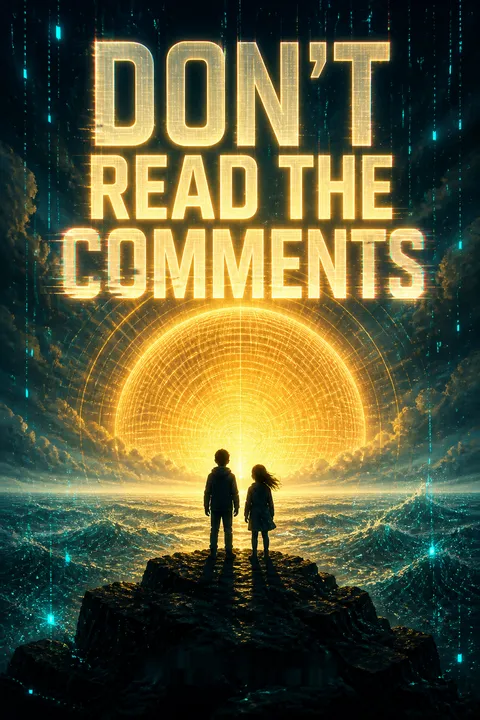


Plot Summary
Rent Runs on Streams
Eighteen-year-old Divya Sharma streams Reclaim the Sun as D1V, guiding her online Angst Armada through a boundless galaxy with help from her producer and closest friend, Rebekah. The channel brings sponsorships and a little income, but its real purpose is keeping Divya and her mother afloat after Divya’s father left.
Her mother is close to finishing graduate school while working multiple jobs, and Divya quietly sells sponsored gadgets to cover rent, groceries, and future tuition.
She also absorbs racist and sexist abuse from anonymous viewers, while urging her mother not to read the comments. When a packed fleet gathers for a stream, Divya sees how much her audience matters, even as her private finances and public exposure pull in opposite directions.
Divya’s fame is not a fantasy of effortless success. It is precarious labor, assembled from sponsorship obligations, audience attention, and possessions she would rather keep. The contrast between her mother’s worn apartment and the game’s limitless star systems makes money feel both brutally immediate and absurdly abstract. Divya’s stream offers pleasure and community, but it also turns her face into a product that strangers feel entitled to judge. Her insistence that her mother ignore comments reveals a protective reflex she cannot fully apply to herself. From the outset, visibility is both the means by which Divya helps her family and the vulnerability that will expose them.
Planet Butts, Doctor Dreams
In Philadelphia, Aaron Jericho escapes family pressure by exploring Reclaim the Sun and writing stories for ManaPunk, a small game studio where his best friend Ryan illustrates. Aaron’s mother wants him to work at her medical practice and eventually follow her into medicine; his father quietly covers the office so Aaron can pursue game writing.
Six-year-old Mira, Aaron’s little sister, helps him name a newly discovered world Planet Butts, turning his private game session into a family joke. The affection does not erase the pressure: his parents still expect him to help at the clinic, and ManaPunk’s founder, Jason, has not paid Aaron or Ryan for earlier work. Aaron wants to make games, but he has little money and few guarantees.
Aaron’s conflict is not simply a choice between a practical career and a childish hobby. His parents’ expectations are bound to love and sacrifice: his mother fears he will be exploited, while his father has endured poorly paid work and wants his son to have better options. Aaron reads their concern as an attempt to author his future for him. Games, by contrast, let him imagine himself as a maker rather than a successor. His care for Mira and loyalty to Ryan show that his independence is not indifference to others. The question is whether he can honor those bonds without surrendering the work that makes his life feel like his own.
The Armada Is Ambushed
When Divya leads hundreds of Armada members to an icy planet, a fleet of white ships marked with red slashes descends without warning and opens fire. The attackers call themselves the Vox Populi. Ships explode, players lose equipment they spent weeks earning, and Rebekah is blasted out of the game. Divya reaches her own ship, but the attackers destroy it and leave her avatar to drown beneath the ice.
After the stream ends, Divya finds a message from the Vox Populi declaring that the attack is only the beginning. An attached daytime photograph shows her apartment building. She has carefully hidden her real name and address, so the image changes the threat from online cruelty into the possibility of physical stalking.
The attack makes a game’s rules carry emotional force: losing a ship means losing time, effort, and the sense of safety Divya had built inside a virtual world. The Vox Populi exploit that attachment by turning a public stream into a spectacle of punishment. Their rhetoric denies that gender and race matter even as their targeting makes those categories impossible to ignore. The apartment photograph is the more consequential escalation. It collapses the distinction between avatar and person without needing to publish Divya’s address yet. Her fear comes not only from what has happened, but from having no way to know what the attackers can reach next.
One Planet, Two Gamers
Rebuilding her ship forces Divya to grind through low-level missions, until the game unexpectedly announces that another player is contesting her claim to an unexplored planet. That player is Aaron, who arrives distracted by Mira and awkwardly asks Divya to share the resources rather than fight.
When he recognizes D1V, he offers to leave the planet to her, but Divya refuses to make him give way. They name it Initium Novum, then explore together. A dangerous creature drives them into a scramble, and Divya uses a creature lure to make two monsters fight each other. Aaron records the encounter, and Divya adds him to her friends list, giving their chance meeting a future beyond that planet.
Their first meeting turns the game’s competitive mechanic into a small ethical test. Divya has practical reasons to seize every resource she can, while Aaron has no desire to dominate another player. Their decision to share is not sentimental; it is a form of trust negotiated through action. Aaron’s recognition of D1V briefly risks making her a celebrity rather than a partner, but his willingness to step aside and her refusal to accept that deference reset the balance. The creature encounter then lets them become capable teammates. Their friendship begins not with personal disclosure, but with mutual attention to what the other can do.
Quarters Become a Threat
At a Hoboken arcade, Divya and Rebekah try to reclaim an ordinary afternoon by playing Time Crisis. Walt, a college student, first lends Rebekah quarters, then treats the favor as an obligation when she refuses to give him her number. He recognizes Divya, while another student raises a phone to record them.
Divya slaps Walt as he advances; Brian, one of his companions, pulls Walt away and later returns Divya’s dropped phone. Divya gets Rebekah out of the arcade and calls the police. Detective Nikki Watts visits Divya, explains that local authorities are investigating organized online harassment, and offers to help. Divya still hides the photograph of her apartment, afraid that reporting it will expose her family further.
The arcade incident gives the harassment a mundane, recognizable setting: a place Divya and Rebekah chose precisely because it was usually theirs. Walt’s small gesture becomes coercive when he treats payment as a claim on Rebekah’s attention. Divya’s slap is an immediate refusal, but it also exposes her to the camera and the online audience waiting to recast her response as provocation. Brian’s intervention complicates the group dynamic without undoing the harm. Detective Watts offers an institutional alternative to the familiar dismissal that online abuse is not real. Divya’s lie about the doxxing threat shows how fear can make even help feel dangerous.
Eggs at the Library
When Divya returns to streaming, her Angst Armada surprises her with more than 100,000 in-game credits, enough to rebuild her ship. Their generosity moves her to tears and restores her faith in the community that the Vox Populi tried to scatter. Aaron joins the expedition, and Divya’s mother unexpectedly comes home during the live broadcast, covered in egg and crying.
Several boys attacked her outside the library where she works, then left her to walk home after she fell and broke her phone. Divya realizes the trolls have found her mother’s workplace. She calls Detective Watts and finally reveals the earlier photograph of her apartment, making the threat part of an official investigation.
The Armada’s gift is a counterattack conducted through care rather than force. Its credits restore Divya’s in-game capacity, but the deeper consequence is emotional: she learns that her followers can act as a community rather than a crowd. That fragile relief ends when her mother is assaulted. The attack reaches Divya through the very relationship that motivates her streaming, converting family devotion into leverage for the trolls. The accidental broadcast compounds the violation, showing how a camera can make private pain public before its subject can consent. Divya’s decision to tell Watts marks a shift from managing danger alone to allowing others to document and confront it.
ManaPunk Cuts Aaron Loose
As the Vox Populi’s attacks attract publicity, ManaPunk founder Jason tells Aaron that the company can no longer be associated with D1V’s controversy. He fires Aaron and Ryan, despite their unpaid work on Thundertail, and pressures them to accept contracts that would let the studio use their story and art without credit. Ryan refuses to sign.
Aaron, already shaken, searches a hidden folder on the clinic computer and finds his father’s old, elaborate letters to an unnamed beloved. He assumes they prove an affair, and the discovery makes his family’s expectations feel even more tangled. Meanwhile, Rebekah sends Aaron her VR headset, giving him a way to join Divya more fully in the game and drawing the two friends closer.
Jason’s decision exposes the difference between calling collaborators friends and treating them fairly. He invokes business necessity, but the unpaid labor and proposed loss of credit reveal who is expected to absorb the risk. Aaron’s sudden loss of work echoes the economic insecurity Divya already knows, while Ryan’s refusal models a boundary Aaron has not yet learned to assert. The letters introduce a second kind of misreading: Aaron interprets private creative work through the family tensions he already carries. The headset arrives as an act of generosity from Divya, countering Jason’s transactional logic. It also makes their online intimacy more embodied without removing the distance between them.
A Headset Across States
With the headset Rebekah sent, Aaron meets Divya on her hidden gathering planet and experiences Reclaim the Sun in virtual reality for the first time. He tells her about the letters he found and his fear that his father is having an affair; Divya understands the wound of a father who left, but does not pretend to know what Aaron’s evidence means.
When Aaron suggests meeting in person, Divya admits she is not ready. He accepts her limit, and their connection deepens rather than breaking. Later, Aaron buys digital copies of movies at a flea market and arranges a shared viewing inside the headset. Their first date is a film watched from separate bedrooms, a small experiment in closeness that respects Divya’s need for distance.
The headset changes the texture of their relationship without pretending to abolish risk. In virtual reality, Aaron can share a landscape and a movie with Divya, while she retains control over whether that closeness becomes an in-person meeting. His response to her hesitation matters more than the invitation itself: he does not turn affection into a debt she must repay. Divya’s caution is not a rejection of intimacy but a learned survival practice, shaped by harassment that has already crossed into her home and family. Their remote date therefore becomes meaningful precisely because it preserves boundaries. Connection here is built through consent, patience, and ordinary shared pleasure.
Gold Turns to Fire
On a richly resourced planet, Divya and Aaron discover lakes of gold, then spot the Vox Populi waiting to ambush the Armada and seize the planet. The attackers reveal that they threatened Rebekah with her exposed address and fabricated nude images, explaining her recent silence. Divya refuses to blame her friend.
Instead, she leads the remaining Armada into battle and fires missiles into the gold lakes, destroying the resources before the trolls can claim or sell them. Aaron joins her, eventually crashing his upgraded ship into a pool of gold when he runs out of missiles. The survivors escape, but the Vox Populi have already hacked Divya’s accounts, erased her streaming channel, and sent a dangerous strobe video to her headset.
The gold makes the conflict unusually concrete: Divya can imagine exactly what the resource would buy for her family, yet she destroys it to prevent the Vox Populi from gaining power. Her choice rejects the idea that every opportunity must be converted into private advantage. It is also costly rather than triumphant; Aaron sacrifices the ship he worked to rebuild, and the attackers retaliate by targeting Divya’s digital identity and physical safety. The revelation about Rebekah reframes her withdrawal as fear, not disloyalty. Divya’s refusal to turn against her friend is the moral center of the battle, even as the hacked accounts leave her feeling erased.
The Letters Were Fiction
After the account takeover, Divya considers leaving streaming behind, but she decides to appear at GamesCon rather than let the Vox Populi dictate where she can go. Rebekah agrees to join her, and Detective Watts arranges a plan with them.
In Philadelphia, Aaron’s parents learn he wants to attend the convention for his writing. When Aaron confronts his father about the letters, his father reveals that he has been writing fantasy fiction inspired by Ultima Online, not conducting an affair.
Aaron apologizes, and his mother admits that her opposition to game work comes from seeing his father exploited in low-paid jobs. Their family repairs some of its misunderstandings. Then Ryan shows Aaron that Jason is using their uncredited story and artwork in a convention demo, giving them a reason to go.
Two stories about hidden motives converge here. Aaron has mistaken his father’s creative privacy for betrayal, while his parents have mistaken caution for a demand that Aaron abandon his ambitions. Once they explain the history behind their fears, their conflict becomes negotiable rather than absolute. Divya’s choice to attend GamesCon likewise turns fear into a decision she can own, especially with Rebekah and Watts involved. The final discovery of Jason’s demo prevents the family reconciliation from becoming a simple emotional resolution. Aaron still has to defend his work in public. The section links intimacy and authorship: people need to be seen accurately, whether they are parents, collaborators, or an online friend.
Stolen Work Goes Public
At GamesCon, Divya arrives in disguise, with short orange hair, bright glasses, and Rebekah’s support at their Angst Armada table. Aaron and Ryan find Vox Populi stickers around the convention floor, then spot Jason displaying Thundertail with Ryan’s artwork and Aaron’s prose. Aaron confronts Jason while Ryan slips behind the booth and disconnects the development computer.
The television and display collapse in the confusion, and Ryan escapes with the machine containing their demo. Aaron runs toward Divya’s panel carrying a tube of signs he prepared for her. Their protest over stolen work now shares the same crowded convention with the planned confrontation between Divya and the harassers.
GamesCon gathers the novel’s private and public conflicts into one physical space. Divya’s disguise lets her enter on her own terms, but her appearance at the table makes her visible again. Aaron and Ryan’s confrontation with Jason is not clean heroism: they use a staged distraction and take the computer, risking consequences while trying to stop further exploitation. Yet Jason has already made their work public without permission, so their action answers a prior theft. The signs Aaron carries offer a different kind of intervention, one designed to restore Divya’s sense of worth rather than speak over her. He is learning that support can require preparation and restraint, not just impulsive rescue.
The Armada Holds the Room
During Divya’s panel on harassment in gaming, the Vox Populi hijack the presentation screen and reveal themselves in matching shirts, then surge toward the stage. Divya refuses to leave. As the audience divides between heckling and support, police officers from Watts’s operation enter through the emergency exits and detain the attackers.
Aaron reaches the stage with his signs, which describe how Divya’s videos and community have helped other fans. Divya recognizes him and takes his hands. Jason then arrives, demanding his computer, but agrees to remove Aaron and Ryan’s work from the game when journalists gather. When a Vox Populi member attacks Aaron, Divya strikes the man with the poster tube. The danger breaks, and she kisses Aaron.
The climax does not depend on Divya defeating the Vox Populi alone. The planned police response, the Armada’s presence, and ordinary attendees who refuse to join the heckling create a collective defense. Divya still takes the stage and makes her own refusal visible; assistance does not replace her agency. Aaron’s signs matter because they testify to the effects of her work without claiming ownership of her story. His arrival is not a rescue fantasy, since Divya has already chosen the confrontation and helped coordinate it. Jason’s retreat under public scrutiny also contrasts with his earlier reliance on commercial pressure. The kiss follows a moment of mutual recognition, not a reward for Aaron’s intervention.
Reclaimed on Her Terms
After the convention, Ryan’s father sells Jason’s cleared development computer online, and the proceeds give Aaron money to buy tools for making games of his own. Divya regains access to her social accounts but chooses not to resume professional streaming.
She sells much of her equipment, pays for her mother’s final class, and registers for courses at community college. Rebekah remains her closest friend, while Maggs takes over the channel and keeps the Angst Armada active.
Divya and Rebekah agree to play together when they are ready, rather than forcing a return to their old routine. Aaron asks to visit, Divya agrees, and he travels to see her for a real date. Divya steps away from the performance of D1V without giving up the people she found there.
The ending defines victory less as restoring the old platform than as recovering choice. Divya does not prove her courage by continuing to monetize the same exposure that made her vulnerable; she secures practical support for her mother and education, then relinquishes professional streaming. Passing the channel to Maggs preserves the community without making Divya its permanent laborer. Aaron’s computer money similarly supports a future he can build himself, rather than returning him to Jason’s promises. Their in-person date completes the movement from virtual connection to physical presence, but only after Divya has regained control over the terms. Reclamation is not a return to an untouched past. It is choosing what to carry forward.
Analysis
The novel makes digital life materially consequential. A destroyed ship costs hours of work; a hacked channel threatens Divya’s income; an apartment photograph changes how safe a walk home feels. These consequences prevent the familiar dismissal of online harm as unreal. The Vox Populi are not simply rude commenters. They organize across platforms, exploit anonymity, and use public attention as a weapon. Their insistence that their campaign is not about race or gender is contradicted by the targets they choose and the language they use.
Divya’s streaming career also complicates the idea that visibility is uncomplicated empowerment. She uses sponsorships and audience attention to support her mother, but the same exposure invites strangers to scrutinize her body, identity, and private life. When she eventually leaves professional streaming, the choice is not defeat. She has secured money for education and family needs, and she can preserve gaming as pleasure rather than compulsory labor. Passing the channel to Maggs lets the community continue without requiring Divya to remain its public face.
Aaron’s story tests the difference between support and rescue. He is drawn to protecting women he cares about, but Ryan repeatedly challenges him to respect their decisions. Divya’s boundaries teach him that affection is not permission to take charge. His own family plot mirrors that lesson: Aaron mistakes his father’s private writing for infidelity, while his mother’s pressure hides a fear of seeing him exploited. Honest disclosure replaces projection with understanding.
The novel’s most persuasive alternative to online cruelty is not solitary toughness but accountable connection. The Armada gives practical help, Rebekah and Divya share responsibility without ceasing to have separate limits, and Detective Watts treats harassment as a public safety issue. At GamesCon, Divya confronts the attackers herself, but she does so with allies and institutional support. The final movement toward college, self-directed creative work, and an in-person date suggests that reclaiming a life means choosing which forms of visibility, labor, and intimacy are worth keeping.
Review Summary
Don't Read the Comments is a YA novel that resonates with readers for its exploration of online gaming, harassment, and diversity. Many praise the relatable characters, particularly Divya, and the accurate portrayal of gaming culture. The book tackles important issues like sexism, racism, and cyberbullying while maintaining a fun, geeky atmosphere. Some readers found the pacing slow or struggled with gaming references, but overall, the novel is lauded for its timely message and representation of marginalized voices in the gaming world.
People Also Read

Characters
Divya Sharma
Streamer under siegeEighteen-year-old Divya is the gamer known online as D1V, a skilled explorer and magnetic host whose stream supports her mother and helps pay their bills. She is proud, funny, and practical, but the work of being visible leaves her exposed to a constant stream of racist and sexist abuse. Her devotion to her mother makes her generous and resourceful, yet also encourages her to put her own education and safety second. Divya values the community she has built through gaming, not merely the sponsorships it brings. Her central tension is between wanting to remain open to people and knowing that openness can be exploited. She is cautious without being passive, and her courage grows most clearly when she sets her own terms.
Aaron Jericho
Reluctant game writerAaron is a teenager who writes stories for games and builds his computer from discarded parts. His parents hope he will enter medicine, while he wants to make games and earn recognition for his writing. He is thoughtful and generous, sometimes so eager to help that he mistakes concern for a need to intervene. His best friend Ryan often reminds him to respect other people’s agency. Aaron’s loyalty is tangible: he shows up, shares his time, and takes other people’s work seriously. He also has to learn that good intentions do not exempt him from listening. His warmth and awkward humor make it easier for Divya to trust him, while his own family and work conflicts reveal the insecurity beneath his confidence.
Rebekah Cole
Producer and first mateRebekah is Divya’s closest friend, streaming producer, and trusted partner in Reclaim the Sun. A gamer and book lover with vivid personal style, she handles the technical work that helps turn Divya’s play into a successful channel. She is observant, funny, and protective, often noticing Divya’s emotional shifts before Divya admits them. Rebekah also guards her privacy and has reasons to be wary of public attention. Her care does not make her endlessly available or invulnerable; she has her own limits and needs. The friendship between her and Divya is built on shared work, teasing, and loyalty, with each trying to protect the other without taking control of the other’s choices.
Divya’s mother
Dreaming library workerDivya’s mother works multiple jobs while finishing a graduate degree in library science. After Divya’s father leaves, she tries to keep their household stable without asking her daughter to surrender her future. Her worry about Divya’s streaming comes from love and from seeing how cruel strangers can be, but she also struggles to recognize how much the work means to Divya. She and her daughter share a habit of hiding fear to spare each other. Their closeness is tender and imperfect: both want to protect the other, and both must learn to say when they need help.
Aaron’s mother
Doctor with a planAaron’s mother runs a medical practice and hopes her son will choose a secure career in medicine. Her insistence can feel controlling, especially when she connects college support to his future profession. Yet her fear is rooted in watching her husband endure low-paid, exhausting work and worrying that Aaron’s game-industry collaborators will exploit him. She is ambitious for her son, but her vision of safety can crowd out his own desires. Her guarded manner softens when she explains what lies beneath her pressure, revealing a parent trying to protect her child from hardship she knows firsthand.
Aaron’s father
Quiet kitchen dreamerAaron’s father helps run his wife’s practice and supports Aaron’s creative ambitions more openly than she does. An immigrant who has worked demanding jobs in restaurants and elsewhere, he carries the weariness of years spent providing for family. He is affectionate with Aaron and Mira, often using humor to soften household tension. His private interest in games and fantasy writing shows a quieter imaginative life that he has not yet made comfortable sharing. He wants to care for others and can resist being cared for himself, a habit shaped by responsibility as much as temperament.
Mira Jericho
Aaron’s playful copilotMira is Aaron’s six-year-old sister, an irrepressible presence who turns his exploration game into shared play. Her jokes, excitement, and affection reveal the gentler side of Aaron that his career worries can obscure. She also makes the Jericho household feel like a family rather than a battleground over Aaron’s future.
Ryan
Artist and honest friendRyan is Aaron’s longtime best friend and the illustrator for their small game-making team. He is talented, teasing, and clear-eyed about contracts, credit, and the limits of Aaron’s urge to rescue people. His relationship with Aaron combines deep affection with blunt correction. Ryan’s own plans for an art portfolio and college make him vulnerable to the studio’s instability, but he refuses to let friendship substitute for fair treatment. His steady support helps Aaron distinguish solidarity from self-appointed heroism.
Jason Pherlin
Ambitious studio founderJason founded ManaPunk and gave Aaron and Ryan early opportunities to work on games. Charismatic and imaginative, he can make collaborators feel included in a shared creative vision. He is also financially pressured and willing to blur the line between friendship and business when the studio’s future is at stake. Jason’s casual promises about payment and credit leave his younger collaborators exposed. His weakness is not a lack of creative belief, but a tendency to treat other people’s labor as flexible when his own company feels threatened.
Laura
ManaPunk’s programmerLaura is the programmer on the ManaPunk team and has a close relationship with Jason. Practical and technically skilled, she contributes to the studio’s game projects while navigating its uneven power dynamics. Aaron worries about her relationship with Jason and is repeatedly reminded that concern does not entitle him to manage her choices. Her presence helps expose Aaron’s habit of imagining himself as someone else’s protector.
Detective Nikki Watts
Local harassment investigatorDetective Watts investigates organized online harassment affecting young women in the region. Direct, observant, and unusually attentive to the connection between online abuse and physical danger, she treats Divya’s reports as worthy of real police work. She is building cooperation with local colleges and state authorities rather than treating each incident as isolated. Her humor and interest in D1V’s videos make her approachable, but she remains alert to the risks Divya and Rebekah face.
The Vox Populi
Anonymous online attackersThe Vox Populi is an organized group of anonymous gamers who target Divya and others through coordinated harassment. They use game attacks, threatening messages, doxxing, and public intimidation while presenting their actions as a defense of gaming culture. Their facelessness is part of their power: it makes individual responsibility difficult to establish and lets members hide behind a collective identity. They function as an antagonist not because they are unknowable, but because they work to make their victims feel isolated and unsafe.
Brian
Reluctant arcade bystanderBrian is one of the students who enters the Hoboken arcade with Walt. He intervenes when Walt becomes aggressive toward Divya and Rebekah, then returns Divya’s phone after they escape. His actions show that even within a hostile group, a bystander can choose to interrupt harm.
Maggs
Armada fan and scoutMaggs is a young member of Divya’s gaming community who discovers a valuable planet and shares it with the Armada. Her enthusiasm reflects the generosity and belonging that draw players to Divya’s stream. She also contributes creative support to the community beyond the game.
Hannah Siddiqui
Oculus publicistHannah works in public relations for Oculus and has previously sent Divya gaming equipment. Her personal gesture acknowledges Divya’s hardship and offers a practical invitation to return to the game. She represents a rare instance of professional support that feels personal rather than transactional.
Alberto
Ryan’s supportive boyfriendAlberto is Ryan’s boyfriend and a familiar part of Aaron’s social circle. He teases Aaron about his feelings for Divya and helps establish the affectionate, frank atmosphere of the friends’ group. His steady relationship with Ryan offers Aaron a model of attention and partnership.
Plot Devices
Reclaim the Sun
Virtual meeting groundThe sprawling online game lets players explore procedurally generated planets, gather resources, customize ships, and sometimes fight over territory. For Divya, it is both the setting of her public streams and a livelihood; for Aaron, it is a private escape and a place to meet her. Its upgrade system makes destroyed ships costly because players lose time and accumulated equipment. The game also gives the Angst Armada a shared identity and a way to help Divya rebuild. It functions as a genuine community space, while the Vox Populi exploit its mechanics to turn play into intimidation.
The Angst Armada
Community made visibleDivya’s audience gathers in Reclaim the Sun under the name Angst Armada. The group gives young players a place to explore, share support, and talk about pressures beyond gaming. Its scale makes Divya’s streams successful, but its importance is not only numerical: members pool in-game credits to help her recover from the first attack and later stand with her at GamesCon. The Armada contrasts with the Vox Populi’s anonymity and coercion. Its community is imperfect and cannot guarantee safety, but it gives characters a way to act together rather than face harassment alone.
Vox Populi anonymity
Abuse without a faceThe Vox Populi use hidden accounts and a collective name to coordinate attacks across game servers, social platforms, and real locations. Their anonymity makes it difficult for victims to identify individual perpetrators and encourages members to treat cruelty as consequence-free. The group escalates from destroying Divya’s ship to photographing her building, harassing her mother, threatening Rebekah, hijacking Divya’s accounts, and disrupting her convention panel. This progression demonstrates how online abuse can be organized and physical without being dismissed as mere comments. The device is both a practical obstacle in the plot and a source of sustained uncertainty for Divya.
Virtual reality headsets
Distance made intimateThe headset lets Divya and Aaron experience Reclaim the Sun as a shared three-dimensional space rather than a conventional screen. Divya’s gift of a headset to Aaron marks her growing trust, while their explorations and shared movie date give them ways to spend time together without requiring an immediate in-person meeting. The technology supports intimacy but does not erase boundaries: Divya can still refuse an offline meeting, and Aaron must accept that choice. Later, the headset also becomes a channel through which the attackers send a potentially dangerous strobe video, showing that the same technology that connects users can be weaponized.
The GamesCon panel
Conflict brought onstageGamesCon is the public event Divya and Rebekah planned to attend before the harassment escalated. It represents professional opportunity, a chance to sell Angst Armada merchandise, and the risk of being recognized in person. Divya’s decision to go despite threats creates a place where her online conflict can no longer stay abstract. Detective Watts uses the event to coordinate a police response, while Aaron and Ryan confront Jason’s use of their work elsewhere on the convention floor. The panel gathers fans, critics, security, police, and attackers into one space, forcing different claims about gaming culture to become visible and answerable.
Download PDF
Download EPUB
.epub digital book format is ideal for reading ebooks on phones, tablets, and e-readers.








